
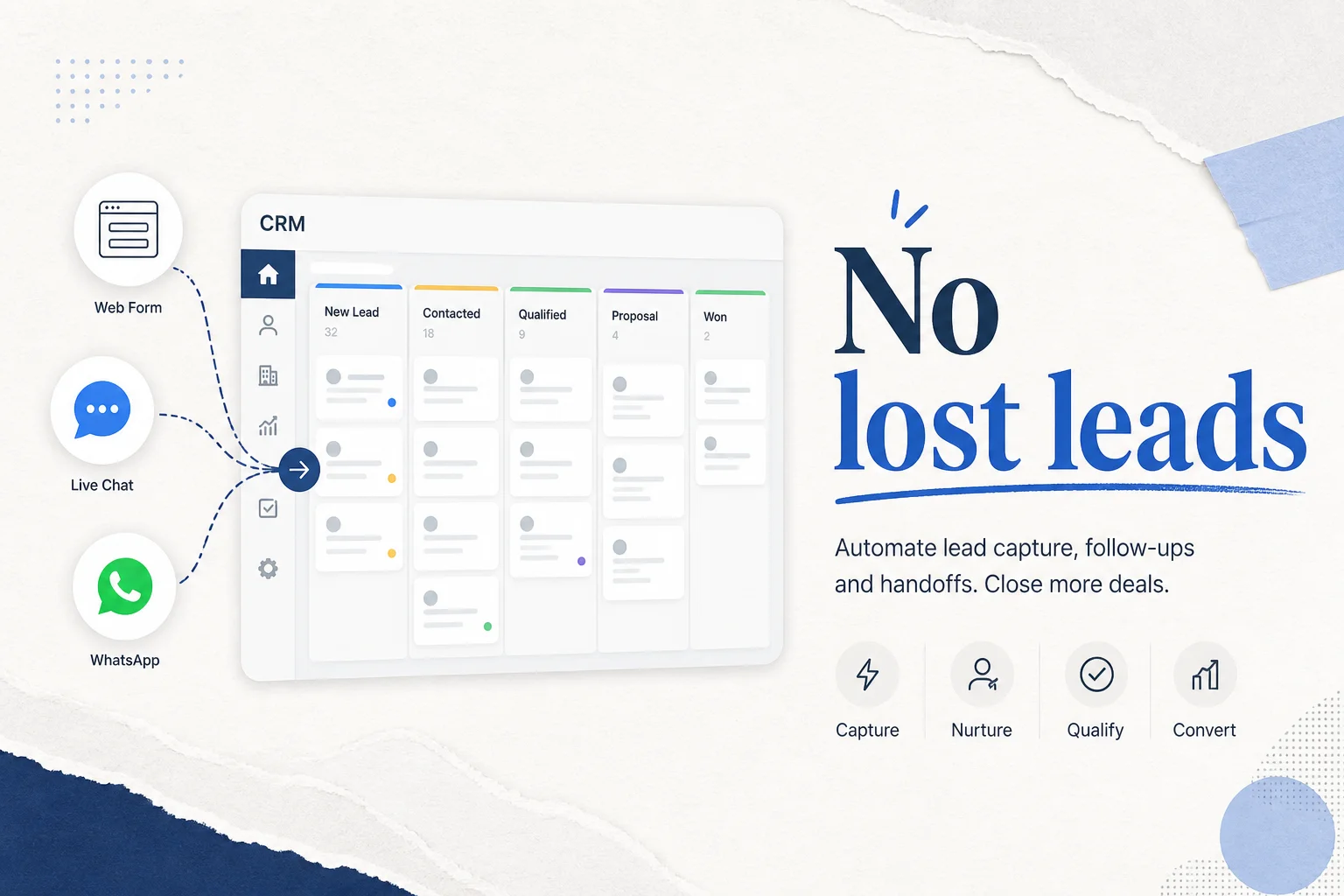
The most expensive B2B lead is the one that filled your form, then sat in someone's inbox until Tuesday.
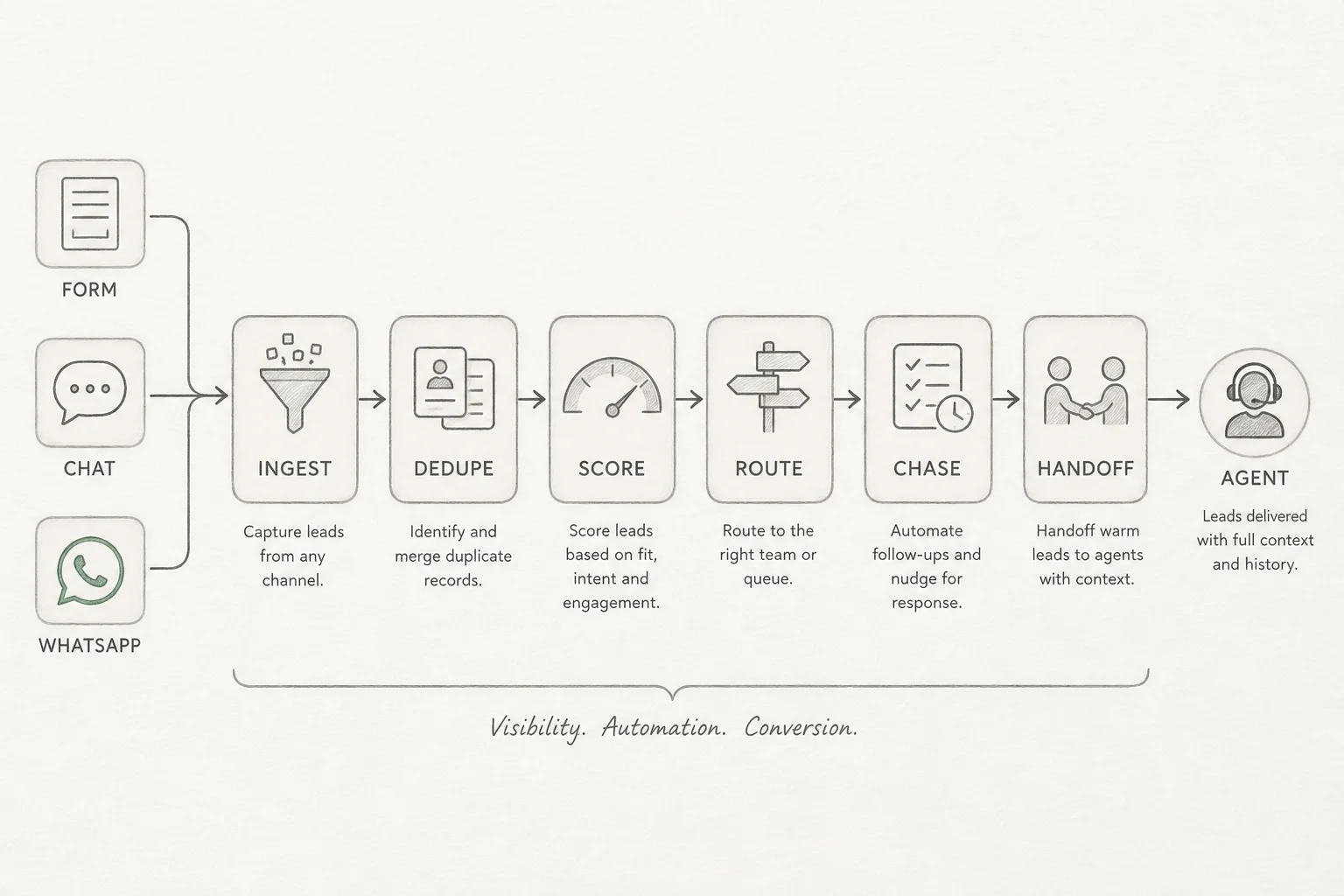
I wire AI and automation for teams that already pay for ads, content, and sales salaries. This post is the no-lost-lead architecture I keep rebuilding: ingest → dedupe → enrich/score → route → chase → handoff. HubSpot, GoHighLevel, and Salesforce are interchangeable shells. The failure mode is always the same: humans acting as middleware.
The architecture in one picture
Direct answer: every channel posts to a single ingestion path that creates or updates one contact, applies a score, assigns an owner by rules, fires an alert, and starts a chase sequence that pauses when a human engages.
Sources: web form, chat, WhatsApp, voice/missed call, ad webhook
  -> Ingest API / n8n / native CRM form
  -> Dedupe by email/phone + company domain
  -> Score (fit + intent) + source stamp
  -> Branch:
       Hot  => Slack/SMS + task + assign owner (SLA clock starts)
       Warm => nurture sequence + softer SLA
  -> Human owns the reply; chase automation pauses
If any step is "forward the Facebook lead CSV," you do not have a system. You have a hope.
Typical symptoms I see in discovery calls: marketing celebrates MQLs, sales says "leads are trash," RevOps finds three contacts for one person, and nobody can report median time-to-first-touch. Automation without ownership just spreads the mess faster.
Step 1: Ingest without duplicates
Rules that save months of cleanup:
- One webhook per source, same payload shape as much as possible (name, email, phone, company, message, UTM, page URL, timestamp).
- Dedupe before create. Search by email, then phone. Update the existing record; do not spawn twins.
- Stamp source and campaign as fields, not as mystery notes.
- Idempotency keys for ad platforms that retry webhooks.
- Spam traps (honeypot, rate limit, basic disposable-email block) so scoring is not polluted.
On a Next.js lead site this is a route handler posting to n8n or straight into the CRM. Why that stack beats plugin spaghetti: WordPress to Next.js for lead sites.
WhatsApp and chat should hit the same pipeline as forms. Channel-specific UX, shared CRM record. Patterns for WhatsApp ops live in WhatsApp Business API automation.
Step 2: Score like an adult
Separate fit (are they our ICP?) from intent (are they acting like a buyer?). Mixing them into one vanity number hides why a lead is "hot."
| Signal type | Examples | Typical action |
|---|---|---|
| Fit | Company size, industry, geo, role | Route to right pod; disqualify students/job seekers |
| Intent | Pricing page, demo request, reply content, call | Fast human SLA |
| Negative | Competitor domain, freemail + no company, "unsubscribe" | Suppress or low-touch |
| Recency decay | No engagement in 14 days | Drop score; move to long nurture |
HubSpot's lead scoring docs are a solid model if you are on that stack: Build lead scores in HubSpot. Salesforce uses flows and assignment rules. GHL often uses custom number fields and workflows. Same ideas.
Optional LLM step: classify the free-text message ("pricing," "partnership," "support," "spam") and write a structured field. Do not let the model invent company size. Enrichment APIs exist for a reason.
Step 3: Route with ownership rules
Two patterns, usually combined:
- Criteria-based: geo, product line, company size, language
- Round robin: fairness inside a pod after criteria filters
Document which system owns assignment if you sync HubSpot ↔ Salesforce. Dual writers on the owner field is how leads vanish into the wrong queue. A clear overview of both styles: Automatic lead routing with HubSpot and Salesforce.
Always:
- Notify the owner on the channel they actually see (SMS for field sales, Slack for desk teams)
- Create a task with a due time
- Log the SLA clock start
- Include the lead's message and score in the alert (no "new lead" with zero context)
Step 4: Chase sequences that know when to shut up
Speed-to-lead research (MIT/InsideSales and the later HBR audit) says qualification odds fall off a cliff after the first minutes and hour. Autoresponders that say "thanks, someone will be in touch" without a real path do not count as contact.
Design chase like this:
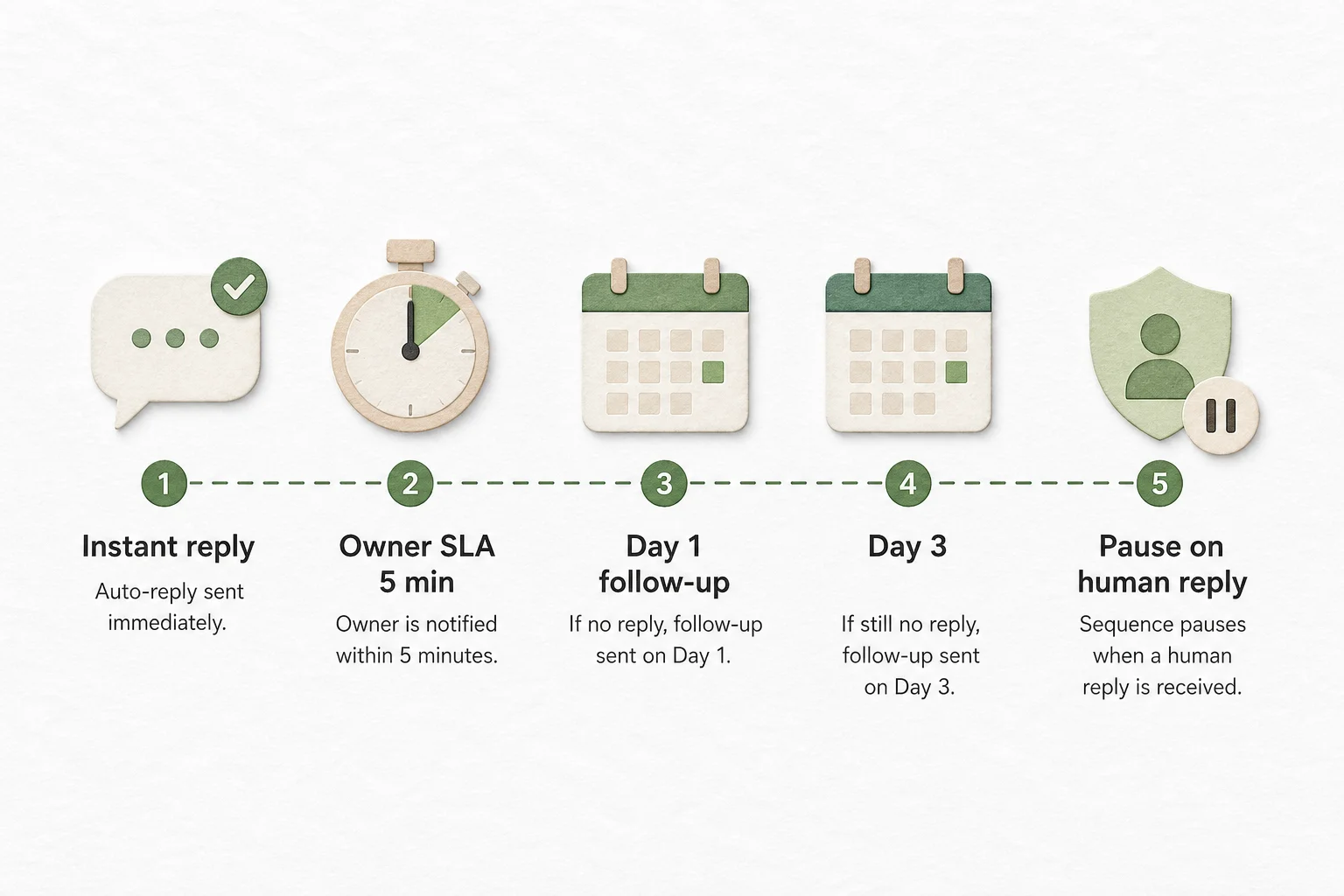
- T+0: channel-matched reply (SMS if they WhatsApp'd, email if they formed) confirming receipt + one clarifying question or calendar link
- T+5 to 15 min: owner task / call attempt for hot scores
- T+1 day, T+3, T+7: short value bumps, then stop or monthly nurture
- Pause rules: any human reply, meeting booked, or "stop" / unsubscribe
Voice fits as another intake and chase channel when the phone is ringing. For high-ticket inbound that expects a call, see the ROI framing in ROI of AI voice agents for real estate. Same pause-on-human-engage rule applies. Multi-channel chase design also shows up in AI lead generation systems.
CRM-specific notes (without holy wars)
HubSpot
Native forms or webhook → workflows for rotate-to-owner and branching. Lead scores as properties. Good default for marketing-led B2B. Start from HubSpot Academy on scoring and routing.
GoHighLevel
Strong when SMS, calendars, and agency ops matter. Build score as a custom number field and workflows that add/subtract points. Round robin and pipelines are first-class. Help center: GoHighLevel support.
Salesforce
Lead Assignment Rules for simple Lead-object cases; Flows for anything serious (contacts, round robin, multi-step). Enterprise teams often ingest via middleware (n8n, MuleSoft, etc.) then let Salesforce own assignment.
Middleware (n8n / Make)
Use when you have more than two sources, need enrichment, or CRMs disagree. Keep business rules versioned. Do not hide critical routing logic only inside an undocumented Make scenario that one contractor owns.
Acceptance tests before you call it done
- Submit a form twice with the same email → one contact, updated activity
- WhatsApp lead and web lead for same phone → merged or associated, not two owners
- Hot score fires owner SMS within a minute in staging
- Owner reply pauses the chase sequence
- Ad webhook retry does not create three deals
- After-hours lead still gets an instant acknowledgment
- Dashboard shows time-to-first-touch and time-to-owner-accept
If you cannot measure time-to-first-touch, you cannot claim you fixed speed-to-lead.
When something breaks in production, the first place I look is webhook logs and the owner field history. Nine times out of ten the lead existed; the assignment or the pause rule did not.
Failure modes I keep seeing
The silent owner. Lead assigns to a rep on PTO. No backup. Fix with out-of-office routing or a pod inbox.
The forever drip. Sequence keeps texting after the deal closed. Fix with lifecycle stage exits.
The dual CRM. Marketing lives in HubSpot, sales lives in a spreadsheet "because HubSpot is slow." Automation cannot fix cultural refusal. Pick one system of record for the pilot.
The LLM that writes the CRM. Models are fine for classifying a message. They are bad at inventing firmographics. Keep enrichment deterministic where you can.
The alert storm. Every lead pings Slack; humans mute the channel. Fix with score thresholds and digest modes for cold traffic.
Minimum viable build (two weeks, not two quarters)
Week 1:
- Inventory every lead source (literally list URLs, ad forms, chat widgets, phone numbers).
- Pick the system of record for contacts.
- Stand up ingest + dedupe for the top two sources only.
- Owner notify + task on create.
- Instant acknowledgment message on the same channel.
Week 2:
- Add a crude score (even five rules beat none).
- Split hot vs warm chase.
- Pause-on-reply.
- Dashboard for time-to-first-touch.
- Retro with sales: which alerts were noise?
Only then add enrichment APIs, LLM classifiers, and the fifth ad network. Complexity is earned.
Clinics and local services use a lighter version of the same map (missed call → CRM → chase). The dental-shaped version is in AI receptionist for clinics and dentists.
What this is not
This is not "AI replaces your SDRs." It is plumbing so SDRs stop copy-pasting and start talking to people who already raised their hand. It is also not a 40-node workflow on day one. Ship ingest + dedupe + notify first. Add scoring and fancy enrichment after the leaks stop.
Soft next step
If your team is drowning in sources and you want a concrete wiring plan (HubSpot, GHL, or Salesforce), book a free call. Bring a list of every place a lead can enter. We will sketch the no-lost-lead path and the first three automations worth building.