
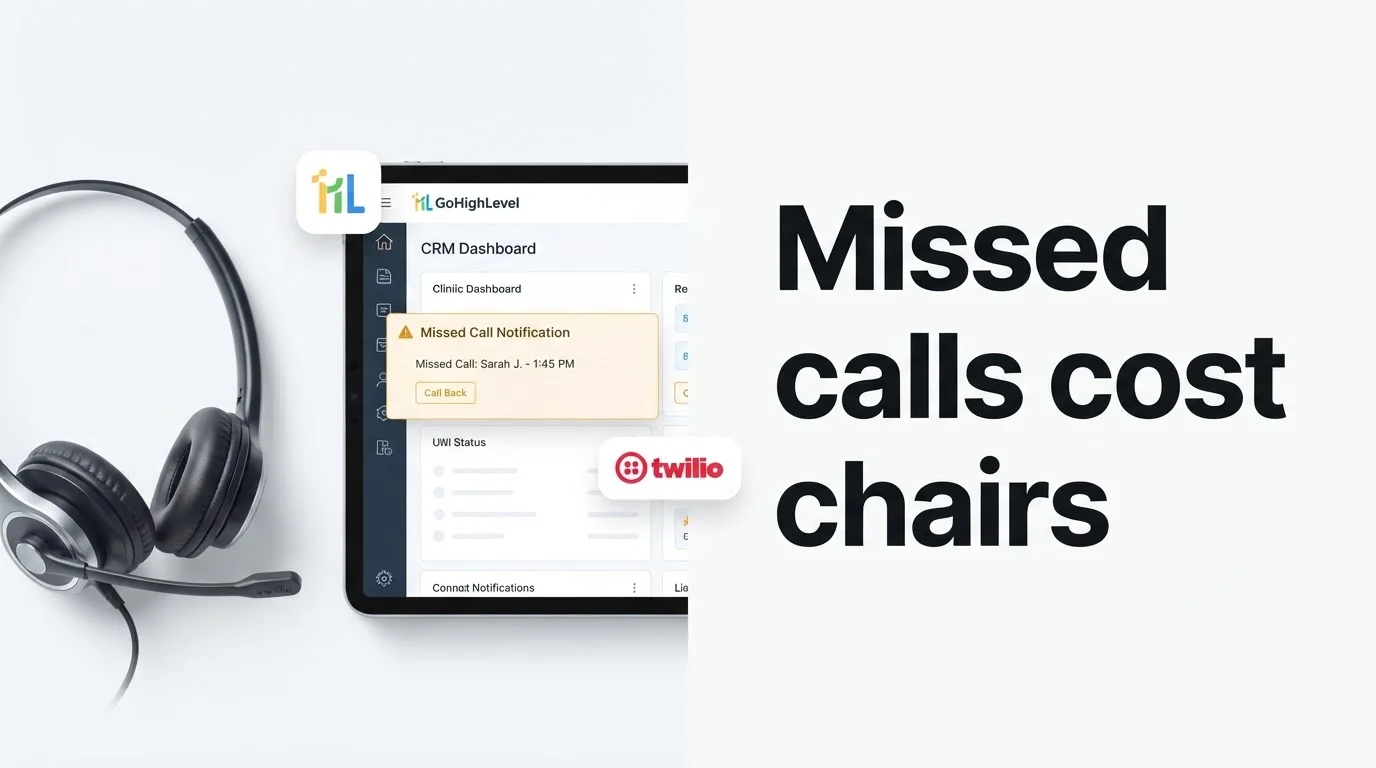
Your front desk closes at 5. Patients do not.
I keep seeing the same pattern with US dental practices, small clinics, and med spas: marketing spend gets the phone to ring after hours, then voicemail eats the lead. By Monday the patient already booked somewhere else. That is not a staffing failure. It is a timing mismatch.
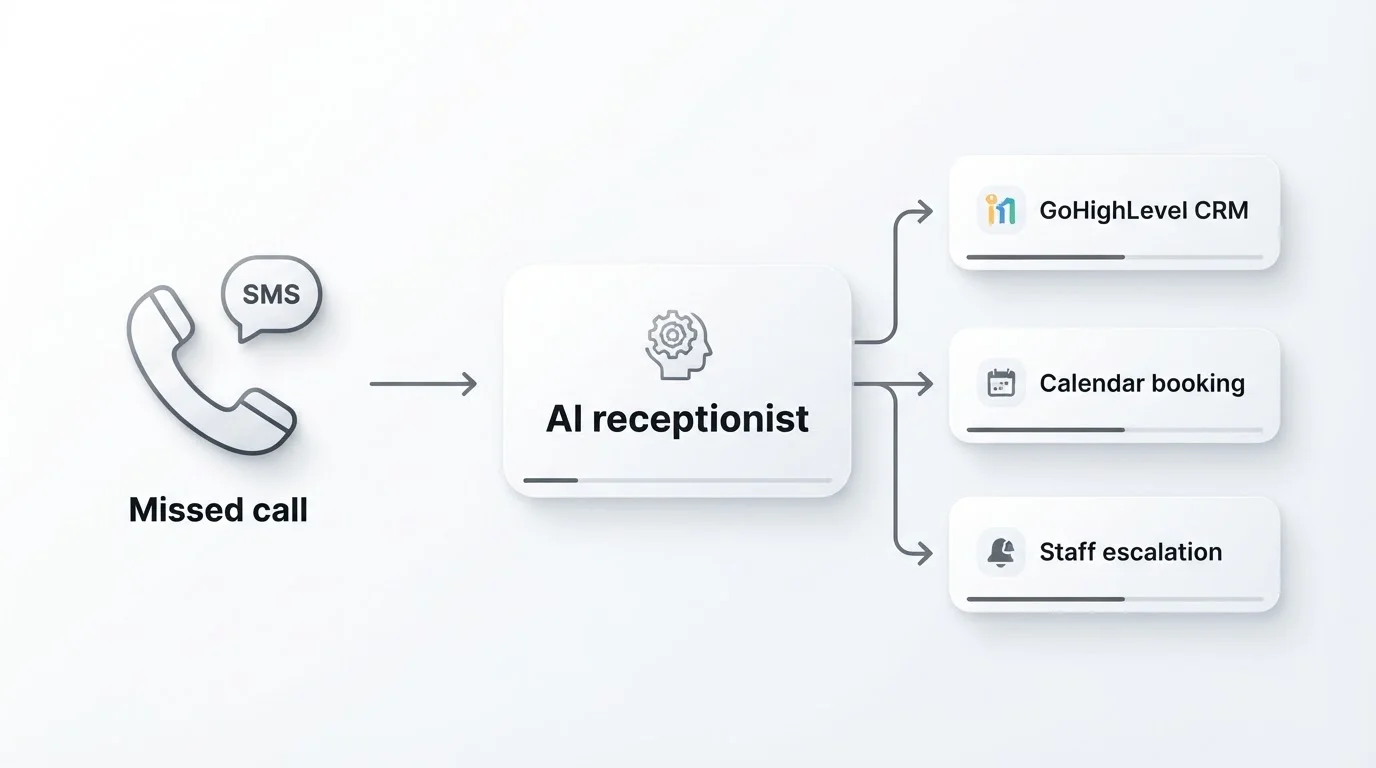
An AI receptionist (voice + chat + CRM) is how I close that gap. The build I use most often is what I call a Missed-Call Killer on the light end, or a fuller inbound AI receptionist when you want live booking and multi-channel coverage.
What this actually is (and is not)
An AI receptionist for a local practice answers the channels patients already use: the main phone line, SMS, web chat, and sometimes WhatsApp. It does the boring front-desk work: hours, location, services, pricing ranges you approve, booking or callback, reminders. It does not diagnose, interpret symptoms, or suggest treatment.
That boundary matters more than the cool demo. Patients trust a practice that says "I can book you a consult" and routes medical questions to a human. They do not trust a bot that invents clinical advice.
Scope it as ops automation, not clinical AI. If someone pitches you a "HIPAA AI doctor on the phone," walk away unless they can show BAAs, audit logs, and a real compliance path.
The missed-call problem in plain numbers
I am not going to invent case studies. Here is the operational reality most owners already feel:
| Moment | What happens without AI | What a good stack does |
|---|---|---|
| After-hours call | Voicemail, no callback until morning | Voice agent answers, captures intent, books or queues |
| Busy lunch rush | Ring through, caller hangs up | Overflow to AI, or instant SMS text-back |
| "Do you take my insurance?" | Staff repeats the same answer 20 times a day | Grounded FAQ from your docs, then handoff if needed |
| No-show risk | Reminder forgotten or one-way only | Timed SMS/email with easy reschedule path |
| Lead in CRM | Sticky note, or nothing | Contact + tag + pipeline stage in GoHighLevel |
If you already run ads or Google Business Profile, every unanswered ring is paid demand you paid to create.
The stack I actually ship
I am biased toward tools that local practices can keep running without a DevOps team.
- GoHighLevel: CRM, calendars, pipelines, SMS, and increasingly native Voice AI
- Twilio (or GHL telephony): numbers, call routing, recordings where allowed
- Optional WhatsApp Business: useful when your patients already message there; not mandatory for every US dental office
- Grounded knowledge: your hours, services, parking, prep notes, pricing sheets you approve in writing
For a visual sense of how dental offices wire GHL for missed-call text-back, reminders, and follow-ups, this walkthrough is a solid starting point (I still customize prompts, escalation rules, and CRM stages per practice):
Native GHL Voice AI is getting better fast. For some clients that is enough. When you need tighter latency control, custom tools, or a phone flow that templates cannot express, I layer a dedicated voice provider and still write everything back into GHL so the front desk has one inbox.
Useful product docs if you want to poke around yourself:
What the agent is allowed to do
I write the prompt and tools like a job description for a careful receptionist, not a doctor.
Allowed
- Answer hours, location, parking, accepted insurers (factual list only), service menus
- Capture name, callback number, preferred window, reason for visit at a high level ("cleaning", "whitening consult", "new patient exam")
- Book into a GHL calendar when availability is live, or create a high-priority callback task
- Send confirmation and reminder texts
- Transfer or escalate when the caller asks for a human, sounds urgent, or mentions clinical symptoms
Not allowed
- Diagnosis, medication advice, "is this normal?", triage severity
- Promising insurance coverage amounts (network list yes, coverage guarantee no)
- Storing chart notes, imaging, or treatment plans in the agent path unless you have a compliant, BAA-backed design
That last point is the non-PHI framing. Most Missed-Call Killer installs never need clinical data. Name + phone + intent + time preference is enough to stop losing chairs. Keep PHI out unless you are ready to pay for the compliance work.
Missed-Call Killer vs full inbound receptionist
Same family of builds. Different depth.
| Build | Best for | Typical channels | Rough Tier-1 band (USD) |
|---|---|---|---|
| Missed-Call Killer | Overflow and after-hours recovery | Voice backup + SMS text-back + GHL contact | About $1.5k-$3.5k setup, ~$400-$750 / mo |
| Inbound AI receptionist | Practices that want the AI to answer more often | Voice + chat (+ WhatsApp if needed) + live booking | About $2k-$5k setup, ~$400-$800 / mo |
Those are informal floors I use in discovery, not a price list stamped on every quote. Usage (minutes, SMS) and how messy your calendar is move the number. Fixed fee after we scope. No hourly theater.
How I roll it out without breaking the front desk
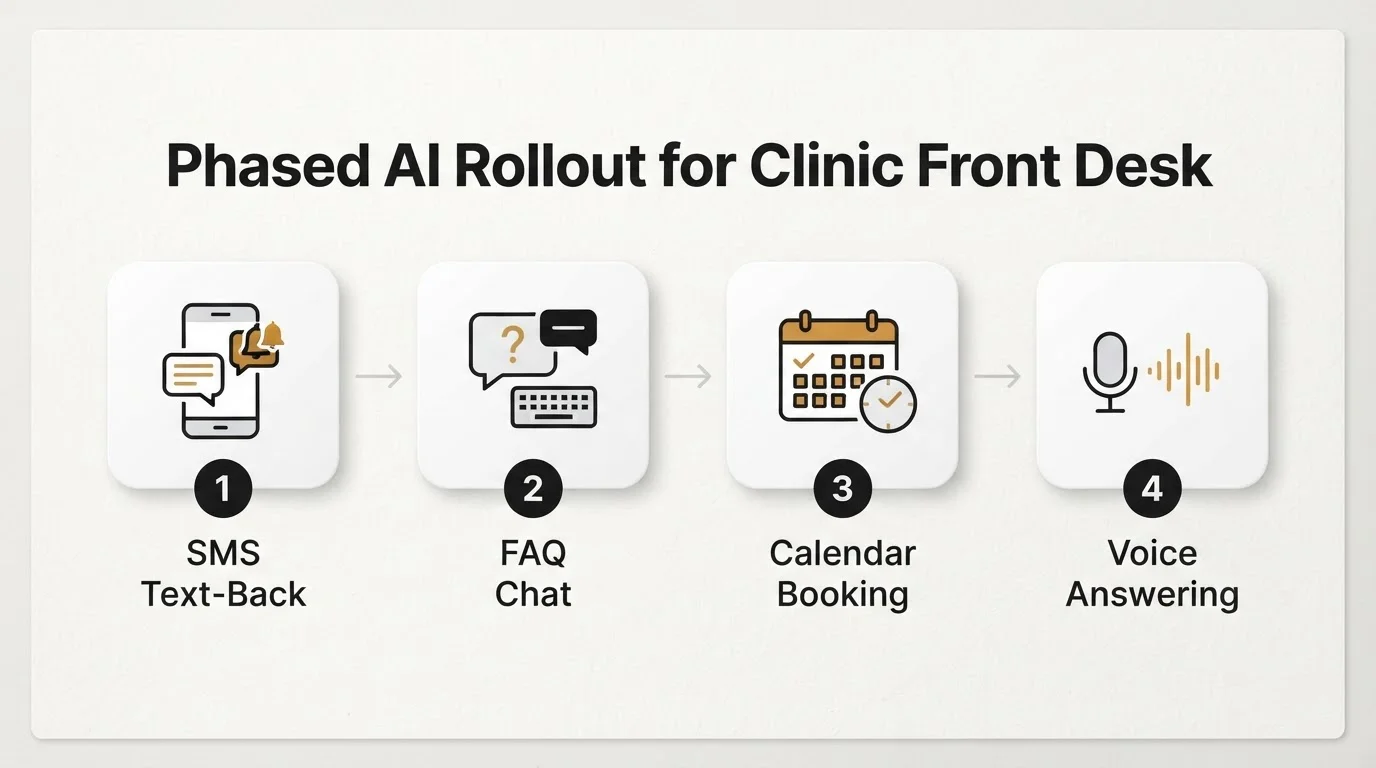
Launching voice, booking, reminders, and WhatsApp on day one is how you get a system nobody trusts.
- Text-back and FAQ first. Missed call triggers an SMS within seconds. Chat widget answers grounded FAQs. Staff reviews transcripts daily.
- Callback capture or soft booking. Agent collects intent and preferred times; humans confirm until you trust the calendar write.
- Live calendar write. Only when availability rules (provider, duration, buffers) are correct in GHL.
- Reminders and light intake. Non-PHI fields only unless compliance is designed in.
- Voice depth last. Full after-hours answer, then selective daytime overflow.
Throughout, a human stays in the loop. The first two weeks are for reading failed calls and tightening the prompt against real patient language, not against the demo script.
What "good" sounds like on a call
A solid after-hours dental call sounds boring in the best way:
- Greeting with the practice name and a clear "virtual assistant" disclosure
- Ask how they can help (new patient, existing, emergency flag for human escalation)
- Collect name and best callback number
- Offer real slots or promise a same-morning callback with a CRM task
- Confirm by SMS so the lead is not trapped in a voicemail transcript nobody reads
If the caller says "my tooth is killing me and my face is swelling," the agent stops booking small talk and routes to your emergency instructions or on-call path. That single behavior is worth more than a fancy voice clone.
Cost honesty (and what monthly covers)
Setup pays for prompt design, phone routing, GHL pipelines, calendar rules, testing, and a short handover. Monthly usually covers hosting the workflows, monitoring failed calls, prompt tweaks, and platform usage pass-throughs (voice minutes, SMS). It does not cover running Meta ads or rewriting your website unless we scope that separately.
If you are comparing vendors, ask three questions:
- Where does the contact land after the call (CRM stage, owner, SLA)?
- What happens on clinical language?
- Who owns the GHL sub-account and phone number when the contract ends?
If the answer to (3) is fuzzy, keep shopping.
When this is the wrong buy
Skip it (or start smaller) if:
- Your calendar rules are chaos and nobody knows which provider owns which chair
- You want the bot to give clinical advice
- You expect "set and forget" with zero transcript review
- You need full HIPAA clinical workflows but have no BAA path and no budget for one
Software will not fix a broken schedule. It will amplify whatever rules you put in it.
Next step if this matches your practice
I build these for US and global local practices that already feel the after-hours leak: dentists, clinics, med spas, similar service businesses. If you want a fixed-scope proposal, book a free discovery call. If you would rather map the gaps first, the free Ops Automation Audit on my site is a short questionnaire that helps me see where calls, chat, and CRM drop the ball before we talk stack.
The goal is simple. Every ringing phone either reaches a human or a trained agent that books, texts back, and logs the lead. Voicemail should be the exception, not the business model.