
Someone asks "how long until AI is live?" and expects a number that fits on a sticky note.
Honest answer for most small and mid-size operators: two to eight weeks for a focused build that actually does work in your systems. That range hides a lot, so here are the timelines I quote when the scope is clear and you are ready with docs and access.
| Project type | Typical kickoff → live | What "live" means |
|---|---|---|
| Grounded FAQ chatbot (website / webchat) | 2–4 weeks | Answers from your docs, escalates cleanly |
| SMS / WhatsApp qualify + book + CRM | 3–6 weeks | Includes provider approvals |
| Voice agent (missed-call or inbound receptionist) | 3–6 weeks | Telephony + CRM + handoff tested |
| Single ops automation (lead route, invoice extract) | 2–4 weeks | One workflow end to end |
| Multi-system ops program (phase one) | 4–8 weeks | First connected slice in production |
| RAG over messy internal knowledge | 4–8 weeks | Chunking, evals, citation behavior |
| Enterprise / compliance-heavy | 2–6 months | Security review, change control, phased rollout |
A vendor promising a fully wired custom system in three days is selling a template with your logo. A six-month timeline for a simple SME FAQ bot is usually their process, not your product.
Why timelines swing so hard
Five factors multiply. Each one adds days or weeks.
Integrations are the largest. Every system the AI must read or write (calendar, GoHighLevel, HubSpot, booking tool, accounting) is engineering against real data, not a slide deck. Official docs like the GoHighLevel help center and HubSpot API docs beat guessing field names mid-build.
Data readiness is second. Clean price lists and FAQs? Knowledge work takes days. Prices living in a senior employee's head across three conflicting spreadsheets? Add one to two weeks of consolidation before the model has anything honest to say.
Channel approvals run on someone else's clock. Meta verification for the WhatsApp Cloud API, telephony number setup on Twilio or GHL, template approvals. Budget a few days to two weeks and start those on day one.
Languages and accents matter when you serve mixed markets. English-only is faster. Bilingual testing with real phrasing adds scope.
Compliance in healthcare-ish or finance-ish contexts can bump a project up a whole tier. If you need PHI in the agent, you need BAAs and architecture, not a weekend chatbot.
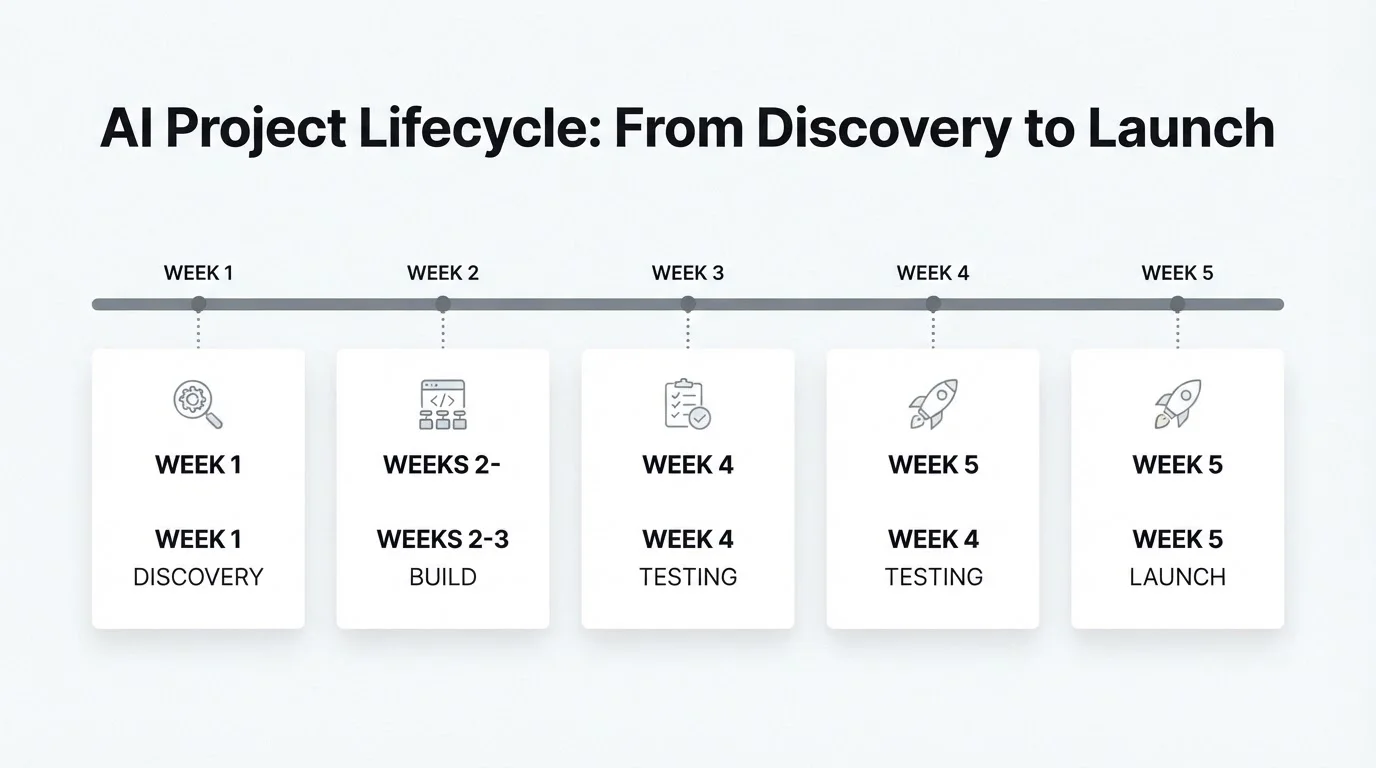
A realistic week-by-week for a 4–5 week build
This is the arc I run on most SME chatbot, voice, or single-automation builds.
Week 1: Discovery and design
Map the conversations or process. Define success in numbers (first-response time, booked consults, after-hours capture rate). Collect docs and credentials. Submit WhatsApp, telephony, or API access requests early so approvals overlap the build.
Weeks 2–3: Build and integrate
Ground the bot or voice agent on your real information. Wire calendar and CRM. Design the flows that matter: qualify, book, escalate. For voice, that includes barge-in behavior, after-hours branching, and SMS text-back when a call fails.
Week 4: Break it on purpose
Human testing, edge cases, staff training on handoff. This week is the difference between a launch and an embarrassment. I deliberately try weird phrasings and angry tones here.
Week 5: Launch with eyes on
Go live on real traffic with daily review of failed turns for the first week. Launch is the starting line. Plan two to four weeks of tuning after go-live; real customers invent phrasing no test suite catches.
Chatbot vs voice vs RAG vs full ops
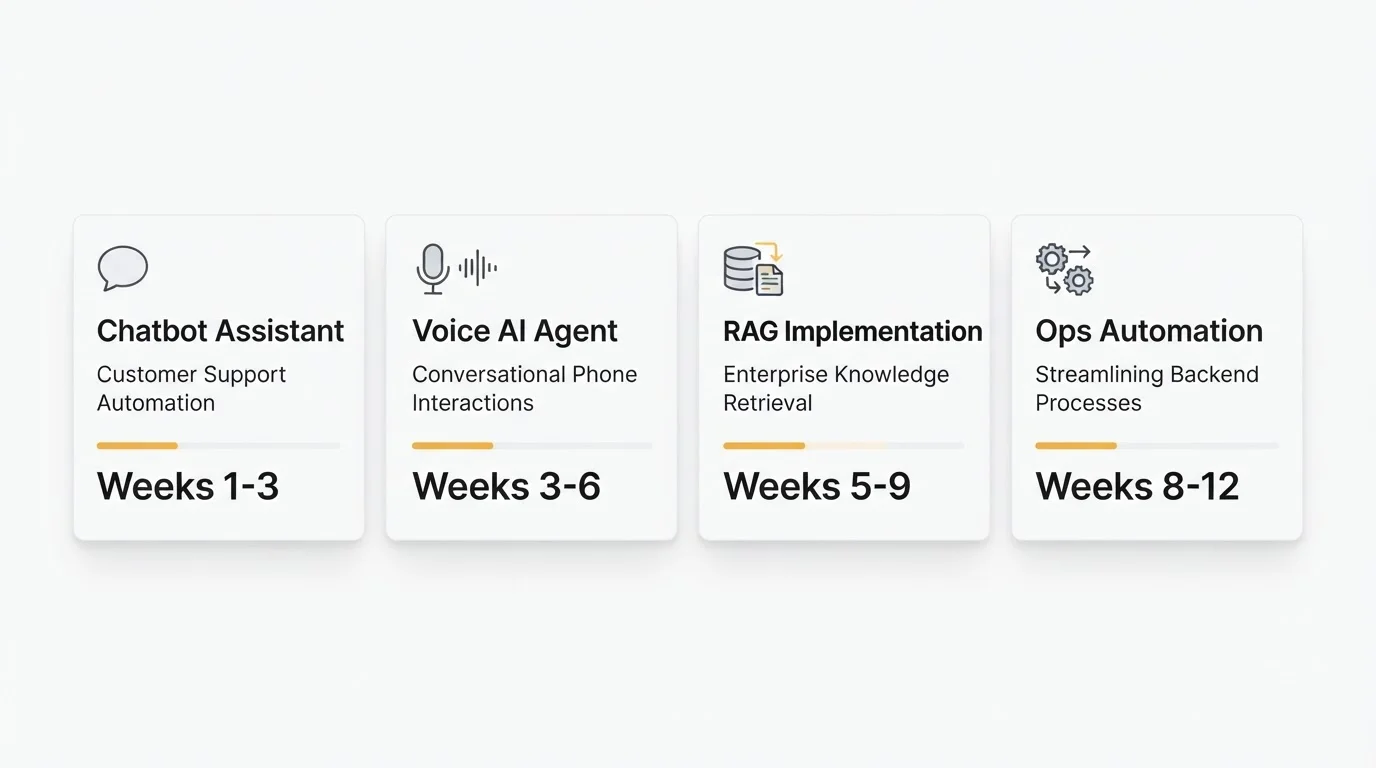
Chatbot (web / SMS / WhatsApp): Fastest when knowledge is ready and you only need Q&A plus light booking. The long pole is usually CRM sync and template approval, not the LLM.
Voice agent: Similar calendar of weeks, plus telephony quirks. Latency, interruption handling, and "press zero for a human" are not optional. See also my notes on clinic builds in related posts; the Missed-Call Killer pattern is often the right phase-one voice project because scope stays tight.
RAG (retrieval over your docs): The model is the easy part. Chunking strategy, stale docs, eval sets, and "cite your source" behavior eat calendar. Budget the upper half of the 4–8 week band if your knowledge base is a graveyard of PDFs.
Full ops automation: Do not parallelize five workflows on day one. Ship one end to end, run it beside manual for two weeks, then stack the next. Teams that sequence usually have three or four automations live within six months, each faster than the last because integrations accumulate. Glue often lives in n8n or Make so retries and logging are not a one-off script.
What actually blows the schedule
Four delays account for most overruns. None of them is "the AI was hard."
- Data preparation: policies never written down, or three conflicting versions.
- Access and approvals: waiting on the IT person who is on leave, or Meta review sitting in a queue.
- Decision latency: every conversation-design choice needs a committee. Assign one internal owner who can say yes within a day.
- Scope creep: the FAQ bot is now also processing refunds and speaking a third language. Lock version one in writing; park the rest in phase two.
How to compress the timeline (your side of the table)
Vendors can only go as fast as you unblock them.
- Put current prices, hours, FAQs, and policies in one folder before kickoff.
- Have admin logins, API keys, and business verification docs ready on day one.
- Appoint a single decision-maker for flows and copy.
- Fix version-one scope: one channel, defined tasks, defined launch date.
- Start with one process, not five.
After launch: when results show up
Response-time improvements are immediate if you were previously measured in hours. Booking and lead-capture gains usually show within the first month on the same ad spend. By month two, a healthy system should handle most routine volume without babysitting, with humans on exceptions.
Build that tuning window into the contract. A system that nobody reviews after week one decays quietly.
Compared with traditional IT projects
A new CRM or ERP module is often measured in quarters. A scoped AI project sits on top of tools you already run, so it fits inside a single budget cycle. That changes planning: pilot, measure, expand with evidence.
The operators who look "fully AI" eighteen months later are almost always running a chain of six-week projects, not one eighteen-month moonshot.
Getting a timeline for your stack
Your number depends on channels, integrations, and how clean the knowledge is. If you want a concrete week-by-week for your clinic, agency, or service business, book a free discovery call on Cal.com. Bring the tools you already use and the one workflow that hurts most. We can usually say whether you are looking at three weeks or eight before anyone writes a line of glue code.
Six to ten weeks from first conversation to measured results is the normal path when both sides do their homework. The businesses that hit it prepare the checklist above before kickoff.