
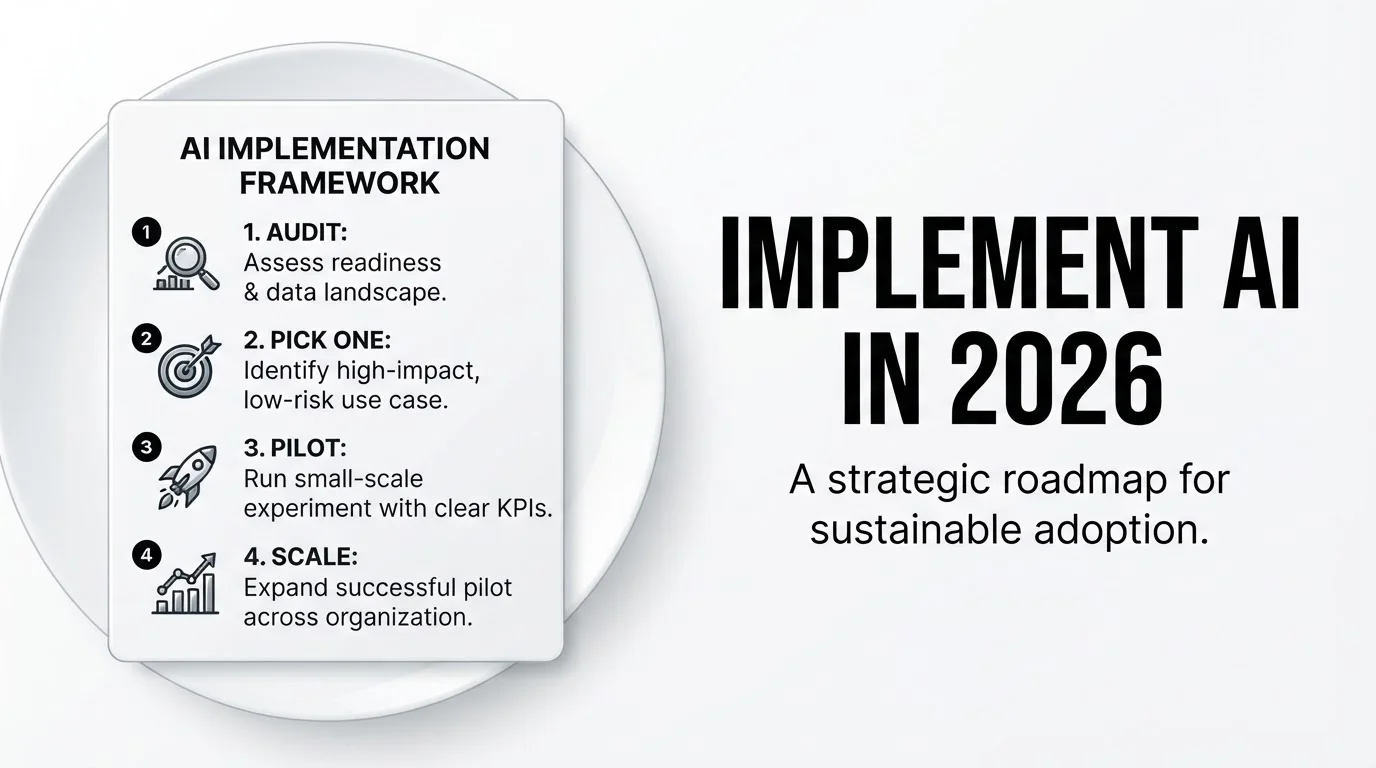
Successful AI adoption in an SME is boring on purpose.
Audit workflows. Pick one bottleneck. Measure a baseline. Pilot with real traffic. Wire the CRM. Expand only what the numbers justify. Businesses that follow that sequence get compounding wins. Businesses that buy "AI transformation" get invoices and a Slack channel nobody opens.
I am writing this for founders and operators under pressure to "do something with AI" in 2026. The seven steps below are the same sequence I use when scoping work around GoHighLevel, n8n, voice, and WhatsApp. Unglamorous. Repeatable.
Why projects fail before they start
The failure mode is starting with technology ("we need AI") instead of the problem ("we lose leads every night because nobody answers after 8pm"). LinkedIn and competitor ads make that worse. Force the problem-first sequence and most of the risk falls away.
Step 1: Audit where time actually goes
Spend one week mapping recurring work. For each process note frequency, minutes per run, and how much judgment it needs. You are hunting high volume, low judgment, painful: CRM copy-paste, the same twenty FAQ answers, document chase, invoice typing, weekly report assembly.
Ask the people doing the work. They know the leaks better than any consultant. Output: a shortlist of 5–10 candidates with rough hours-per-week attached.
| Process example | Volume signal | Judgment | First-project fit |
|---|---|---|---|
| After-hours lead reply | High | Low–medium | Excellent |
| Appointment reminders | High | Low | Excellent |
| Custom enterprise proposals | Low | High | Poor first pick |
| Payroll adjustments | Medium | High | Avoid for pilot |
Step 2: Pick ONE high-ROI bottleneck
Discipline beats ambition here. Filter with three tests:
- Measurable value. You can state current cost in hours or lost revenue, and you will know within a month if it improved.
- Contained scope. Clear start and end. Touches at most two or three systems.
- Tolerable failure. A week-one mistake means a correction, not a catastrophe. Nobody should pilot on payroll.
Winners I see most often for US and global SMEs: lead response and qualification, repetitive support questions, booking/reminders, or invoice and document processing. All have direct revenue or hard-cost impact.
If you cannot write a one-sentence success metric before kickoff, you are not ready to build. "Make us more AI-driven" is not a metric.
Step 3: Make the data usable
AI is only as good as what you ground it in. For an SME this is not a data warehouse project. It is three checks:
Does the knowledge exist in writing? Prices, policies, and scripts stuck in one employee's head need a doc first.
Is it current and consistent? Three price lists produce a bot that confidently quotes the wrong one. Designate a single source of truth.
Is it accessible? Tools with APIs (modern CRMs, cloud accounting, online booking) integrate cleanly. A filing cabinet of scans means adding digitization to the plan.
Budget a week or two. Least exciting step. Highest payoff.
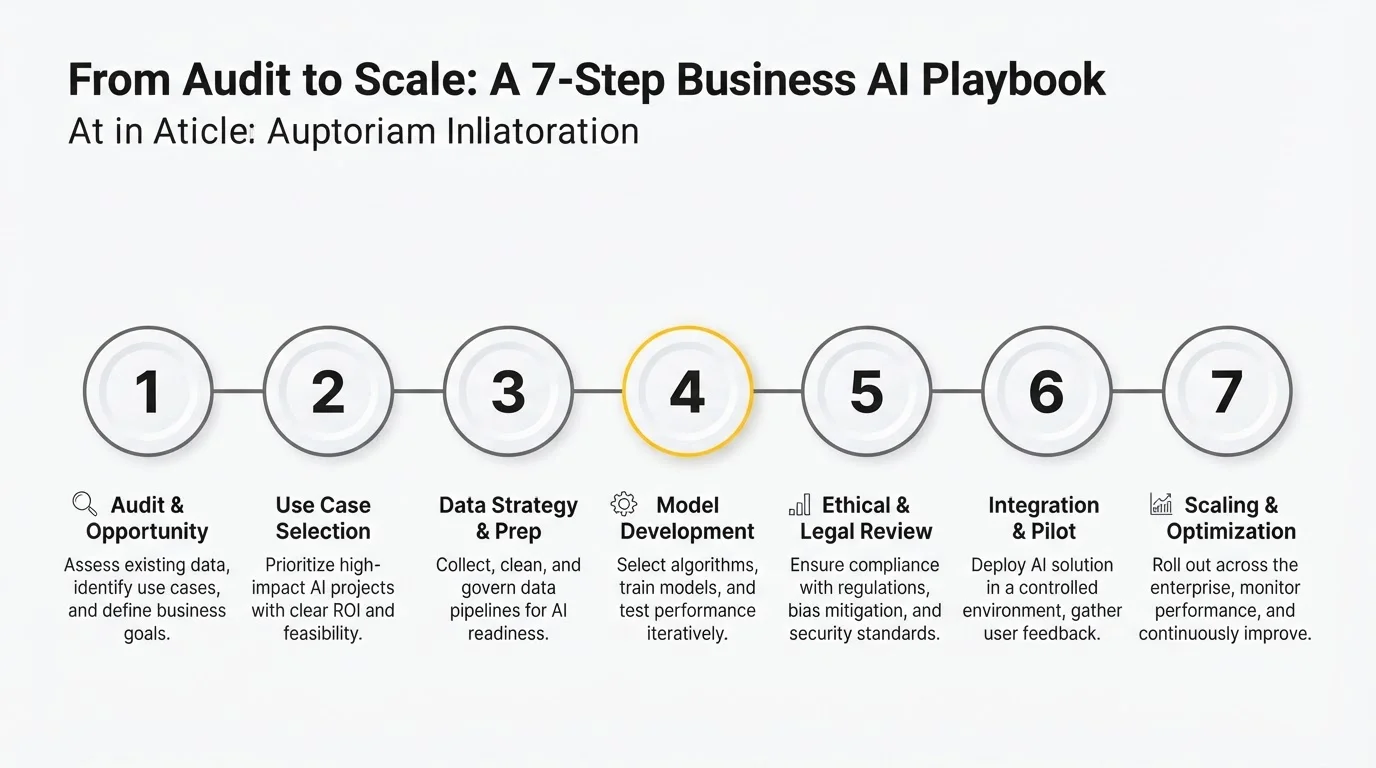
Step 4: Decide build vs buy honestly
Skip ideology.
Buy off-the-shelf when the need is generic and does not touch your systems: meeting transcription, writing help, image drafts. Cheap. Fast.
Build or custom-integrate when the process runs on your data and your systems: a bot that knows real inventory and books your real calendar, an n8n flow between GHL and QuickBooks, voice that must follow your clinic's script.
| Need | Default | Why |
|---|---|---|
| Internal drafting / notes | Buy | Commodity quality is fine |
| Customer-facing Q&A + booking | Integrate / build | Needs your calendar + policies |
| Cross-tool ops (CRM ↔ accounting) | n8n / custom | Your stack is not average |
| "Migrate us to a new AI platform" | Push back | Platform sale disguised as AI |
Most SMEs end with a mix: cheap generic tools for staff productivity, custom wiring for anything that touches customers or money. If you hire help, prefer builders who integrate over resellers who demo templates. The difference shows the first time you need a behavior the template does not support.
References worth bookmarking:
Step 5: Run a real pilot (not a demo)
A pilot is your chosen process on real workload for a defined window, usually two to four weeks after a two-to-four-week build.
Set it up properly:
- Define success metrics before launch (response time, hours saved, bookings, error rate).
- Keep the human process as a safety net at first.
- Route edge cases to a person by design.
- Have the team log every failure they see.
Failures in week two of a pilot are the system working. Each one found early is a failure customers will not meet in month two.
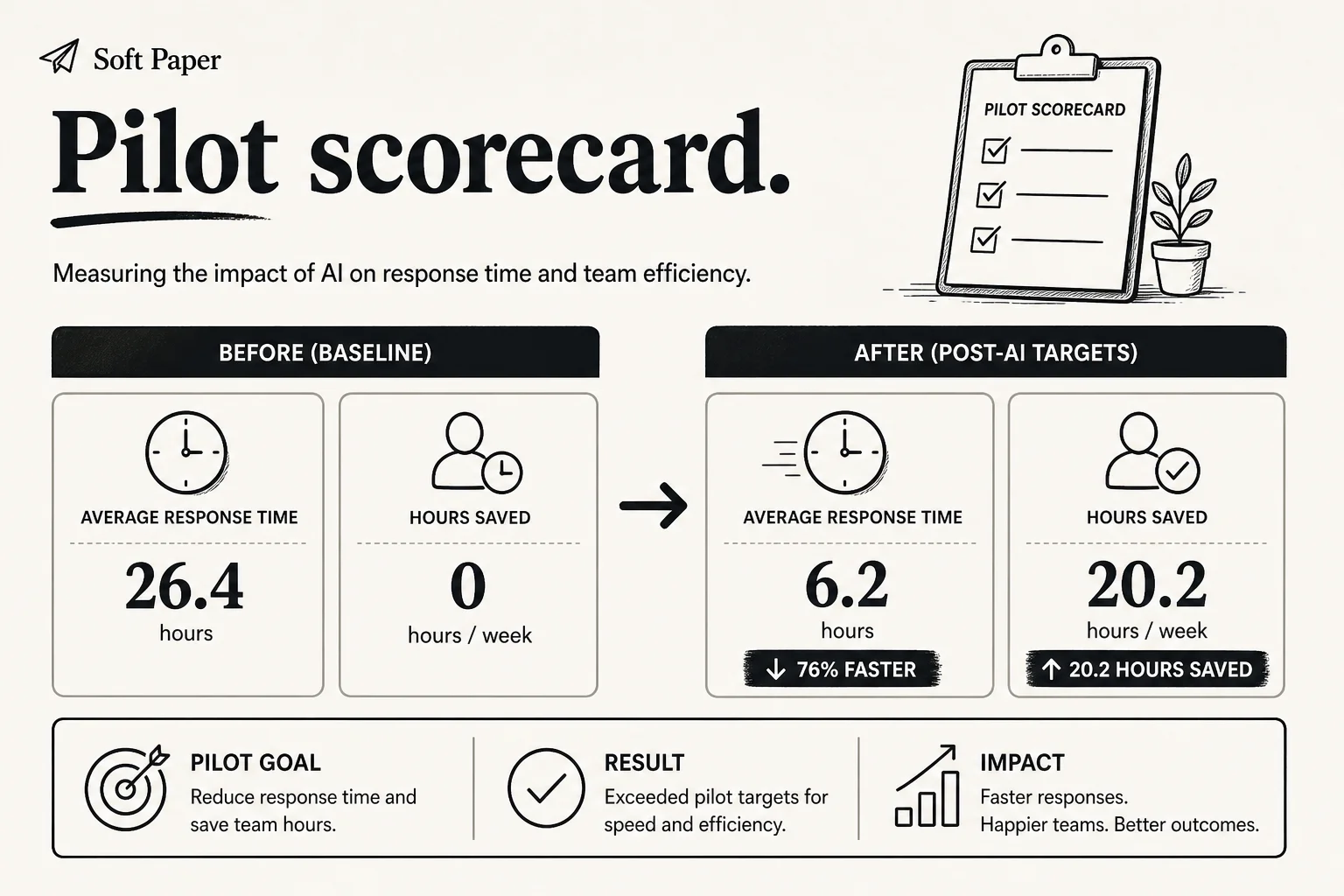
Step 6: Measure against the baseline
Compare to Step 1 numbers, not to enthusiasm.
| Metric | Baseline (week 0) | Pilot target | Kill / fix / expand |
|---|---|---|---|
| First response time | e.g. 4 hours | < 5 minutes | |
| Staff hours on process / week | e.g. 12 | < 4 | |
| Bookings or qualified leads | e.g. 20 | +15% or hold quality | |
| Error / escalation rate | human baseline | ≤ human, trending down | |
| Team trust (1–5) | n/a | ≥ 4 after week 2 |
Fill the baseline trust score honestly after week one of shadowing. Fake scores help nobody.
Then decide: expand, tune (most pilots need one cheap tuning round), or kill. A killed $8k pilot that proved your data was a mess beats a six-figure platform nobody uses.
Step 7: Scale what works (deepen, then widen)
Only now expand, on two axes:
Deepen the winner. If the SMS bot qualifies well, let it book the calendar and write the CRM stage.
Widen to the next item on your Step 1 list, reusing integrations you already paid for. Each subsequent workflow ships faster.
That is how teams look "AI-powered" eighteen months later: seven or eight measured wins, not one grand program.
Pitfalls that sink SME AI projects
Four patterns account for most wreckage:
Starting too big. Company-wide transformation has no baseline, no owner, and no contained scope. Seven small wins beat one initiative.
Skipping data. Outdated prices and empty CRM fields get blamed on "the AI." Step 3 exists because this is the most common disappointing pilot.
Nobody owns it. Without an internal owner, knowledge bases rot and failed chats go unreviewed. Assign one person before launch, even if an agency handles maintenance.
Ignoring the team. Staff who fear replacement quietly work around the system. Tell the truth on day one: automation takes copy-paste; humans keep judgment. Involve front-line people in testing. They find failure cases engineers miss.
Realistic timeline and budget shape
For planning, a first project often looks like this:
| Phase | Duration | Whose time |
|---|---|---|
| Audit + data prep | 1–2 weeks | Mostly yours |
| Build + integrate | 2–4 weeks | Builder |
| Pilot on real load | 2–4 weeks | Shared |
| Tune + decision | 1 week | Shared |
| Kickoff → measured result | ~6–10 weeks |
Cost scales with integrations and whether the surface is customer-facing. Monthly run costs are usually modest (LLM tokens, messaging fees, hosting) compared with the staff hours you are buying back. Compare that with multi-month "digital transformation" quotes and the incremental path is obvious: learn what works for a fraction of the spend, then compound.
For channel-specific cost context, see AI chatbot and voice cost in 2026.
Compliance and trust (design in, do not retrofit)
Two non-negotiables for 2026 pilots:
Data handling. Know where customer data is hosted, who can access logs, and whether your data trains anything beyond your own system. Health, finance, and some regional regimes add residency rules. Put the answers in the contract.
Messaging consent. If the first project uses WhatsApp or SMS outreach, opt-in and template rules apply. Meta's conversation windows and carrier rules are not optional. Designing consent into the flow is cheap. Fixing it after a complaint is not.
Neither item is a reason to delay. Both are reasons to ask vendors boring questions early.
Start this month
The audit costs you a week and almost no money. Start there. Pick one bottleneck. Write the baseline. Then decide build vs buy.
If you want a second opinion on which process to cut first, book a free discovery call. Bring the shortlist from Step 1 and the tools you already run. We will leave with one pilot scope and pass/fail numbers, not a transformation deck.
The 2026 playbook is still the same sentence: one bottleneck, one metric, one pilot, then expand. Everything else is noise.