
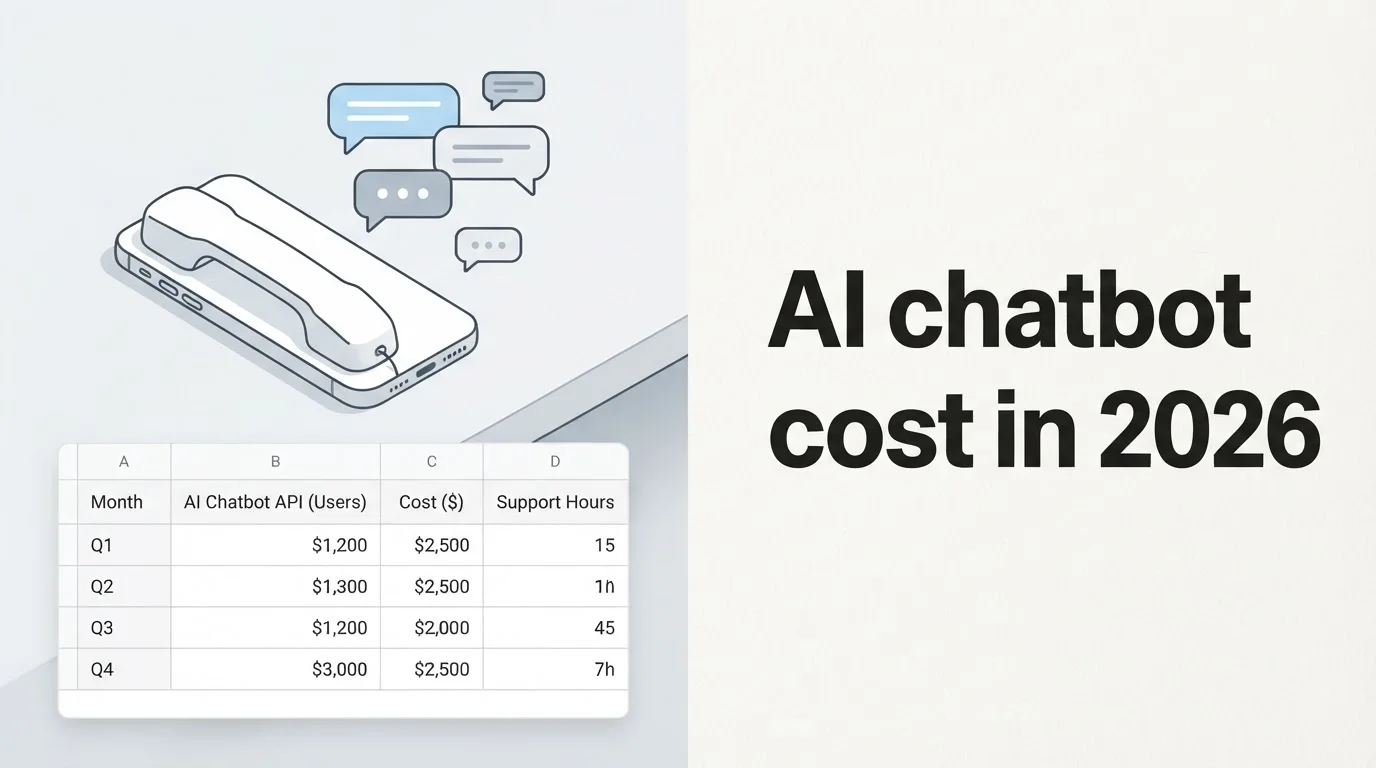
Search "AI chatbot cost" or "AI receptionist price" and you will see $29/month widgets sitting next to six-figure enterprise decks. Same word. Completely different products.
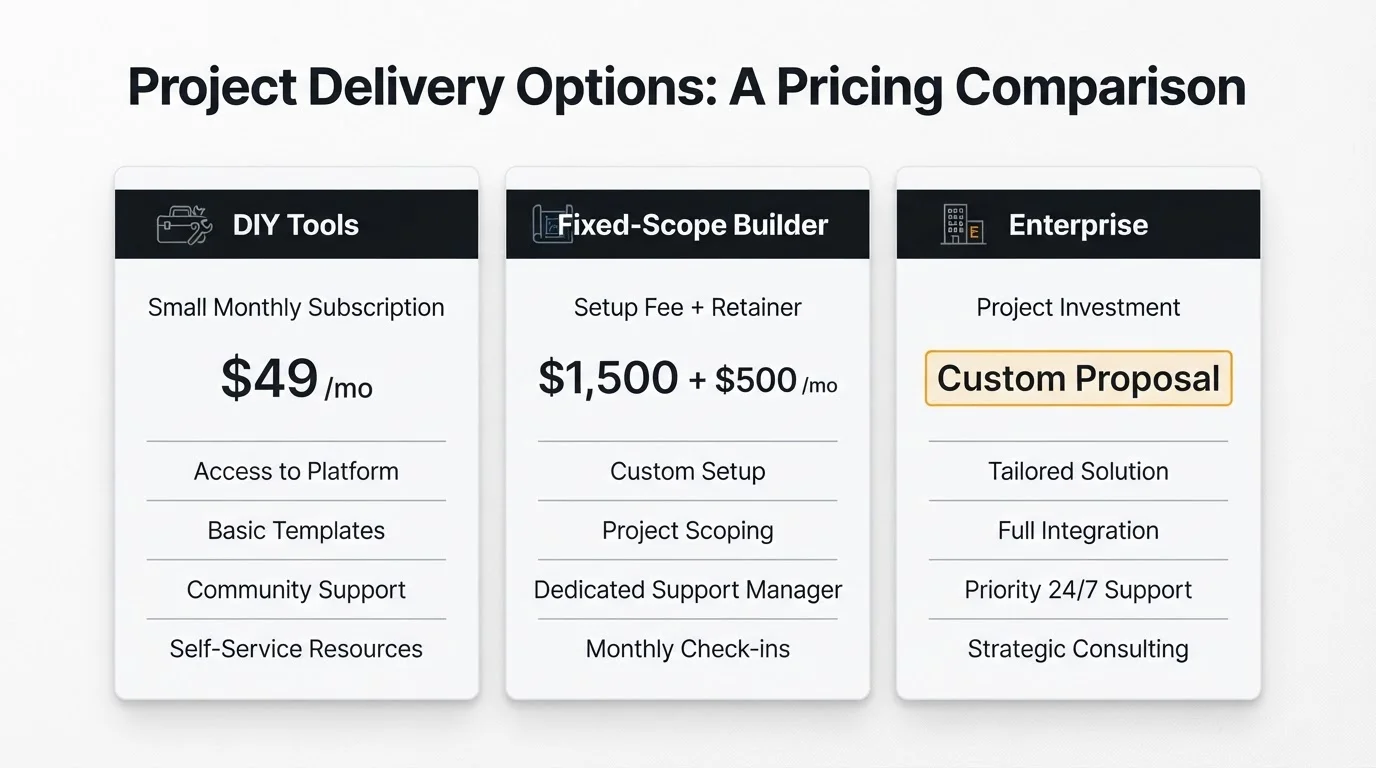
In 2026, an AI chatbot or voice receptionist for a US, EU, or global SMB usually falls into three real tiers: DIY tools you configure yourself, a fixed-scope build from a freelancer or small studio, or an enterprise project. Pick the tier based on where your revenue moves (leads, bookings, support). Ignore how pretty the demo looks.
I build these for operators who need chat and voice wired into CRM, not another widget that only answers opening hours. Below are honest USD bands, what you actually get, and the line items that never make the splashy screenshot.
The three tiers in plain English
| Tier | Typical setup (USD) | Typical monthly (USD) | What you get | Best for |
|---|---|---|---|---|
| DIY tools | $0–$200 | $20–$200 | FAQ widget, light docs, limited channels | Simple deflection, low lead volume |
| Fixed-scope builder | $1,500–$5,000 | $400–$800 | Custom flows, CRM/calendar actions, monitoring | SMBs where chats and calls drive revenue |
| Enterprise | $25,000+ | Custom retainer / SLA | Deep systems, compliance, contact-center handoff | Regulated or multi-system orgs |
These are orientation bands, not a public price list. A narrow website FAQ lands at the DIY end. A missed-call voice agent plus SMS text-back and CRM logging sits in the fixed-scope middle. Touching ERP, private hosting, or formal uptime SLAs pushes you into enterprise.
DIY chatbot builders
Platforms like Tidio, Chatbase, and Botpress let you paste a site URL, upload a few PDFs, and embed a widget in a day. Some Voice AI sandboxes on Retell or Vapi feel the same: fast demos, usage meters, and you own the ops when something goes weird at 11pm.
What works: ten repetitive questions a day, no booking logic, no CRM write-back. The monthly fee is real money you can expense without a proposal.
What breaks: the bot talks but cannot book, update a contact, or chase a missed call. Nobody reviews failed conversations. Usage pricing climbs when traffic spikes. Suddenly you are the unpaid integration engineer on nights and weekends.
If conversations are incidental to revenue, start DIY. Just stay honest about the ceiling.
Fixed-scope builds (freelancer or small studio)
This is where most service businesses should be shopping. Someone maps your real questions and outcomes, structures the knowledge base so retrieval stays accurate, connects calendar or CRM, and deploys on web, WhatsApp, phone, or all three.
Illustrative ranges from builds I actually scope (framed as typical fixed-scope bands, not a promise on every quote):
| Solution shape | Typical setup | Typical monthly |
|---|---|---|
| Missed-call / text-back style voice | $1,500–$3,500 | $400–$750 |
| Inbound AI receptionist (voice + booking) | $2,000–$5,000 | $400–$800 |
| WhatsApp or web qualify + CRM log | Often similar mid-band | Usually in the same monthly care range |
Setup covers discovery, conversation design, knowledge engineering, integrations, and launch testing. Monthly covers model/hosting, channel fees when bundled, conversation review, and iteration. Launch is the starting line. A bot that never gets failure-case edits starts sounding dated within a month. I have watched that happen on projects where "set and forget" was the whole plan.
I work fixed fee after discovery. You get a written scope and a number. No hourly surprise at the end of week three because someone "just needed one more integration."
Useful stack refs when you evaluate builders:
- GoHighLevel for CRM + Voice AI workflows many local businesses already run
- n8n for custom automation between chat, sheets, and CRMs
- WhatsApp Cloud API pricing so you can model Meta fees yourself
- OpenAI API pricing and Anthropic pricing for token math on RAG answers
Enterprise AI systems
Here you are not buying a chatbot. You are buying an AI layer on core systems: ERP, PMS, hospital or banking platforms, private or region-bound hosting, retrieval over huge corpora with access controls, and human handoff into existing contact-center software.
Budget is project-scale. Timeline stretches because integration and compliance reviews dominate, not the model prompt. If you need formal SLAs, audit logs, and data residency, plan for enterprise scoping. Do not pay enterprise rates for a dressed-up DIY template. Ask what is actually engineered.
The hidden costs that change the invoice
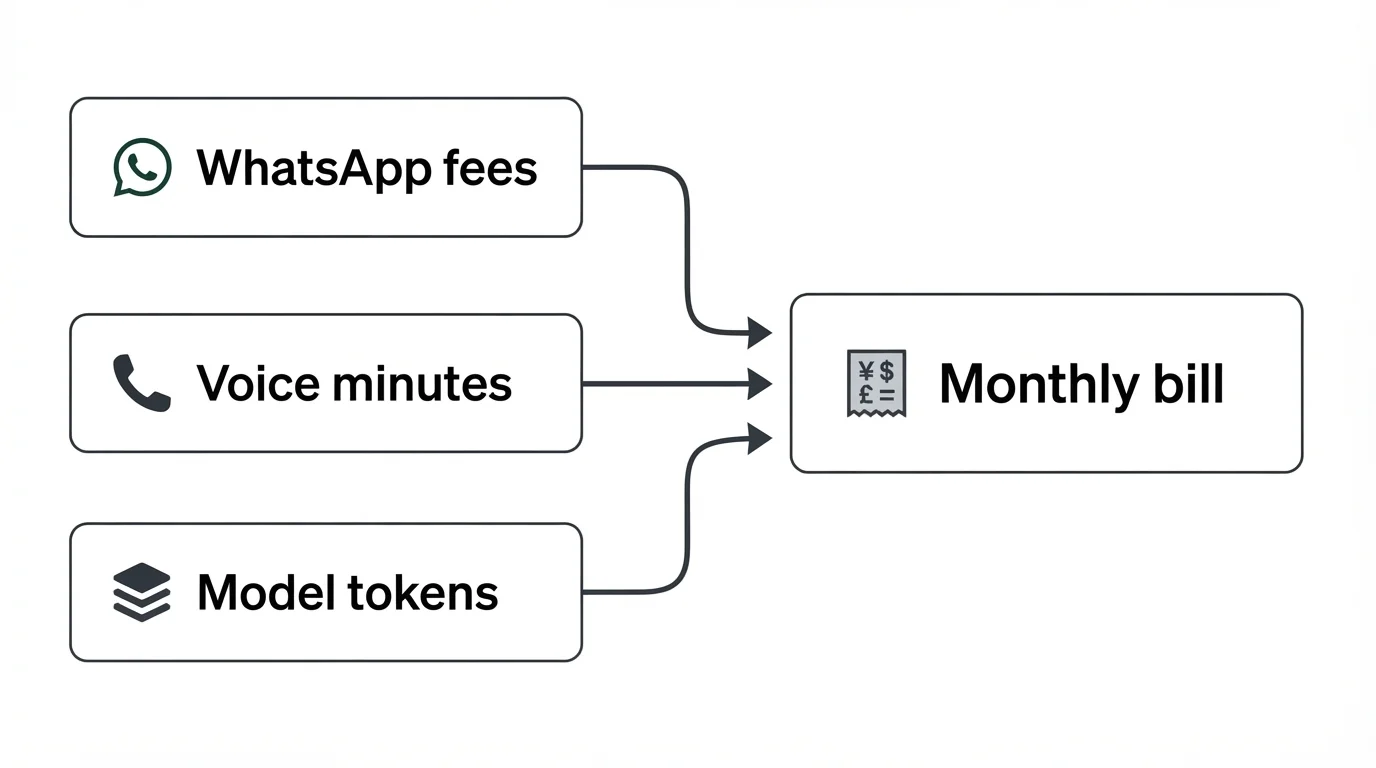
Quotes that only show "setup + retainer" are incomplete. These line items show up in production:
WhatsApp conversation fees. Meta bills per 24-hour conversation window on the Business API. At real volume this is a monthly line item, not a rounding error. Model expected inbound and template outbound before you sign.
Voice minutes and media. Phone agents burn telephony, STT, and TTS. A busy after-hours line costs more to run than a quiet website widget even if the "AI" looks identical in a demo.
Model tokens. Frontier models charge per token. Long, document-grounded answers cost more than short FAQ replies. Ask whether tokens are included in monthly care or passed through.
Knowledge upkeep. Prices, policies, and inventory change. If nobody updates the knowledge base, the bot quotes last quarter confidently. Decide whose job that is.
The cheap bot that damages trust. Wrong availability or pricing answers do not just fail. They teach customers not to trust you. Quality belongs in the cost math.
What actually moves the price
Within a tier, five levers matter more than the vendor logo:
- Channels. Website-only is baseline. WhatsApp adds API setup and per-conversation fees. Voice multiplies testing and usage variance.
- Integrations. Read-only FAQ is cheap. Write access (book, update CRM, create tickets) needs error handling and costs more.
- Languages. Real bilingual or multilingual agents need tested prompts and voices, not machine-translated copy pasted into a system prompt.
- Knowledge complexity. Forty FAQs is a small job. Hundreds of pages of policies and SKUs need serious retrieval work.
- Compliance. Audit logging, access control, and data residency can bump a project up a full tier.
When two quotes differ a lot, compare these five, not only the bottom line.
ROI math that is worth running
You can estimate return with numbers you already have.
Recovered after-hours leads. Count inquiries that arrive when nobody answers, apply your normal close rate, and compare that to monthly care. For many clinics and trades, a handful of recovered bookings covers the retainer.
Staff hours. Price the hours your team spends repeating the same WhatsApp and phone answers.
Speed-to-lead. In categories where the first reply wins, seconds beat an inbox checked hourly.
If that math is small, stay on DIY. If it is large, a $2k–$4k setup is often a rounding error against the leak it plugs.
How I scope a fixed-fee build
I keep the commercial model simple on purpose:
- Short discovery (what channels, which CRM, what success looks like).
- Written scope with architecture notes and a fixed build quote, usually within a day or two after a completed discovery.
- Build and launch on an agreed timeline (often measured in weeks, not quarters, for SMB chat/voice).
- Monthly care for hosting, monitoring, and iteration inside the agreed scope.
Out of scope stays visible. No fake "unlimited conversations" that explode into overages you were not warned about.
Which option fits your business?
Follow the revenue. If chats and calls are side noise, DIY is fine. If leads, bookings, or support outcomes flow through conversations (dental, home services, hospitality, real estate, ecommerce), a fixed-scope build usually pays for itself through response speed and fewer dropped inquiries. If you must touch regulated data or core enterprise systems, budget for enterprise.
Be skeptical at both extremes. A "fully integrated custom voice agent" promised in three days is usually a template. A four-month quote for a single-location SMB receptionist is often process billing, not product.
If you want a number tied to your channels and CRM rather than a blog table, book a free discovery call. Bring your call volume, WhatsApp volume, and which system must get the booking. That is enough to scope a fixed fee without a six-week sales theater.