
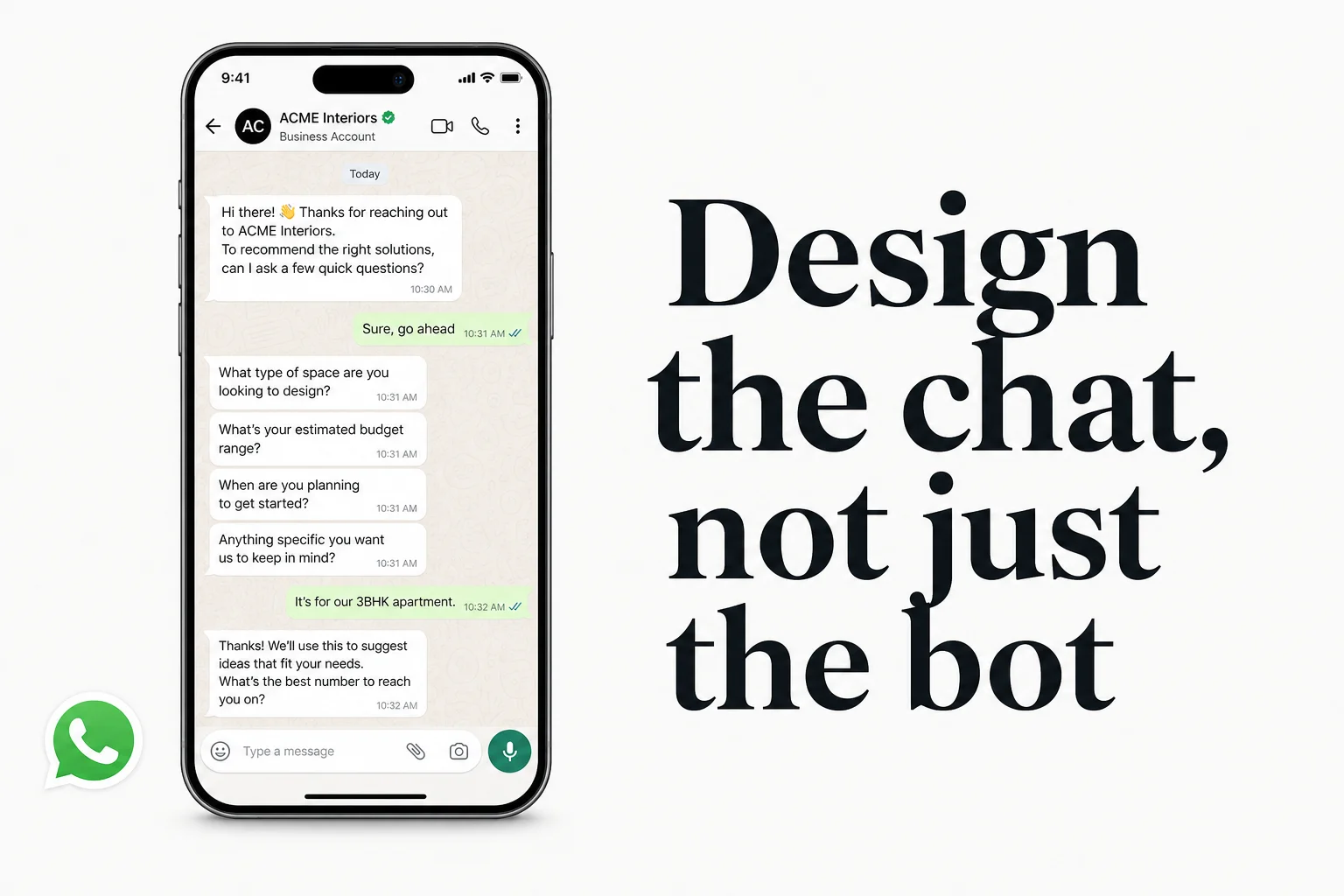
Most WhatsApp "AI chatbots" fail in the first five messages, not at Meta verification.
The model is fine. The conversation design is not. Customers get numbered menus, fake confidence on prices that changed last week, and no clean path to a human. Then they leave. You blame the channel. The channel was never the problem.
I wire WhatsApp AI for shops, clinics, agencies, and service businesses that already live in that green bubble. This post is about how the conversation should feel: qualify without interrogating, use templates where they belong, and hand off like a grown-up. For the App vs API plumbing and CRM sync basics, read WhatsApp Business App vs API first. Here we stay in the chat itself.
When the Business App is enough (and when it is not)
Direct answer: stay on the free WhatsApp Business App if one person owns the inbox, volume fits their shift, and you only need a profile, catalog, and quick replies. Move to API plus AI when leads arrive after hours, you need booking or CRM write-back, or more than one person must share the same conversation history.
| Signal | Stay on Business App | Move to API + AI |
|---|---|---|
| Daily inbound chats | Under ~20, mostly during open hours | Spikes after close, ads, or weekends |
| Outcome you need | Human reply is fine | Book, qualify, or log to CRM without waiting |
| Team | One operator | Multiple agents or shifts |
| Risk if slow | Mild inconvenience | Lost booking or paid lead |
If a vendor demos "AI on WhatsApp" without mentioning webhooks or the Cloud API, ask where the bot actually runs. The free app does not host real automation.
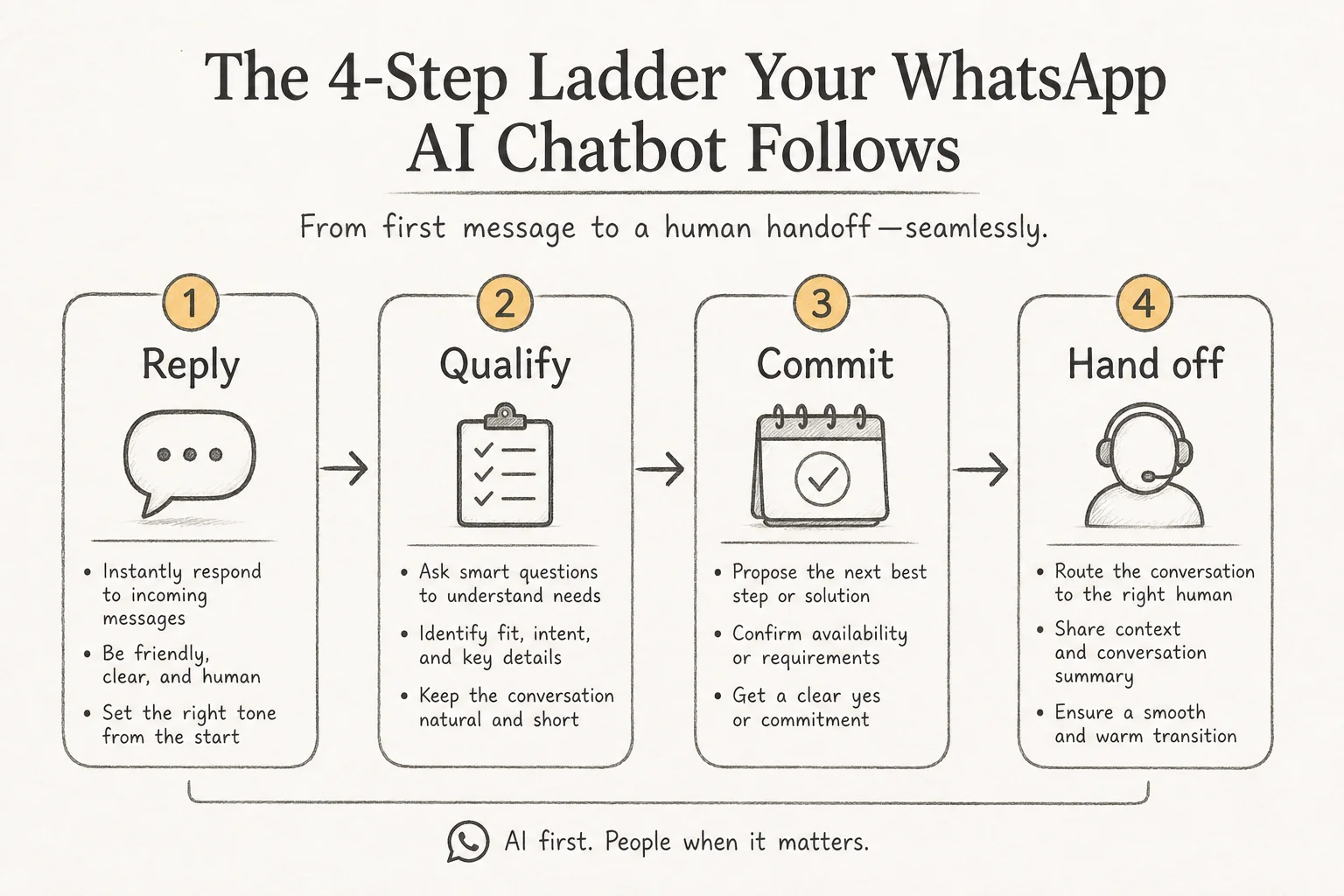
The 4-turn qualify ladder
I design most inbound bots around four turns. Not a rigid script. A ladder. Each rung has one job. If you skip a rung, conversion drops. If you add a fifth interrogation before offering a next step, people ghost.
Turn 1: Reply to the real question
Customer: "hi do you do kitchen remodel quotes in Austin?"
Bad bot: "Welcome! Press 1 for sales, 2 for support, 3 for hours."
Good bot: answers the actual ask in one or two sentences, then asks one useful follow-up. Ground answers in your docs (service area, hours, starting price bands you approve). If you do not know, say so and escalate. Fake certainty on WhatsApp destroys trust faster than silence.
Turn 2: Qualify with two constraints, not a form
Pick the two fields that change routing: budget band or ticket size, timeline, party size, insurance, service type. Ask them in chat language. Do not paste a web form into a bubble.
Example for a home services lead:
- Rough project size (small repair / full remodel / not sure yet)
- Ideal start window (this month / next 1 to 3 months / just researching)
Then stop asking. Extra fields belong in CRM after the call or site visit. See how I connect AI to CRM for the write-back side.
Turn 3: Commit to a concrete next step
Offer a real slot, a callback window, or a clear "I logged this for Maya, she replies by 10am." Vague "someone will get back to you" is how leads die politely.
Wire availability to a live calendar when you can. Static "we will call you" is the Business App era. API bots should book or queue.
Turn 4: Hand off or close the loop
If the bot finished the job (booked, answered, confirmed), confirm and stop talking. If it cannot finish, execute the handoff contract below. Never invent a fifth rung of "would you also like to hear about our newsletter."
Design for four turns of progress. Menus and twenty-question funnels are how you train customers to ignore you.
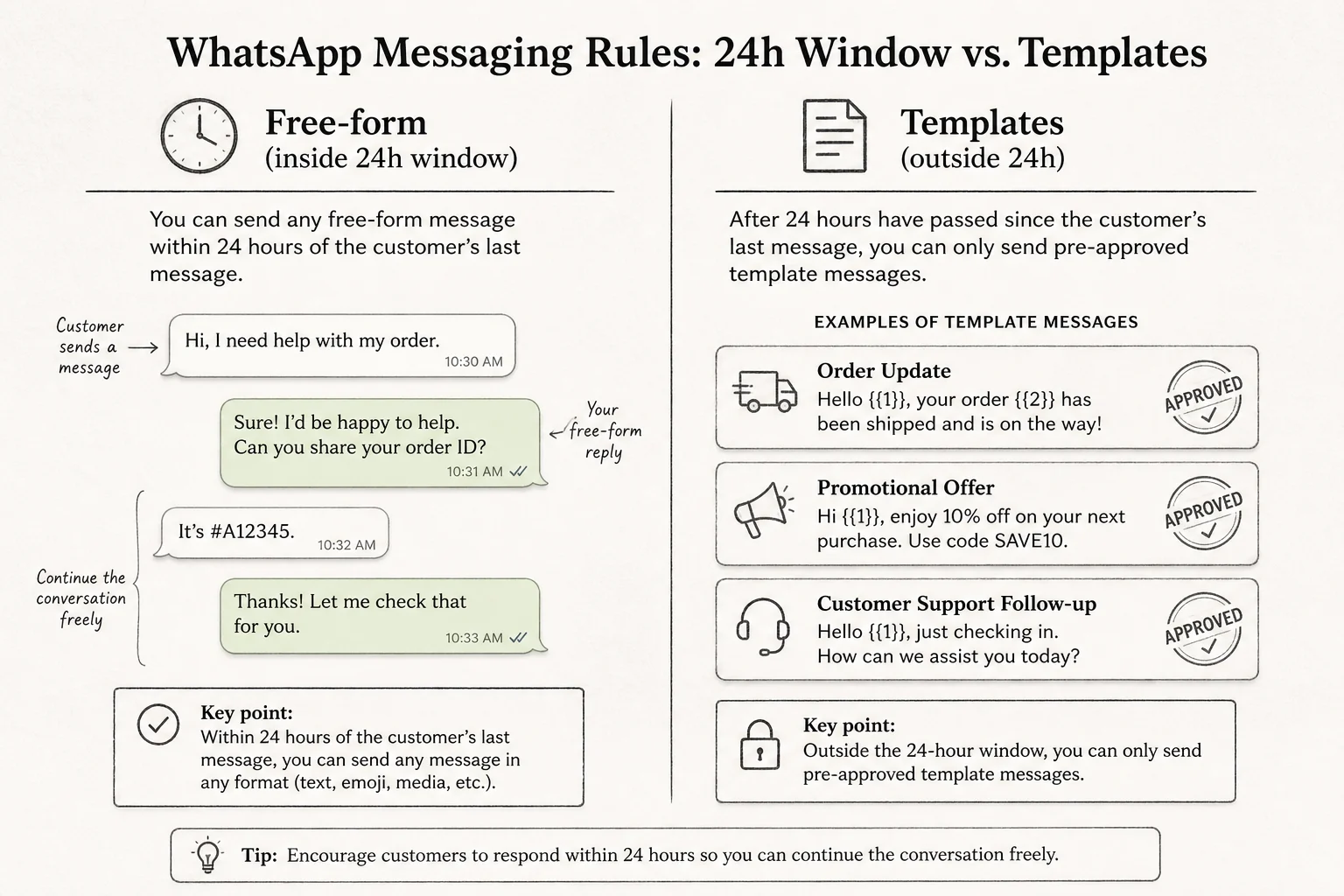
Templates vs free-form (stop mixing them up)
Operators confuse these constantly, then wonder why Meta rejects templates or why the bot goes quiet after a day.
Free-form is anything the bot or human types inside the 24-hour window after the customer's last message. This is where conversation design lives: qualify, book, clarify, apologize, escalate.
Templates are pre-approved message shapes for outside that window: appointment reminders, order updates, auth codes, careful re-engagement. Categories and pricing are documented in Meta's template guide. Smuggle a sales pitch into a "utility" reminder and expect rejection plus quality-score pain.
Practical rule I ship with:
| Moment | Use |
|---|---|
| Customer just messaged | Free-form AI or human |
| Reminder day-before booking | Utility template with confirm / reschedule buttons |
| Quiet lead after 24h+, still opted in | Template to reopen, then free-form again |
| Cold purchased list | Do not. Ever. |
Template copy should be boring and useful. Save personality for free-form inside the window, where the model can adapt.
The handoff contract (this is the product)
Automation without handoff is a customer support trap. I write a one-page contract before prompts:
Triggers (bot must escalate immediately):
- Customer asks for a person, manager, or "stop the bot"
- Complaint, refund fight, or anything emotionally charged
- Negotiation outside published price bands
- Model confidence low, or knowledge miss on a factual question
- Regulated or safety topics you never put in the bot (medical advice, legal promises)
Context attached to the human:
- Full transcript
- Extracted fields (intent, phone, preferred time, score)
- CRM link or contact ID
- Suggested next action ("offer Thursday 4pm" or "owner callback")
Promise to the customer:
Say who replies and by when. "Connecting you to Alex, usually within 30 minutes during open hours" beats "transferring now" into a void.
I often put the escalate path through n8n into GoHighLevel or HubSpot: create task, notify Slack or SMS, pause the bot so it does not keep talking over the human. That wiring is half the build. The model is the other half.
Qualification patterns that actually convert
Three patterns I reuse. Steal the structure, rewrite the words for your vertical.
Pattern A: Book-or-queue
Best for clinics, salons, consultants with calendars.
- Answer the service question
- Ask preferred daypart
- Offer two live slots or create a callback queue contact
- Send utility reminder later
Pattern B: Score-then-route
Best for real estate, B2B, high-ticket home services.
- Confirm intent
- Capture budget band + timeline
- Tag hot / warm / research in CRM
- Hot gets human ping in under five minutes; warm gets nurture template sequence you already approved
Pattern C: Status-first
Best for e-commerce and logistics.
- Detect "where is my order" intent
- Look up order ID from CRM or store API
- Reply with status; escalate exceptions (lost, damaged, angry)
Status-first bots should not upsell mid-complaint. Fix the package, then market later.
Language, tone, and the "sounds like us" test
If you serve bilingual markets, test English, the second language, and code-switch in one thread. Machine-translated Arabic (or any second language) reads as exactly that. Ground product names and prices so they do not get "helpfully" rewritten.
Tone test I run before go-live: paste ten real customer messages from last month into the staging bot. If staff laugh or cringe at the replies, fix prompts and retrieval before launch. A WhatsApp bot is public voice for the brand. Treat it like hiring a front-desk person who never sleeps and never improvises policy.
What to measure (so you know the design works)
Forget vanity "messages sent." Track:
| Metric | Healthy signal |
|---|---|
| First response time | Seconds, not hours |
| Turns to outcome | Often under 6 for booking flows |
| Bot resolution rate | Majority of routine threads, not 100% |
| Handoff success | Human replies inside the promised window |
| Block / report rate | Flat or falling after launch |
Review failed transcripts weekly for the first month. Each failure is a free lesson in missing knowledge or a broken rung on the ladder.
Cost context for chat vs voice vs DIY widgets lives in AI chatbot and voice cost in 2026. Design first, then pick the tier that matches the revenue you protect.
Ship the conversation, then the model
Order of work I actually use:
- Export two weeks of real WhatsApp history (or staff memory of top 20 questions)
- Write the 4-turn ladder and handoff contract on one page
- Decide App vs API with the table above
- Ground knowledge, connect calendar/CRM, approve templates
- Soft launch on a secondary number or limited hours, then cut over
If you want help turning that one-pager into a live qualify-and-book bot on WhatsApp, book a free call. Bring your messiest chat export. That file is better than any brief.