
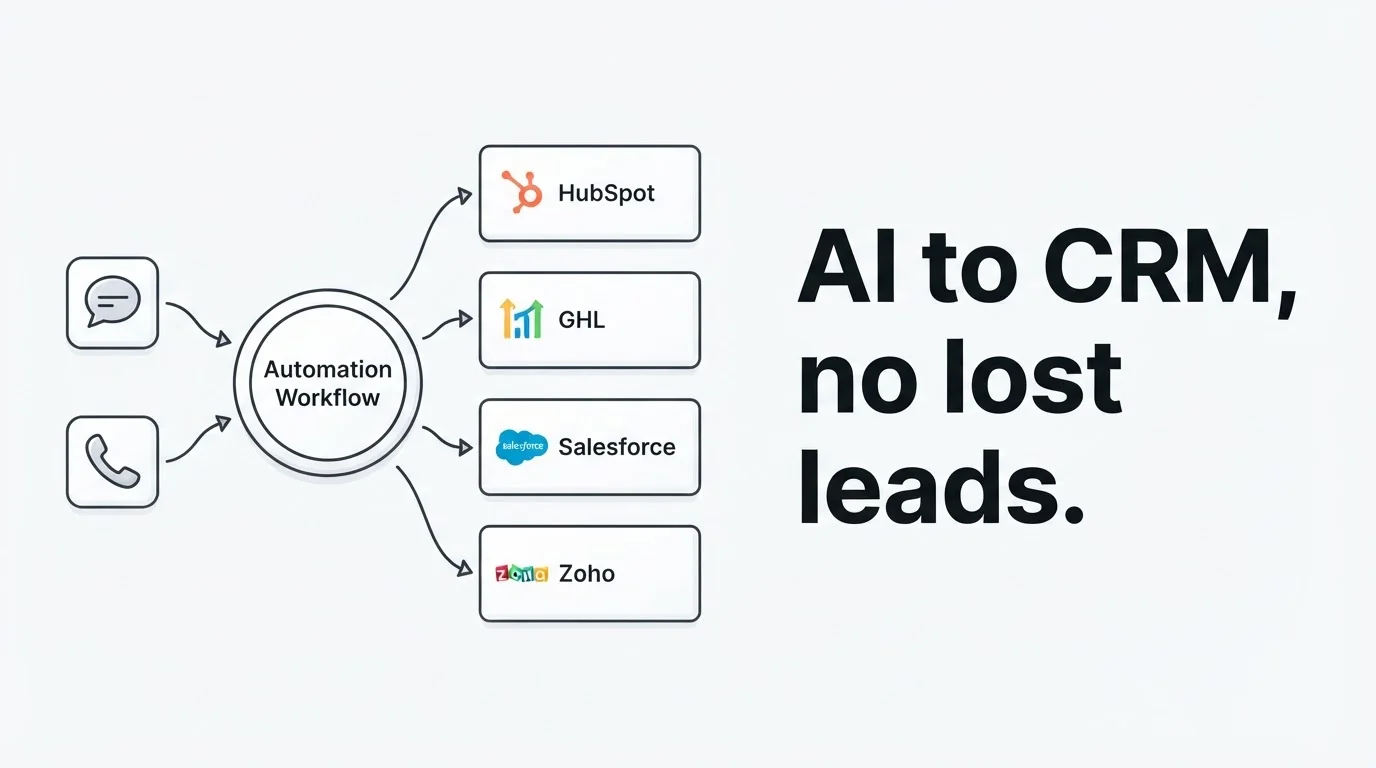
"Connect the AI to the CRM" sounds like a checkbox. In production it is three moving parts: the API you write through, the webhooks that tell your automation something changed, and the AI layer that decides what should happen.
Reading CRM data is easy. Writing it safely is the real engineering. A careless write corrupts the system of record your sales team lives in. I have cleaned up enough duplicate pipelines to have opinions.
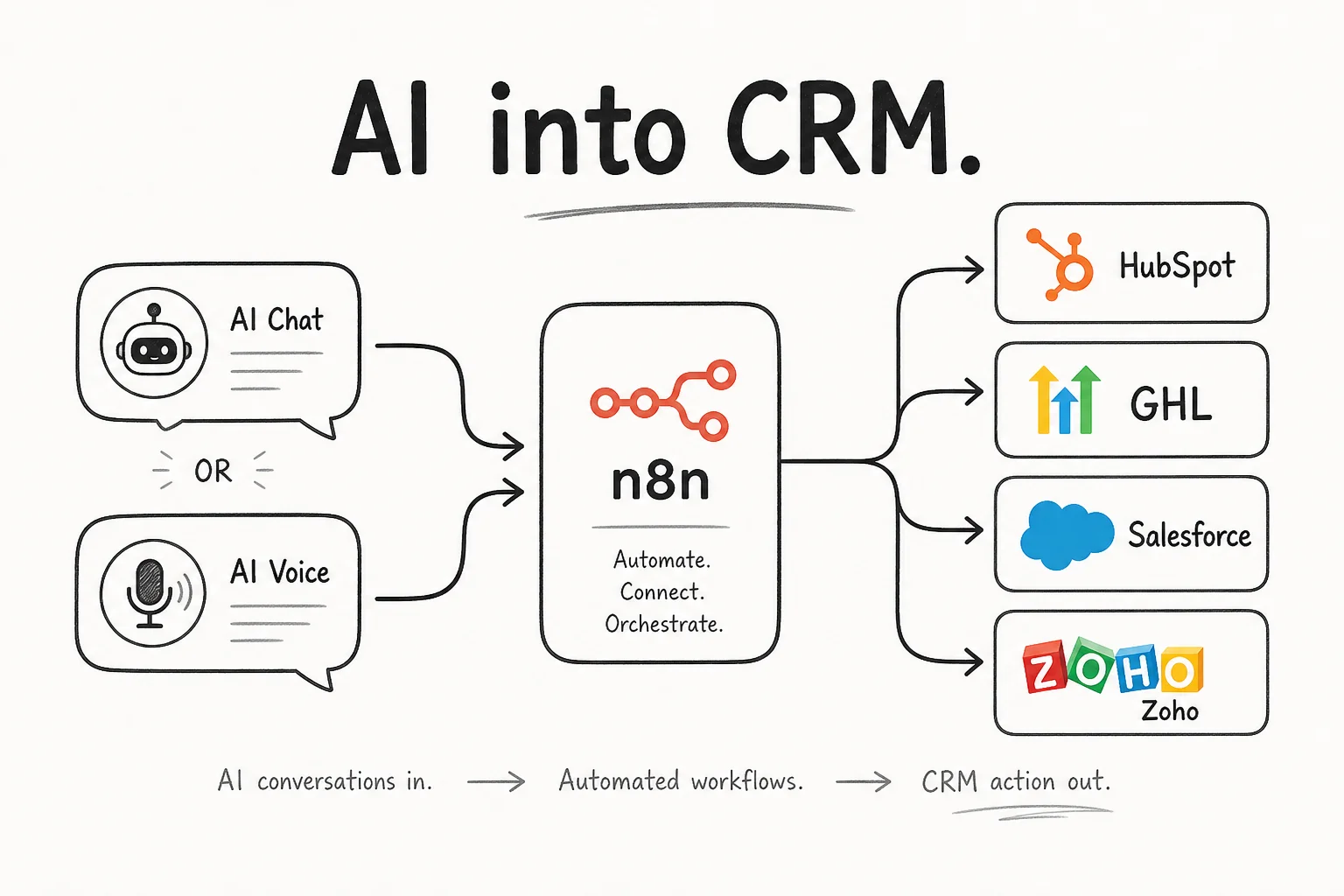
Here is how I wire chat and voice into HubSpot, GoHighLevel, Salesforce, and Zoho CRM without losing leads.
The integration surface (API, webhook, AI)
Every serious CRM integration is built from the same pieces.
APIs: read and write the system of record
REST APIs create contacts, update stages, log notes, and attach call summaries. Auth is usually OAuth, private app tokens (HubSpot), or connected apps (Salesforce). If a human can do it in the UI, a machine can usually do it through the API. That is where the agent hands off its decisions.
Docs worth keeping open while you scope:
Webhooks: push when something changes
Polling "any new deals?" every minute wastes quota and adds delay. Webhooks fire when a contact is created, a stage moves, or a field flips. Your workflow reacts in real time: stop SMS when unqualified, start onboarding when won, alert a VIP owner.
Native connector vs middleware
Native CRM workflows and vendor connectors are fast to switch on and hit a ceiling quickly. Middleware like n8n sits outside both systems: receive webhook, call the model, validate fields, upsert CRM, dead-letter failures. For anything with AI judgment plus de-dup plus multi-channel routing, middleware is where the durable version lives. Same trade-off I cover in n8n vs Make vs custom.
Read vs write: why writes deserve fear
| Read | Write | |
|---|---|---|
| Failure mode | Empty result, retry | Corrupt or duplicate data |
| Retry safety | Usually fine | Needs idempotency |
| Who notices | Bot sounds dumb | Sales and reporting break |
| Engineering bar | Often a checkbox | Treat like production code |
Safe write habits I treat as non-negotiable:
- Validate before the call. Required fields present. Picklist values the CRM accepts. Phone parses. Date formats match.
- Make writes idempotent. Networks fail mid-request. Retries must not create two contacts. Use upserts and external IDs.
- Handle partial failure. Batch of fifty, three rejected: log which three, alert a human, do not pretend success.
"The model said so" is not a defense when pipeline data is wrong. The integration owns the consequence.
The no-lost-leads pattern (capture in, status out)
Most valuable AI-to-CRM loops are bi-directional.
Capture: WhatsApp, web, voice into CRM
Inbound half turns unstructured events into clean records. A WhatsApp message, a web form, a voice transcript. AI extracts intent and fields (service wanted, budget band, preferred time), tags or scores the lead, and routes to an owner before a human reads the thread.
For local operators on WhatsApp, this is often the highest-ROI first integration. Pair with the channel basics in WhatsApp Business API automation.
Minimum fields I want on create or update:
| Field | Why |
|---|---|
| Normalized phone (E.164) and/or email | Match key |
| Source / channel | Attribution |
| Intent or service tag | Routing |
| Raw transcript or summary note | Context for the human |
| Owner or queue | Who acts next |
| Status / lifecycle stage | Stops double chase |
Status out: CRM drives follow-up
Outbound half: deal moves to Won, webhook starts onboarding. Lead marked Unqualified, automation stops messaging. Appointment confirmed, reminder sequence arms. CRM is source of truth. Workflows react.
Kill the echo loop
Classic failure: system A updates a field, webhook hits B, B writes back to A, forever. Defenses:
- One source of truth per field
- Tag machine-originated writes so webhooks can ignore their own echoes
- Compare values before writing; skip no-op updates
Handoffs humans actually use
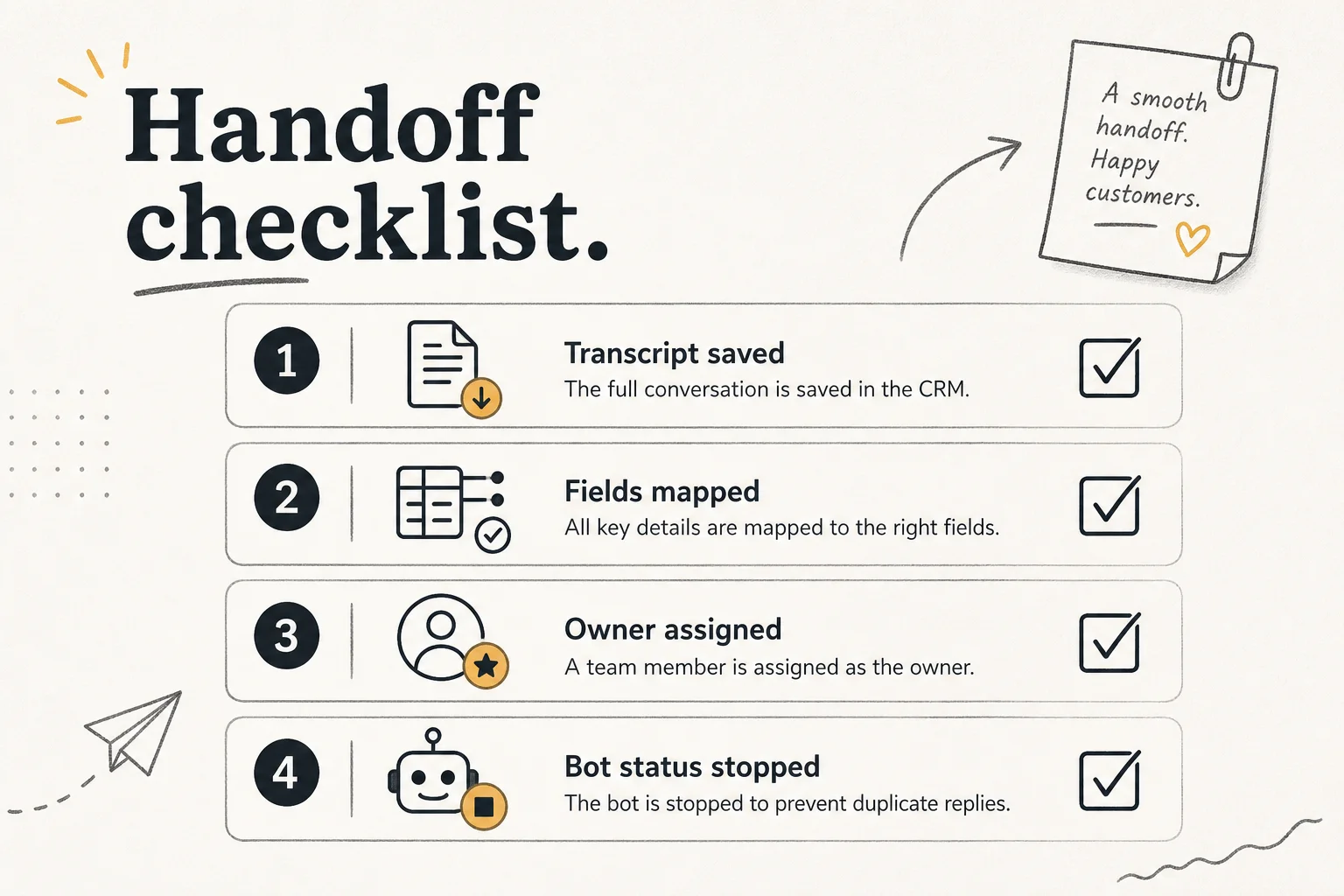
AI that dumps a contact with no context is how leads still die. Design the handoff:
- Bot or voice agent escalates on low confidence, explicit "talk to a person," or high-value intent
- CRM task or conversation assignment fires with owner, SLA, and the transcript
- Human sees extracted fields plus raw text, not a blank contact named "WhatsApp User"
- After human closes, status sync stops the bot from double-texting
For clinics and dental ops, this sits next to booking agents: AI receptionist patterns for clinics.
De-dupe and field hygiene (boring, mandatory)
An integration that runs perfectly and fills CRM with duplicates made your data worse.
Normalize before you match. +1 555 010 2299, 15550102299, and (555) 010-2299 are one person if you canonicalize to E.164. Lowercase emails. Trim whitespace. Match second.
Pick a stable key and upsert. Phone or email, depending on channel. Blind create is how you get three contacts for one buyer.
Decide merge policy field by field. Newest wins? Non-empty wins? CRM authoritative and AI only fills gaps? Write it down. Blank overwriting a good mobile is the silent killer.
CRM-specific notes from builds:
| CRM | What helps |
|---|---|
| HubSpot | Email de-dupe by default; search API for other keys; clean private-app tokens |
| GoHighLevel | Explicit search/upsert in workflows; popular with local agencies and Voice AI |
| Salesforce | Matching rules, external IDs, Bulk API for volume; governor limits bite |
| Zoho | Upsert with duplicate-check fields; watch daily API credits by edition |
HubSpot, GHL, Salesforce, Zoho: practical differences
Fundamentals are identical. Friction is not.
HubSpot is usually the friendliest first AI integration: clear REST, batch endpoints, reliable webhooks, contact email de-dupe out of the box. Rate limits still exist. Batch anyway.
GoHighLevel is where many US local businesses already live for SMS, Voice AI, and pipelines. API and workflow design need more intentional upsert logic than HubSpot's email defaults. Worth it when the team will not leave GHL.
Salesforce is the most powerful and most demanding. Bulk APIs, Platform Events, Change Data Capture. Also governor limits and a heavier data model. Rewards careful design. Punishes "just POST a lead" shortcuts.
Zoho is capable and cost-effective for many SMBs, with a wide suite (Books, Desk, Flow). API credits and multi-product surfaces mean you scope which Zoho product you are actually writing to.
Scoring and enrichment (decision support, not a black box)
Once capture is reliable, AI can add judgment:
Scoring. Read the enquiry, weigh it against existing fields, write a hot/warm/cold tag or numeric score so reps sort the day. The value is triaging a hundred messages without a human inbox sweep.
Enrichment. Infer industry from company name, standardize location, attach context from your own history. Label derived fields so humans see what the machine inferred versus what the customer said. Do not scrape indiscriminately into production contacts without a clear purpose and policy.
Common pitfalls (and the fix)
| Pitfall | Fix |
|---|---|
| Rate limits from one-record-at-a-time writes | Batch, honor retry-after, exponential backoff |
| Field mapping rejects | Map against schema; validate picklists before call |
| Duplicates | Normalize + upsert on stable key |
| Silent failures | Dead-letter store + alert |
| Sync loops | Source-of-truth per field + ignore self-echoes |
| Blank overwrites | Merge policy: never replace good with empty |
Where to start (one flow, not "connect everything")
Do not begin by picking a connector brand. Describe one flow on a single page:
- What event starts it? (WhatsApp message, missed call, web form)
- What must the AI decide?
- Which fields does it read and write?
- What is the match key?
- What happens on failure?
- What does the human see on handoff?
That description picks the layer (native vs n8n vs custom), the CRM constraints, and the de-dupe rules. One solid WhatsApp-to-CRM capture beat a vague "AI everywhere" roadmap every time I have shipped this.
If you want that flow scoped against your stack, book a free call. Bring your CRM name, the inbound channel that matters most, and one example of a lead that fell through the cracks last month. That is enough to design a write path that does not invent duplicates.