
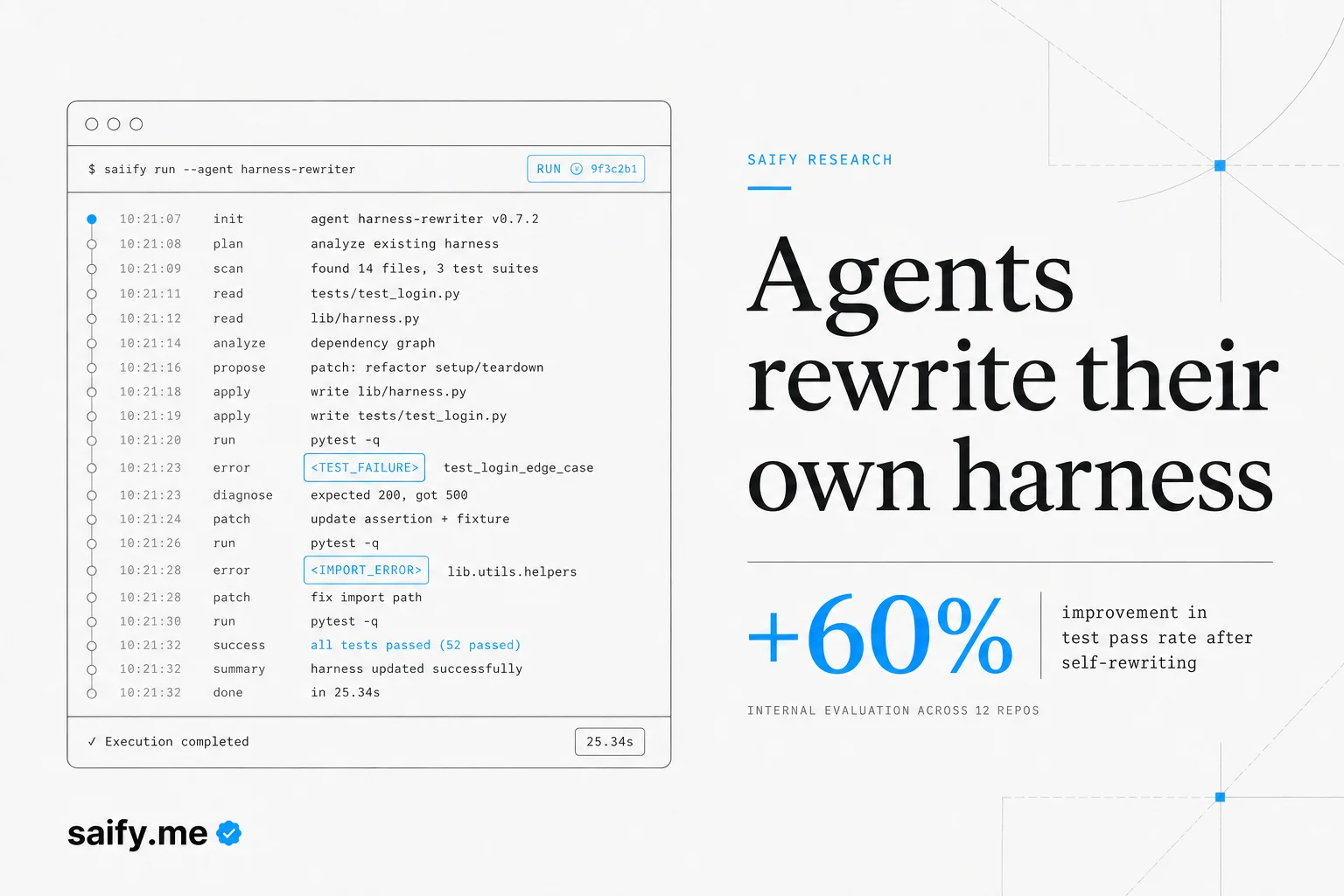
Swap the model under your agent and the whole stack wobbles. Prompts that worked on Qwen choke on GLM. Tool wrappers tuned for Claude Code assumptions break on Codex. You end up hand-editing harness code every time a vendor ships a new checkpoint.
Self-Harness is a different bet: keep the model frozen, let the agent read its own crash logs, propose small harness edits, and promote only what survives regression tests. Shanghai Artificial Intelligence Laboratory published the method in Self-Harness: Harnesses That Improve Themselves (June 2026). On Terminal-Bench 2.0, pass rates jumped 33% to 60% relative depending on the base model, with no weight updates.
This is not abstract. It is the same layer I ship in client work: orchestration, not bigger GPUs. If you already think in loop engineering terms, Self-Harness is a concrete inner loop for the harness itself.
What counts as a harness
A harness is everything between the raw LLM and the environment:
| Piece | Examples |
|---|---|
| System prompts | Role, constraints, output format |
| Tool routing | When to call bash vs browser vs file write |
| Memory | What gets persisted between turns |
| Error handling | Retry rules, file-exists checks, rollback |
| Verification | Pre-commit hooks, test commands, linters |
Cursor, Claude Code, Codex, and OpenClaw are commercial harnesses. Your custom RAG pipeline or n8n + MCP stack is one too. The model is the engine. The harness is the transmission.
Manual harness work scales poorly. Models diversify faster than your team can regression-test prompt diffs. Self-Harness automates the edit loop while keeping humans out of the hot path.
The three-stage loop
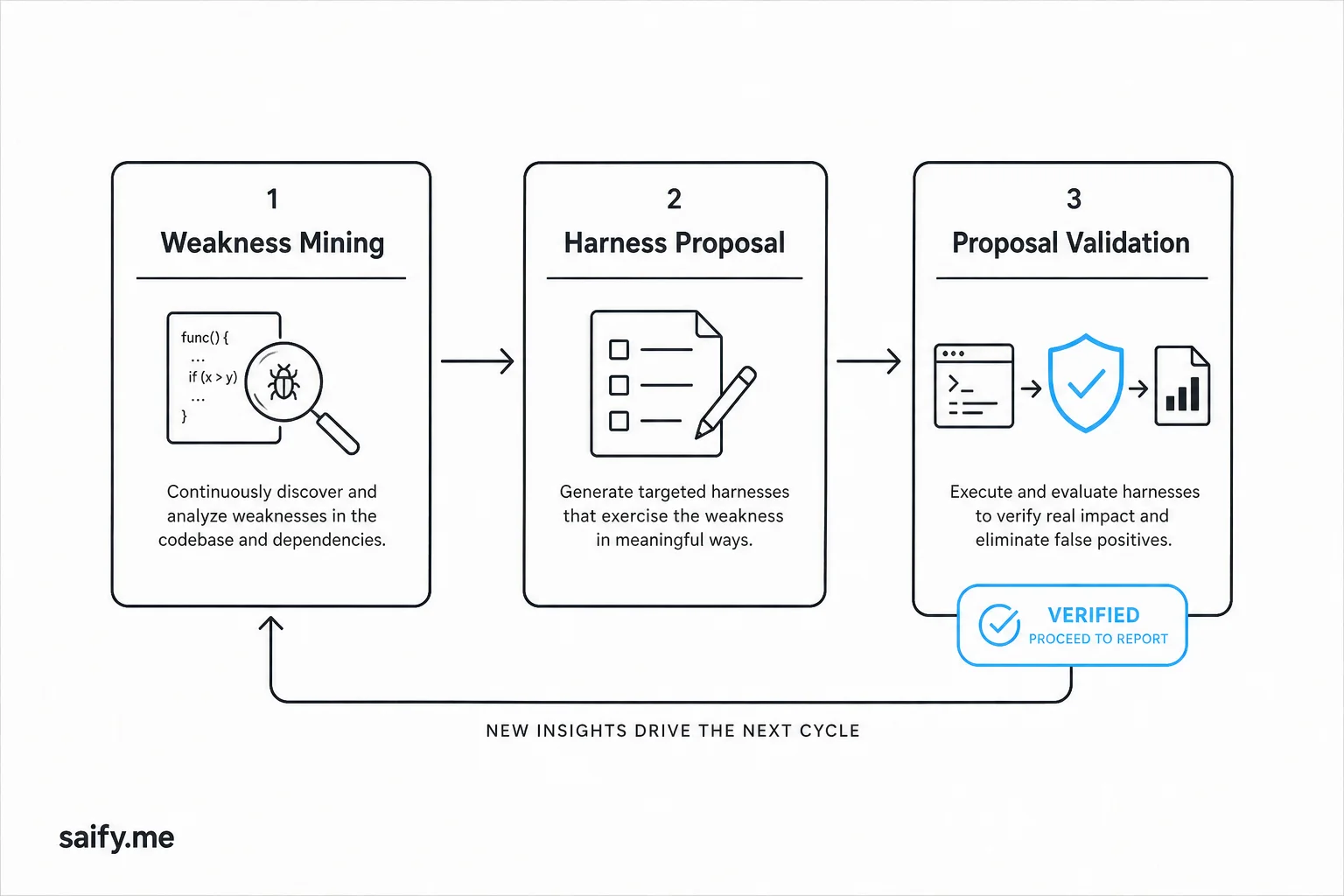
1. Weakness mining
The agent runs a batch of tasks and stores execution traces. A mining step clusters recurring failure patterns: file overwrite errors, missing pre-checks, wrong tool choice, timeout loops.
This is not "read the last error message." It is batch statistics over traces. If 40% of failures share the same stack tag, that pattern becomes a harness ticket.
2. Harness proposal
Given a failure cluster, the system generates minimal edits: add a file-exists guard before write, tighten a tool description, inject a verification step after patch application. Proposals stay tied to observed failures, not generic "be more careful" prompt bloat.
The paper stresses diversity of candidates with small surface area. You want surgical diffs, not a rewrite of AGENTS.md every round.
3. Proposal validation
Each candidate runs on a held-in split (what the proposer saw) and a held-out split (what it did not). An edit ships only if at least one split improves and neither degrades. That is the anti-loopmaxxing gate: no promoting vibes, no reward hacking on a single lucky task.
Rejected proposals stay logged. Accepted edits merge into the next harness version. The loop repeats.
If your gate is vibes, you are not doing Self-Harness. You are automating hope.
Terminal-Bench numbers worth citing
The authors evaluated three model families on Terminal-Bench 2.0 with the same minimal DeepAgent-style starting harness:
| Model | Initial pass rate | Final pass rate | Relative gain |
|---|---|---|---|
| MiniMax M2.5 | 40.5% | 61.9% | +52.8% |
| Qwen3.5-35B-A3B | 23.8% | 38.1% | +60.1% |
| GLM-5 | 42.9% | 57.1% | +33.1% |
Held-out splits improved on every run. Qualitative wins were specific: better artifact handling in terminal tasks, patch verification on SWE-style work, state retrieval fixes on AppWorld-style flows.
Alpha Signal's companion write-up, How to Let a Fixed Model Rewrite Its Own Harness, notes there is no public package yet. The method reproduces by hand. That is fine for production teams with logs and a test suite.
DIY Self-Harness without the paper's infra
You do not need Harbor or their exact splits to steal the pattern:
- Instrument everything. Structured logs per agent run: task id, tools called, exit codes, stderr snippets, final pass/fail.
- Build a held-out set. 20 to 50 tasks with objective graders (tests, schema checks, file hashes). Never let the proposer tune on this set.
- Cluster failures weekly. Group by error class, not by chat title.
- One edit per cluster. Single harness diff per promotion cycle.
- Regression gate. Run held-in + held-out. Ship only on non-degrading improvement.
I have seen clients get 15 to 25 point benchmark lifts from this alone, before touching model routing. The bottleneck is usually missing verifiers, not missing intelligence.
Self-Harness vs prompt tweaking vs loop engineering
| Approach | What moves | Best when |
|---|---|---|
| Prompt tweaking | Prose in one shot | Single-turn tasks, no tools |
| Loop engineering | Outer control system | You have oracles and state files |
| Self-Harness | Harness code/prompts | Same model, repeated task distribution |
Self-Harness sits inside loop engineering: weakness mining is an inner optimizer; validation is your outer gate. Pair it with harness benchmarks when you compare commercial stacks.
What I would not copy blindly
- No repo yet. Budget engineering time to build the trace store and gates yourself.
- Benchmark scope. Terminal-Bench is 89 container tasks. Your CRM webhook agent has different failure physics.
- Edit size creep. Teams that skip the "minimal edit" rule end up with 400-line system prompts that pass held-in and fail in prod.
Start with one agent, one benchmark slice, one promotion rule: improve held-out or do not ship.
Where this is heading
Model labs will keep shipping faster. Harness diversity will outpace any team's manual prompt review. Self-Harness is early evidence that scaffolding can co-evolve with traces, the same way compilers learned optimization passes from profiles.
For applied work today: log failures, gate edits, treat harness code like application code with CI. The model you have might already be enough if the wrapper stops stepping on the same rake.
If you want help wiring regression gates around production agents, book a free discovery call. I audit harness layers more often than I swap base models.