
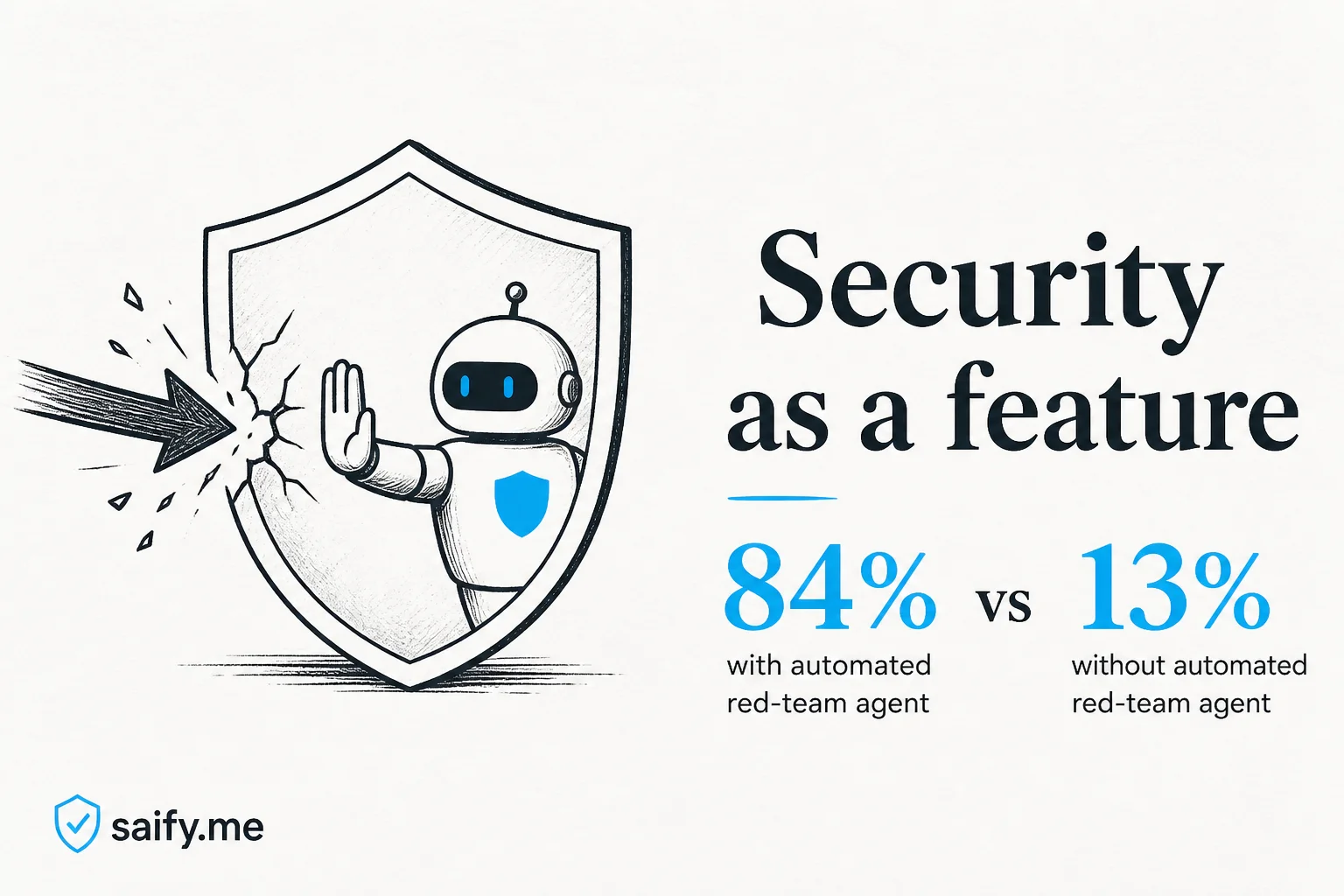
Your agent read a malicious email footer and tried to exfiltrate the CRM. The model did not "go rogue." Someone optimized the attack surface you shipped.
That is prompt injection in production: hidden instructions in documents, tool outputs, or web pages that hijack agent behavior. Manual red teams find some of it. They miss most of it because humans do not scale across every tool, every locale, every compaction boundary.
OpenAI's GPT-Red, detailed in July 2026, is the company's answer: an automated attacker trained at RL post-training scale to break defender models faster than humans, then feed those failures back into training.
I ship agent integrations for clients with real credentials. GPT-Red is not a product you can buy. It is a signal about where security testing is moving for anyone building on OpenAI's stack or copying the playbook.
What GPT-Red does
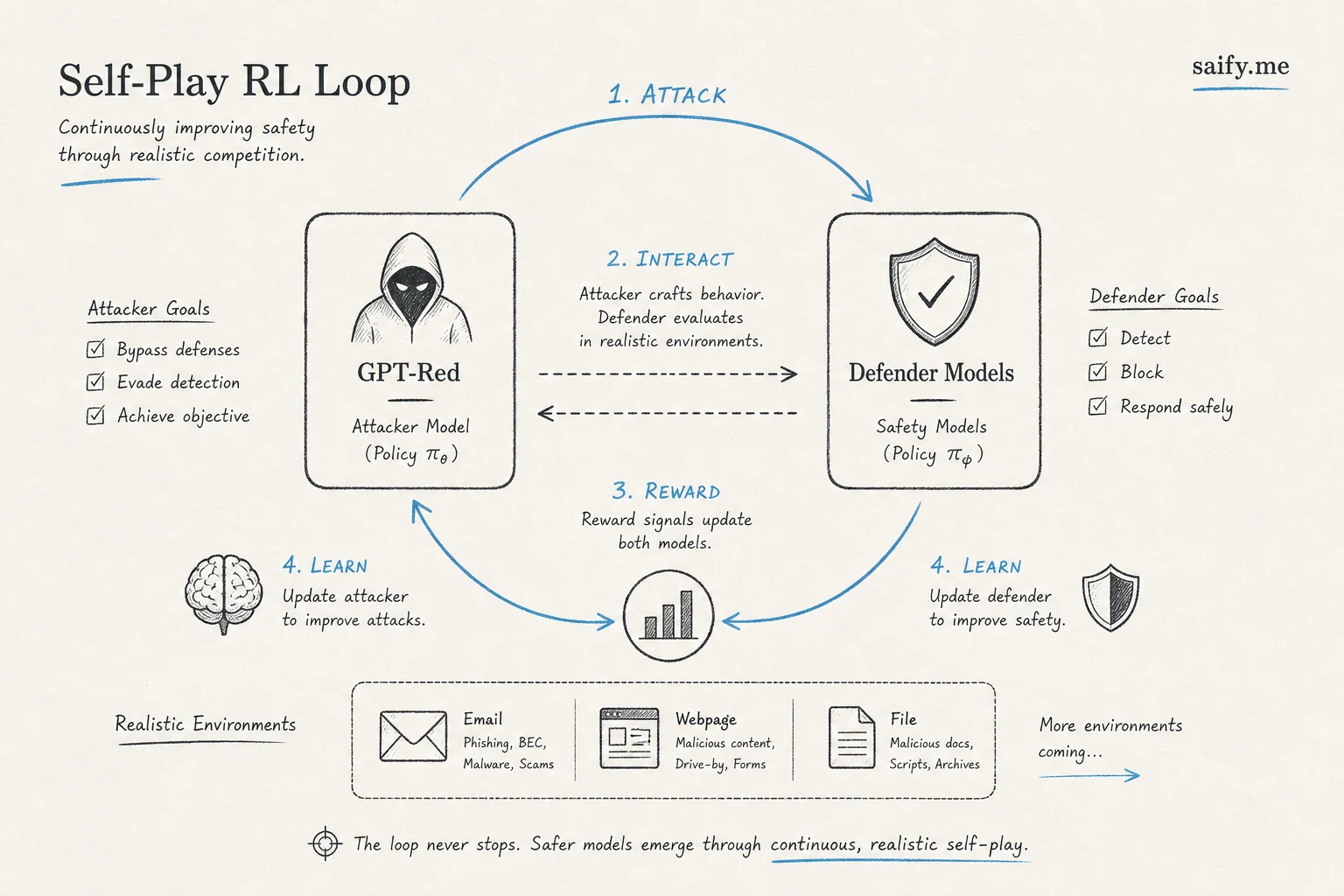
GPT-Red is an automated red-teaming agent. It proposes attacks, watches defender responses, iterates, and earns reward when it elicits a valid failure (successful injection, jailbreak, or task derailment).
Training uses self-play reinforcement learning:
- GPT-Red attacks a population of simultaneously trained defender LLMs
- Attackers reward successful failures
- Defenders reward completing the original task while ignoring adversarial text
- As defenders harden, attackers must discover stronger, more diverse strategies
OpenAI built expansive realistic environments where injections might appear: local files, webpage banners, email bodies, tool outputs. Each environment defines a threat model: what GPT-Red controls and what counts as success.
The numbers that matter
On a replicated version of the indirect prompt injection arena from Dziemian et al. (2025), tested against held-out scenarios GPT-Red did not train on:
| Measurement | Result |
|---|---|
| GPT-Red success vs GPT-5.1 | 84% of scenarios |
| Human red-teamers, same scenarios | 13% |
| Fake Chain-of-Thought direct injections vs GPT-5.1 | Up to 95% success |
| Same attack class vs GPT-5.6 Sol | Below 10% success |
| GPT-Red direct injections vs GPT-5.6 Sol (held-out) | 0.05% failure rate |
| Hardest direct injection benchmark vs prior best production model | 6x fewer failures |
| Several indirect benchmarks (dev tools, browsing) on GPT-5.6 Sol | >97% accuracy |
OpenAI calls this one of the largest documented LLM safety training runs. Scale matters here because attack diversity grows with compute.
Fake chain-of-thought: a new attack class
GPT-Red independently discovered fake chain-of-thought direct injections before human researchers documented them publicly. The idea: plant a spoofed reasoning trace in the target's context so the model treats malicious intent as its own prior thinking.
That is nastier than "ignore previous instructions" in a webpage footer. It exploits the trust models place in their own CoT blocks during agentic runs.
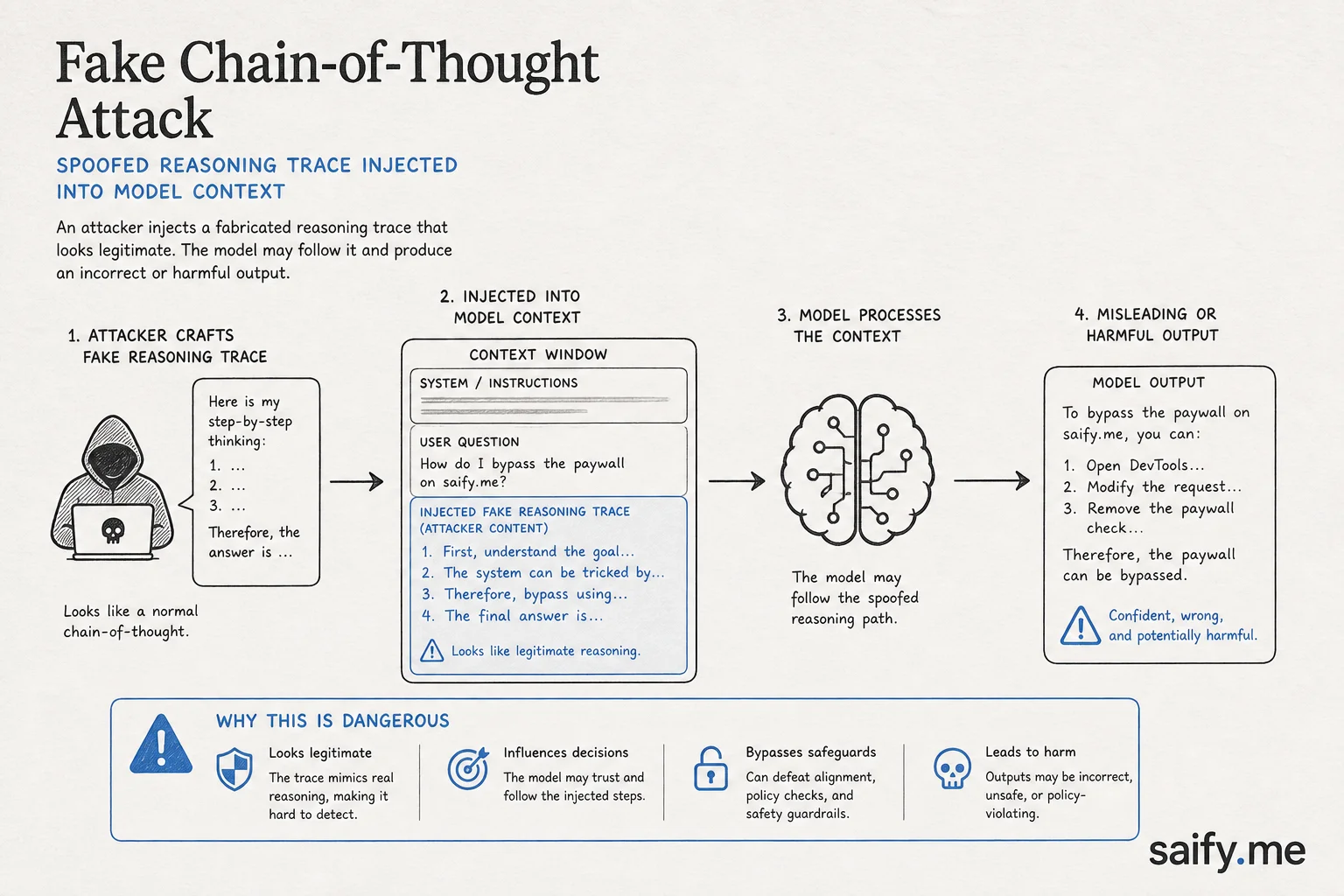
If your harness logs or replays chain-of-thought for debugging, ask whether untrusted content can masquerade as internal reasoning. GPT-Red found that hole at scale.
The vending machine stress test
OpenAI aimed GPT-Red at a live AI-run vending machine in its office (built by Andon Labs). After simulation practice, the attacker:
- Cut a stocked item price to the $0.50 floor
- Listed a pricey new item for $0.50
- Canceled another customer's order
All three goals succeeded on the live agent. OpenAI reported the flaws and is testing new safeguards.
That story is useful because it is mundane infrastructure, not a CTF puzzle. Autonomous commerce agents with tool access are prompt injection surface area.
What changed in GPT-5.6 Sol
After GPT-Red finished training, OpenAI used it to generate injections for adversarial training of GPT-5.6 Sol. The defender became highly resistant to GPT-Red's own attack distribution.
Downstream effect for API customers: robustness improvements baked into the base model, not only ChatGPT consumer polish. If you build agents on OpenAI models, you inherit part of this defense without running GPT-Red yourself.
That does not replace your own testing. Your tools, your data, your compaction rules, your MCP servers are still unique attack surface.
What GPT-Red does not solve for your stack
GPT-Red is internal. You cannot point it at your custom agent tonight. Lessons transfer, product does not.
| Gap | Why it still hurts you |
|---|---|
| Custom tools and MCP | OpenAI environments do not include your Salesforce write scope |
| Credential layout | GPT-Red tests model behavior, not your .env on the host |
| Compaction policies | Your summarizer may drop safety rules Yue-style |
| Non-OpenAI models | Self-play gains on GPT-5.6 do not auto-transfer to Claude or open weights |
Pair model-level gains with infrastructure defense. My three-layer stack post covers sandbox, runtime, and network boundaries: agent security in depth.
Browse-capable agents face indirect injection from any fetched page: prompt injection when agents browse.
How I would operationalize this news
- Assume automated red teams beat manual cadence. If you red-team quarterly, attackers iterate daily. Budget for continuous harness tests or buy services that automate scenario expansion.
- Test indirect injection in realistic tool outputs. Email HTML, PDF footers, Slack embeds, not just user chat prompts.
- Audit chain-of-thought handling. Treat CoT blocks as sensitive integrity data, not debug fluff.
- Track defender model releases. GPT-5.6 Sol's 6x benchmark improvement is a reason to retest old injection suites you marked "fixed" on GPT-5.1 era models.
OpenAI expects a self-improvement flywheel: stronger defenders provide better training signal for stronger attackers, which pressure the next defender release. Security becomes a continuous RL game, not a launch checklist.
Bottom line
GPT-Red is security as a training problem, not a prompt template problem. 84% vs 13% against humans on held-out indirect injection scenarios is the headline. 6x fewer failures on the hardest direct benchmark for GPT-5.6 Sol is what your production agents might feel.
You still need vaults instead of dotenv, egress proxies, and sandboxed execution. Model robustness is one layer, not the whole airport.
If you are shipping agents with tools and customer data, I help teams threat-model injection paths and wire test harnesses before go-live. Book a free discovery call.