
Every image pipeline owner has the same quiet fear: your model will spit out a near-copy of a training photo, and someone will notice. Empirical papers have flagged memorization in Stable Diffusion and Midjourney-class systems for years. What we lacked was a clean theory explaining when it happens and why generation sometimes still looks novel.
Two 2026 papers close that gap from different angles. One gives provable separations between memorization and generalization. The other shows models memorize in training but generalize in inference. Both matter if you ship image features to clients.
Paper 1: provable separations (ICLR 2026)
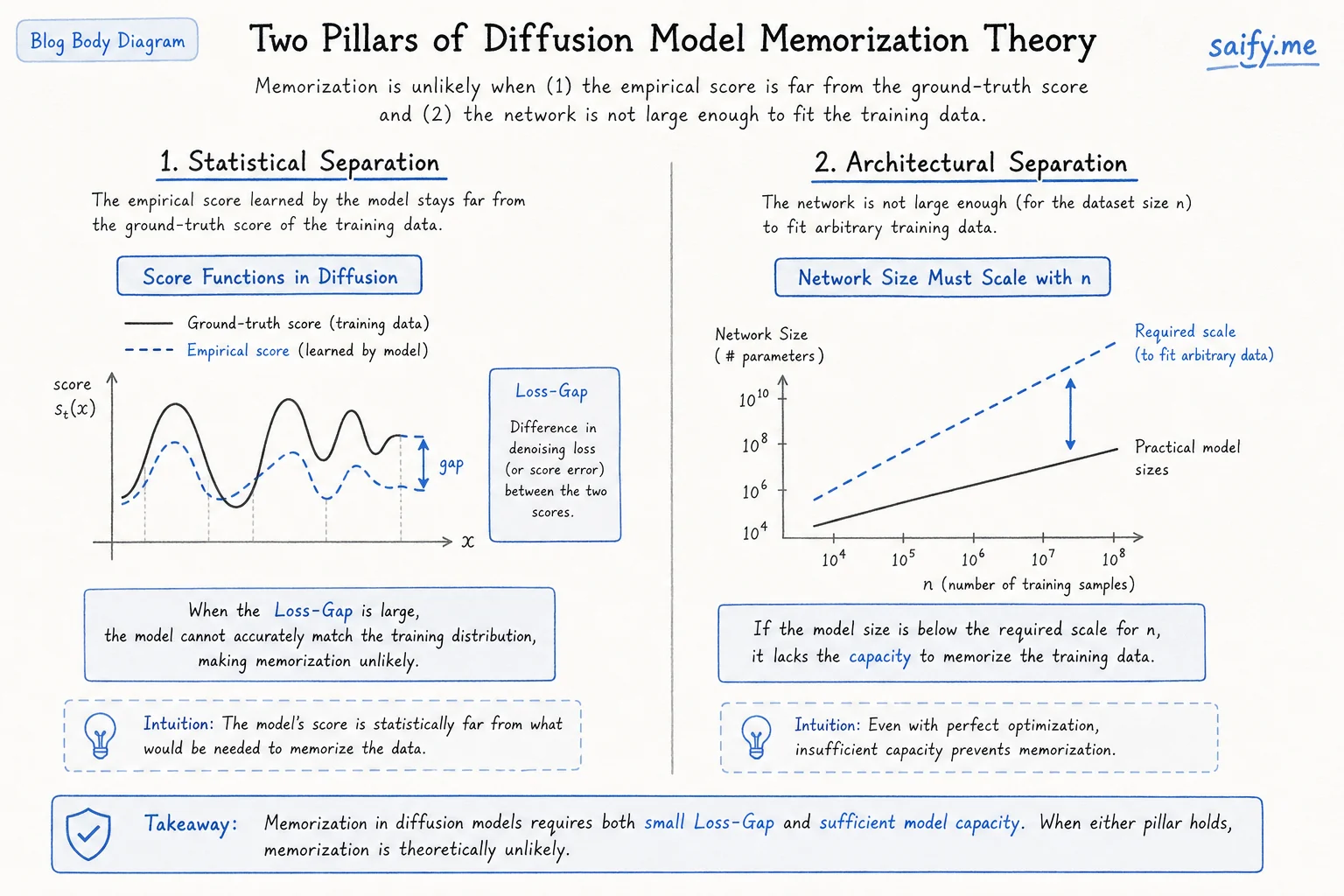
Provable Separations between Memorization and Generalization in Diffusion Models (Ye et al., arXiv 2511.03202) builds a dual-separation framework:
| Perspective | What it proves | Why it drives memorization |
|---|---|---|
| Statistical estimation | Ground-truth score does not minimize empirical DSM loss | Optimizers converge to empirical score, not true score |
| Network approximation | Empirical score needs network size scaling with sample count n | True score admits a more compact representation |
The causal chain, as summarized by paper notes:
Large network + strong optimizer → convergence to empirical score → memorization.
This is not hand-waving about "the model saw too much data." It is a quantified Loss-Gap between the denoising score matching objective and the ground-truth score function, proven for sub-Gaussian mixture models.
The pruning mitigation
The theory is not academic-only. The authors propose a pruning-based method for diffusion transformers (DiT):
- Identify attention heads with minimal contribution during early (small-t) diffusion timesteps
- Prune those heads to restrict network capacity
- Fine-tune the pruned model to maintain generation quality
The intuition: the ground-truth score is more Lipschitz and compact. Shrinking the network pulls the learned function away from the overfitting empirical score.
Limitations they acknowledge:
- Theory covers sub-Gaussian mixtures, not heavy-tailed distributions
- Pruning works in their experiments but lacks formal optimality guarantees
Paper 2: memorize in training, generalize in inference
Diffusion Models Memorize in Training – and Generalize in Inference (March 2026) adds a twist that confused practitioners for years.
The authors show diffusion models progressively overfit the denoising training objective, creating a generalization gap between validation and training performance. That gap peaks at intermediate noise levels.
Yet at inference, generated samples often do not closely resemble training data. Why?
The answer lives in the sampling trajectory. During generation, intermediate states drift far from the distribution of noisy training samples the model was trained on. The flow field localizes sharply around training points (memorization bias), but model error smooths the field enough that sampling paths escape memorized regions.
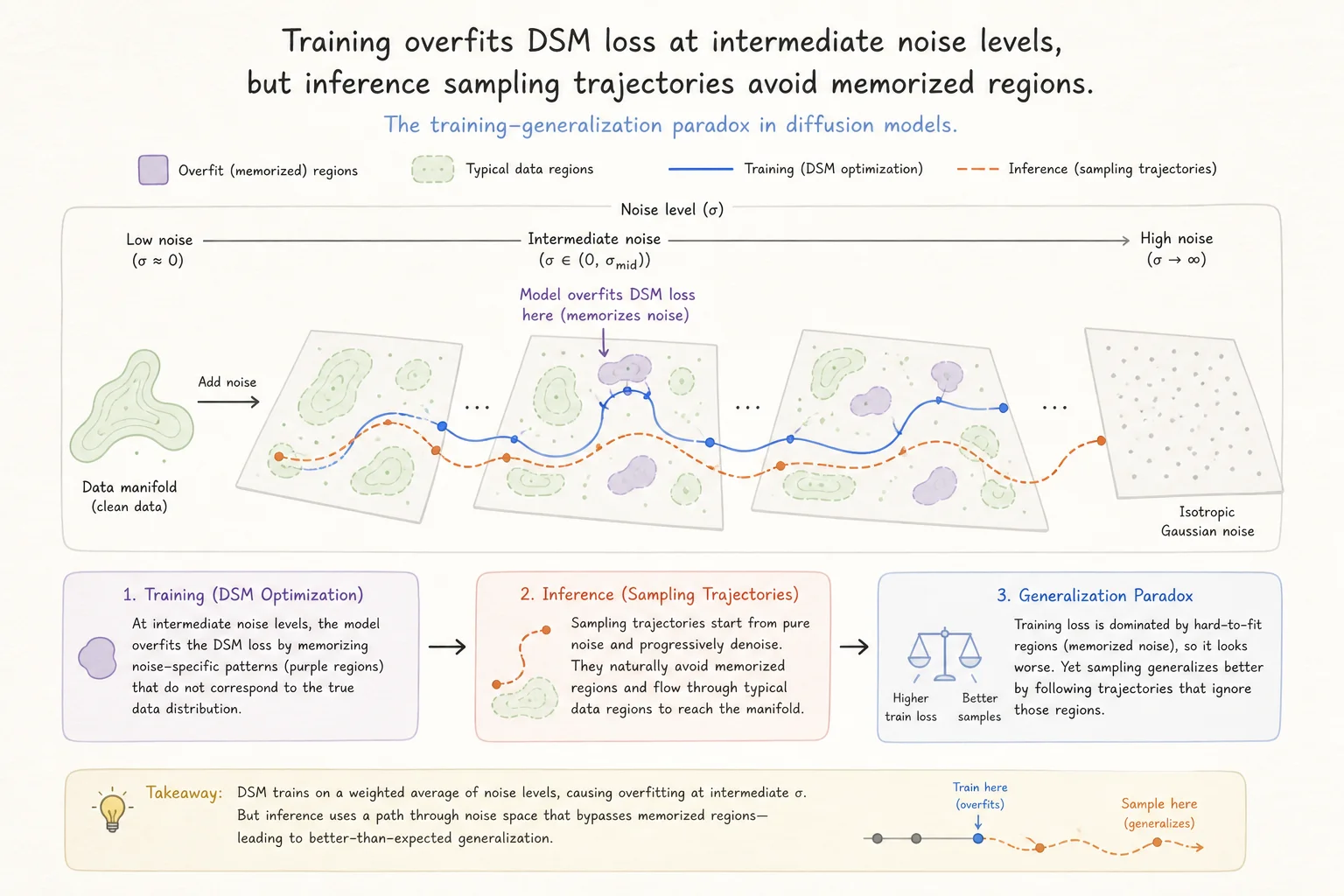
Using a fully analytic 2D toy model, they trace how:
- Small model error + sparse data support → sharp localization → large train/val gap
- Larger model error + dense support → smoother flow field → better inference generalization
This reconciles two observations that seemed contradictory: training metrics show memorization, but users see diverse outputs.
What this means for production image pipelines
I have shipped RAG and image features for clients who care about privacy and copyright. These papers do not give you a compliance checklist. They give you better mental models.
For training-time risk
| Signal | Interpretation | Action |
|---|---|---|
| High train/val gap at mid-noise | Model fitting empirical score | Consider capacity reduction or pruning |
| Near-duplicate outputs in eval | Active memorization | Audit training set for duplicates; dedupe |
| Large model + small dataset | Architectural separation kicks in | Add data or shrink model |
For inference-time risk
Memorization during training does not guarantee memorization at generation. That is good news for diversity. It is bad news for privacy audits that only check training loss curves.
If you need provable non-memorization (medical imaging, legal discovery, licensed stock), you still need:
- Training data deduplication and provenance tracking
- Output similarity checks against the training corpus
- Human review gates for client-facing assets
For fine-tuning workflows
LoRA and domain fine-tuning on small datasets push you toward the "large network + small n" corner of the theory. That is exactly where memorization separations are largest.
Practical mitigations I use today:
- Deduplicate before fine-tuning (perceptual hash + CLIP similarity)
- Cap LoRA rank when the dataset is under 1,000 images
- Run membership inference probes on a held-out set before shipping
- Log output similarity to nearest training neighbor in production
The pruning method from Paper 1 is worth watching for DiT-based stacks. It is not plug-and-play for every architecture yet.
How the two papers fit together
Paper 1 explains why memorization is structurally incentivized by the DSM objective and network scaling laws. Paper 2 explains why users still see novelty despite that structural bias.
Together they suggest a more nuanced production stance:
- Training metrics that look "memorized" are not a false alarm
- Inference diversity is not proof of safety
- Capacity control (pruning, smaller models, more data) attacks the root cause
- Output auditing attacks the symptom
Neither paper solves copyright law or GDPR. They give engineering teams vocabulary that matches what lawyers will ask in discovery.
Open questions I am still tracking
- Does the pruning method transfer to U-Net architectures (SD 1.5/SDXL) or only DiT?
- How does RLHF-style preference tuning on top of a memorizing base model change the inference trajectory story?
- Can membership inference at mid-noise timesteps serve as a cheap production monitor?
If you are building image generation into a client product, the theory matters less than the audit pipeline. But knowing why memorization happens helps you argue for budget on deduplication and eval infrastructure instead of hoping prompt engineering fixes it.
Shipping diffusion-based features and need a memorization audit plan? Book a free discovery call.