
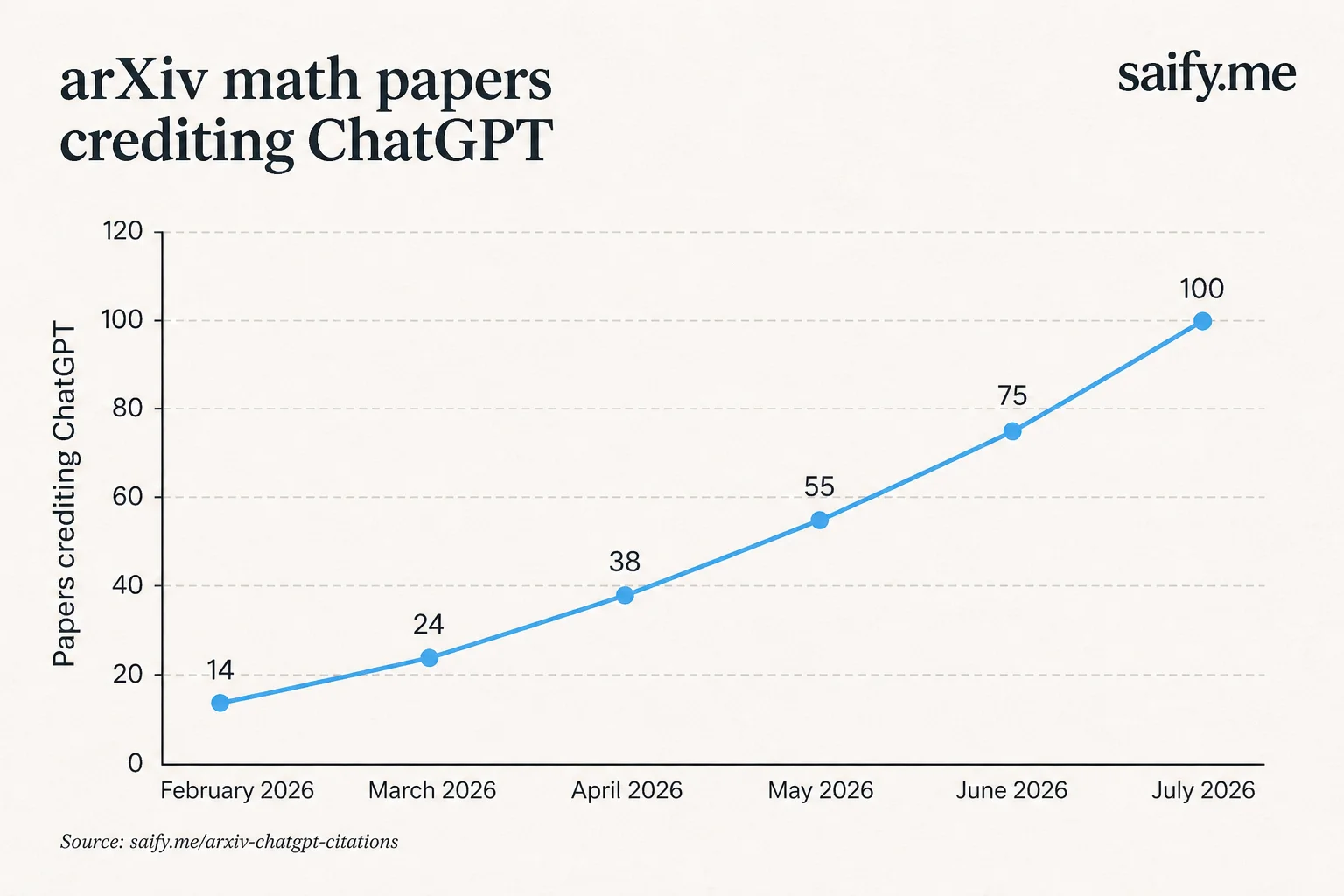
OpenAI wants researchers inside ChatGPT before the next grant cycle renews. On July 29, 2026, the company announced a program for academic researchers offering free ChatGPT to 100,000 scholars, with a stat that stuck: arXiv math papers crediting ChatGPT went from 14 in February to 100 in July 2026.
I work with applied research teams and SMB operators who treat papers as product specs. That citation jump is not vanity. It is workflow adoption showing up in public metadata.
Why OpenAI is buying mindshare in academia
Universities are parallel to enterprise seat land grabs:
| Goal | Mechanism |
|---|---|
| Default research assistant | Free ChatGPT for 100K researchers |
| Citation as social proof | arXiv credit lines in published PDFs |
| Upsell path | Teams that need API, agents, or enterprise controls later |
| Policy goodwill | Support science narrative while Hill talks pacing |
The program sits in the same week Sam Altman discussed pacing on Capitol Hill after the rogue agent breach. Free researcher access is the soft power counterweight to security headlines.
What researchers actually use ChatGPT for
From lab workflows I have seen and OpenAI's positioning:
- Literature triage summarizing dozens of PDFs before deep reading
- Drafting abstracts, rebuttals, and slide outlines
- Code scaffolding for analysis scripts and experiment harnesses
- Explaining math step-by-step for interdisciplinary collaborators
Tools like Anthropic's science workbench (see my Claude science workbench post) and Stanford STORM (cited research reports) push deeper agentic research. ChatGPT's play is breadth: get every grad student a seat.
Citation ethics and review risk
A paper that says "we used ChatGPT" is not the same as rigorous disclosure. Journals still expect:
- Which model version was used
- Whether outputs were verified
- Data handling if proprietary datasets were pasted into chat
The arXiv stat proves visibility. It does not prove quality. Reviewers will get sharper about spotting uncited model assistance, similar to Claude watermarking debates.
If you run a lab, publish an internal model use policy before free seats normalize silent reliance.
Free ChatGPT vs API for research engineering
| Need | Free ChatGPT seat | Research API / agents |
|---|---|---|
| Personal drafting | Enough | Overkill |
| Batch PDF ingestion | Painful | RAG pipeline |
| Reproducible experiments | Weak | Required |
| Multi-agent literature review | Limited | STORM, NotebookLM agents |
| Cost at scale | Free tier caps | Metered but attributable |
OpenAI's academic program is a wedge, not a replacement for Gemini Embedding 2 multimodal RAG or private vector stores on lab data.
Implications for applied AI builders
Talent pipeline. More incoming researchers already prompt in ChatGPT. Your hiring interviews should test whether they can ship without it, not whether they have heard of it.
Product citations. If you sell to R&D buyers, expect ChatGPT familiarity as baseline. Differentiate on integration, governance, and domain evals.
Grant budgets. Free seats may shrink line items for Copilot or Claude subscriptions in small labs, but API spend for robotics, vision, and agent evals still grows.
Should you apply?
If you are eligible, take the seat. Use it for exploration. Keep production pipelines on governed infrastructure with agent secrets vaults, not pasted into a shared chat history.
If you are building research agents for a team (literature review, cited reports, lab notebook automation), book a free discovery call. I wire the parts ChatGPT free tiers do not cover: retrieval, citations, and deployable harnesses.