
Deep research products are everywhere now. Most of them return a polished summary with links you cannot audit. Stanford's STORM project takes a different path: simulate how strong human researchers actually work before they write a single paragraph.
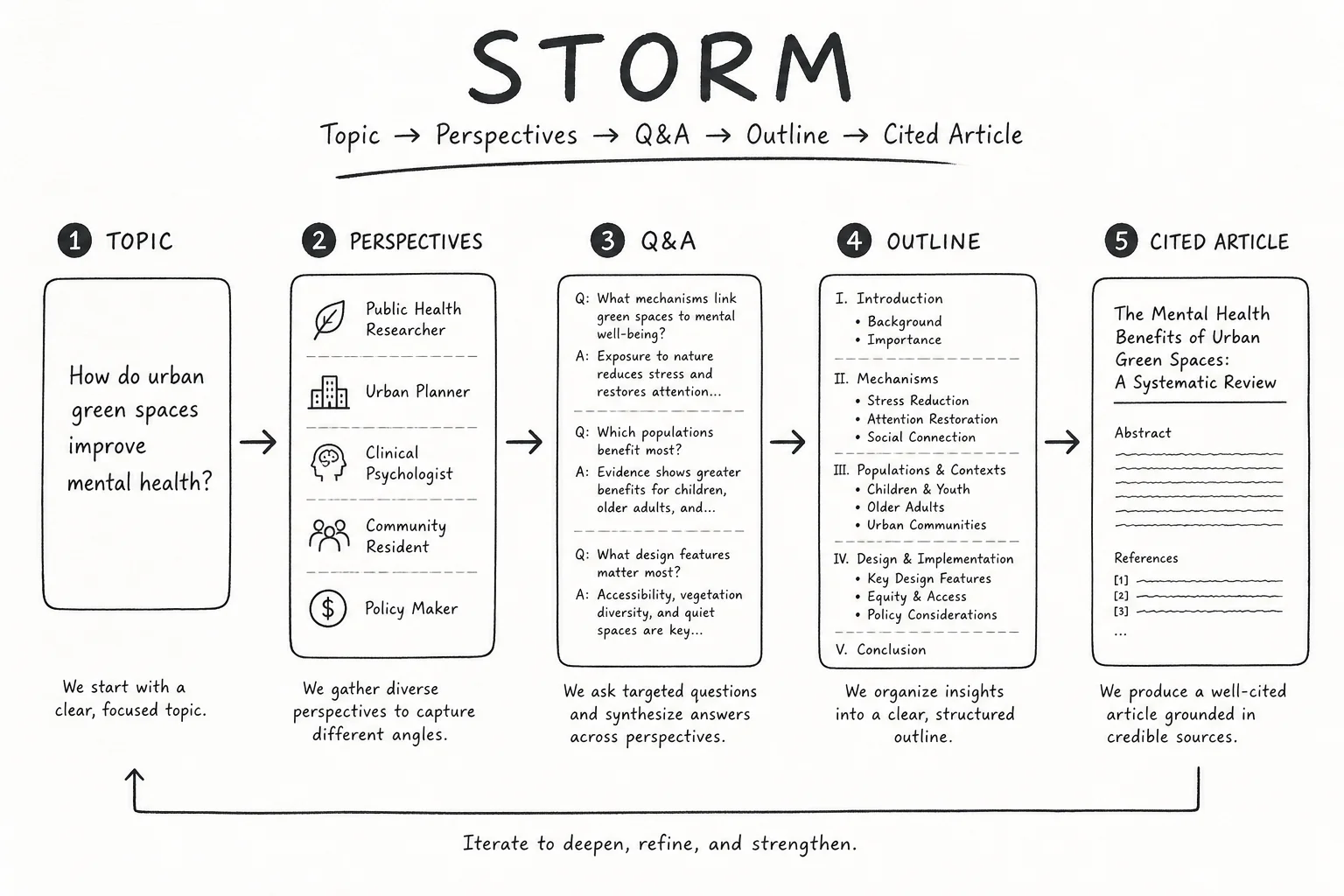
Ask for a topic. STORM discovers perspectives, runs retrieval-grounded Q&A from each angle, curates an outline, then drafts a long article where claims tie back to sources. The output reads closer to a Wikipedia draft than a chatbot monologue.
The open-source repo has crossed 31,000 GitHub stars. More than 70,000 people have tried the hosted preview. If you need cited background briefs for content, sales, or strategy, this is worth an afternoon.
How STORM splits the work
STORM stands for Synthesis of Topic Outlines through Retrieval and Multi-perspective question asking. The pipeline has two macro stages:
| Stage | What happens |
|---|---|
| Pre-writing | Internet research, perspective discovery, simulated expert interviews, outline curation |
| Writing | Section-by-section drafting grounded in collected references |
The insight from the STORM paper : the hard part of automated research is not summarization. It is asking good questions. Directly prompting an LLM to "ask questions about X" produces shallow lists. STORM instead:
- Discovers diverse perspectives on the topic
- Simulates writers from each perspective interviewing a grounded expert
- Merges findings into a hierarchical outline with source mapping
Compared to outline-driven RAG baselines, more STORM articles were rated organized (+25% absolute) and broad in coverage (+10%) in their FreshWiki evaluation. Wikipedia editors flagged real remaining issues: source bias transfer and over-association of unrelated facts. Worth remembering before you ship STORM output without human edit.
Try it in three ways
1. Hosted demo (fastest)
storm.genie.stanford.eduNo install. Good for testing whether the citation style fits your use case.
2. Python package
pip install knowledge-storm
The engine centers on a STORMWikiRunner class. You plug in LLM configs and a retrieval module (You.com, Bing, vector store, etc.). See examples in the
stanford-oval/storm
repo.
3. Self-hosted with your keys
Clone the repo, configure secrets.toml with OpenAI (or other provider) and a search API, then run the wiki pipeline on your machine. Full control over models, corpora, and data retention.
Co-STORM: human in the loop
Stanford followed STORM with Co-STORM, a collaborative variant where humans steer perspective discovery and knowledge curation mid-run. Think moderator pass: surface unknown unknowns, challenge weak sources, align the outline before the final write.
For client deliverables I still want a human editor. Co-STORM is the bridge between "fully automated brief" and "I have a research assistant."
When STORM fits vs when it does not
| Good fit | Poor fit |
|---|---|
| Broad topic primers with citations | Breaking news in the last 48 hours |
| Internal strategy memos (edited) | Proprietary data rooms |
| Content research before you write | Legal or medical decisions without expert review |
| Open-source customization | Zero API budget (needs LLM + search calls) |
STORM is MIT licensed. Customize retrieval, swap models, point at private vector stores. That is why teams with data residency requirements run the GitHub version instead of hosted demos.
Wiring STORM into a content workflow
Here is how I would use it without replacing your voice:
- Input — Narrow topic + audience + "what decision does this inform?"
- STORM run — Capture outline and source list first; skim before full article generation
- Human pass — Cut redundancy, fix citations, add first-person experience
- Publish — Your MDX site, not raw STORM output
The outline and source graph are often more valuable than the prose. They give you an auditable research trail for fact-checking.
# Minimal conceptual flow (see repo for full runner setup)
# 1. Configure STORMWikiRunner with LLM + retriever
# 2. runner.run(topic="...", do_research=True, do_generate_outline=True, do_generate_article=True)
# 3. Review storm_gen_outline.txt and storm_gen_article_polished.txt in output dir
Bottom line
STORM is one of the few open research tools that treats citation structure as a first-class output, not an afterthought. For applied AI builders, it is a useful reference architecture: perspectives, grounded Q&A, outline, then write.
If you want help connecting research agents to your content pipeline, private docs, or lead-site SEO workflow, get in touch.