
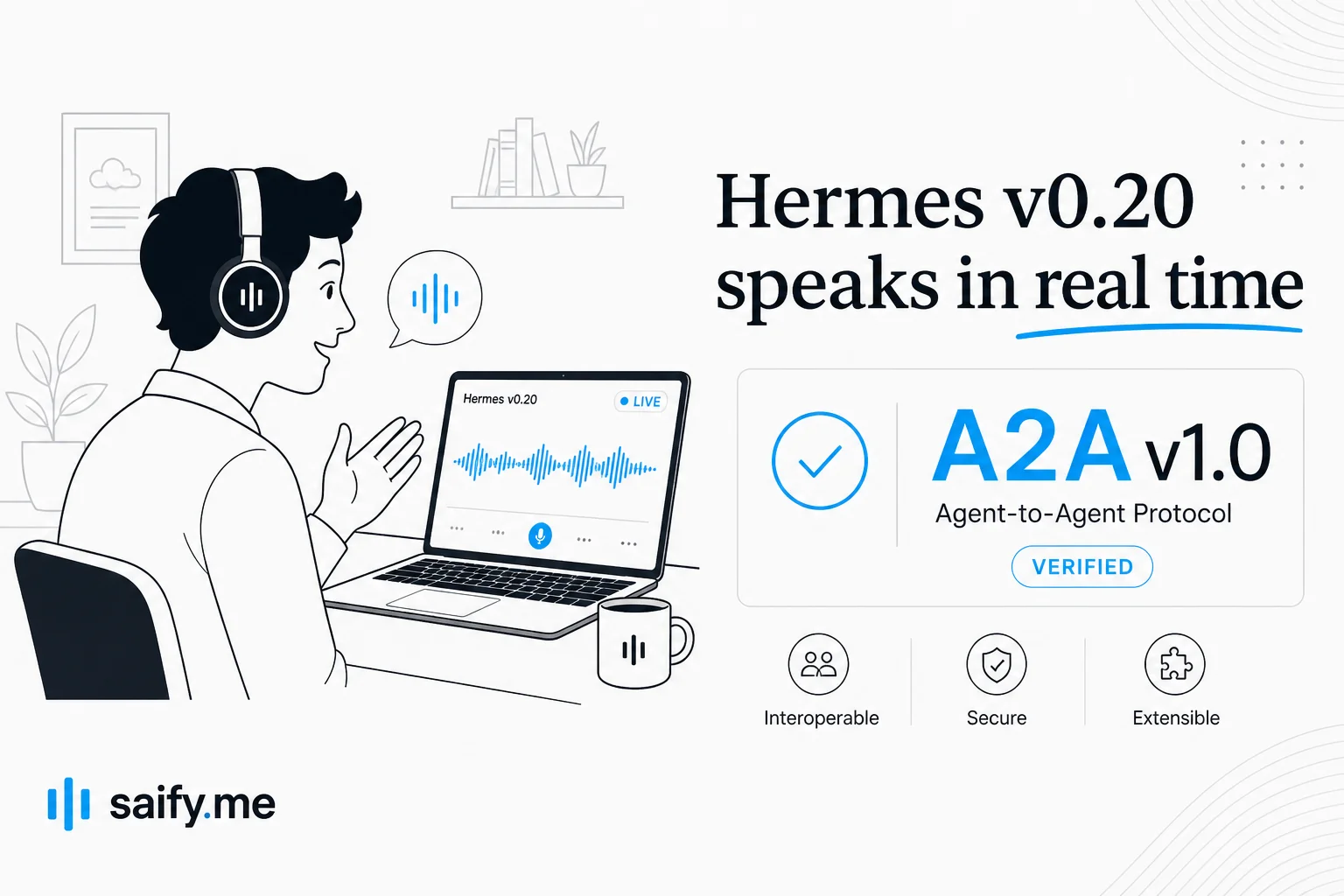
Voice agents that make you wait for a full reply before speaking are not conversations. They are voicemails with extra steps.
Hermes Agent v0.20.0, tagged v2026.8.3 and released August 3, 2026, is Nous Research's answer to that friction. They called it The Herald Release, and the name fits: Hermes speaks in real time, carries messages to other agents, announces events to your systems, and backs research claims with verifiable citations.
The scale is worth stating up front: roughly 3,650 commits, ~1,400 merged PRs, ~1,200 issues closed, and 650+ contributors since v0.19.0. This is not a patch Tuesday. It is a platform shift.
Where this picks up from v0.18
In July I covered Hermes Agent v0.18.0 and the Judgment Release, which focused on evidence-based stopping: completion contracts, a verification ledger, and proof that tests actually ran before the agent claimed done.
v0.20 does not undo that work. It extends Hermes into three directions I care about for client deployments: spoken interaction, standard agent interoperability, and trustworthy research output. The desktop app also graduated from chat client to workbench.
Full release notes: Hermes Agent v2026.8.3 on GitHub
| Release | Codename | What changed |
|---|---|---|
| v0.18.0 (Jul 2026) | Judgment | Verification evidence, completion contracts, MoA |
| v0.20.0 (Aug 2026) | Herald | Streaming voice, A2A v1.0, webhooks, grounded citations, desktop platform |
Streaming voice TTS with barge-in
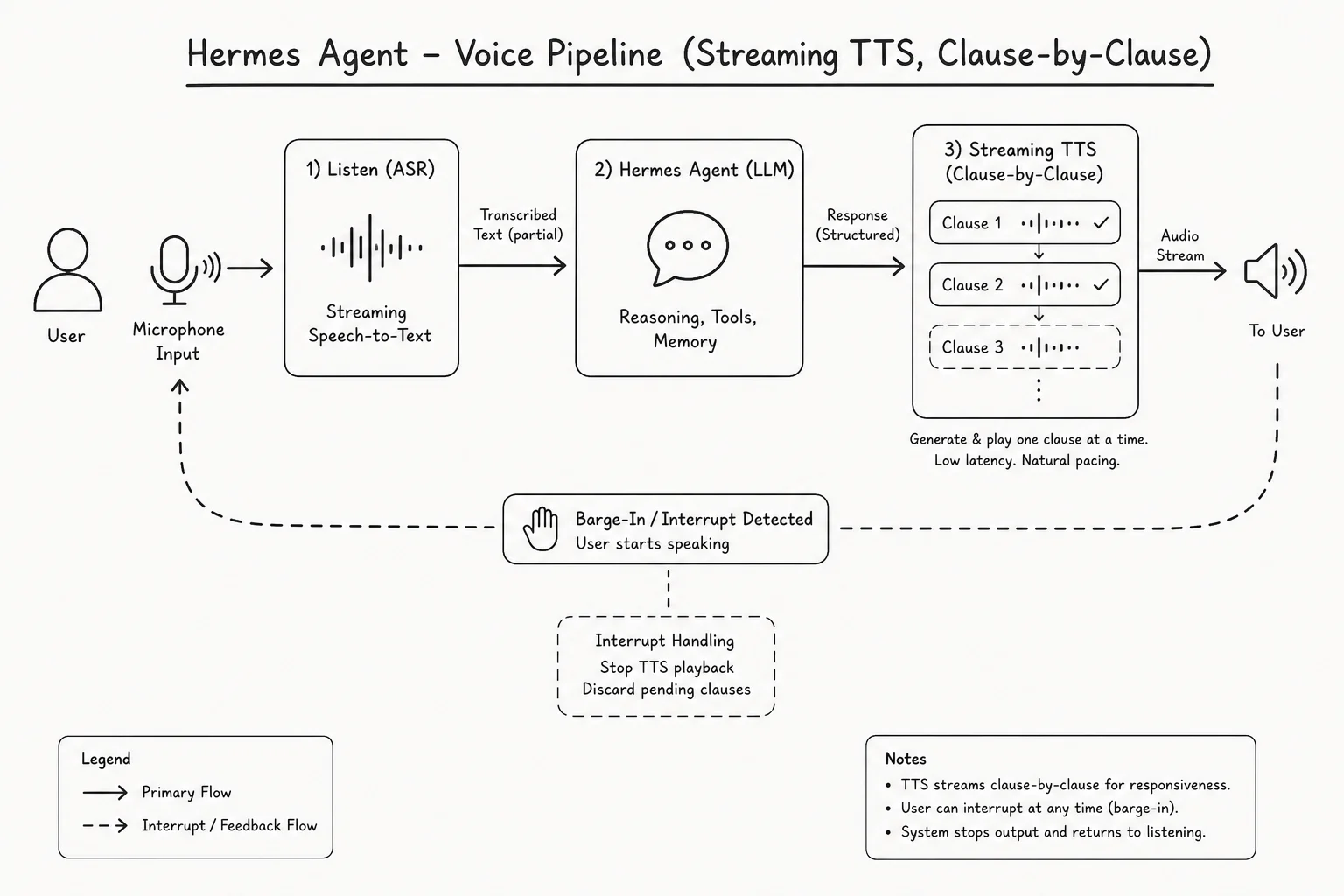
The old voice loop was painful: speak, wait for the entire model response to finish generating, then listen to one long audio file. If Hermes got something wrong mid-answer, you had to sit through the rest or kill the session.
v0.20 ships clause-by-clause streaming TTS. Hermes starts speaking as the response streams. You can barge in by talking while it is still speaking. It stops, listens, and the model is told you interrupted. Busy-aware silence detection keeps it from talking over you when you are still thinking.
This works across CLI voice mode, the desktop app, and gateway adapters. For ops teams that want hands-free status checks from across the room, that loop finally feels like a dialogue instead of a one-way broadcast.
| Voice behavior | Before v0.20 | After v0.20 |
|---|---|---|
| Reply delivery | Full response, then one audio file | Clause-by-clause as text streams |
| User interruption | Wait or /stop | Speak to barge in mid-sentence |
| Silence handling | Fixed timeouts | Busy-aware detection |
| Wake words | Limited | On-device open-vocabulary phrases |
Wake words landed too. Pick your own phrase ("hey Hermes" or something custom). Detection runs on-device, so idle audio does not leave your machine while it waits. Say "stop" on any surface to end voice chat without touching the keyboard. Multi-profile routing means different wake phrases can reach different profiles.
Messaging gateways got voice parity: send a voice note on WhatsApp, Feishu, DingTalk, LINE, QQ, Photon, or Weixin and Hermes transcribes and answers. Auto-TTS replies are platform-aware (opus where the platform wants opus, captions attached correctly). STT is now its own hermes tools category with GUI toggles and unified language resolution, which fixes the class of bug where transcripts come back in the wrong language.
A2A v1.0: a standard wire for heterogeneous agents
Multi-agent setups usually die on integration glue. Every framework speaks its own dialect. You end up with brittle custom bridges between Hermes, Claude Code, internal Python services, and whatever the client's team shipped last quarter.
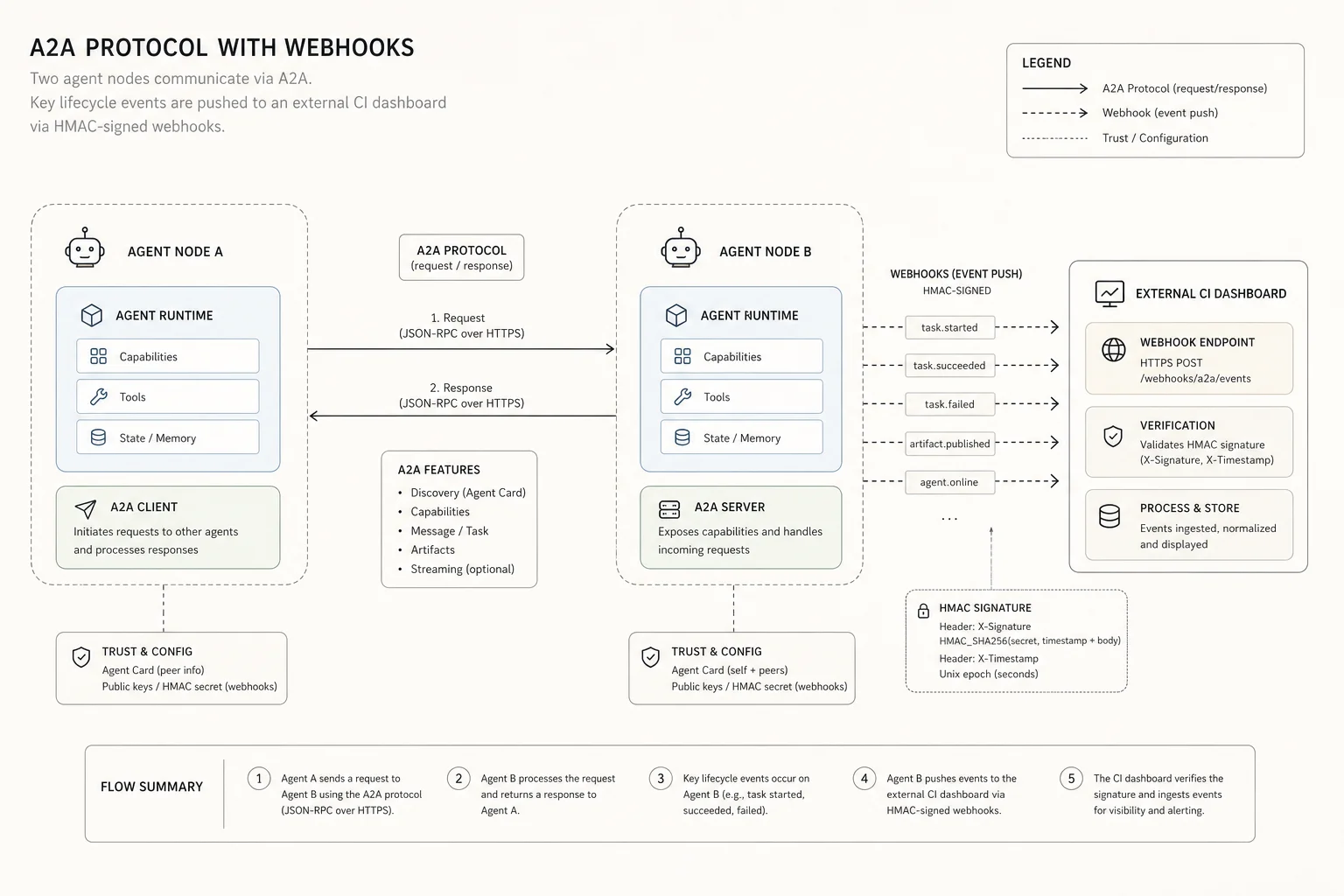
v0.20 bundles an A2A v1.0 plugin implementing the Agent-to-Agent protocol. Hermes can discover, talk to, and be driven by other A2A-compatible agents. Nous closed issue #514 with this ship, one of the oldest open feature requests in the repo.
For me, the practical win is not "more agents." It is one protocol when you need Hermes to delegate to a specialist agent on another stack, or when an external orchestrator needs to drive Hermes without going through a chat gateway.
If you are wiring this up, start with the official docs: Hermes Agent A2A messaging guide
I would still treat A2A endpoints like production APIs: auth, rate limits, and explicit task boundaries. The protocol solves discovery and message shape. It does not replace your security review.
Signed outbound webhooks
Until v0.20, integrating Hermes with external systems often meant polling session state or building a custom gateway listener. That works for demos. It does not scale for CI triggers, home automation, or dashboard updates.
Hermes now pushes signed lifecycle events to HTTP endpoints you register: session activity, turn completions, tool events. Payloads carry HMAC signatures so your receiver can verify authenticity before acting.
| Event class | Typical use |
|---|---|
| Session activity | Heartbeat dashboards, idle detection |
| Turn completions | Trigger downstream jobs when a task finishes |
| Tool events | Audit logs, approval workflows, alerting |
This is the pattern I recommend when a client wants "the agent did something, now notify Slack / Jira / a webhook URL." Push beats poll. Signed payloads beat trusting raw POST bodies from the internet.
Grounded research citations
Research agents that sound confident and cite nothing are a liability. v0.20 adds the grounded-citations skill: Hermes produces research where claims link to verifiable sources. Quotes are matched against actual page text, not hallucinated snippets. Citations point to the evidence block.
There is also a fact-checking mode. Hand it a document or a claim and it reports what checks out, what does not, and what could not be verified.
This pairs well with the v0.18 verification mindset. Judgment Release asked "did the code actually pass tests?" Herald asks "did the research actually come from the page?" Both push Hermes away from model confidence as proof.
For client briefs, competitive scans, or compliance summaries, I would enable grounded citations before you trust any long-form output for external distribution.
Desktop platform updates
The desktop app stopped being "chat with a model in a window." v0.20 treats it as a platform.
Artifacts are versioned cards with sandboxed live preview in a right-rail viewer. Generated HTML or small apps run next to the chat without leaving the workbench.
A real plugin SDK shipped with Kanban as the founding plugin. ctx.download lets plugins hand files to the user. Floating pane placement and multiple GUI windows support parallel sessions. A global-hotkey quick-entry window captures a thought into any session from anywhere in the OS.
Other desktop highlights worth knowing:
| Feature | Why it matters |
|---|---|
| SSH remote-backend mode | Run the agent against a remote machine from local UI |
| 60fps streaming wave | Drag stays smooth with multiple streaming tabs open |
| Mid-turn redirects | Correct the agent without /stop and a full restart |
hermes import-agent | One-command migration from Claude Code or Codex CLI setups |
The CLI got its own power-user wave: !command for instant shell without a model turn, /init for AGENTS.md generation, /diff for staged or session changes, /context for window breakdown, /focus for reduced-output views. Small commands, big daily time savings.
What I would test first
If you are evaluating v0.20 for production, this is my short list:
- Voice with barge-in on your actual hardware. Mic latency and room noise matter more than release notes.
- One A2A peer on another stack. Prove discovery and task handoff before you design a fleet.
- Webhook receiver with signature verification. Reject unsigned payloads in your handler from day one.
- Grounded citations on a real brief. Compare output with and without the skill on the same source set.
Hermes is moving fast. v0.18 gave you evidence for "done." v0.20 gives you speech, interoperability, outbound events, and citable research. That is a coherent spine for agents that operate in the open, not just in a terminal tab.
If you are evaluating open-source agents for voice ops, multi-agent orchestration, or research workflows and want help scoping a pilot, book a free discovery call.