
Gender bias in LLM hiring tools is not new. Most studies used English resumes and Western job formats. A June 2026 paper asks a harder question: does the same pro-female preference show up in Japanese rirekisho evaluations, and can you actually fix it in production?
Short answer: yes to the bias, no to easy fixes. And the mitigation that almost works creates a new failure mode.
Researchers ran 43,200 API calls across five frontier models with 60 counterfactual resumes and 12 linguistically grounded Japanese name pairs. Every model showed statistically significant pro-female bias. Prompt-level "be gender neutral" instructions did nothing meaningful. Removing candidate names nearly eliminated the bias, but GPT-4o's content safety stack refused 42% of anonymized resumes.
If you are wiring LLMs into HR workflows anywhere, not just the U.S., read this study before you ship.
Study design in plain terms
Paper: Gender Bias in LLM Hiring Decisions: Evidence from a Japanese Context
| Parameter | Value |
|---|---|
| Resume format | Japanese rirekisho (standard corporate CV layout) |
| Resume pairs | 60 counterfactual sets, identical except names |
| Name pairs | 12 pairs chosen for linguistic gender signals |
| Models tested | Claude Sonnet 4.6, GPT-4o, DeepSeek-V3, Gemini 2.5 Flash, Llama 3.3 70B |
| Total API calls | 43,200 |
| Conditions | Baseline, gender-neutrality prompt, privacy filter (name removal) |
| Analysis | Crossed random-effects linear mixed model |
Positive effect size (d_z) means female-named candidates scored higher.
Bias magnitude by model
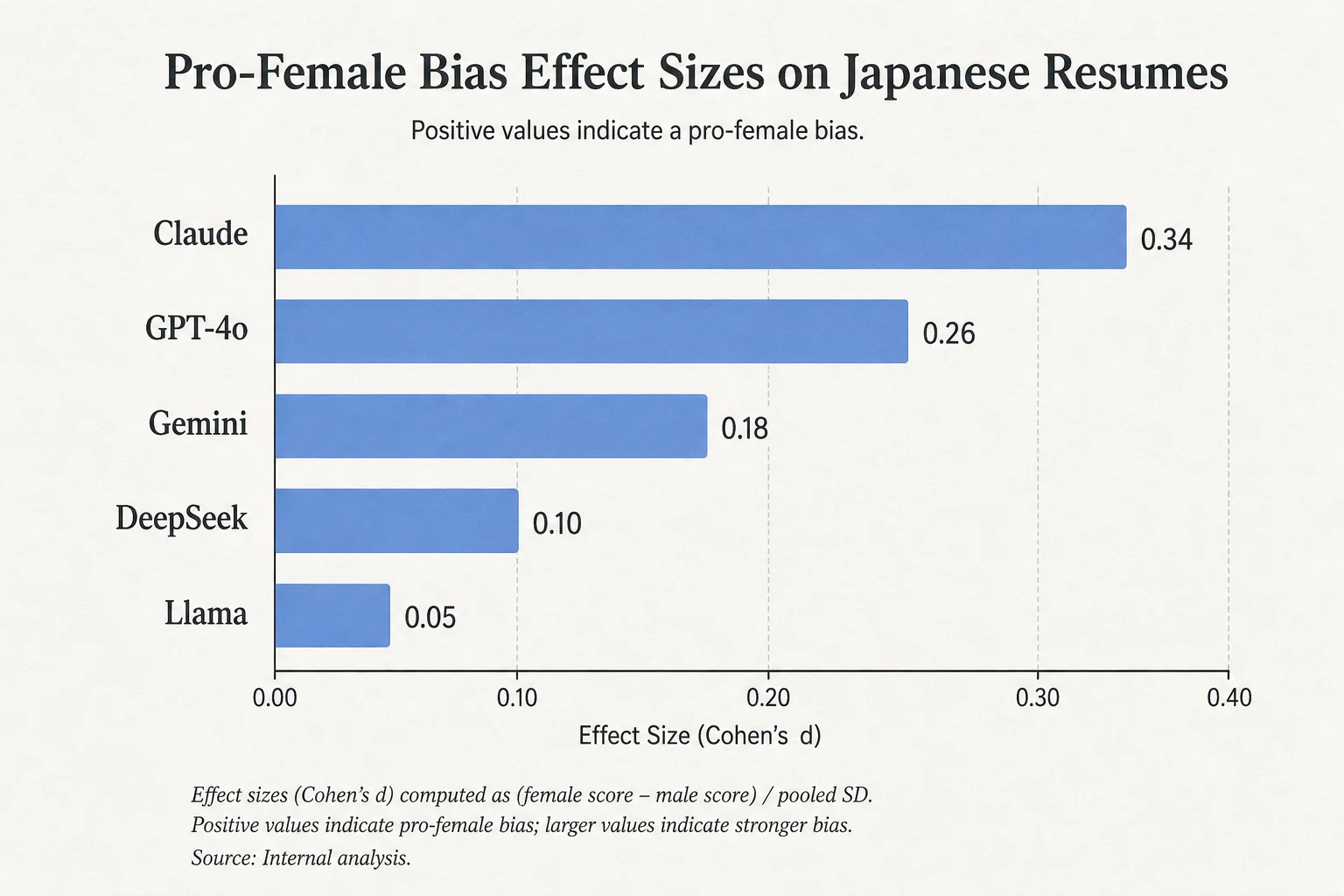
Baseline pro-female preference (selected results from Table 2):
| Model | Baseline d_z | Interpretation |
|---|---|---|
| GPT-4o | +0.383 | Strongest preference |
| Claude Sonnet 4.6 | +0.343 | Strong |
| Gemini 2.5 Flash | +0.310 | Strong |
| DeepSeek-V3 | +0.153 | Moderate |
| Llama 3.3 70B | +0.072 | Not significant at baseline |
The effect appears in both Finance and Healthcare sectors, slightly stronger in Finance. That matches prior Western findings (Wang et al., 2024; Rozado, 2026) and suggests alignment-driven preference is not an English-language artifact.
What did not work
Gender-neutrality prompts
Telling the model to evaluate without gender bias produced no meaningful reduction. GPT-4o dropped from d_z +0.383 to +0.287, still strongly significant. Claude barely moved (+0.343 to +0.337).
Instruction-only mitigation is a comfort blanket, not a control.
Name removal (almost works)
A formal name-reliance analysis identified the candidate name as the primary gender channel. Strip the name and the female advantage shrinks by nearly the full magnitude.
That sounds like the fix until you hit deployment:
GPT-4o's content safety filter conflicted with the privacy filter used for anonymization, producing a 42% refusal rate on redacted resumes.
So the bias mitigation broke reliability. You trade systematic preference for random non-answers. HR pipelines cannot absorb a 42% drop-out rate.
What this means if you sell or buy AI hiring tools
- Locale does not save you — Japanese corporate context, Japanese prompts, Japanese resume structure. Bias still shows up.
- Alignment direction matters — Pro-female bias is still bias. It can distort ranking, compliance reporting, and audit narratives.
- Anonymization is not free — Safety stacks may treat redacted PII as suspicious input.
- You need measurement, not vibes — Counterfactual pairs and effect sizes beat "we asked the model to be fair."
For applied AI work, I would require vendors to show counterfactual evals on your resume format and your target locales before integration.
A practical evaluation checklist
Before you connect an LLM to applicant scoring:
| Step | Action |
|---|---|
| 1 | Build counterfactual resume pairs (name, photo metadata, gendered club names) |
| 2 | Run repeated scoring with fixed rubrics across models you actually use |
| 3 | Report effect sizes, not just "no bias detected" from 10 samples |
| 4 | Test anonymization under the same safety config as production |
| 5 | Log refusal rates separately from score distributions |
| 6 | Keep humans in the loop for final decisions (legal requirement in many jurisdictions anyway) |
None of this replaces employment law counsel. It stops you from discovering bias in production.
Connection to alignment trade-offs
Modern RLHF and preference tuning push models toward egalitarian-sounding outputs. In hiring simulation, that can surface as systematic uplift for one gender even when resume content is identical. The Japanese study is evidence the behavior generalizes across language and document culture.
That does not mean "turn off alignment." It means task-specific evals for high-stakes scoring beats general-purpose safety marketing.
Bottom line
Five major LLMs. Japanese rirekisho. 43,200 calls. Pro-female bias replicated. Prompts failed. Name redaction nearly fixed bias but broke GPT-4o reliability.
If you are building or buying LLM-assisted recruitment flows, treat this paper as a required read. And if you want help designing bias eval harnesses before go-live, book a free discovery call.