
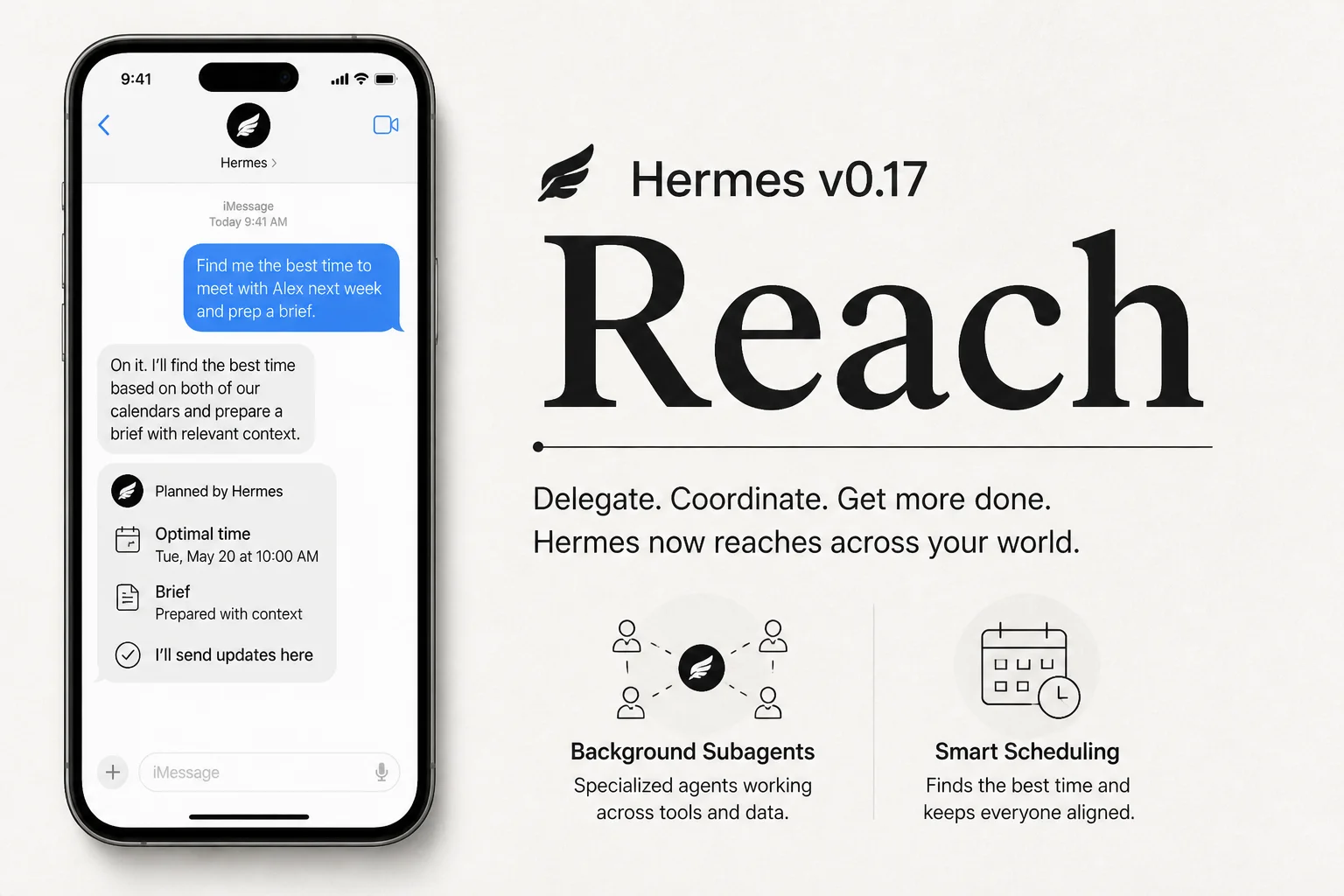
The last Hermes Agent release asked a simple question: how far can one agent actually reach? v0.17.0, codenamed Reach, answers with iMessage on your phone, background subagents that do not freeze your chat, and automation blueprints that skip cron syntax entirely.
Hermes Agent is Nous Research's open-source, self-improving agent framework. v0.16 put it on your desktop. v0.17 pushes into messaging platforms and async work patterns that matter for real ops automation.
This release also shipped Blank Slate setup (minimal tools by default). That deserves its own write-up. Here I am focused on reach: where the agent runs, how it handles parallel work, and how non-engineers can schedule it.
iMessage without a Mac relay
Hermes now supports iMessage through Photon Spectrum. No Mac relay box sitting in a closet.
Setup path from the release notes:
hermes photon login
# OAuth flow, then done
That matters if you want one agent thread on the same channel your team already uses for urgent pings. Telegram and Discord integrations existed before. iMessage closes the gap for people who live in Apple's messaging stack.
Trade-off to keep in mind: iMessage automation carries platform policy and account risk that a dedicated bot API does not. Treat it like production credentials. Pair DMs, restrict who can trigger the agent, and read the Hermes security docs before you point it at a shared inbox.
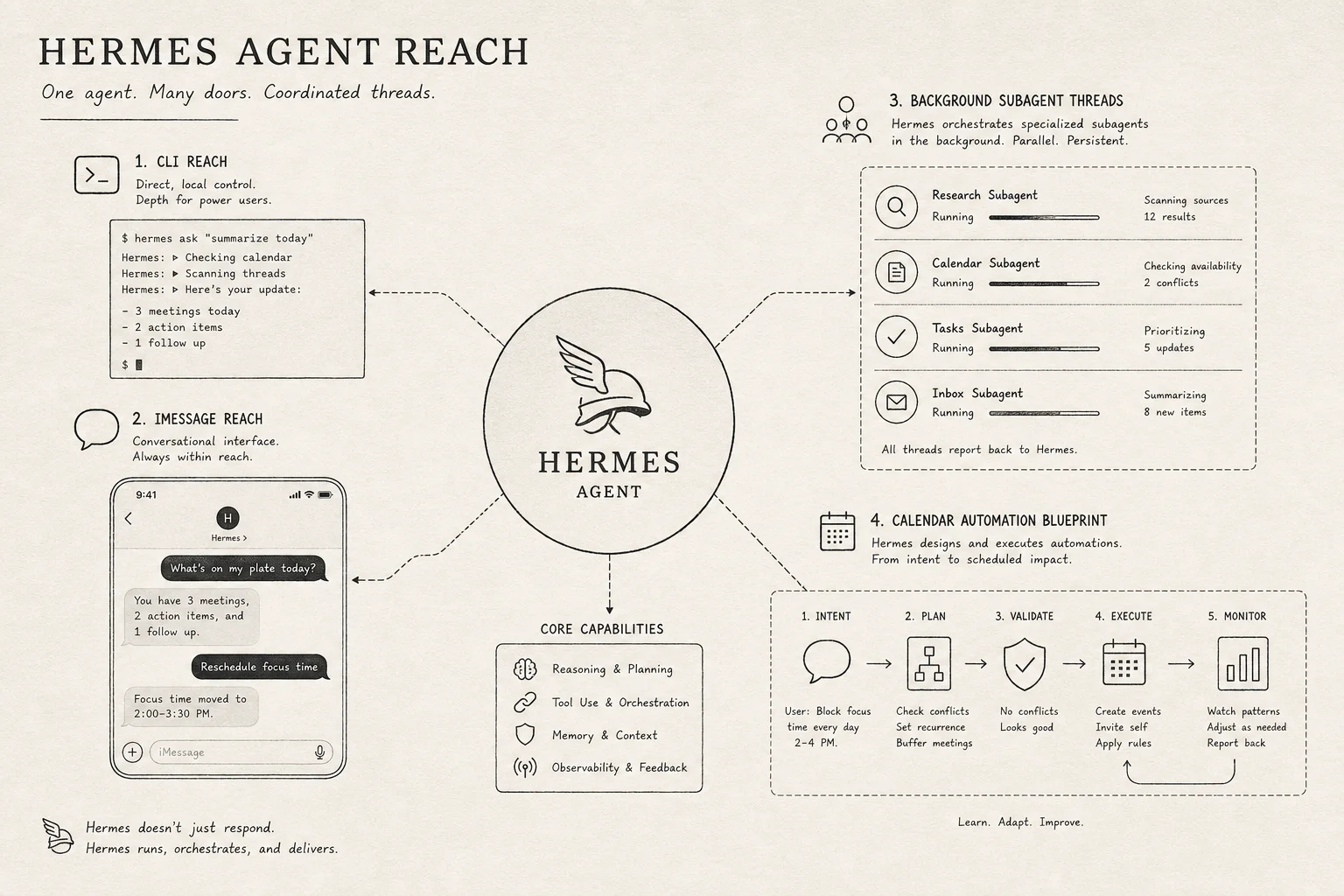
Background subagents that do not block chat
Previously, kicking off a heavy task meant waiting. The main conversation froze until the subtask finished.
v0.17 adds background subagents. You fire a task, keep chatting, and the result drops back into the thread when it completes.
| Pattern | Before v0.17 | After v0.17 |
|---|---|---|
| Long research pass | Blocked chat | Parallel background run |
| Multi-file refactor | User waits | Continue conversation |
| Scheduled follow-up | Manual polling | Result injected when ready |
For anyone running agents as a front desk or ops copilot, non-blocking subagents are the difference between "toy demo" and "I can leave this running during a meeting."
Automation blueprints: cron in plain English
The release introduces Automation Blueprints. You describe a schedule in natural language. Hermes asks a few clarifying questions and wires the job.
No crontab syntax. No "what is minute field again?" for your ops lead who does not live in terminal.
Example intent (paraphrased from the release marketing):
Every Monday at 9am, summarize unread support tickets and post to Slack.
Under the hood it still becomes a scheduled task. The UX win is who can create it.
If you already run n8n or Make for client automations, think of blueprints as the agent-native scheduling layer. Useful when the trigger and the reasoning should live in the same system.
Other v0.17 highlights worth knowing
The release notes pack more than messaging and cron:
| Feature | What it does |
|---|---|
| Cursor Composer via xAI Grok | Access Composer through an existing Grok subscription, no extra API key |
| WhatsApp Business Cloud API | Enterprise messaging channel |
| Raft agent network | Multi-agent coordination |
| Deeper desktop app | Local UI improvements |
The changelog scale is serious: 1,475 commits and 245 contributors in this release alone. Run hermes update to pull it.
How this fits an applied AI stack
I evaluate agent platforms on three ops questions:
- Channels — Can the people who need answers reach it where they already work?
- Concurrency — Does heavy work stall the conversation?
- Scheduling — Can non-engineers own recurring jobs?
v0.17 checks all three. iMessage and WhatsApp Business expand channels. Background subagents fix concurrency. Blueprints lower the bar for scheduling.
Pair that with Blank Slate for least-privilege setup and you have a credible self-hosted agent stack that does not assume "enable every tool and pray."
What I would test first
If you are upgrading from an earlier Hermes install:
hermes update
hermes --version   # confirm v0.17.x
Then pick one vertical slice:
- Messaging — Wire one channel (Telegram is still the fastest smoke test; iMessage if that is your audience).
- Background task — Kick off a research subagent and confirm chat stays responsive.
- Blueprint — Schedule a low-risk weekly summary job before you automate anything customer-facing.
Document which toolsets stay enabled. If you have not read about Blank Slate yet, consider re-running hermes setup on a fresh profile to compare surfaces.
Bottom line
Hermes Agent v0.17.0 is a reach release in the literal sense: more channels, async subagents, and human-friendly scheduling. The commit volume shows the project is moving fast. For production, still start minimal (Blank Slate), add reach features deliberately, and lock down who can trigger the agent on each channel.
Building multi-channel agent ops for your team? Get in touch and we can map channels, tool scope, and scheduling before you point agents at live customer data.