
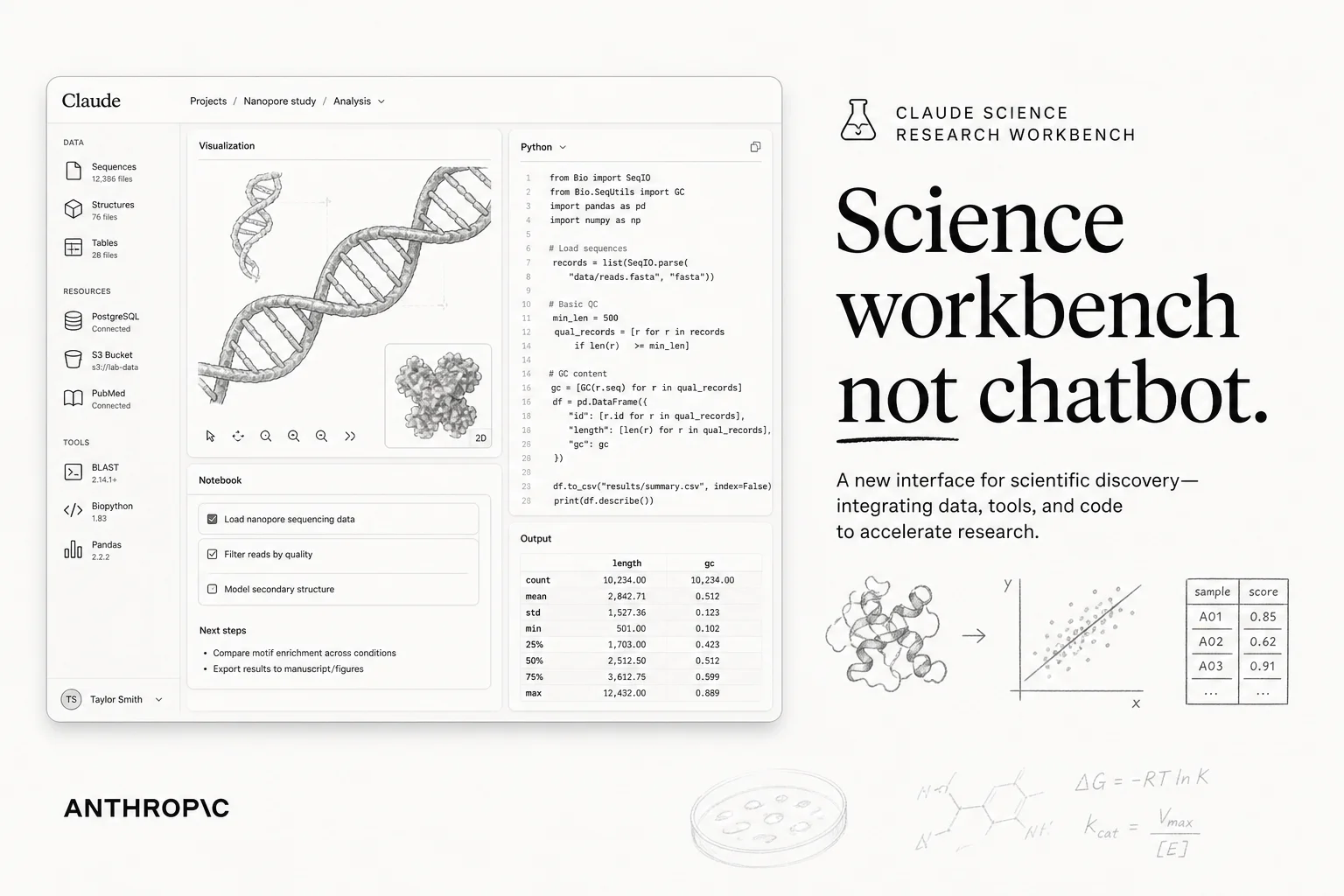
General AI assistants can talk about biology. They cannot run your RNA-seq pipeline, query UniProt without you pasting CSV exports, or remember what failed in last Tuesday's session.
Anthropic's answer is Claude Science, a desktop research workbench that shipped in public beta on June 30, 2026. It is not a new model. It is everything around the model: scientific tools, 60+ database connectors, compute orchestration, and an artifact system that records the code, environment, and conversation behind every result.
What Claude Science actually is
Claude Science is a local application for macOS and Linux that pairs Claude with an analysis environment on your machine. You describe a research task in plain language. Claude writes and runs Python, R, or shell code in a sandbox, reads folders you explicitly grant access to, pulls data through scientific database connectors, and saves versioned artifacts with full provenance.
A background reviewer agent inspects outputs and flags incorrect citations or figures that do not match the underlying code. It reduces errors. It does not eliminate them. Anthropic is explicit that you should verify results before publication or clinical use.
Claude Science product pageRequirements: Claude Pro, Max, Team, or Enterprise plan. Team and Enterprise admins must enable it first. About 5 GB disk for runtime and starter environments.
The fragmentation problem it targets
A single computational biology analysis can touch a dozen databases, Jupyter, R, a cluster terminal, and half a dozen file formats. Claude Science tries to collapse that stack into one surface.
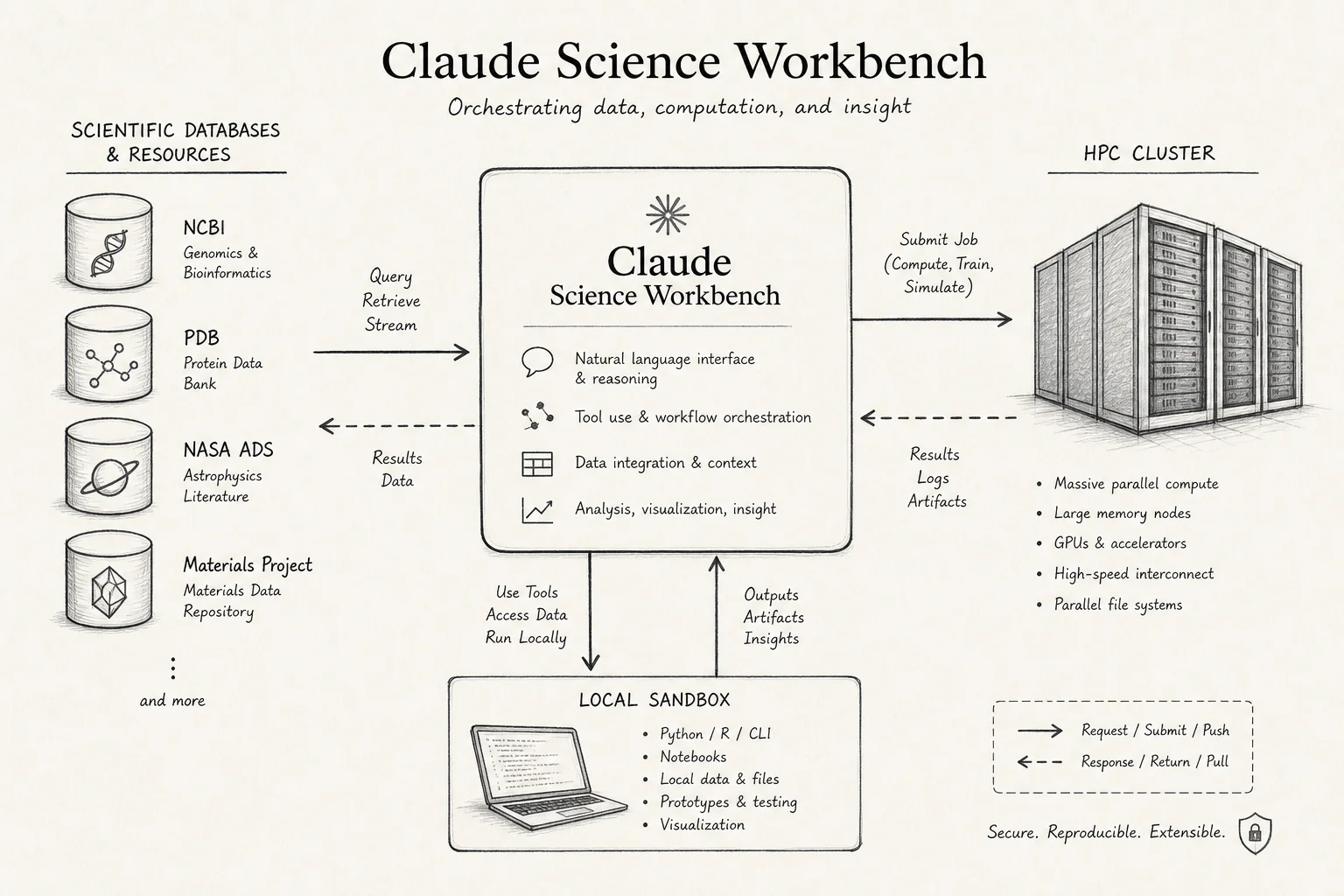
Pre-configured specialist agents cover genomics, single-cell analysis, proteomics, structural biology, cheminformatics, and more. Native connectors reach databases including UniProt, PDB, Ensembl, Reactome, ClinVar, ChEMBL, and GEO.
For heavy compute, Claude Science integrates with your existing infrastructure:
| Integration | What it enables |
|---|---|
| SSH / SLURM | Submit and monitor cluster jobs on lab HPC |
| Modal | Scale from one GPU to hundreds on demand |
| BioNeMo Agent Toolkit | Access Evo 2, Boltz-2, OpenFold3 via NVIDIA's life sciences stack |
| MCP | Connect any service reachable over the Model Context Protocol |
Provenance as a first-class feature
The detail that separates this from "ChatGPT with a Jupyter plugin" is provenance. Every artifact ships with:
- The exact code that generated it
- The environment it ran in
- The conversation that led there
That matters for reproducibility. A figure without the script that made it is a liability in peer review. Claude Science treats the execution record as part of the deliverable, not an afterthought.
Security is local-first. Files stay on your computer. Code runs in a sandbox. You approve each new folder, network host, and remote job before Claude can touch it.
Early results and the research credits program
Anthropic cited a UCSF team reporting certain analyses now take roughly one tenth of the previous time. I have not independently verified that number, but the use case fits: repetitive database queries, pipeline scaffolding, and figure generation are exactly where a workbench beats a chat window.
Alongside the beta, Anthropic opened applications for research credits up to $30,000 in Claude credits, with Modal providing compute. Applications closed July 15, with selected projects running September through December 2026, focused initially on biology and biomedical research.
How this fits Anthropic's platform strategy
Claude Science sits beside Claude Code for engineers, Claude Cowork for knowledge work, and the Claude Platform for API builders. The through-line is vertical specialization: same underlying models, different tooling for different jobs.
For applied AI engineers watching from the outside, the pattern is worth noting. Horizontal chat is commoditizing. The moat is in domain-specific connectors, compute orchestration, and trust infrastructure (provenance, reviewer agents, sandbox permissions).
If your team is in life sciences and evaluating whether Claude Science replaces or complements your existing Jupyter plus SLURM workflow, book a free discovery call. I help research and ops teams wire AI into real pipelines without losing auditability.