
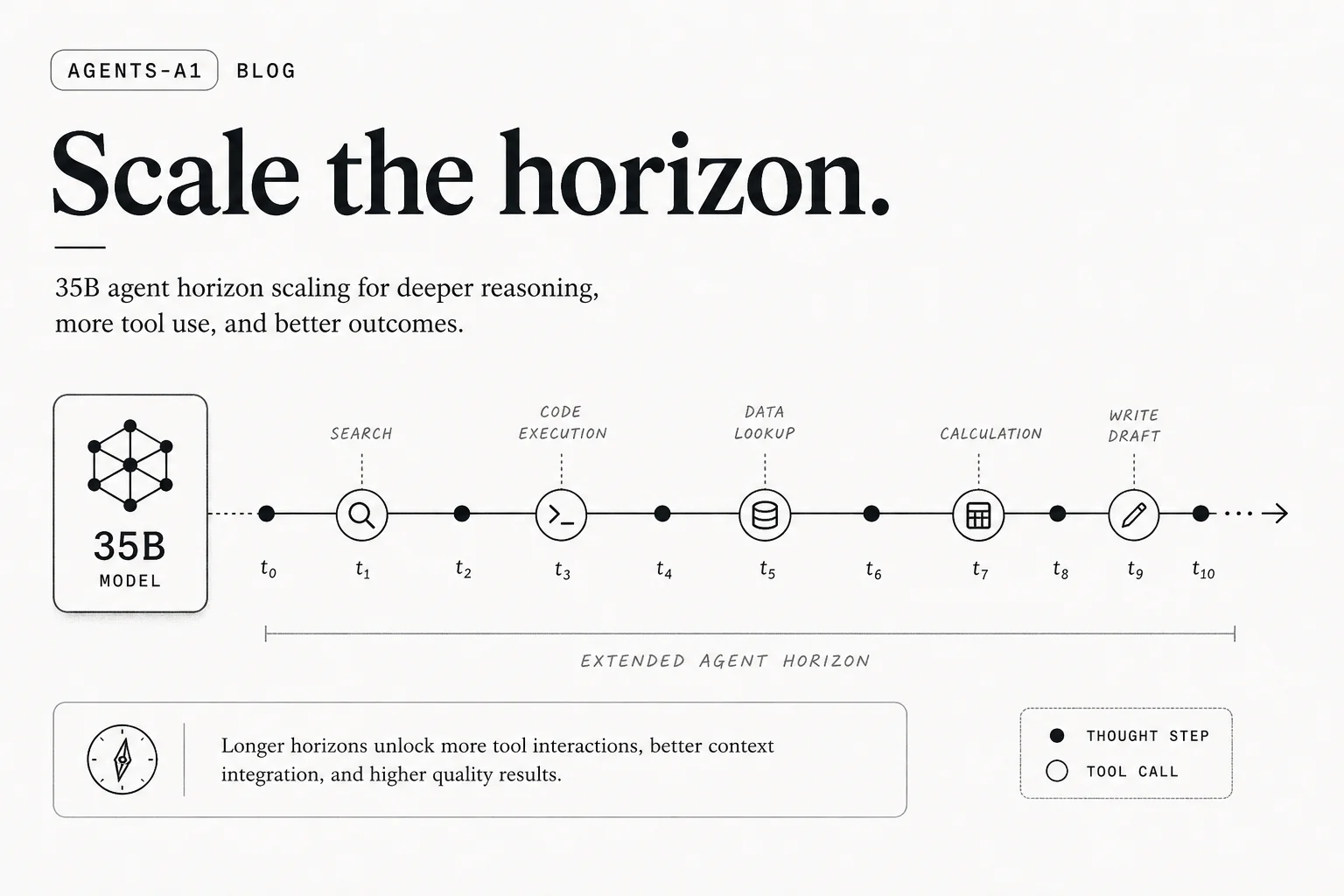
The default move in frontier AI for the last year was simple: make the model bigger. Kimi-K2.6 and DeepSeek-V4-pro sit in the trillion-parameter class and top the hard agent benchmarks.
Agents-A1 from InternScience (Shanghai AI Lab) makes the opposite bet. It is a 35B Mixture-of-Experts model with roughly 3B active parameters per token, initialized from Qwen3.5-35B-A3B. On several long-horizon agent benchmarks, it matches or beats those trillion-parameter systems.
The thesis, straight from the paper title: scale the horizon, not the parameters.
What agent-horizon scaling means
Agent work is not primarily about knowing more facts. It is about sustaining a plan across dozens of tool calls, web searches, code edits, and verifier checks without losing the thread.
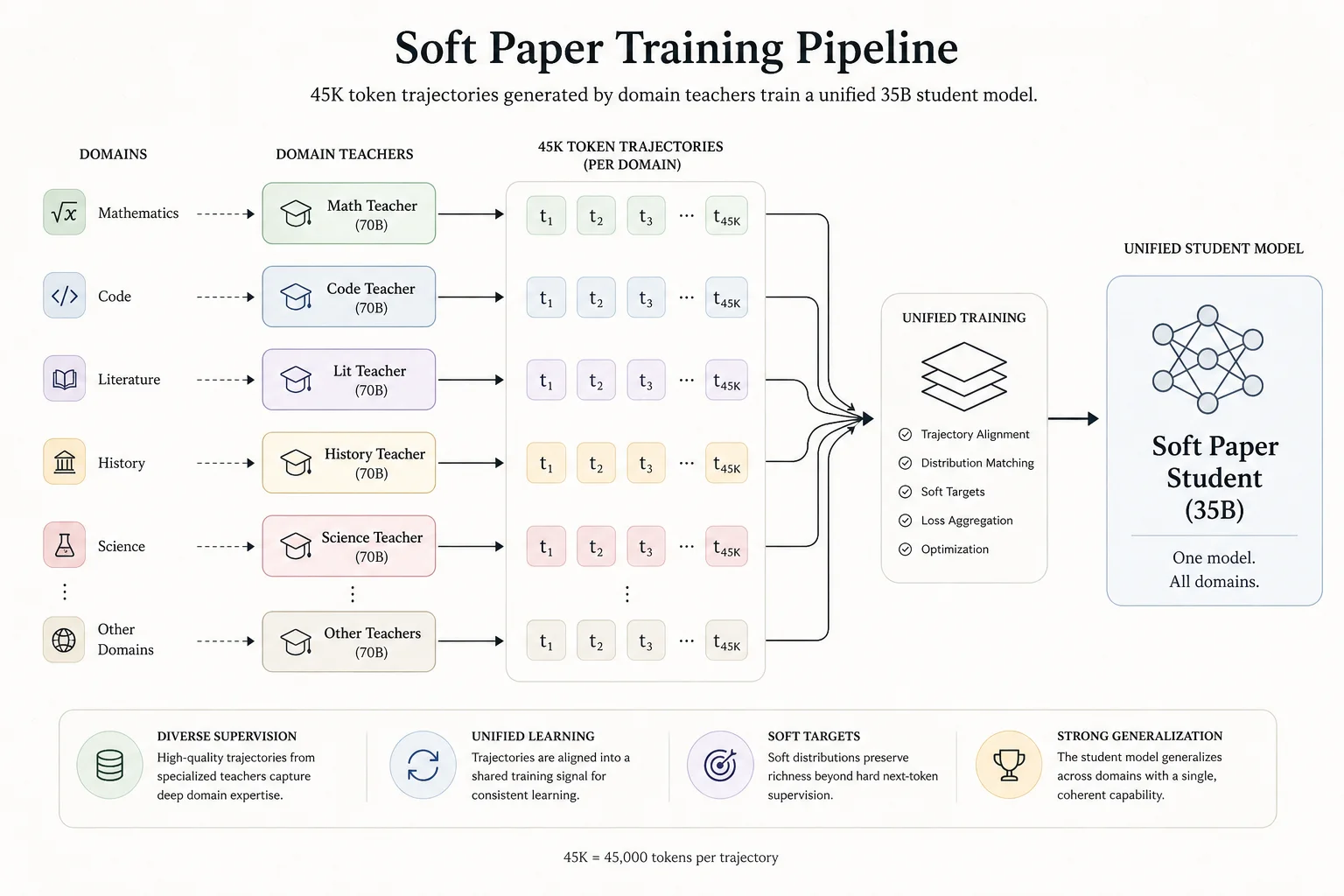
Agents-A1 trains on trajectories averaging 45,000 tokens. The infrastructure connects external knowledge, actions, observations, and verifier outcomes into long-horizon sequences across six domains: long-horizon search, engineering, scientific research, instruction following, general agentic tasks, and scientific agentic tasks.
Agents-A1 on Hugging FaceThree-stage training recipe
| Stage | What happens |
|---|---|
| Full-domain SFT | Align base model with broad agentic behaviors across all six domains |
| Domain teacher models | Train specialized teachers per domain |
| Multi-teacher on-policy distillation | Route domains through teachers, distill into one deployable 35B student with salient vocabulary alignment |
Full-domain SFT alone was not enough. It improved long-horizon search and scientific research but regressed on general agent tasks and instruction following. The multi-teacher distillation step is what unified heterogeneous domains without catastrophic interference.
Benchmark results that matter
Agents-A1 reports leading or highly competitive numbers against GPT-5.5, DeepSeek-V4-pro, and Kimi-K2.6:
| Benchmark | Agents-A1 | Notes |
|---|---|---|
| SEAL-0 | 56.4 | Overall SOTA claim |
| IFBench | 80.6 | Instruction following |
| HiPhO | 46.4 | Physics olympiad |
| FrontierScience-Olympiad | 79.0 | Science reasoning |
| FrontierScience-Research | 40.0 | Research tasks |
| BrowseComp | 75.5 | Web search agent |
| GAIA | 96.0 | General agent |
| HLE (with tools) | 47.6 | Hard reasoning |
It does not win everywhere. GPT-5.5 still leads BrowseComp (84.4) and engineering tasks like SciCode (56.1). DeepSeek-V4-pro tops GAIA (98.1). The honest read is parity in the frontier band with clear leads in science and instruction following, from a model you can serve on a fraction of the hardware.
Agents-A1 paper on Hugging Face PapersWhy this matters for applied AI teams
If a 35B model with 3B active parameters can sit in the same benchmark band as trillion-parameter agents, the interesting frontier shifts from "how big" to "how long and how varied the training trajectories are."
Practical implications:
- Serving cost drops. You do not need a trillion-parameter cluster for competitive long-horizon agent behavior.
- Training data design matters more. 45K-token trajectories with verifier outcomes are the moat, not parameter count.
- Benchmarks are not production. SOTA on BrowseComp does not mean your messy CRM integration agent will work. Always run your own eval.
Caveats I would keep in mind
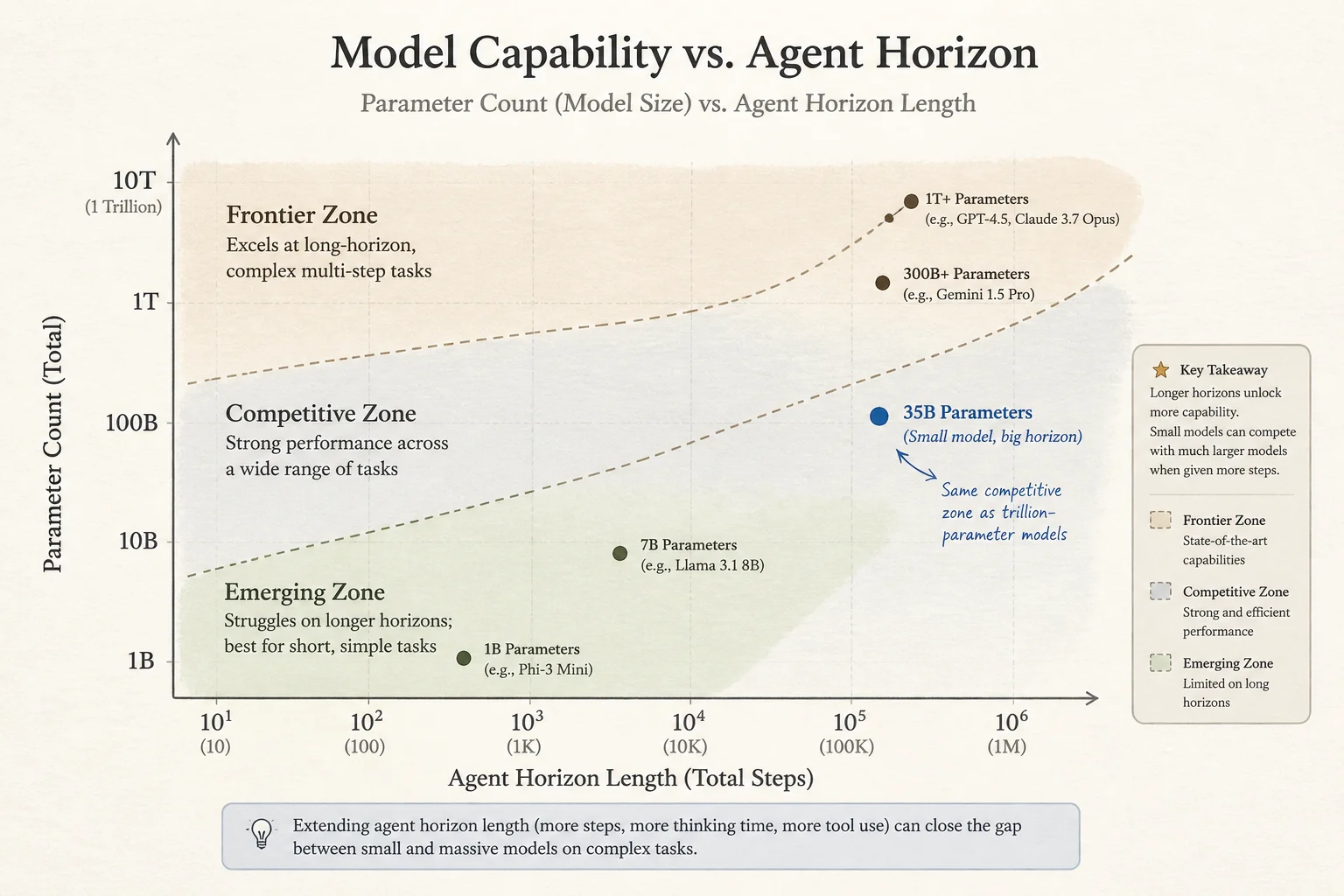
The "trillion-parameter performance" framing rests on benchmark parity, not a fitted scaling law. MoE routing details and expert counts are not fully disclosed. And benchmark SOTA is not the same as robustness in a production loop with stale tools, rate limits, and angry users.
Still, the direction is clear. If you are building agents and assuming you need the biggest model on the menu, Agents-A1 is worth a serious look at your own eval set.
Want help designing long-horizon agent evals or picking a model tier for your workflow? Book a free discovery call.