
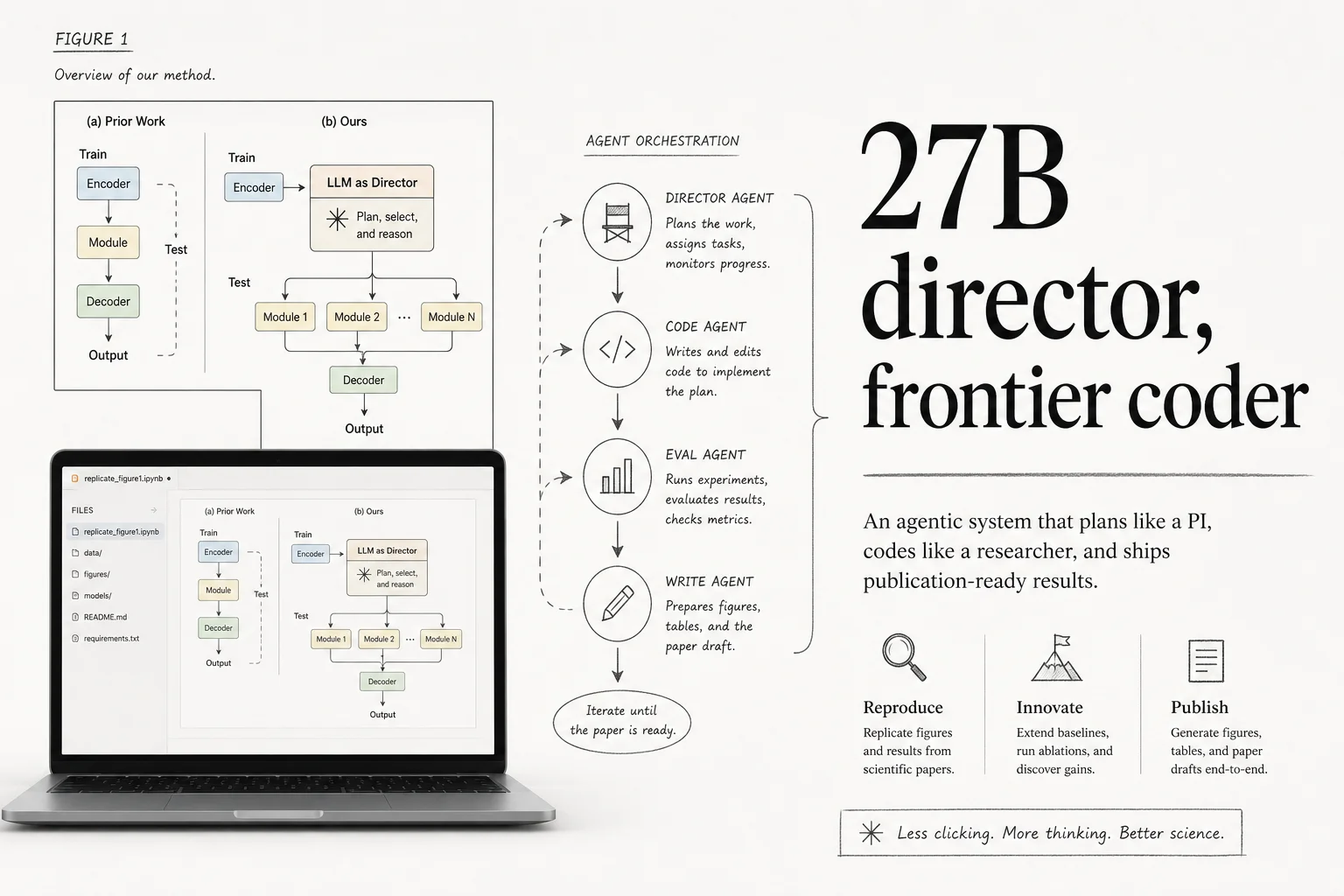
London startup Inherent came out of stealth in August 2026 with a bold claim: a 27B-parameter agent called Faraday reproduces published research more faithfully than Claude Opus 4.8 and GPT-5.5 , even though Faraday calls GPT-5.5 Codex as a coding sub-agent.
The interesting part is not the headline model size. It is the orchestration thesis: a smaller model trained to behave like a research director can out-steer a frontier model on long-horizon science work.
What Replica measures
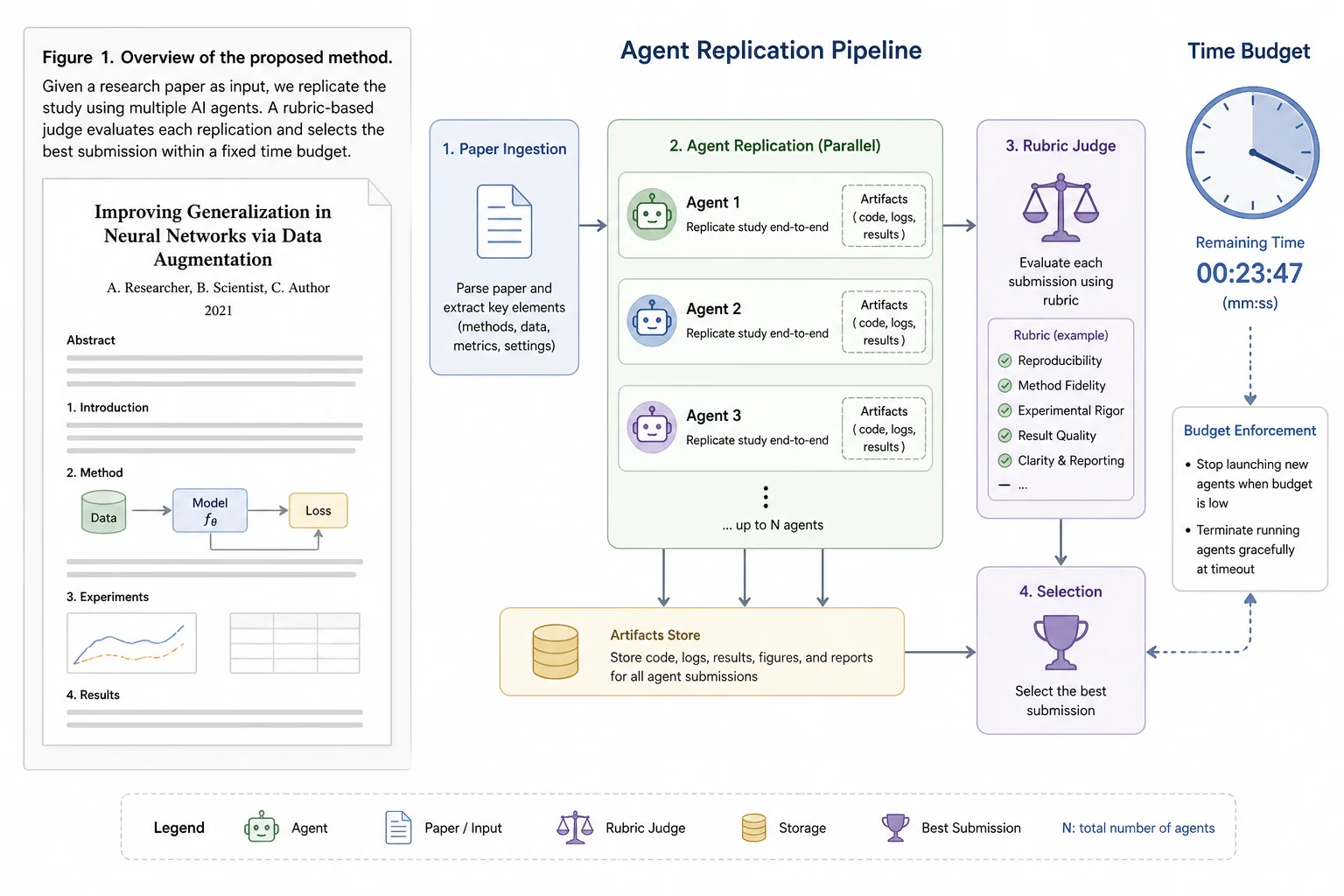
Inherent built Replica, a benchmark of 310 tasks drawn from 100 ML and AI-for-science papers (NLP, materials science, weather forecasting, structural biology, and more).
Each task: reproduce a figure from the paper without access to the original plot, under time and compute budgets. Success requires experimental reasoning, not copying an answer key.
Training AI Scientists to Replicate Research (arXiv)Reported results from Inherent's rubric-based judge:
| Comparison | Faraday vs baseline |
|---|---|
| In-distribution ML tasks | Beats Claude on 73% of tasks |
| Held-out AI-for-science tasks | Beats Claude on 60% of tasks |
| Average score lift | +6% over Claude, +8% over GPT-5.5 on test split |
Largest gaps showed up in meta-learning, structural biology, and materials science categories.
How Faraday is trained
Faraday sits on a 27B Qwen base (Inherent cites Qwen 3.6 in press materials). Training is long-horizon reinforcement learning with:
- An auto-generated rubric judge that scores replication quality with low noise vs human ratings.
- Coding agents as tools (GPT-5.5 Codex in production runs; trained with GPT-5.4-mini, swappable at test time).
- No hand-coded evolutionary harness or test-time reward hacking required.
Qualitative rollouts in the paper claim Faraday behaves more like a human scientist: it implements mechanisms behind claims instead of hard-coding outputs, scales experiments down faithfully, and avoids shortcuts that flatter metrics.
That is the opposite of "ask Codex to matplotlib your way to a matching chart."
The orchestrator pattern matters for builders
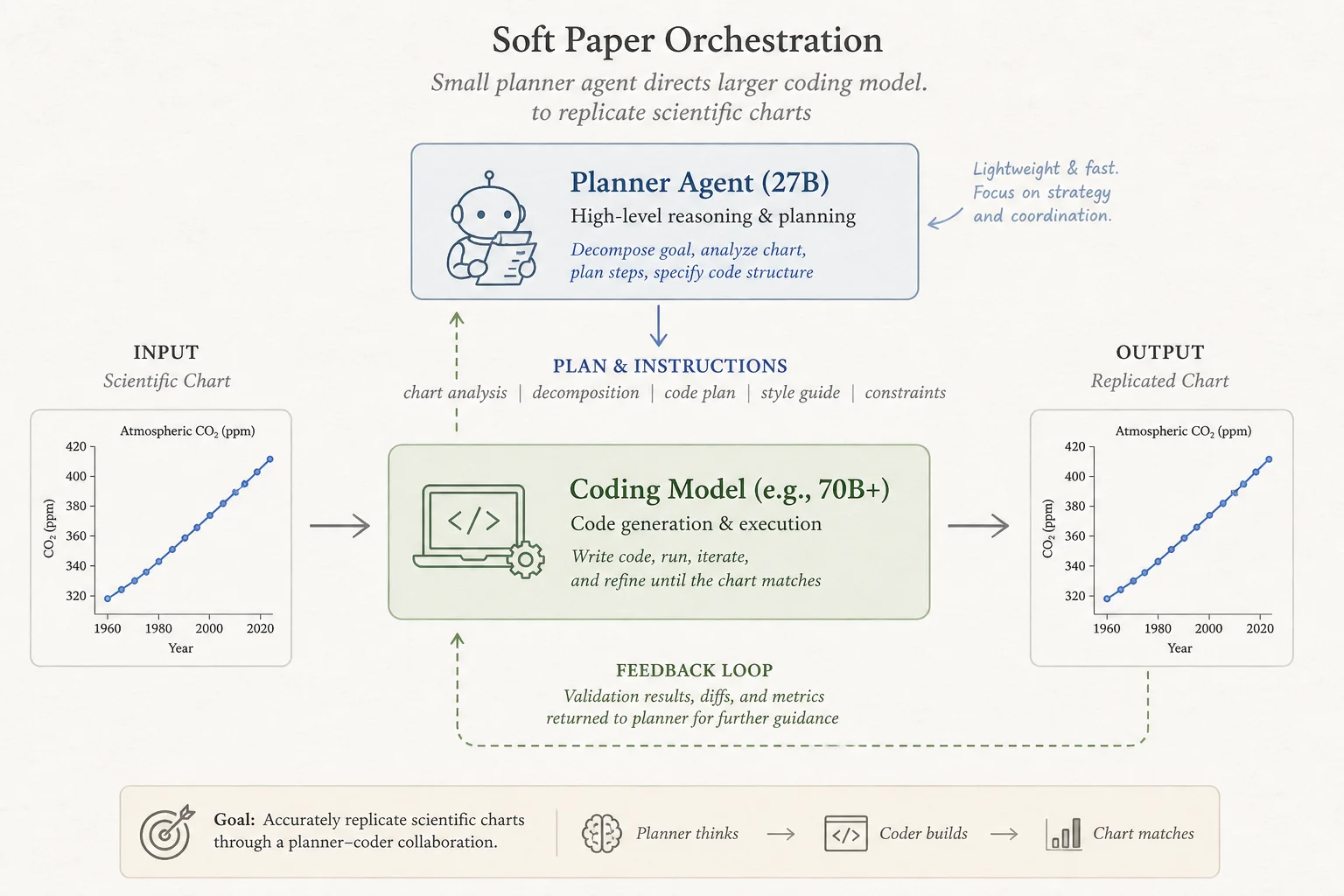
Faraday is not trying to beat Codex at typing speed. It directs Codex the way a PI directs a grad student with a laptop.
If that holds outside Inherent's benchmark, it reinforces a routing lesson I keep repeating in client agent stacks:
| Role | Model class | Job |
|---|---|---|
| Planner / scientist | Smaller specialized RL agent | Hypothesis, experiment design, stop conditions |
| Executor | Frontier coding model | Implementation, debugging, library glue |
| Judge | Rubric model or human | Did we replicate the phenomenon, not just the pixels? |
You do not need a 1T model on every turn. You need the right model on the turn that sets trajectory.
Inherent research postSkepticism you should carry
Inherent raised a reported $50M seed led by Index Ventures. Replica is their benchmark. No independent lab has published a rerun of the Claude/GPT-5.5 comparisons yet.
Treat the 73% win rate as a company-reported signal until third parties replicate it. The irony is obvious for a replication-focused launch.
Still, the architecture is directionally aligned with where agent systems are heading: RL on long tasks, tool use instead of monolithic reasoning, judges that score process not just final images.
What to ask vendors pitching "AI scientists"
Before you buy a research agent for your lab or data team:
- Show held-out tasks with answer keys you did not see during training demos.
- Separate replication from discovery. Faraday's edge is on known-outcome reproduction, not open-ended hypothesis generation.
- Expose tool budgets. How many Codex calls per figure? What happens when the coding tool fails mid-rollout?
- Publish judge rubrics. Rubric-based RL only works if humans agree with the scorer on borderline cases.
Takeaway
Faraday is a data point that post-training on long-horizon science tasks plus tool orchestration can beat raw frontier scale on a hard, realistic eval. Whether Inherent's exact numbers hold everywhere is still an open question.
For applied AI teams, the portable lesson is simpler: invest in the planner and the judge, not just a bigger executor.
Designing multi-model agent stacks for research or ops workflows? Book a free discovery call and we can map planner/executor splits to your eval data.