
Last month a founder sent me a proposal for "full AI transformation" at $18k. The deliverable list was three logos, a chatbot widget, and "ongoing optimization." No CRM fields. No ownership clause. No mention of what happens when Meta rejects a WhatsApp template.
I asked one question: can I see the live system this stack already runs for a paying client? The call ended early. That is the buyer skill this post is about.
If you are choosing an AI automation partner, an applied engineer, or a small studio, you are not shopping for vibes. You are picking who owns the failure modes on your calendar, CRM, and after-hours inbox. Run an ops automation audit first so you know which workflow is worth paying for. Then use the scorecard below.
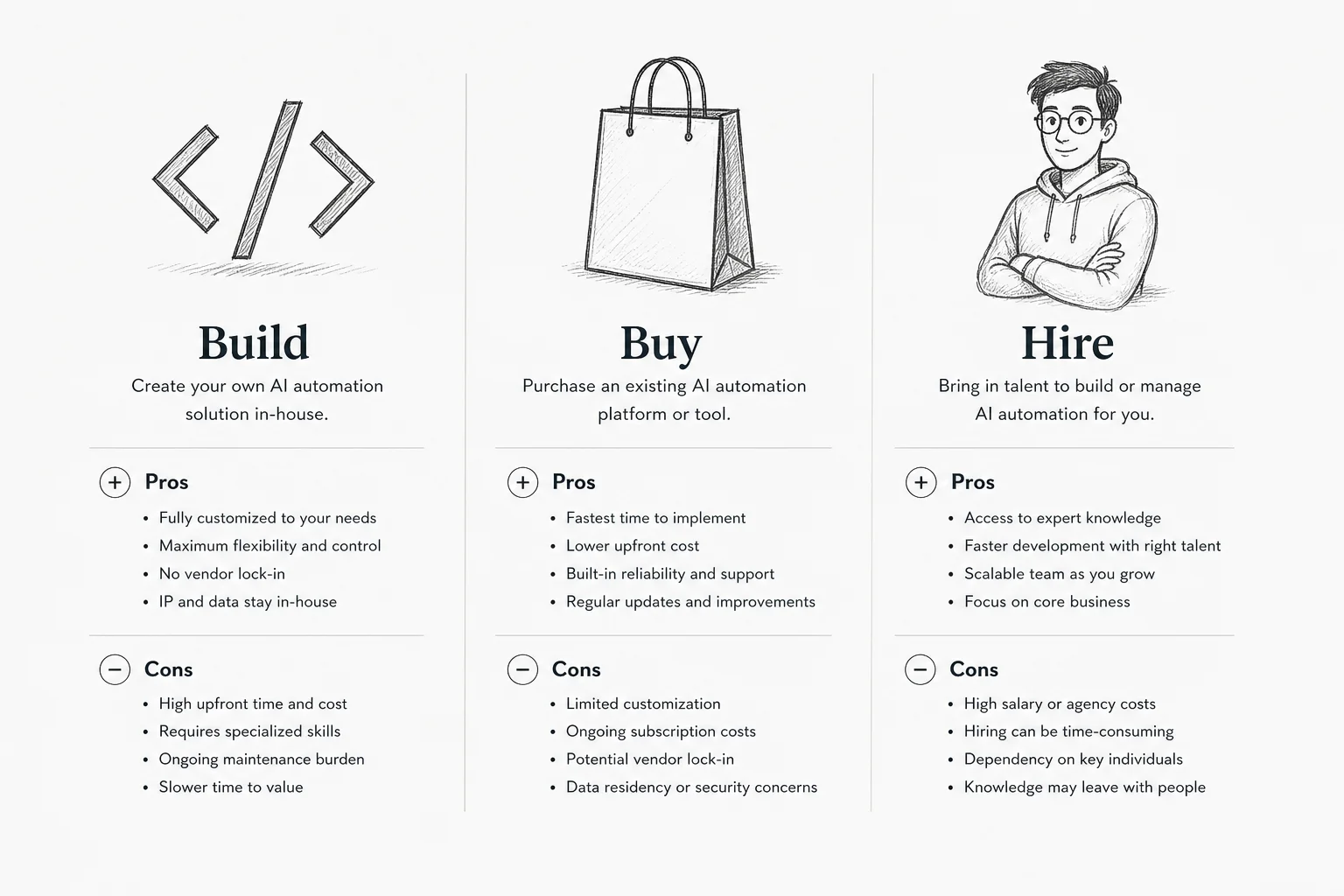
The BBH decision: build, buy, or hire
Direct answer: most service businesses should hire for the first production workflow, buy narrow SaaS for the boring middle, and only build in-house when they will keep someone on payroll to maintain it. Mixing those three without naming them is how you pay engineering rates for a logo swap.
| Path | When it fits | What you own | Common failure |
|---|---|---|---|
| Buy | One job, mature product (booking link, SMS blast, basic form → CRM) | Config and subscription | Vendor lock, no custom channel behavior |
| Hire | WhatsApp + voice + CRM + grounding across tools you already use | Specs, credentials, and usually the code or workflows | Vague SOW, no post-launch owner |
| Build in-house | You have an engineer who will stay, and AI is a product feature | Everything | Opportunity cost; ops automation rarely gets product priority |
I default to hire for Missed-Call Killer style work, qualify-and-book on WhatsApp, and quote drafting rails. I reach for buy when the client only needs a calendar widget. I push back hard when someone wants a custom LLM platform before their leads hit a CRM at all.
For stack opinions I already published, see n8n vs Make vs custom and how long AI implementation takes.
Reseller vs builder (the only split that matters)
Strip the pitch deck. You are talking to one of two animals.
Resellers live inside one platform. They open GoHighLevel or a chatbot SaaS, drop your FAQ, add a widget, and invoice a "custom AI project." Fine at the right price. Dangerous when sold as engineering, or when your real need is a WhatsApp Cloud API webhook that writes into HubSpot with retries.
Builders ask about volumes, exception paths, and which system is allowed to be source of truth. They will say no to automating a messy process. They show production traffic, not a staging demo. When the platform cannot do X, they write code or an n8n rail instead of telling you to "wait for the roadmap."
Neither label appears on a homepage. You find it with questions.
Ten questions that expose weak partners
Ask these in the first scoping call. Take notes. Compare answers, not vibes.
- Show me a live production system for a real client (with permission). Video walkthroughs of demos do not count.
- Who writes the code and workflows? Are you talking to that person, or only an account manager?
- What do you refuse to automate? If the answer is "nothing," they optimize for invoices.
- How does this attach to tools we already run? Listen for CRM field names, calendar APIs, and WhatsApp template strategy, not "we integrate with 500 apps."
- What is custom vs configured? Force a percentage. Evasion is the answer.
- Who owns the accounts, prompts, knowledge base, and workflow exports if we leave? Put it in writing.
- What are the running costs for model usage, WhatsApp conversations, and voice minutes when volume doubles?
- How do you handle bilingual or dialect traffic? "Supports 95 languages" is a brochure line. Ask what they test.
- What is the human escalation path when confidence drops or the customer asks for a person?
- What does week one after launch look like? Monitoring, transcript review, and who is on call.
If they cannot answer 1, 6, and 9 without hedging, walk.
Useful reading while you evaluate vendors: Meta's WhatsApp Cloud API docs, n8n docs, and Anthropic's building effective agents note. Partners who have never opened those pages are guessing.
Red flags worth ending the call over
Guaranteed revenue lifts with fake precision ("+47% in 90 days") are marketing math. Ask for mechanisms and ranges instead.
Other walk-away signals:
- Trend-chasing positioning (crypto → metaverse → "AI everything" with the same team)
- No engineer in the room before you sign
- Quote produced before anyone mapped your workflows
- Pressure to migrate everything into their proprietary platform on day one
- Open-ended hourly billing with no scoped deliverable and no cap
- Unusually cheap fixed fee with a mandatory high monthly "maintenance" that is really the product
I have also seen partners hide that junior offshore labor will build the system after a polished sales call. Subcontracting is fine when named. Surprise subcontracting is how launches slip and nobody owns the pager.
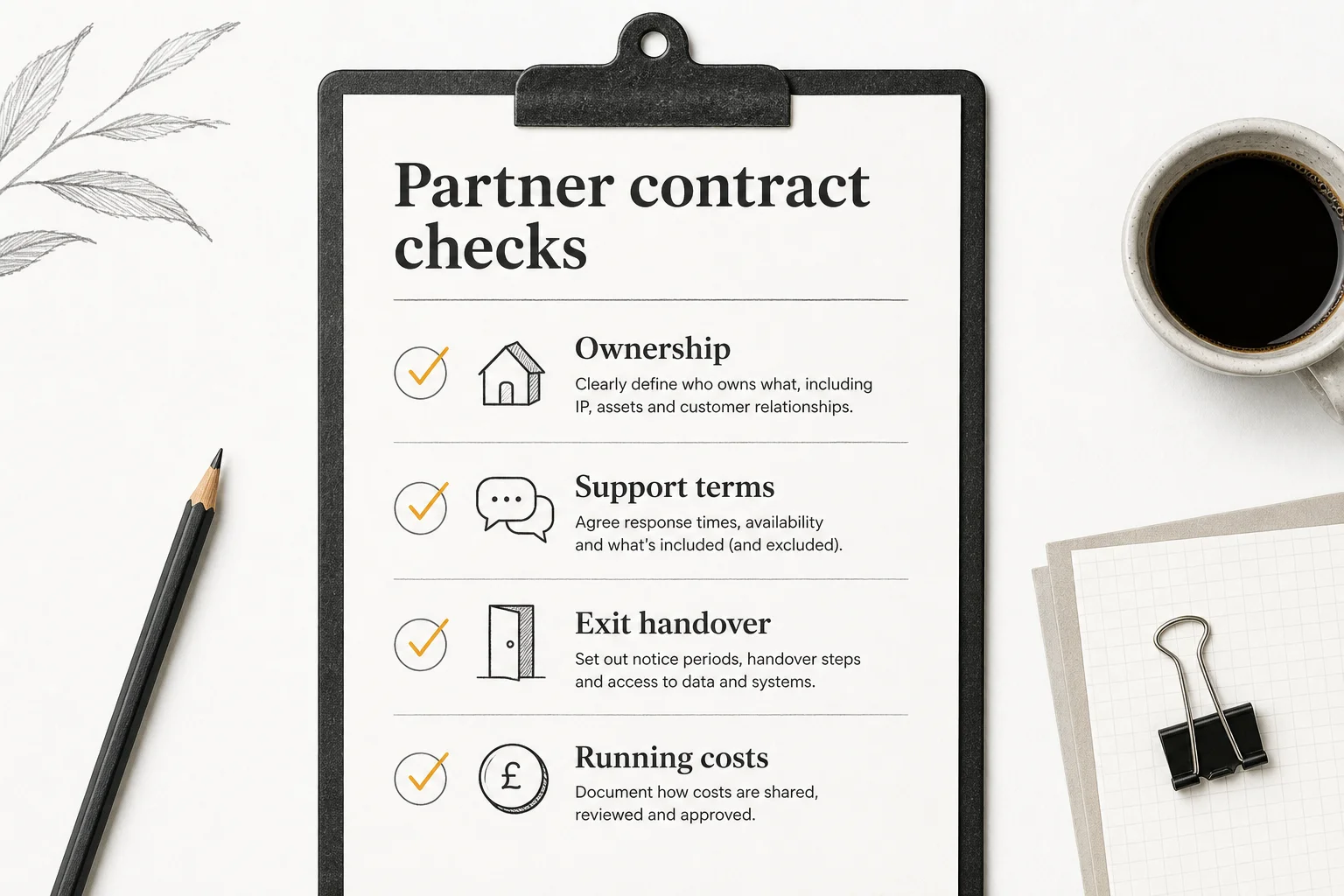
Ownership matrix (put this in the contract)
Before any deposit, fill this table in the SOW. If they resist writing it down, that is data.
| Asset | Who owns it | Export / handover |
|---|---|---|
| CRM account and pipelines | You | Full admin access from day one |
| WhatsApp / phone numbers | You | Number portability and Meta Business access |
| n8n / Make / custom repo | You (or irrevocable license) | Repo + deploy docs on exit |
| Prompts and knowledge base | You | Markdown / JSON export |
| Conversation logs | You | Export path documented |
| Model API keys | You or shared with spend caps | Keys rotated on exit |
Support terms need the same clarity: what is included monthly, response time for outages, and what counts as new billable scope. Vague "unlimited optimization" usually means nothing scheduled and everything negotiable later.
A two-week evaluation that actually works
You do not need a procurement department. You need structure.
Days 1 to 3: Shortlist three candidates from evidence, not ads. Look for specific writeups of systems (WhatsApp qualify, voice booking, CRM sync), not logo walls. Cross-check against your audit scores from the ops checklist.
Days 4 to 8: Give each the same real workflow. Example: "Missed call → SMS or WhatsApp within 60 seconds → qualify → book or task in GHL." Watch who asks about volumes, languages, and edge cases before pitching. Insist on meeting the builder.
Days 9 to 14: Compare written scopes: deliverables, integrations, languages, timeline, ownership, post-launch support. Compare scopes, not sticker prices. A cheaper proposal that skips CRM sync and human handoff is incomplete, not a deal.
For any engagement above a few thousand dollars, start with a paid pilot: one workflow, two to four weeks, pass/fail metrics (first-response time, booking rate, escalation rate). It costs a fraction of a full build and tells you more than reference calls.
What I look for when I am the partner (so you can mirror it)
When founders hire me, the first deliverable is usually not a model. It is a thin rail: webhook → qualify → CRM write → human task, often on n8n into GoHighLevel, with WhatsApp or voice only where the channel already wins. See patterns in WhatsApp Business API automation and AI receptionists for clinics.
I will tell you when a form and a Make scenario are enough. I will also tell you when "AI agent" is the wrong label for what you need. Partners who never push back are sales teams.
Soft close
Bring one workflow, your CRM name, and last week's missed-call or first-response numbers to a free discovery call on cal.com/saifyxpro. We can usually tell in 30 minutes whether you should buy a tool, hire a builder, or fix process before spending anything on models.
Pick on evidence: live systems, named ownership, and a pilot you can kill. Everything else is branding.