
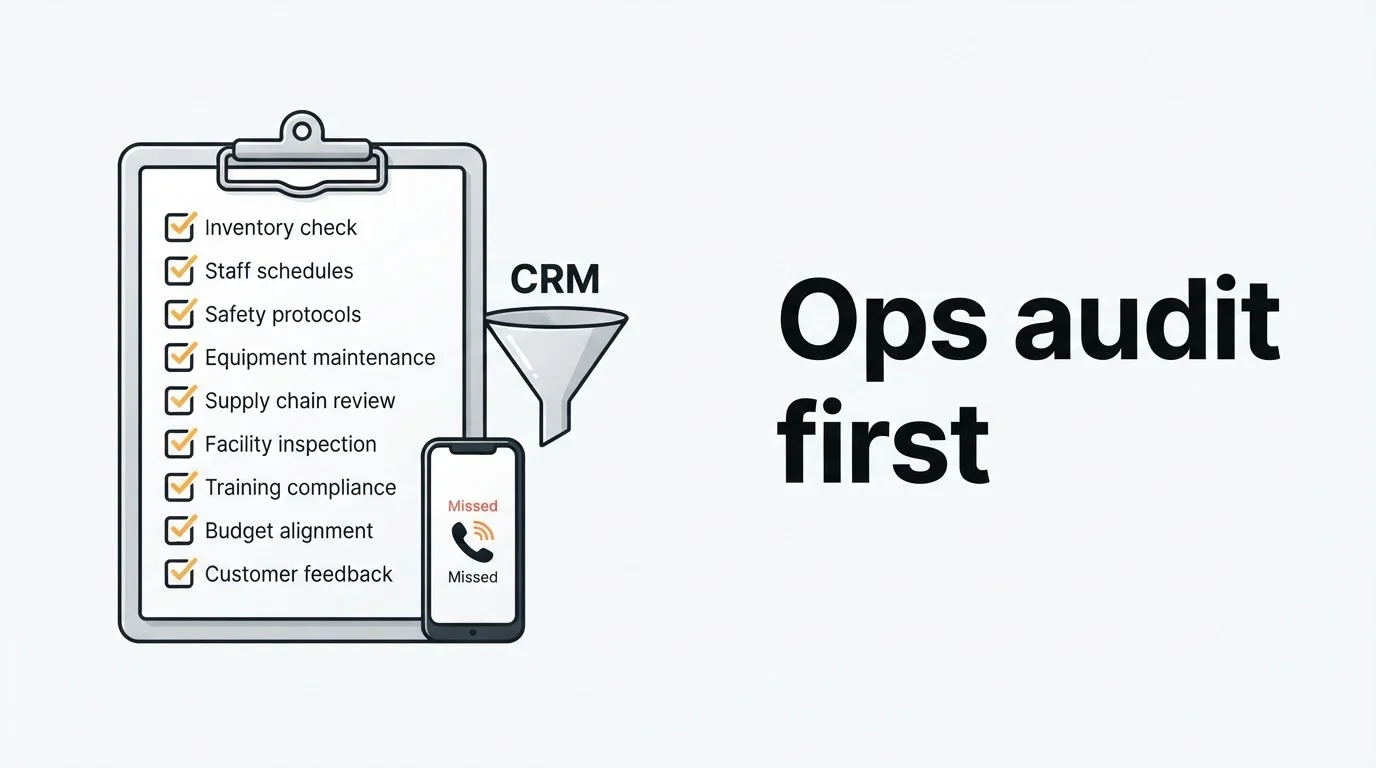
Most AI pitches start with a demo. That is backwards. Start with where your week already leaks: slow replies, missed calls, WhatsApp threads that never hit the CRM, bookings that need three humans to land on a calendar.
I run a simple Ops Automation Audit with operators before anyone talks models or retainers. You can run the same checklist yourself this week. No card. No "book a call to see the PDF." Just numbers from your own shop.
When you want a second pair of eyes after you score yourself, the free discovery call is on cal.com/saifyxpro. The audit below is the homework.
Why audit before you buy
Direct answer: AI and automation pay off when they remove a measured bottleneck. Without a baseline, you buy a chatbot that answers FAQs while missed calls still die in voicemail. Score the funnel first. Then pick the smallest workflow that recovers the most hours or bookings.
| Buy first (common) | Audit first (better) |
|---|---|
| Chat widget on the site | Know median first-response time by channel |
| "AI receptionist" pitch | Know missed-call volume and text-back rate |
| New CRM because the old one feels messy | Know whether leads are logged with outcomes at all |
| Twelve automations at once | One workflow with a before/after hour count |
Prerequisites that decide success are boring: API access to your CRM and calendar, one source of truth for prices or services, and an exception path to a human. If a proposal starts with "migrate everything to our platform," you are being sold a platform.
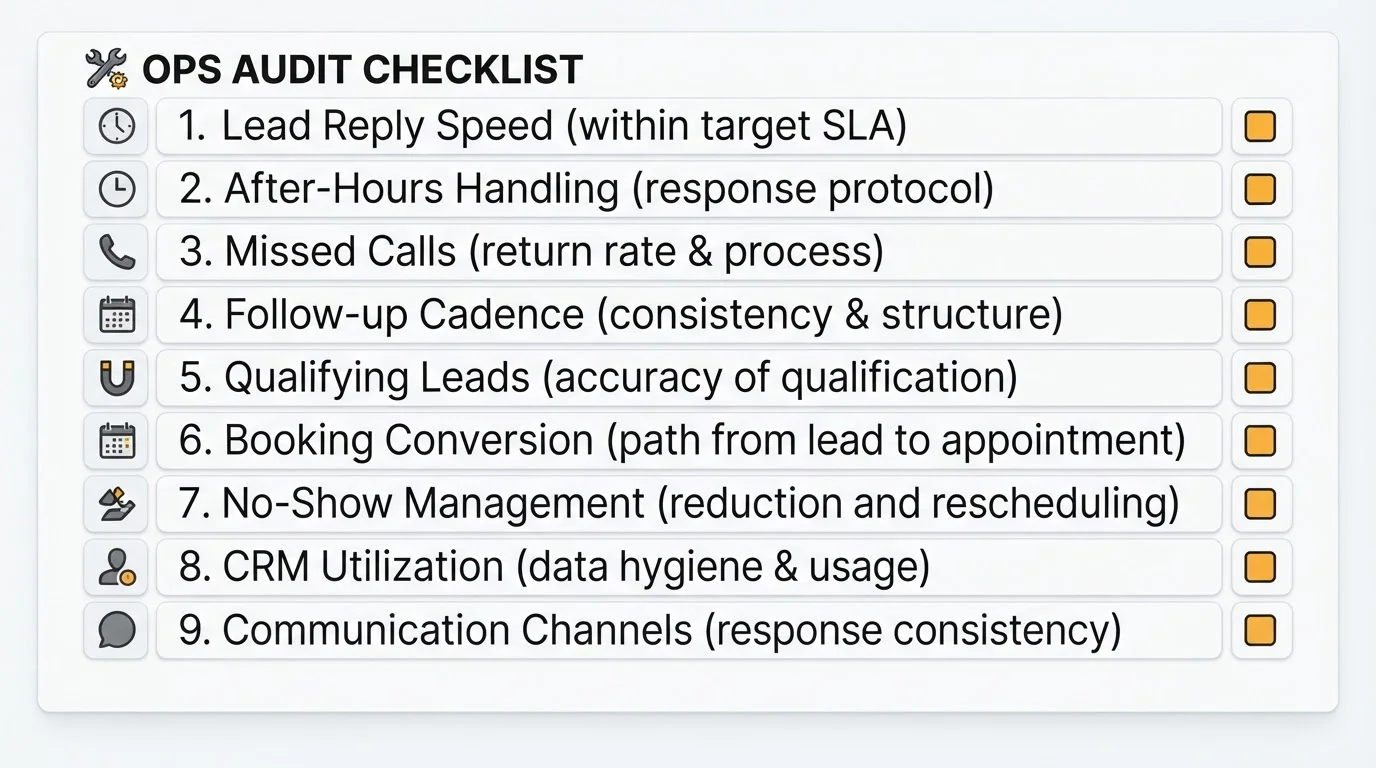
The nine-point checklist
Score each item 0 (broken / unknown), 1 (partial), or 2 (reliable). Max score: 18. Treat anything under 10 as "stop shopping for AI, fix the basics."
1. Lead replies during open hours
What is your average first-response time on web forms, SMS, and chat while you are open?
- 2: Under 5 minutes on money channels, measured weekly
- 1: Same day, but not measured
- 0: Hours later, or only when someone remembers to check the inbox
Pull the last 20 leads. Timestamp inquiry vs first human or bot reply. Guessing does not count.
2. After-hours leads
What happens nights and weekends?
- 2: Auto-ack within minutes, qualify or book, or schedule a callback with a real slot
- 1: Generic "we'll call tomorrow" with no capture into CRM
- 0: Silence until Monday
After-hours demand is often your highest intent. Leaving it to voicemail is a choice.
3. Missed calls
Voicemail vs text-back vs AI voice.
- 2: Missed call triggers SMS or WhatsApp within ~60 seconds, plus a CRM task
- 1: Voicemail only, someone sometimes dials back
- 0: No idea how many calls you miss per week
If you cannot export missed-call count from the phone system, install counting before you buy a voice agent. See also patterns in my notes on WhatsApp Business API automation and AI receptionists for clinics.
4. Follow-ups (Day 1 / 3 / 7)
Do sequences exist for leads that did not book?
- 2: Automated touches with stop conditions when they book or opt out
- 1: Manual "I'll follow up" that dies in personal reminders
- 0: One reply, then hope
Most pipelines do not need clever copy. They need the second and third touch to fire.
5. Qualifying
Scripted questions vs free-form inbox chaos.
- 2: Shared script or bot asks the same 3 to 5 qualifiers; answers land on the contact record
- 1: Experienced staff qualify well; new hires wing it
- 0: Every chat is a novel; pricing and fit live in people's heads
6. Booking
Can a lead land on the calendar without a human rewriting the thread?
- 2: Self-serve booking against live availability, or bot books with confirmation
- 1: Staff paste Calendly links when they remember
- 0: "Someone will call you to schedule" as the only path
7. No-shows
Reminders and recovery.
- 2: Automated reminders with confirm / reschedule; no-show recovery sequence
- 1: Manual reminder texts some of the time
- 0: Empty chairs with no data on why
8. CRM / records
Is every lead logged with a source and an outcome?
- 2: Forms, calls, and WhatsApp sync to GoHighLevel, HubSpot, or your CRM of record within minutes
- 1: Web forms sync; phone and chat live on devices
- 0: Spreadsheet archaeology
9. Language and channels
Phone, SMS, WhatsApp, web chat: which ones you advertise vs which ones you actually staff.
- 2: Each public channel has an owner or automation, and handoff rules
- 1: One channel works; the others are decorative icons in the footer
- 0: Leads choose a channel and disappear into it
How to turn scores into hours
Pick your weakest 0s and 1s. Estimate volume for one week, then multiply.
| Leak | Simple estimate |
|---|---|
| Slow first reply | Leads per week × % that go cold after 1 hour × average job value × close rate |
| Missed calls | Missed calls per week × callback connect rate gap × job value |
| Manual CRM entry | Staff hours per week on copy-paste × loaded hourly cost |
| No-shows | No-shows per week × slot value |
| After-hours silence | Weekend inquiries × % never recovered |
You do not need perfect finance math. You need a number ugly enough that "buy a random chatbot" feels silly next to "fix missed-call text-back."
Worked sketch: 40 inbound leads a week, 15 missed calls, median reply time 4 hours, no sequences. If even 4 leads a week die from slow follow-up at $400 contribution each, that is ~$6,400 a month before you count empty chairs. A focused n8n + CRM workflow that answers in under five minutes and texts missed callers often pays for itself in weeks. Stack choice notes: n8n vs Make vs custom.
What to automate first (after the audit)
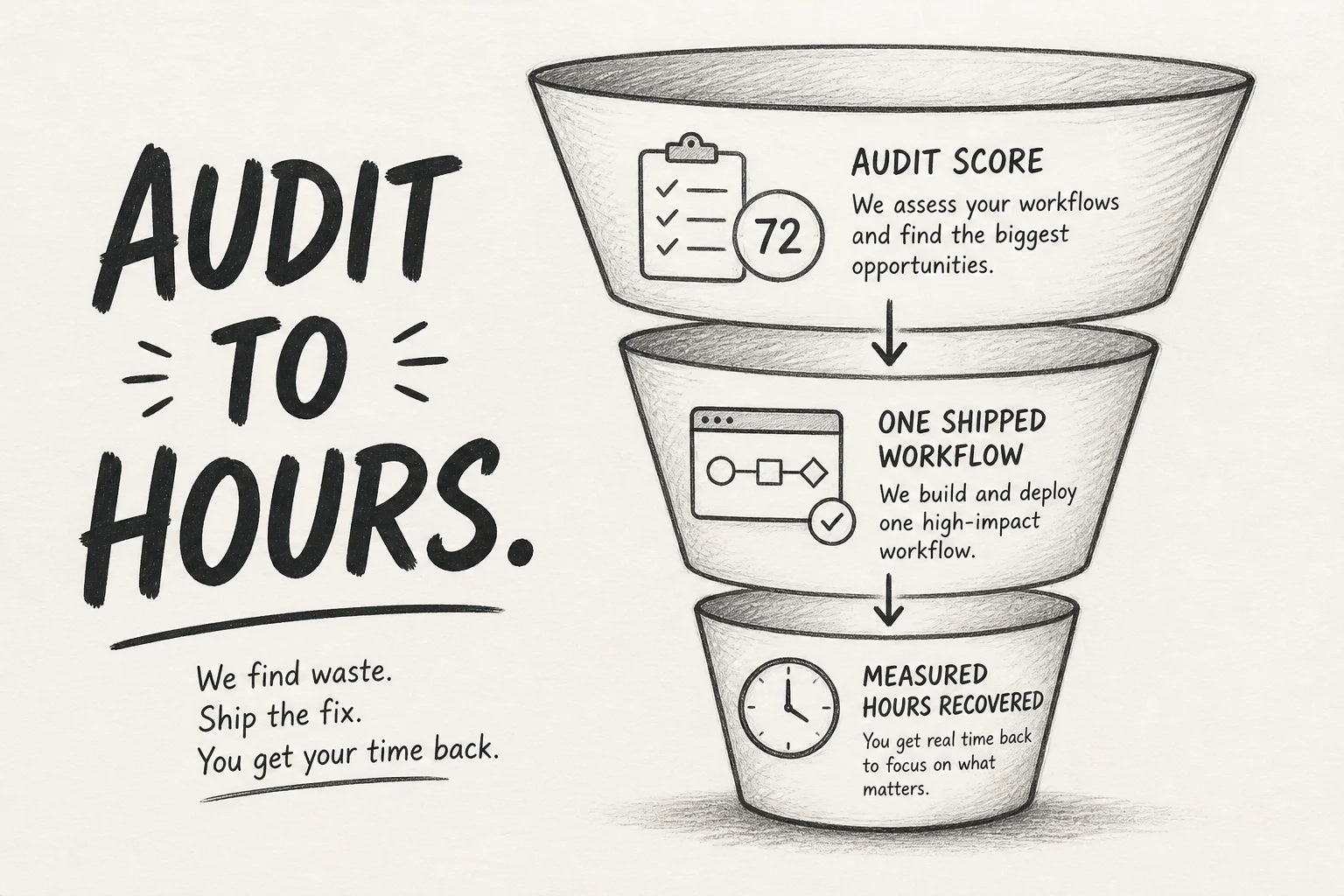
Resist the twelve-workflow wishlist. Sequence that works:
- Measure the nine scores with real samples
- Pick one high-cost, relatively clean process (often missed-call text-back + CRM log, or form-to-calendar)
- Ship with an exception path to a human
- Run parallel with the old process for one to two weeks
- Recount hours and bookings, then take the next item
Tools I reach for when the audit points at lead ops: n8n for orchestration, GoHighLevel or HubSpot as system of record, WhatsApp Cloud API when chat is the front door, and voice only when callbacks still convert better than text.
Official docs worth keeping open while you scope:
Red flags in vendor demos
Walk away (or slow down) when you hear:
- No interest in your missed-call or first-response numbers
- "Replace your CRM" as step one
- Unsupervised model writes to production without validation
- Cold WhatsApp or SMS blasting as the growth plan
- Pricing that only makes sense if you buy the whole suite on day one
Good partners decompose your workflow the way I described in AI agents vs RPA: rules for stable steps, agents for messy language, humans on exceptions.
Scorecard you can copy
| # | Check | Score (0-2) | Notes / evidence |
|---|---|---|---|
| 1 | Lead replies (open hours) | ||
| 2 | After-hours leads | ||
| 3 | Missed calls | ||
| 4 | Follow-ups Day 1 / 3 / 7 | ||
| 5 | Qualifying | ||
| 6 | Booking | ||
| 7 | No-shows | ||
| 8 | CRM / records | ||
| 9 | Language / channels | ||
| Total | /18 |
Fill it once this week. Fill it again 30 days after your first automation. The delta is the only report that matters.
Soft next step
Run the checklist cold. If you want help interpreting scores or scoping the first workflow, book a free discovery call at cal.com/saifyxpro. Bring your scorecard, one week of lead volume, and the CRM you actually open on Mondays. We will leave with a short list of fixes ordered by hours and revenue, not a tool catalog.
A self-serve interactive version of this Ops Automation Audit is planned on saify.me (/ops-audit). Until that ships, this page is the full checklist. Use it.