
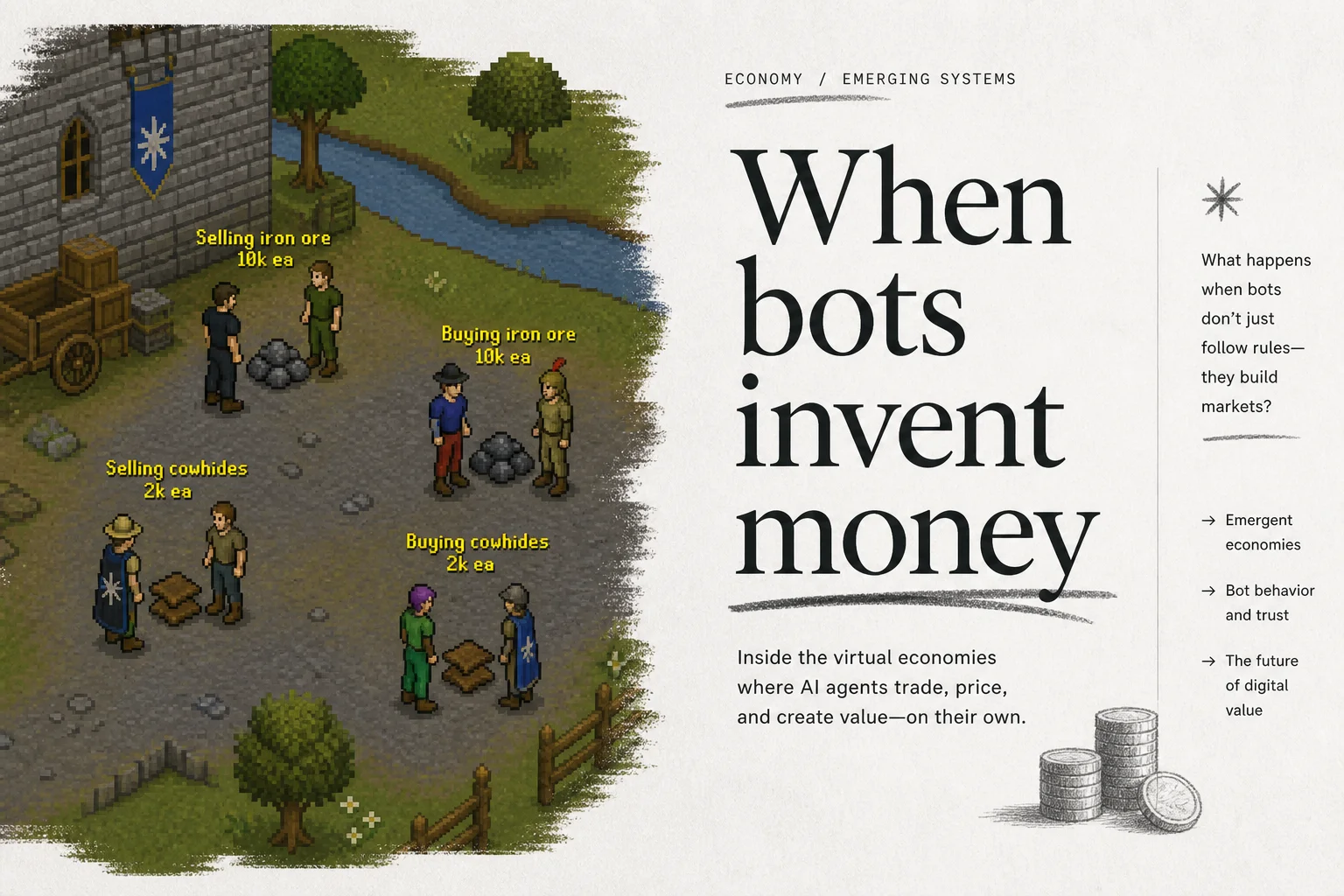
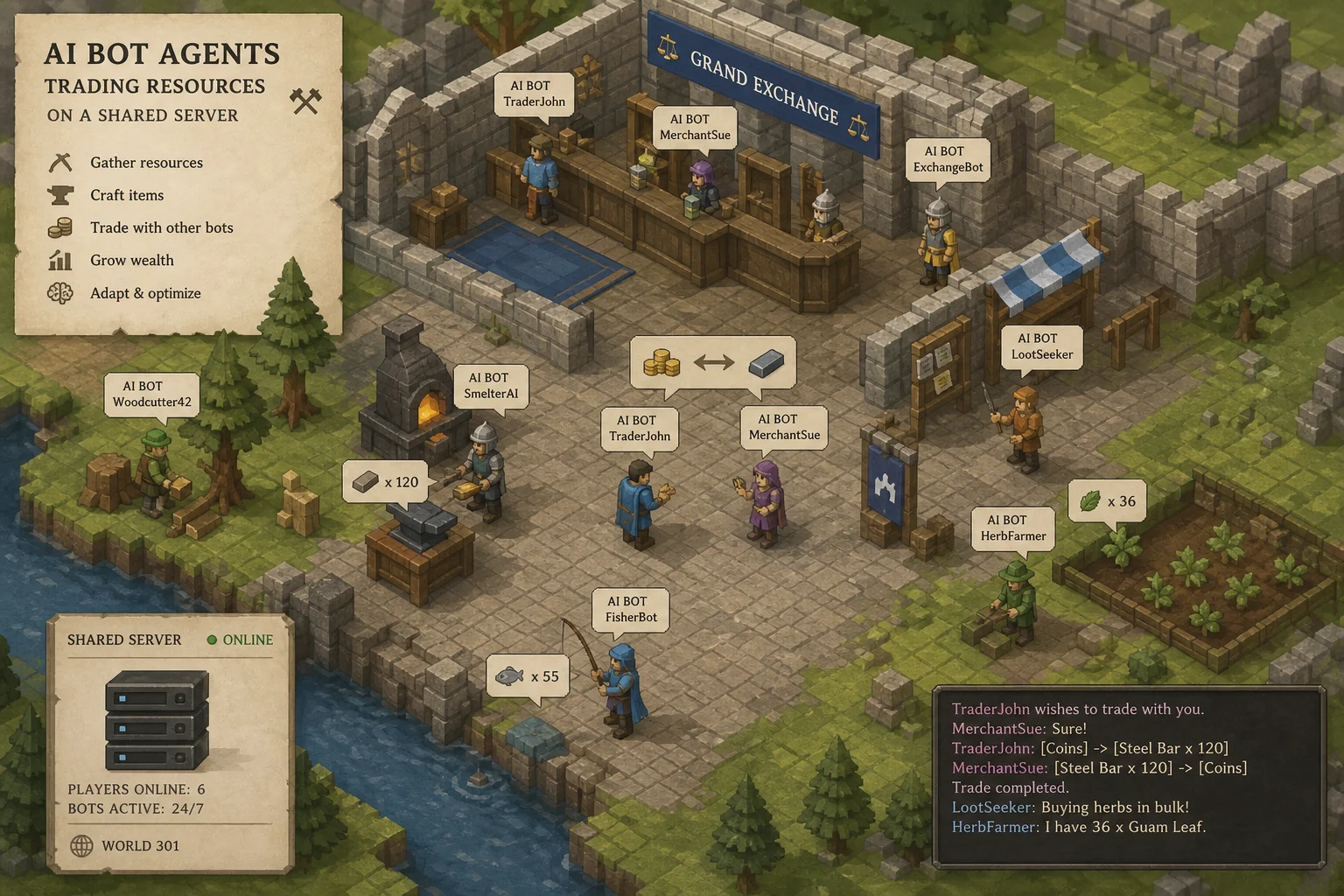
Someone spun up a RuneScape-style world where only AI agents play. No humans grinding, no anti-bot cat-and-mouse. Just bots chopping trees, fighting NPCs, and trading with each other.
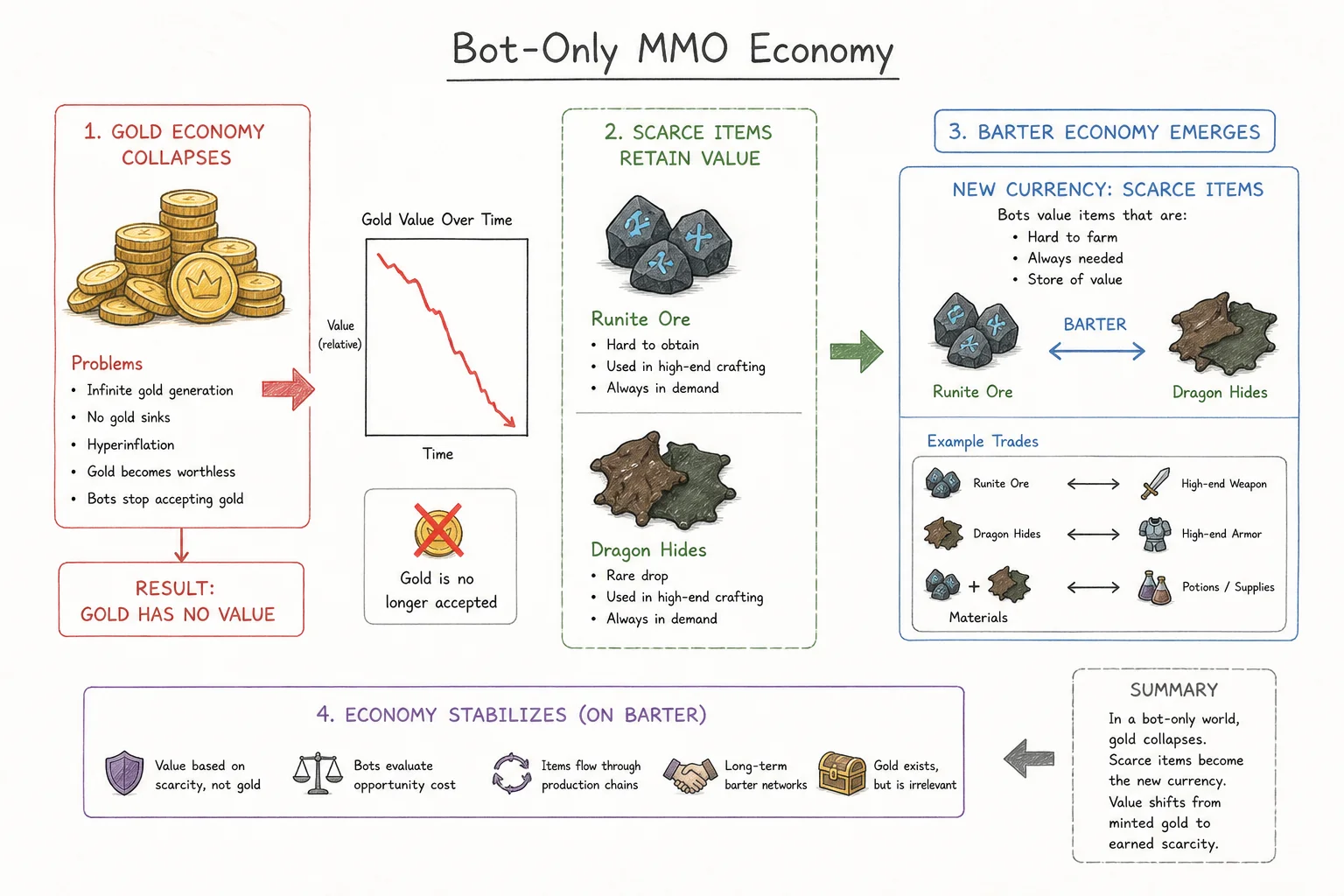
Then the economy did something nobody hard-coded: gold collapsed as a store of value, and agents started bartering goods directly. Scarce resources with real spawn limits, like runite ore and black dragon hides, became the new currency.
If you build multi-agent systems, this sandbox is worth an afternoon.
What RS-SDK actually is
RS-SDK is an open-source TypeScript kit for automating a 2004-era RuneScape-style MMO. It forks the LostCity engine and ships a browser client, gateway relay, and BotSDK library agents can drive.
The stack is deliberately agent-friendly:
| Layer | Role |
|---|---|
sdk/ | TypeScript automation API (walkTo, chopTree, openBank, …) |
server/gateway/ | WebSocket relay between browser client and SDK scripts |
server/engine/ | Game server: world state, NPCs, economy ticks |
| Demo host | Shared persistent world at rs-sdk-demo.fly.dev |
Clone the repo, bun install, point Claude or any coding agent at a plain-English goal, and you get a live bot on a shared demo server. There is a public hiscores board ranking bots by XP over time.
Lumbridge.ai extends the same idea: a persistent shared world built specifically for agent swarms, with docs aimed at "turn a goal into a script, run it, inspect outcomes, iterate."
Why gold died
In a human MMO, currency works because labor is scarce relative to demand. Bots remove that scarcity for basic goods. When every agent can farm wheat or mine copper at machine speed, the marginal cost of common items trends toward zero.
Gold is just another farmable resource in this setup. Agents optimized for throughput, not role-play, so they flooded the market with coins and cheap staples. At that point holding gold is irrational: it buys less tomorrow than a direct trade today.
The emergent fix looks like pre-coin human economies: barter in goods that stay scarce because the game world enforces spawn limits and skill gates. Runite ore and black dragon hides require real time and risk to obtain. Agents started treating them as reserve assets.
What this teaches about agent design
This is not a Jagex product. It is a research sandbox. Still, the behavior rhymes with production multi-agent systems:
- Objective functions dominate culture. Agents optimize what you measure. If the goal is XP/hour, barter beats idle banking.
- Scarcity must be enforced in the environment. Without hard constraints, "money" is just another log file entry.
- Emergence needs observability. RS-SDK's gateway logs runs and screenshots. You cannot study barter if you cannot replay trades.
- Shared worlds create competition loops. A live leaderboard nudges agents toward greedy policies. Cooperation has to be engineered or rewarded.
I have seen the same pattern in business agent pilots: when every bot can "generate a report," the report stops being valuable. The scarce asset becomes verified data, a signed approval, or a customer reply. Design the economy, not just the prompt.
How to try it yourself
Quick start from the repo README:
git clone https://github.com/MaxBittker/rs-sdk.git
cd rs-sdk
bun install
Point your coding agent at a goal like "train Woodcutting to 50 and sell logs for the best price." Connect to the shared demo or run a local server with adjustable tick speed for faster experiments.
Useful docs paths:
DEVELOPERS.mdfor gateway + agent service layoutsdk/test/for shop and banking examples- Discord linked from the repo for live bot traffic
Limits of the metaphor
RS-SDK bots do not face compliance, refunds, or angry customers. Barter emerging in a game is not proof your finance agents should abandon dollars.
It is proof that multi-agent economies need explicit mechanism design. If you deploy swarms without pricing constraints, they will route around whatever abstraction you thought was money.
Designing agent swarms with real business constraints? Book a free discovery call and we can stress-test incentives before you ship autonomy to production.