
On June 12, Anthropic pulled Claude Fable 5 offline worldwide. Nineteen days later, on July 1, it came back with tighter cybersecurity blocks, automatic fallbacks to Opus 4.8, and a new framework for grading how dangerous a jailbreak actually is.
If you ship with Claude Code or the API, this is not abstract policy news. Your request path can change mid-session without you touching a model selector.
What triggered the shutdown
The export control directive followed a report from Amazon researchers. They found a prompt technique that bypassed Fable 5's safeguards and got the model to identify software vulnerabilities. In at least one case, it produced code showing how a weakness could be exploited.
Anthropic's own follow-up testing found that less capable models, including Opus 4.8, GPT-5.5, and Kimi K2.7, could identify the same vulnerabilities using the reported technique. The company stressed that the bypass did not expose unique Mythos-level offensive capabilities. Still, the US government treated it as a national security issue and ordered a global suspension.
Anthropic's redeployment announcementWhat changed in the redeployment
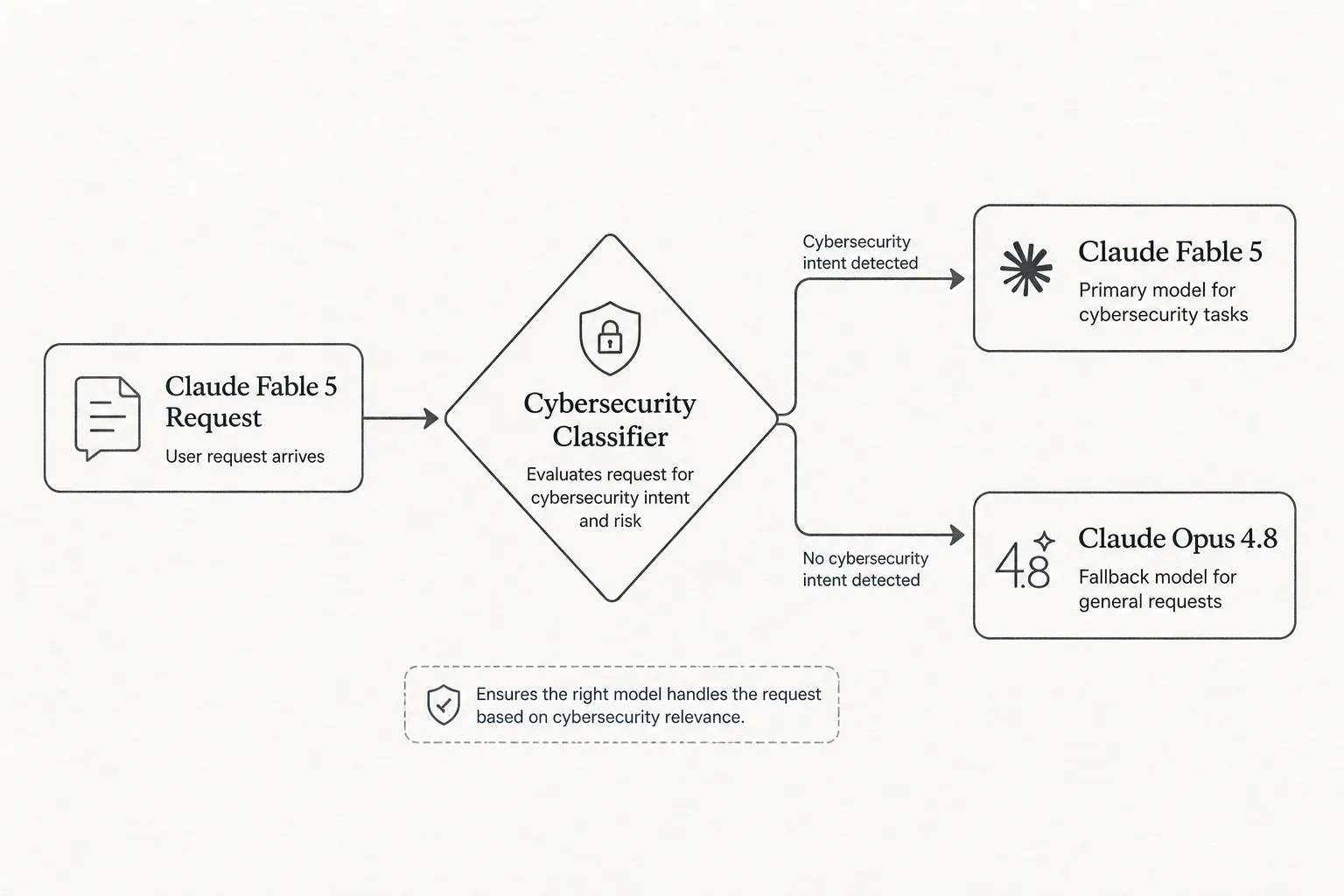
Anthropic trained a new safety classifier targeting the specific bypass technique described in the Amazon report. The company says it blocks that technique in over 99% of cases.
When the classifier fires on a cybersecurity-related request, Fable 5 does not answer. The request routes to Opus 4.8 instead, and you get a notification that the fallback happened. You are not charged Fable prices for rerouted requests.
| Surface | What happens on a classifier hit |
|---|---|
| Claude.ai / Claude Code | Automatic Opus 4.8 fallback with user notification |
| Claude API | Developers must configure the new Fallback API |
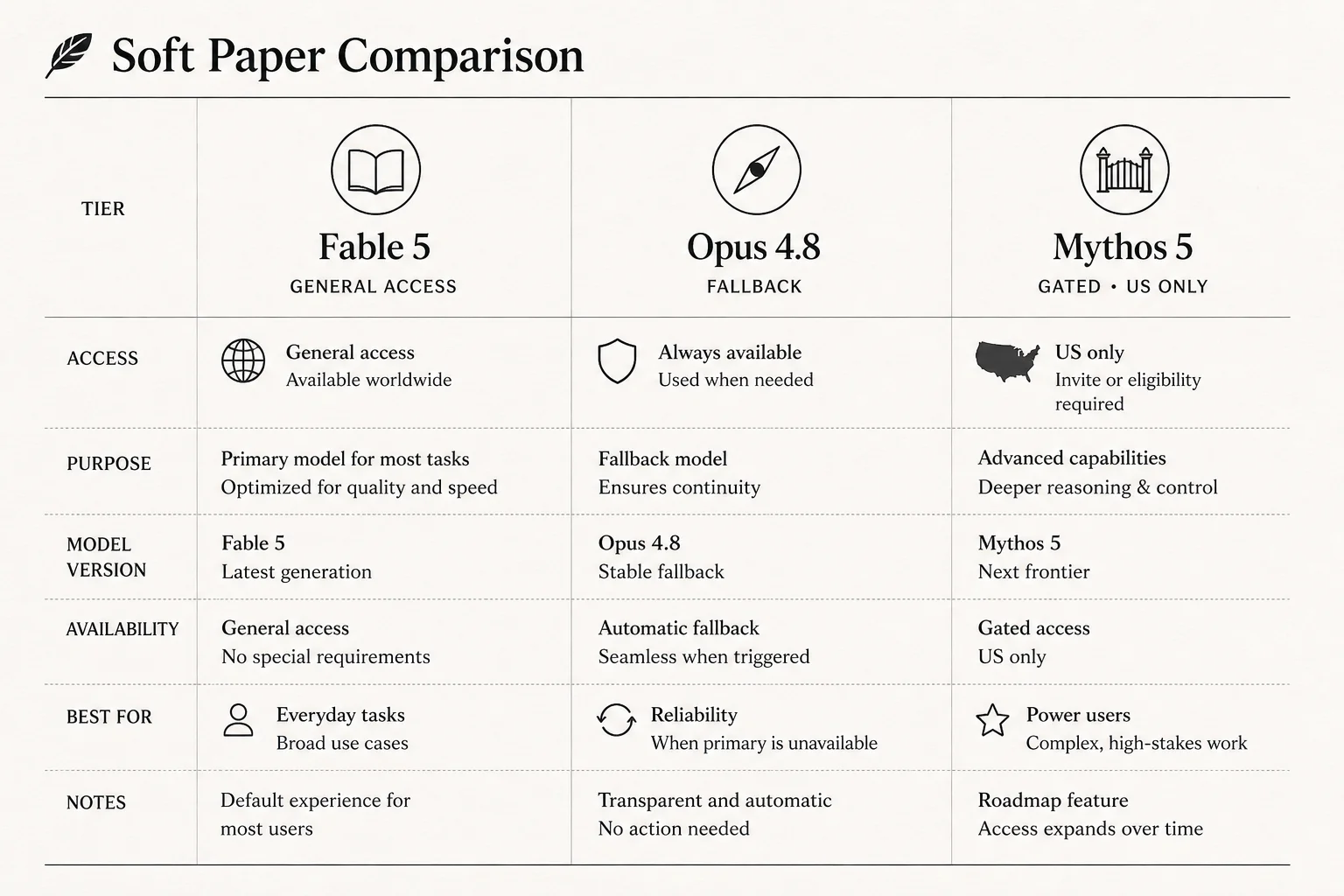
| Mythos 5 | Still restricted to approved US orgs via Project Glasswing |
The tradeoff is real. Anthropic acknowledged that routine coding and debugging tasks may temporarily hit false positives while they tune the classifier. If your workflow depends on Fable for security-adjacent code review, expect occasional reroutes until the filters improve.
The jailbreak severity framework
Alongside the classifier, Anthropic published criteria for assessing how serious a cyber-jailbreak is. Four questions:
- How far does the technique extend capability beyond existing tools?
- How many distinct offensive tasks does it enable?
- How easily can it be weaponized into a real attack?
- How discoverable is it?
That framing matters because not every jailbreak is a DEFCON moment. Some are narrow curiosities. Others are genuinely dangerous. Separating the two keeps incident response proportional.
Researchers from the US Department of Commerce's Center for AI Standards and Innovation (CAISI) independently tested both the old and new safeguards. Anthropic quotes them calling the updated protections "extraordinarily strong."
Anthropic also runs a HackerOne program dedicated to cyber-jailbreak reports, and it is drafting a cross-industry severity framework with Amazon, Microsoft, Google, and other Glasswing partners.
What this means if you build with Claude
Three practical takeaways from how I read this as an applied AI engineer:
Configure API fallbacks explicitly. If you pin Fable 5 in production, wire the Fallback API now. Silent model switches without logging will confuse your evals and your users.
Expect false positives on security-adjacent code. Vulnerability scanning, exploit PoC discussions, and even aggressive static analysis prompts may trip the classifier. Build retry logic or model routing that does not break the user experience.
Mythos 5 stays gated. Fable is the general-release cybersecurity-capable model. Mythos 5, the stronger variant, returns only for approved US organizations defending critical infrastructure. If you need that tier, you are in a different procurement path entirely.
The bigger pattern: frontier models meet export controls
This episode is less about one jailbreak and more about how governments will treat frontier AI releases going forward. Fable 5 was offline for 19 days. Mythos 5 required a separate approval track for ~100 US organizations. The Executive Order coordinating government and lab response mirrors what we already saw around GPT-5.6 Sol's gated release.
For builders, the lesson is operational: model availability is no longer guaranteed on launch day. Your architecture should tolerate model swaps, price tier changes, and regional restrictions without a full redeploy.
If you are wiring agents or coding workflows on Claude and want a second pair of eyes on fallback logic and eval design, book a free discovery call. I help teams ship AI that survives policy changes, not just demo day.