
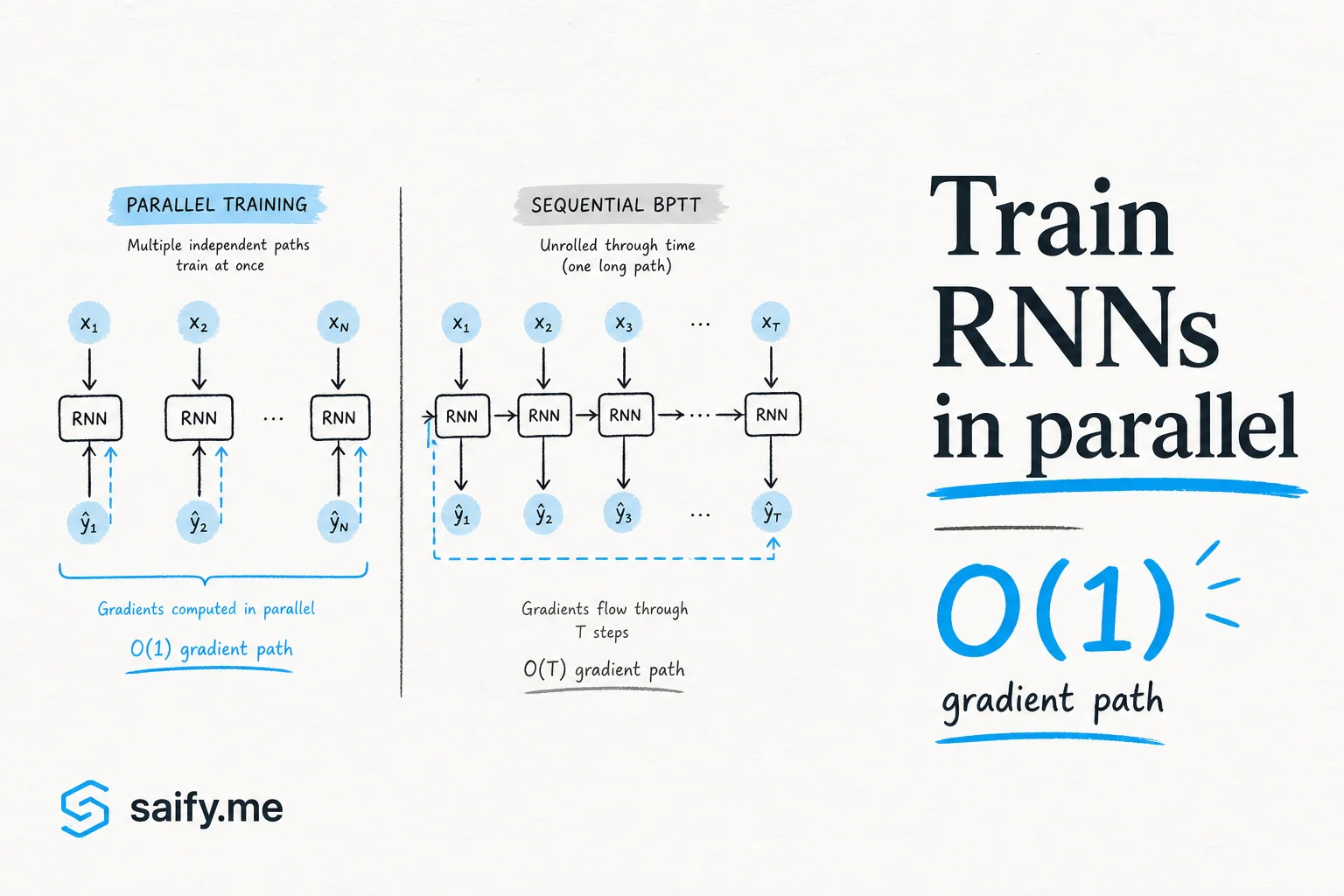
Transformers won because they train in parallel. RNNs lost because backpropagation through time (BPTT) is sequential, unstable, and painful on long contexts.
A June 2026 MIT preprint asks a sharper question: what if you never unroll the RNN at all during pretraining?
Pretraining Recurrent Networks without Recurrence introduces Supervised Memory Training (SMT). Akarsh Kumar and Phillip Isola train nonlinear RNNs by reducing the problem to one-step supervised learning on memory transition labels.
Why BPTT breaks down
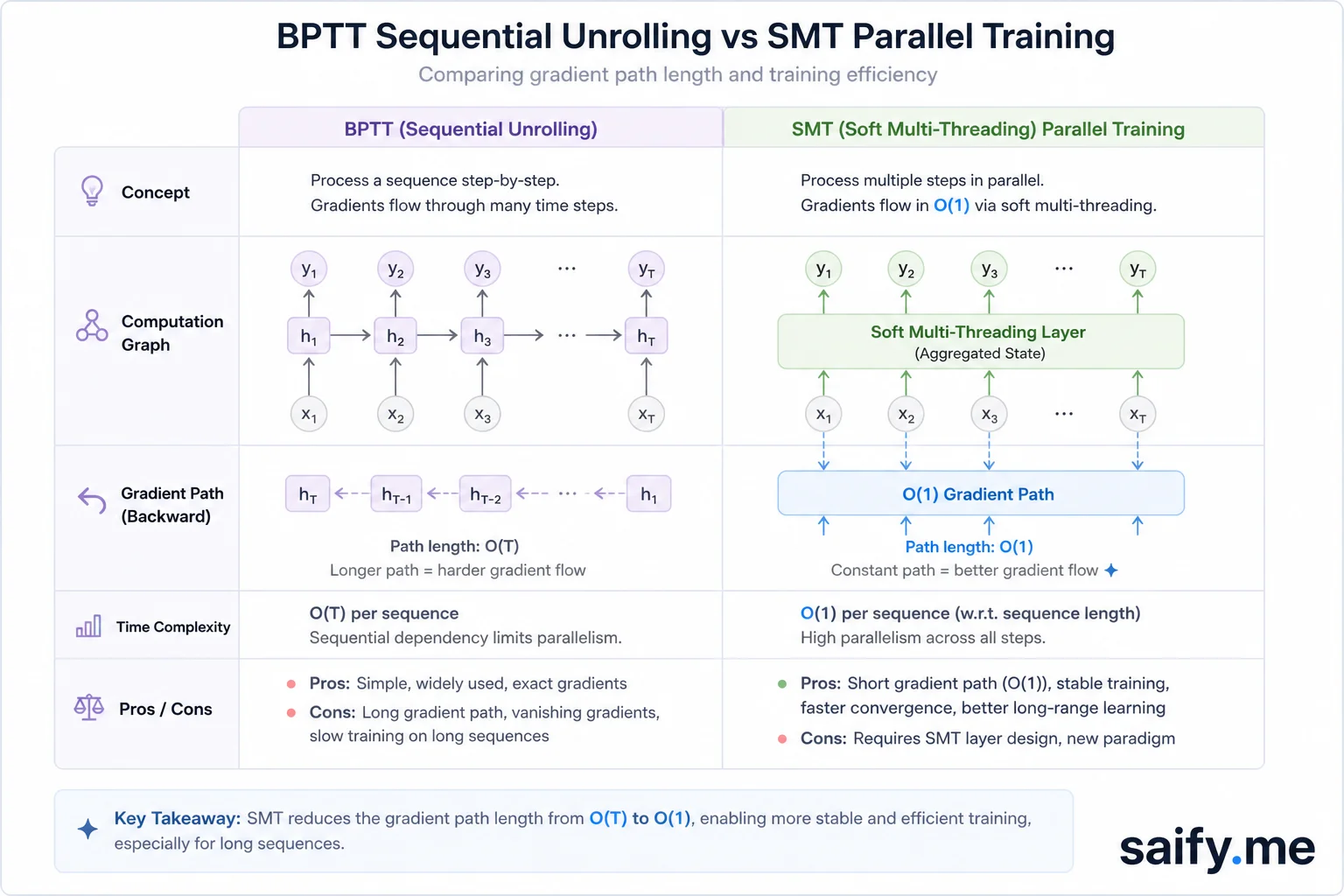
Standard RNN training propagates credit across every timestep. That creates two well-known problems:
| BPTT pain point | What goes wrong |
|---|---|
| Sequential unrolling | Hard to saturate GPU parallelism on long sequences |
| Gradient path length | O(T) between distant tokens |
| Vanishing/exploding grads | Long-range associations are hard to learn |
Transformers sidestep recurrence with attention. RNNs keep O(1) memory per token at inference, which still matters for edge deployment, streaming, and fixed-state controllers. The missing piece was a training method that does not inherit BPTT's baggage.
How SMT works in plain language
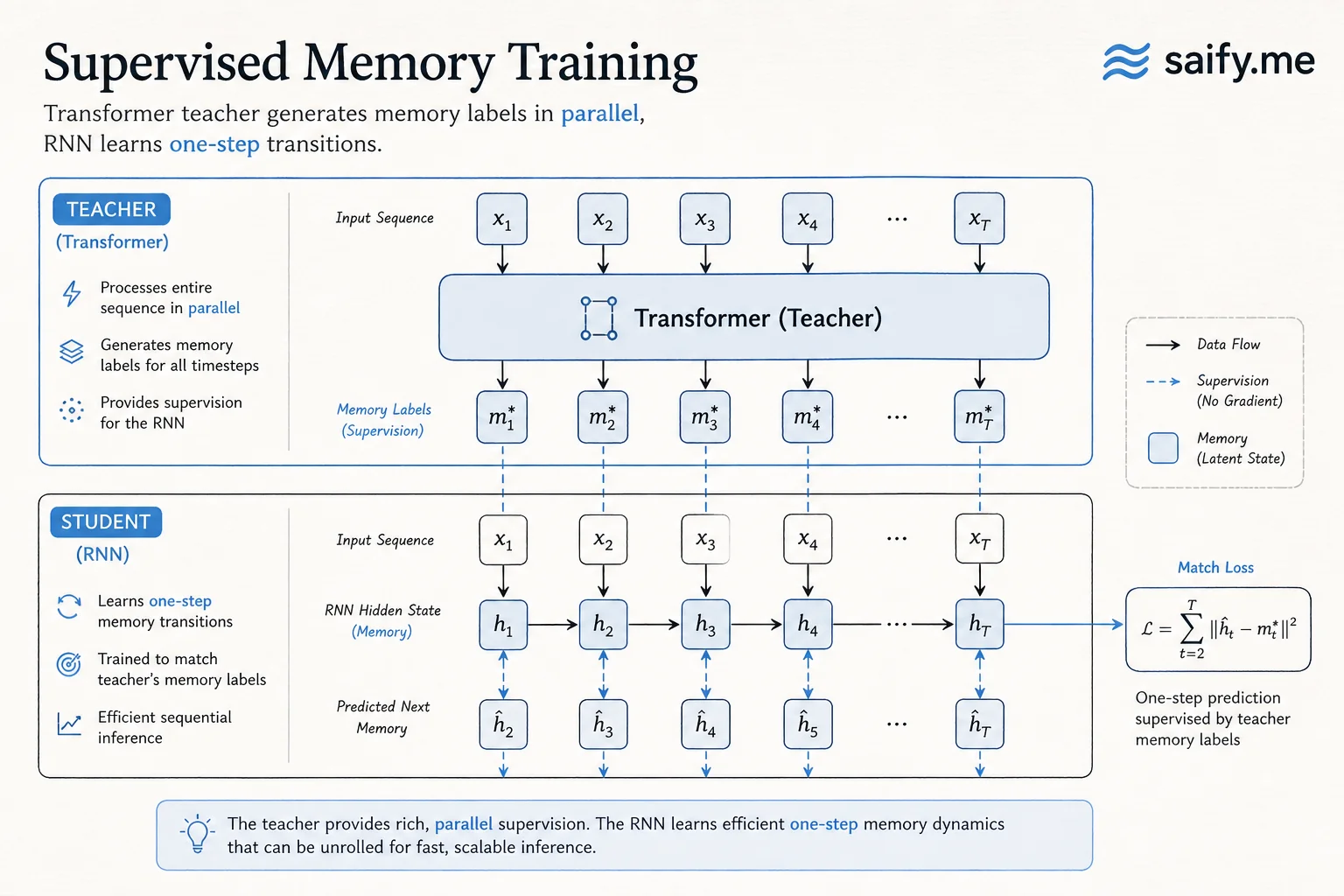
SMT splits the problem into two jobs:
- What to remember (memory representation): learn a predictive state that compresses the past into what is needed to predict the future.
- How to update memory (memory dynamics): train the RNN to execute
(m_t, x_{t+1}) -> m_{t+1}with supervised targets.
The trick is getting those targets. SMT trains a Transformer-based teacher on a predictive state objective. The teacher sees the sequence in parallel and outputs optimal memory labels m*_t for every timestep.
Then the nonlinear RNN trains with ordinary supervised loss to mimic those transitions one step at a time, without ever unrolling credit across the full horizon during pretraining.
Result: time-parallel RNN pretraining with a stable O(1) gradient path between any two tokens.
DAgger Memory Training (DMT) for drift
Pure teacher forcing can drift when the RNN's own states diverge from the teacher distribution. The paper adds DAgger Memory Training (DMT): a lighter fine-tuning stage where the RNN continues on its own rollouts while staying aligned to teacher trajectories.
Think of SMT as parallel pretraining, DMT as distribution correction. DMT is not fully parallel, but it is cheaper than full BPTT on long sequences.
What the experiments show
The authors benchmark on synthetic sequence tasks and generative modeling:
| Task family | SMT vs BPTT |
|---|---|
| Gradient stability, memory capacity, associative recall | SMT wins as sequences lengthen |
| Pixel sequence modeling (MNIST, Sketchy) | Better structure preservation vs BPTT GRUs |
| TinyStories language modeling | Competitive data efficiency, lower sequential compute |
The headline is not "RNNs beat Transformers on everything." It is nonlinear RNNs can capture longer dependencies when you stop training them with BPTT.
Limitations are explicit on the project page: SMT targets seq2seq pretraining (language modeling, behavioral cloning). It does not directly optimize arbitrary RL reward functions the way BPTT can.
Why applied AI engineers should care
Most production teams are not swapping GPT-class Transformers for GRUs next quarter. The paper still matters for three reasons:
1. Inference economics. Constant memory per token is attractive for on-device agents, robotics state estimators, and streaming pipelines where KV cache growth hurts.
2. Training recipes transfer. Teacher-student memory labeling is a pattern you can borrow in smaller systems (compression layers, world models, recurrent critics) even if the full SMT stack stays in research.
3. Hardware utilization. Parallel label generation plus one-step RNN updates is closer to how we already train encoders and heads separately in multimodal stacks.
If you want the full walkthrough, the authors posted a paper explainer on YouTube.
Open questions I am watching
- Does SMT scale to billion-parameter RNN backbones, or stay in the "interesting mid-size" regime?
- How gated architectures (LSTM/GRU) behave vs newer recurrent blocks under SMT (the paper notes some gated backbones struggle with memory-space collapse).
- Whether predictive-state teachers can be distilled away so inference needs only the RNN.
Recurrent models are not dead. They were stuck behind a bad training default. If you are evaluating edge inference or building sequence models for ops automation, book a free call and we can sanity-check whether recurrent architectures fit your latency and memory budget.