
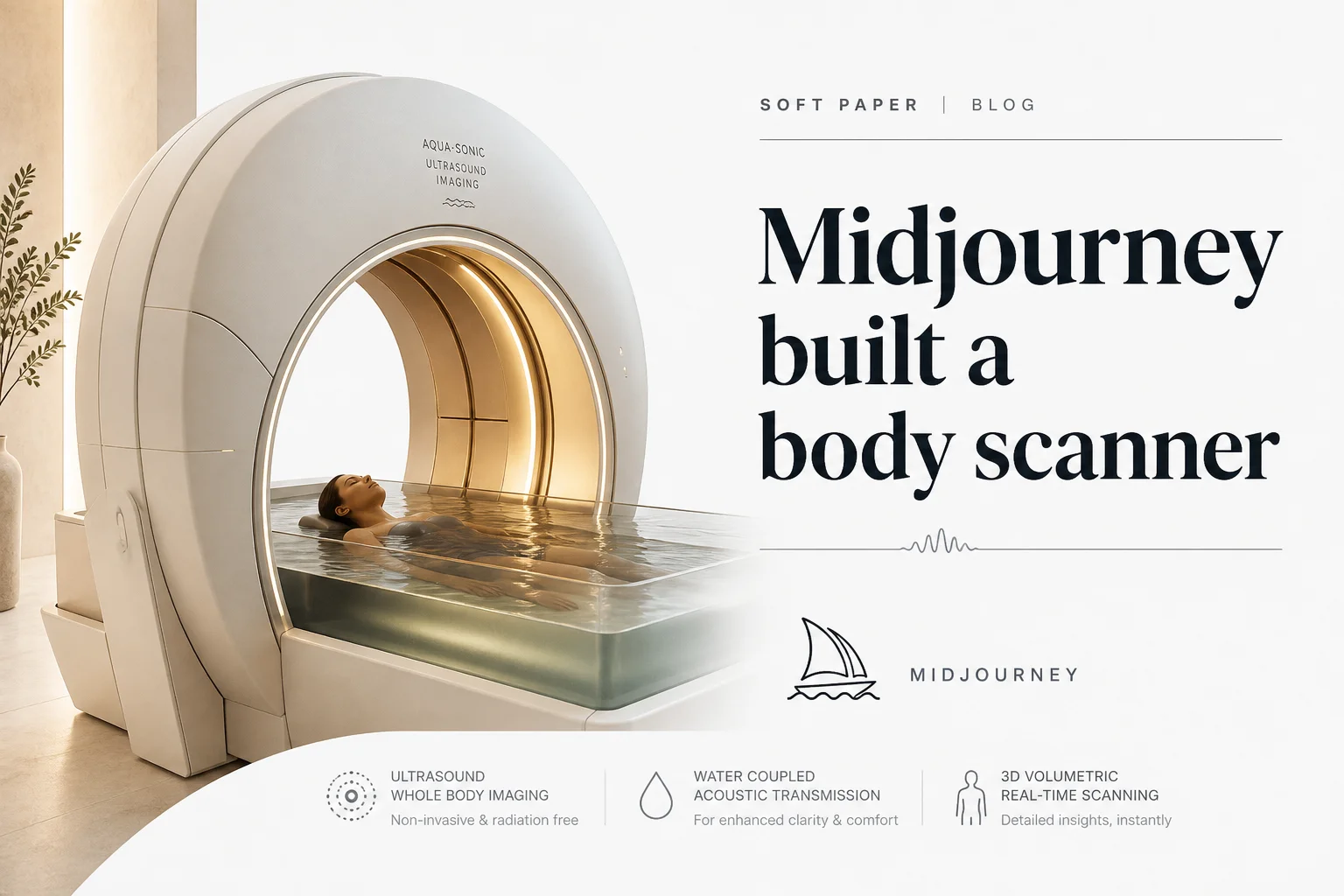
Midjourney made cat pictures famous. In June 2026, CEO David Holz walked on stage and announced a full-body medical scanner, a San Francisco spa, and a goal of 50,000 devices worldwide by 2031.
I did not see that pivot coming. Neither did most of the AI crowd. But the more I read the specs, the more interesting the story gets: the scanner does not use Midjourney's generative AI at all.
What Midjourney Medical actually announced
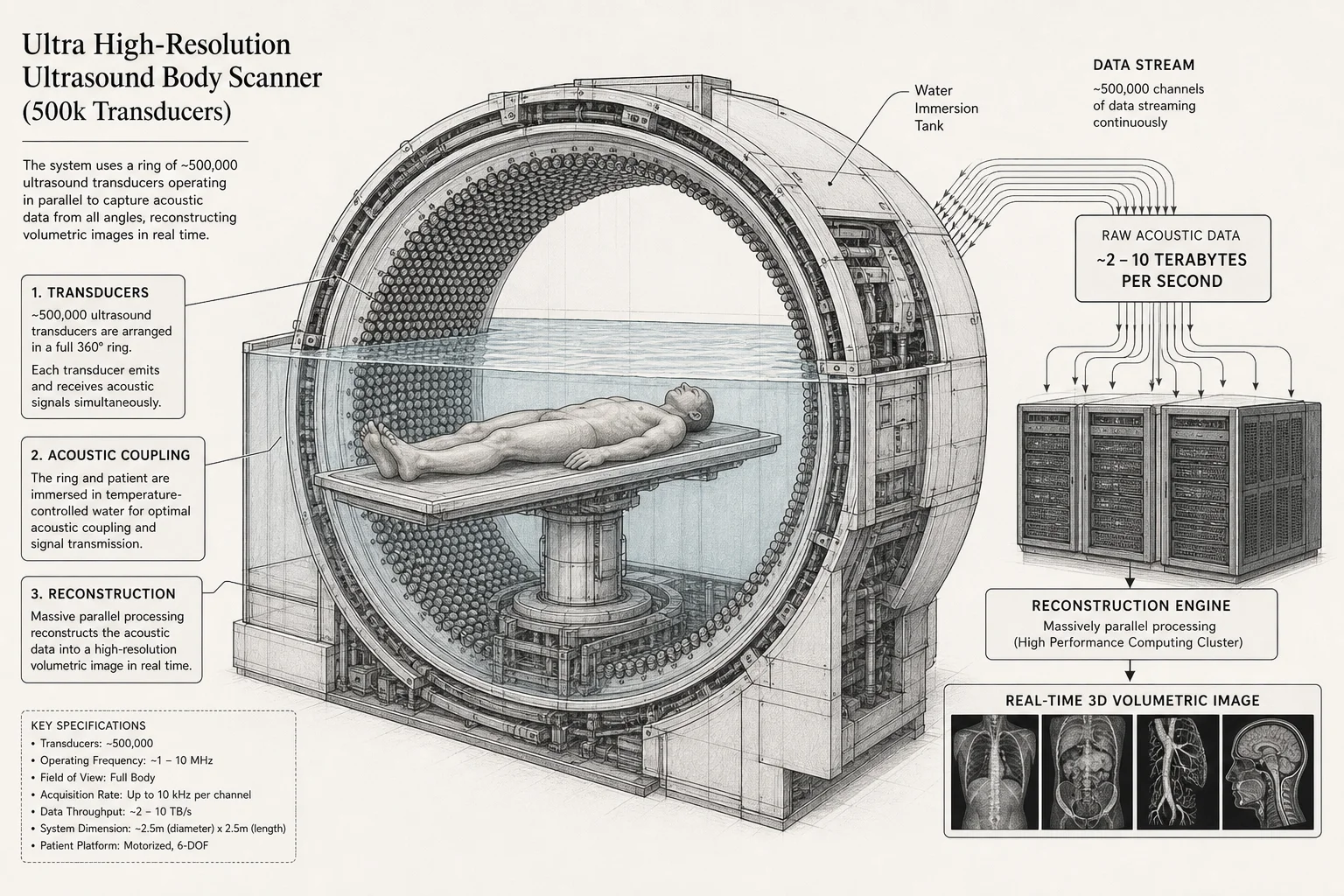
The product is called The Midjourney Scanner, branded as Ultrasonic CT or USCT. It is not a CT scan. No X-rays, no radiation. It is ultrasound tomography: sound waves pass through your body from every angle while you are immersed in water.
| Spec (prototype) | Claim |
|---|---|
| Transducer elements | ~500,000 in a ring array |
| Scan time (target) | 60 seconds |
| Data rate | Terabytes per second |
| Reconstruction compute | ~2 petaflops per system |
| Cost per scan (goal) | A few dollars |
| People scanned at reveal | ~12 |
You step onto a platform. It lowers you at roughly 2 inches per second through a ring of transducers while submerged in a shallow pool. The water is not spa theater. Ultrasound needs acoustic coupling; air reflects almost all incident sound.
Holz described the goal as catching health changes early, like version control for your body. Scan regularly, spot drift in muscle, fat, bone density, and organs before symptoms show.
Butterfly Network, not diffusion models
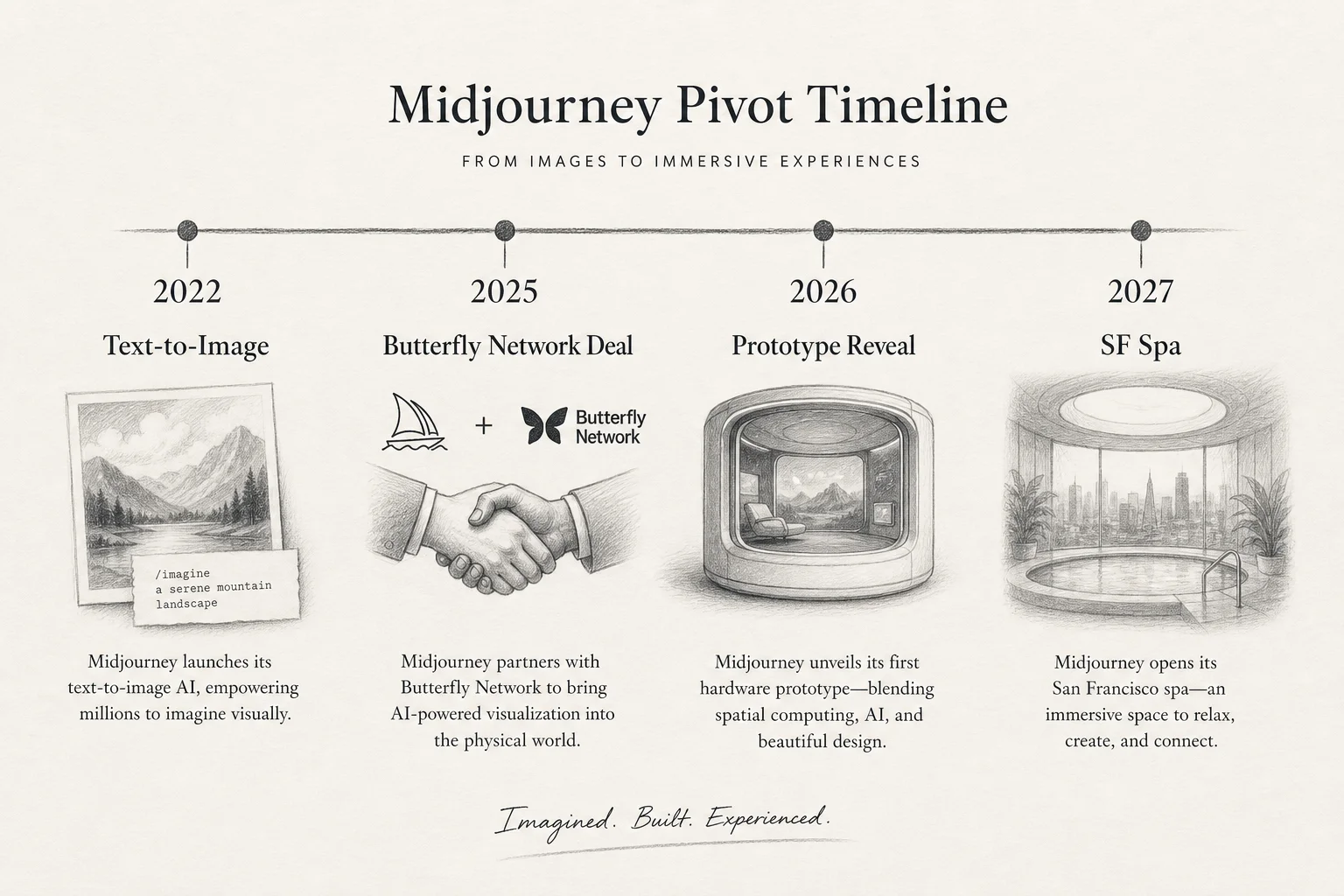
The imaging physics come from Butterfly Network , not from Midjourney's diffusion stack. In November 2025, the companies signed a co-development and licensing deal worth up to about $74 million over five years.
The Gen-1 prototype uses 40 Butterfly Ultrasound-on-Chip modules, with 358,400 to 500,000 individual sensor elements depending on the source. Each element acts as both emitter and receiver. Future generations are expected to scale up the chip count.
Butterfly has been clear: they will support clinical claims with valid data "as applicable." That is a measured position for a prototype that has scanned roughly a dozen people.
The Verge coverage notes Holz compared image quality ambitions to MRI in some respects. Those are Midjourney's claims, not peer-reviewed results.
What is real vs what is roadmap
This is where hype and engineering diverge.
| Exists now | Claimed or planned |
|---|---|
| Working Gen-1 prototype, demoed live | Image quality comparable to MRI |
| Body composition mapping (launch capability) | Full diagnostic imaging |
| Butterfly licensing deal | 50,000 scanners by 2031 |
| Public announcement and marketing site | 1 billion scans per month |
| ~12 people scanned | Midjourney Spa in SF Union Square, late 2027 |
No FDA clearance as of the announcement. Midjourney is positioning early offerings as wellness and body composition, not clinical diagnosis. Expanded diagnostic claims would require regulatory evidence they have not published.
There is also a timing gap: reports note the Gen-1 scanner takes roughly 20 minutes for a full scan today, not 60 seconds. The sub-minute experience is a Gen-2/Gen-3 target with custom silicon.
Why an AI company is building spas
The business model is the part I keep thinking about. Holz wants Midjourney Spa locations: gym, saunas, cold plunges, and scanning rooms with hot tubs. The first flagship targets San Francisco before end of 2027, with about 10 scanners per site.
That is a consumer wellness play, not an enterprise imaging sale. Cheap recurring scans, longitudinal body maps, upsell into fitness and recovery services. It rhymes with how some MRI startups tried direct-to-consumer screening, but with ultrasound economics instead of million-dollar machines.
For context on the pivot from software to atoms, see BetaNews and the detailed skepticism in Creeta's breakdown of what is verified vs aspirational.
What this means if you build AI products
Three lessons land for applied AI work, even if you never step into a scanning tank.
1. Adjacent industry pivots are real. AI labs are not just adding features. They are launching hardware, spas, and regulated health products. Your competitor might not be another SaaS tool.
2. Brand ≠ technology. Midjourney Medical sounds like generative imaging. The scanner is classical acoustic physics plus massive compute. Read the stack, not the logo.
3. Prototype demos ≠ production scale. A dozen scans, no FDA path published, and a five-order-of-magnitude gap to a billion monthly scans. Due diligence matters when vendors show glossy hardware.
I am not betting against ambitious hardware. I am betting that evidence timelines will be the story through 2027.
Open questions for 2027
- Will the SF spa open on schedule with diagnostic-grade outputs or wellness-only maps?
- How does Butterfly's clinical data support evolve as Midjourney makes stronger claims?
- Does custom silicon actually hit 60 seconds and single-digit-dollar scan costs?
- What happens to Midjourney's core AI image business while capital flows to medical imaging?
If you are in health tech or wellness, watch the FDA filing trail more than the launch event photos.
Shipping AI into regulated or hardware-adjacent products? Book a free discovery call and we can pressure-test the architecture before you commit.