
Your brain is a noisy electrical storm. Turning that chaos into readable text used to mean drilling into skull tissue or settling for single-character guesses from EEG caps.
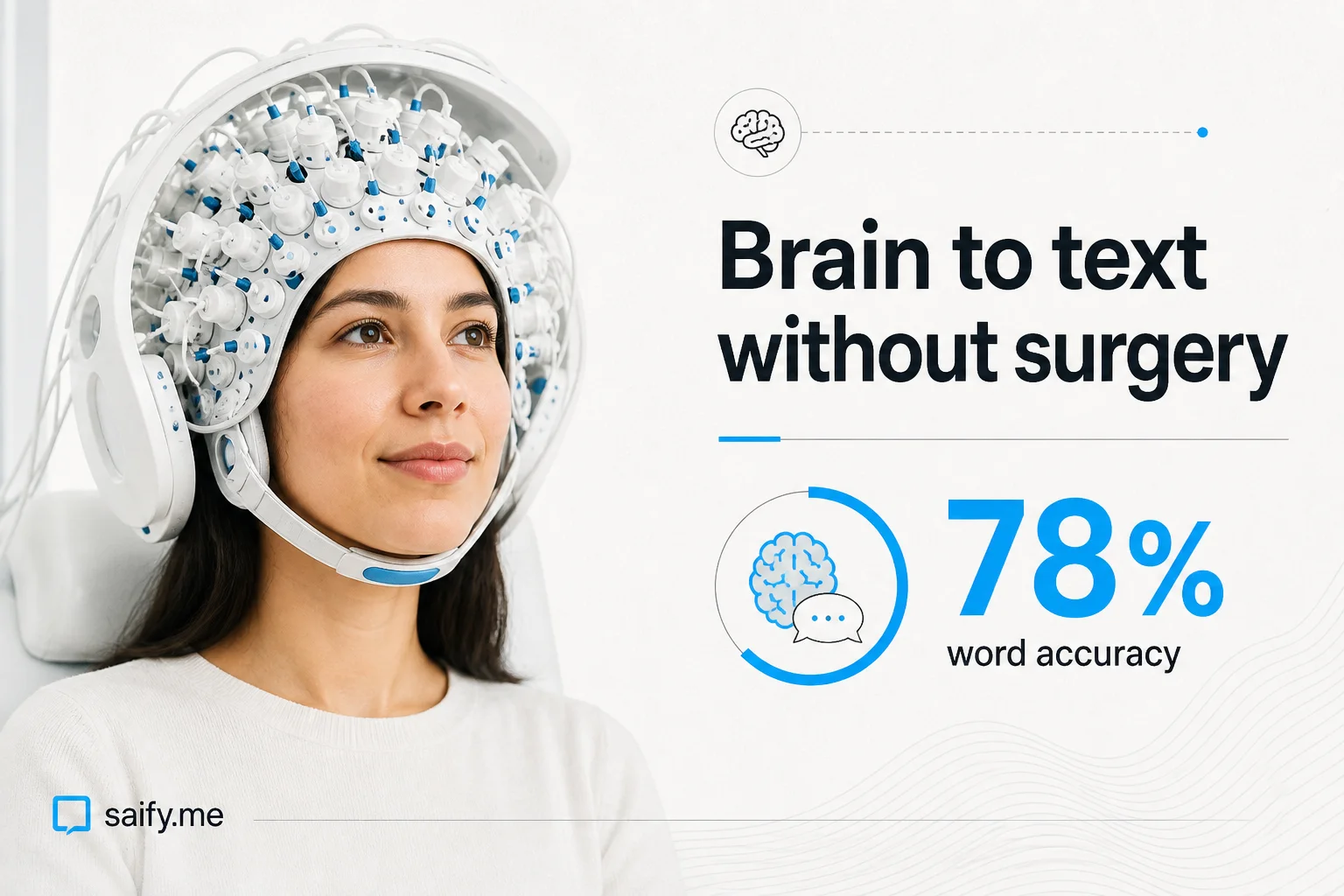
Meta's Brain2Qwerty v2 changes the framing. It decodes full natural sentences from a non-invasive MEG helmet, hits 78% word accuracy on the best participant, and ships open training code you can extend today.
What v2 actually does differently
Brain2Qwerty v1, published in Nature Neuroscience, predicted keystrokes from MEG patterns. Useful science, but not real-time typing. v1 needed the timing of every keypress, so it could not run asynchronously while someone thinks and types.
v2 removes that constraint. It decodes whole sentences from one continuous MEG window without segmenting around individual keystrokes.
The architecture stacks three modules trained jointly:
| Module | Role |
|---|---|
| Conv + Conformer encoder | Reads raw MEG signals with a character-level CTC head |
| Word-level contrastive aligner | Maps neural word embeddings to LM word embeddings |
| LoRA-adapted language model | Autoregressively generates the final sentence |
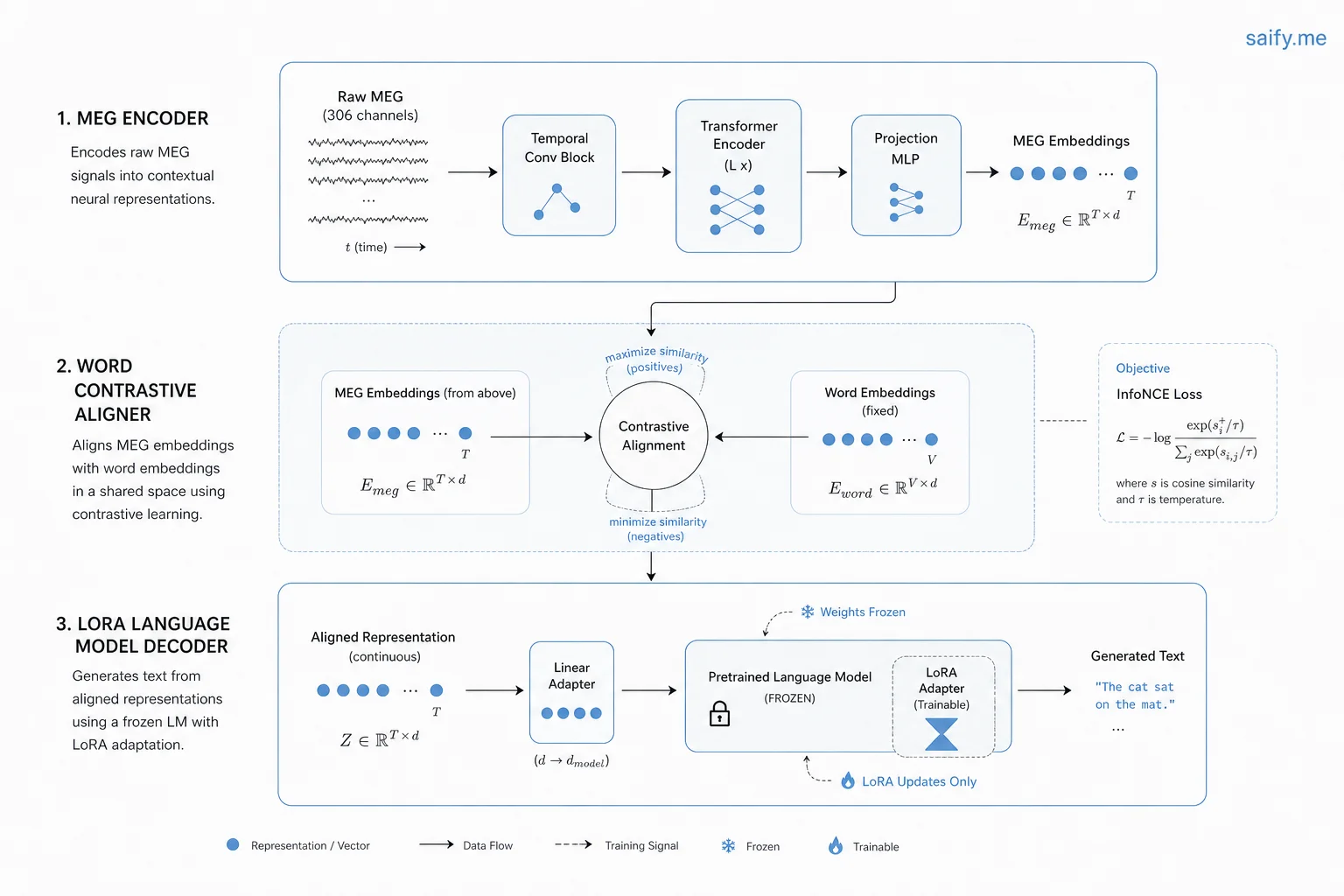
That hierarchy matters. v1 chased characters. v2 chases words and meaning, then uses a fine-tuned LM to clean up noise. The LM is doing real work, not just post-processing.
The numbers from nine volunteers
Meta trained on roughly 22,000 sentences from nine participants, each wearing a MEG device for about 10 hours while actively typing.
| Metric | Result |
|---|---|
| Average word accuracy | 61% across all participants |
| Best participant | 78% word accuracy |
| Sentence quality | 50%+ decoded with one word error or less |
| Scaling | Log-linear improvement with more data per person |
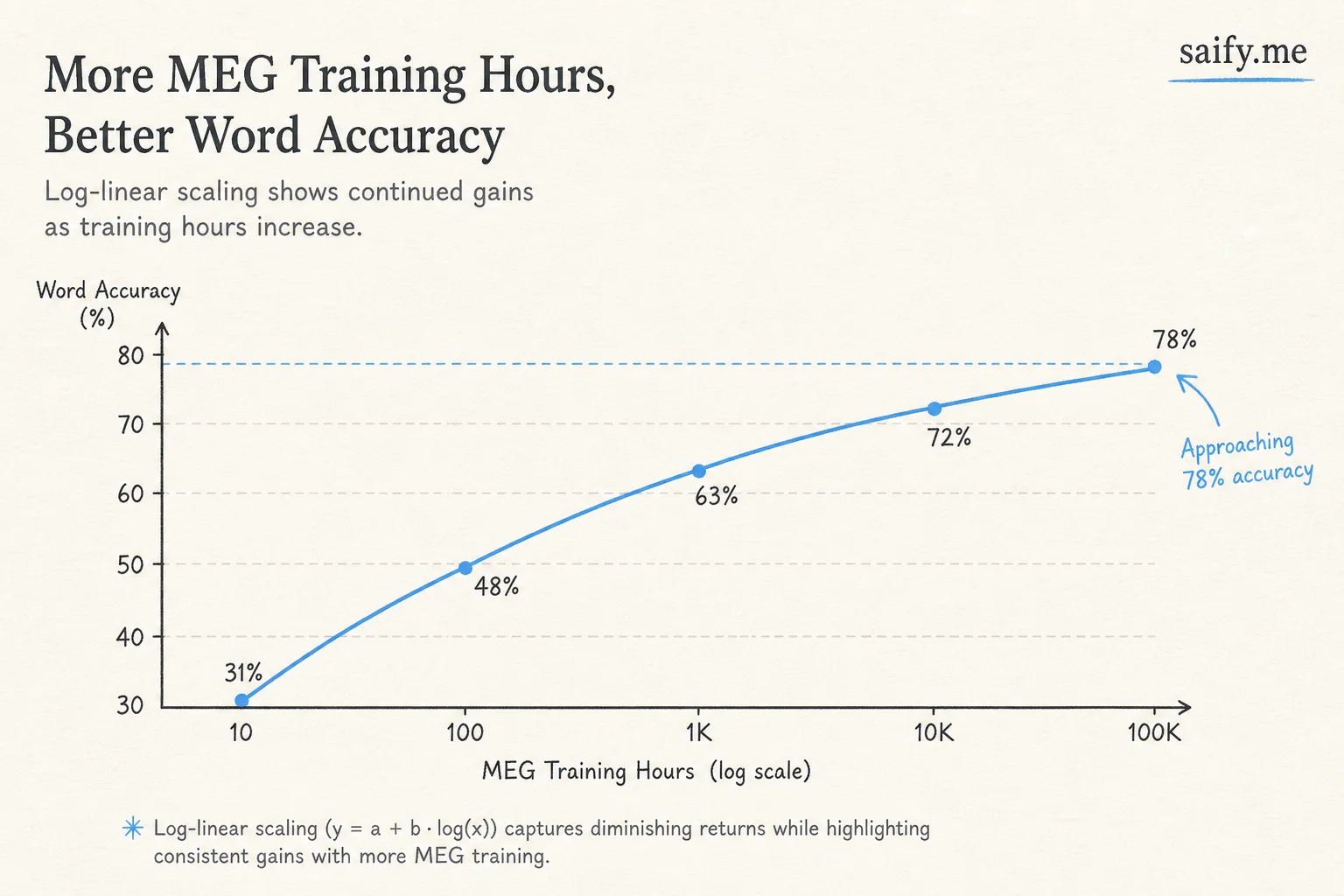
The scaling law is the part I keep coming back to. Meta reports a detectable performance plateau, but accuracy still climbs log-linearly with data volume. That suggests the gap versus surgical BCIs might narrow with more recording hours, not only better algorithms.
For context, invasive implants still win on raw accuracy. But 78% word accuracy without surgery is a different product category than "type one letter at a time."
Why MEG, and why this is still hard
MEG reads magnetic fields from neural activity. It is non-invasive: you wear a helmet with superconducting sensors cooled in a dewar. The study setup is a large scanner, not a consumer wearable yet.
Meta is explicit about two remaining blockers:
- Accuracy for daily use. 61% average is research-grade, not clinic-grade for locked-in patients who need near-perfect decoding.
- Hardware access. Room-scale MEG is not something you buy on Amazon. Wearable MEG sensors are improving, which is why Meta sounds cautiously optimistic about clinical transfer.
None of that diminishes the software contribution. The decoder is now open. The bottleneck is increasingly data and sensors, not secret model architecture.
What Meta released (and what is still locked)
The facebookresearch/brain2qwerty repo includes:
- Full v1 and v2 training code (PyTorch Lightning)
- Evaluation pipelines and experiment configs
- Links to v1 Spanish BCBL data on Hugging Face
The v2 English dataset stays under embargo until the paper clears review. You can still study the architecture, reproduce on v1 data, or plug in your own MEG recordings if you have them.
Training entry points from the v2 README:
python -m brain2qwerty_v2.main train
python -m brain2qwerty_v2.main eval --ckpt <checkpoint_path>
The reference config uses a single LoRA adapter (rank 2) tuned across all subjects together. Simpler than per-subject fine-tuning, and the paper reports results for that shared setup.
License is CC BY-NC 4.0. Fine for research. Not for commercial products without a separate deal.
How this connects to applied AI work
I do not build BCIs for clients. I do build signal-to-text pipelines where the input is messy and the output must be usable: call transcripts, OCR dumps, sensor logs, CRM notes.
Brain2Qwerty v2 is a textbook case of the pattern I reuse:
- Raw encoder on high-rate noisy input (MEG, audio, vision)
- Alignment objective that maps latent states to a known embedding space
- Generative LM head that enforces language prior and fixes local errors
Swap MEG for mel spectrograms and you are halfway to a voice stack. Swap word embeddings for document chunks and you are describing a RAG reranker. The stack is general even when the sensors are exotic.
Meta also ties this into broader neuro-AI infrastructure: NeuralSet for brain data at scale, NeuralBench for evaluation, and the Digital Brain Project fund for open datasets. If you are betting on multimodal foundation models that include biosignals, this repo is a concrete baseline.
What I would test first
If you have MEG lab access (university hospital, cognitive neuroscience group):
- Reproduce v1 on the public Spanish BCBL set before touching v2 configs.
- Measure per-subject scaling: Meta's log-linear curve is the most actionable finding for experiment design.
- Ablate the LM head: how much of the 78% ceiling is encoder vs LoRA decoder?
If you do not have MEG access, still worth reading the paper for the joint training schedule (staged objectives across character, word, and sentence levels). That scheduling shows up in other alignment problems.
Risks and honest limits
- Participant count is tiny. Nine people is not population coverage.
- Typing task bias. Active typing while scanned is not the same as imagined speech or attempted movement for ALS patients.
- Hardware lock-in. Software democratization does not democratize a $2M MEG suite.
- Non-commercial license. Product teams need a different legal path.
Bottom line
Brain2Qwerty v2 is the strongest public result I have seen for non-invasive sentence decoding. 78% word accuracy without surgery is a headline. The open code and scaling curve are the story for builders.
We are not at consumer brain keyboards yet. We are at the point where the expensive, exclusive part (the decoder stack) got cheaper and more accessible fast. That is the democratization pattern worth tracking.
If you are exploring multimodal pipelines, assistive interfaces, or custom signal decoders for production, book a free discovery call.