
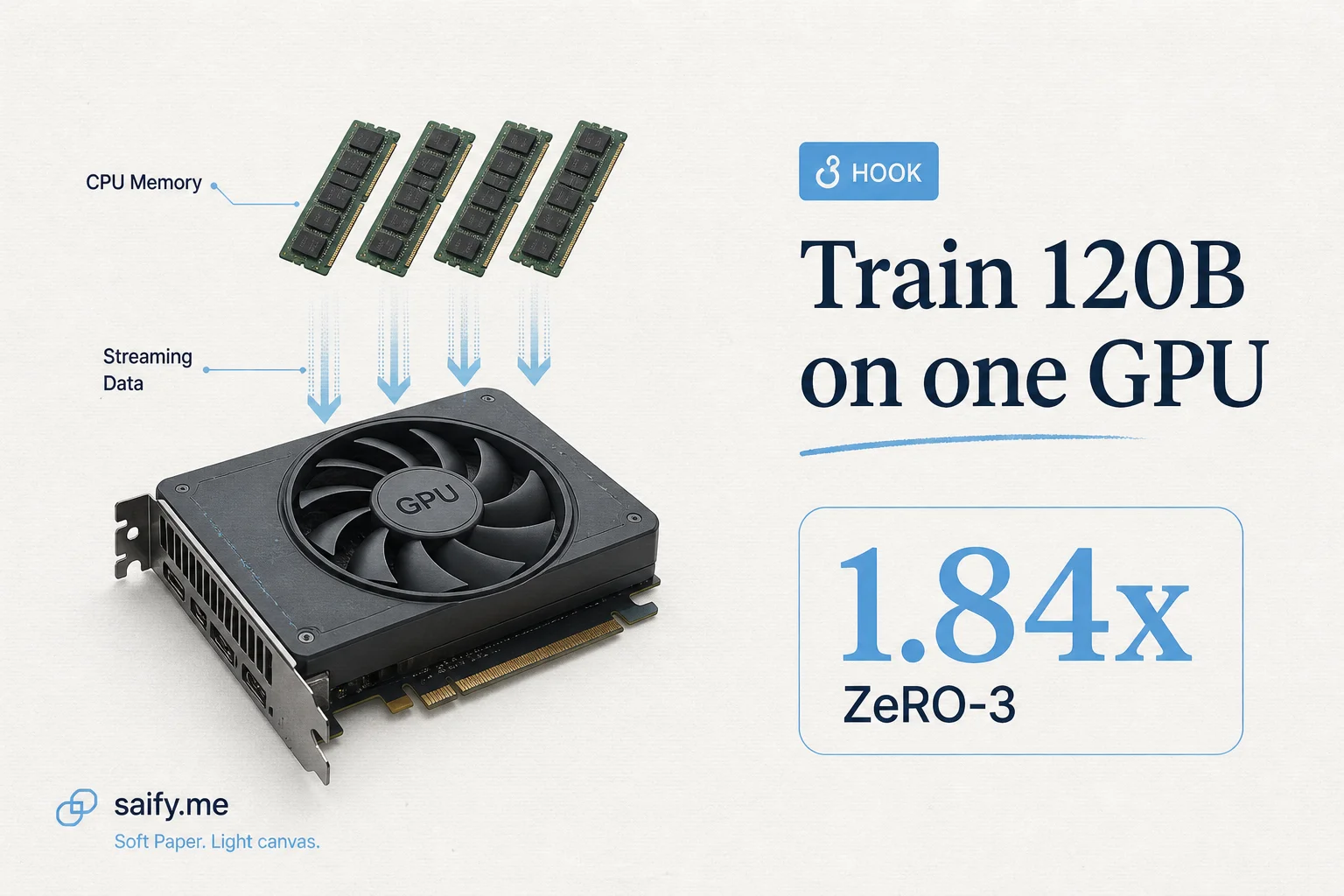
Training a 120B parameter model used to mean a cluster bill or heroic quantization hacks. MegaTrain asks a simpler question: what if the GPU is just a math coprocessor and RAM is the real warehouse?
The MegaTrain paper and open-source implementation train 100B+ models at full precision on a single GPU by storing weights in host CPU memory and streaming one transformer layer at a time.
The memory-centric design
Traditional training stacks are GPU-centric: fit the model, activations, and optimizer states in VRAM or shard across many GPUs with NCCL.
MegaTrain flips the assumption:
| Component | Location |
|---|---|
| Parameters + optimizer states | Host RAM |
| Forward/backward compute | GPU (one layer resident) |
| Autograd graph metadata | Stateless layer templates |
For each layer, MegaTrain prefetches weights, runs the matmuls, offloads gradients, and evicts. Persistent GPU state never exceeds one layer's footprint.
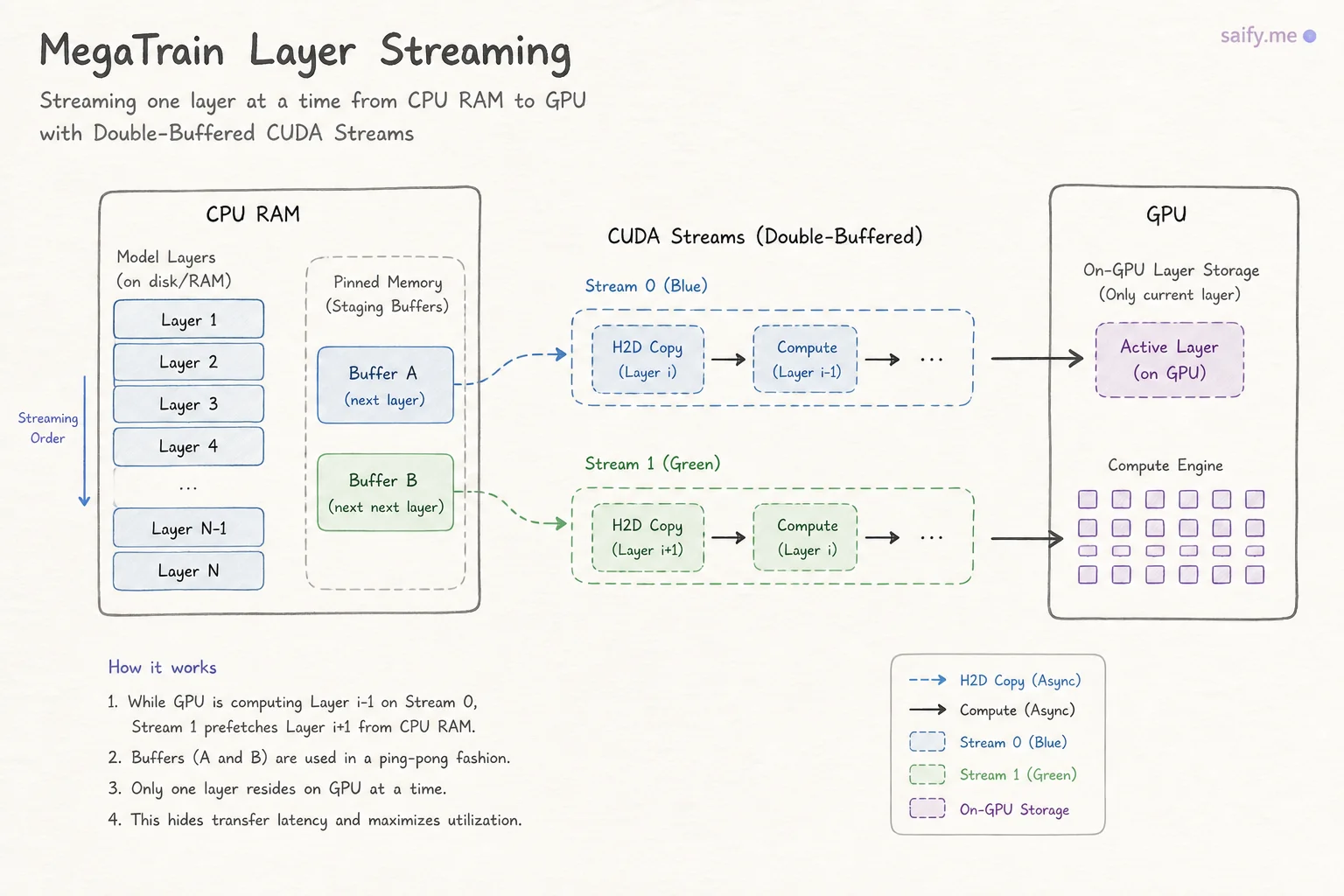
That is how a single H200 with 1.5TB host RAM reaches 120B parameter training. You are not magic-shrinking the model. You are accepting PCIe bandwidth as the price of scale.
Two optimizations that make it practical
Pipelined double buffering
CPU-GPU transfers are slow if you serialize fetch → compute → offload. MegaTrain overlaps them across multiple CUDA streams: while layer n computes, layer n+1 prefetches.
Stateless layer templates
PyTorch autograd normally assumes parameters stay on device for the whole backward pass. Streaming weights breaks that.
MegaTrain binds a stateless template (empty transformer block) to whatever weights stream in. Math ops decouple from persistent tensors. That eliminates huge graph metadata and caps VRAM at one layer.
Benchmark numbers worth citing
From the paper and repo README:
| Scenario | Result |
|---|---|
| Max model on H200 + 1.5TB host | 120B parameters reliably |
| 14B on GH200 vs ZeRO-3 offload | 1.84x throughput |
| 32B on GH200 | 250+ TFLOPS (baselines OOM) |
| Long context bonus | 7B at 512k tokens on single GH200 |
ZeRO-3 Offload and ZeRO-Infinity either OOM earlier or fall off the throughput cliff as scale grows. MegaTrain's pitch is not "free lunch." It is predictable single-GPU scaling when you already bought the RAM.
Who this is actually for
Not for everyone with a 24GB consumer card. Budget ~12GB host RAM per 1B params for full-precision states. 120B wants server-class memory.
Good fit:
- Research labs with one fat GPU box and terabytes of RAM
- Fine-tuning experiments on models too large for VRAM alone
- Teams avoiding multi-GPU NCCL pain for mid-scale runs
- Ultra-long context training (512k tokens on 7B is a side effect of layer-wise design)
Bad fit:
- Latency-sensitive production training (streaming hurts)
- Teams without PCIe bandwidth headroom
- When you already have a healthy multi-GPU cluster (just use FSDP)
The repo supports many architectures (Qwen, Llama, Mistral, DeepSeek, Gemma, GPT-OSS, MoE variants). Check the model table before assuming your config is tested.
How this fits the democratization theme
The digest framed today's news as "expensive → accessible." MegaTrain is the training-side version:
- Before: 120B fine-tune implies cluster orchestration skills
- After: one H200 + RAM warehouse + open code
It does not make 120B training cheap. RAM at terabyte scale is still capital expense. It makes it composable on hardware some teams already own for other workloads.
Pair mentally with consumer GPU quants on the inference side. Training and serving are both moving toward "use the memory you have cleverly."
Risks and limits
- Host RAM is the new bill. 1.5TB is not a laptop.
- Throughput vs cluster. Single-GPU streaming will not beat a well-tuned 8xH100 job on wall-clock for everything.
- Software maturity. New repo; expect sharp edges on MoE and exotic architectures.
- Full precision only in the headline claim. Quantized training paths may differ.
Bottom line
MegaTrain treats GPU VRAM as a cache line and CPU RAM as main memory for billion-parameter models. That mental model is old in HPC. It is new in the "fine-tune a frontier model on whatever box IT already bought" world.
If you are sizing hardware for private model work or exploring single-node training before you rent a cluster, this is worth a benchmark on your actual motherboard and PCIe gen.
Need help evaluating training vs inference economics for a custom model project? Book a free discovery call.