
Future Claude models will ship with an invisible text watermark. Not a badge in the margin. Not a hidden Unicode character. A statistical pattern in low-stakes word choices that only shows up if you have the detection key.
Anthropic published the details in August 2026 to comply with the EU AI Act and the EU Code of Practice on AI-generated content. If you ship customer-facing copy, code comments, or support macros through Claude, this affects your disclosure story even outside Europe because Anthropic is applying it globally at launch.
How the watermark actually works
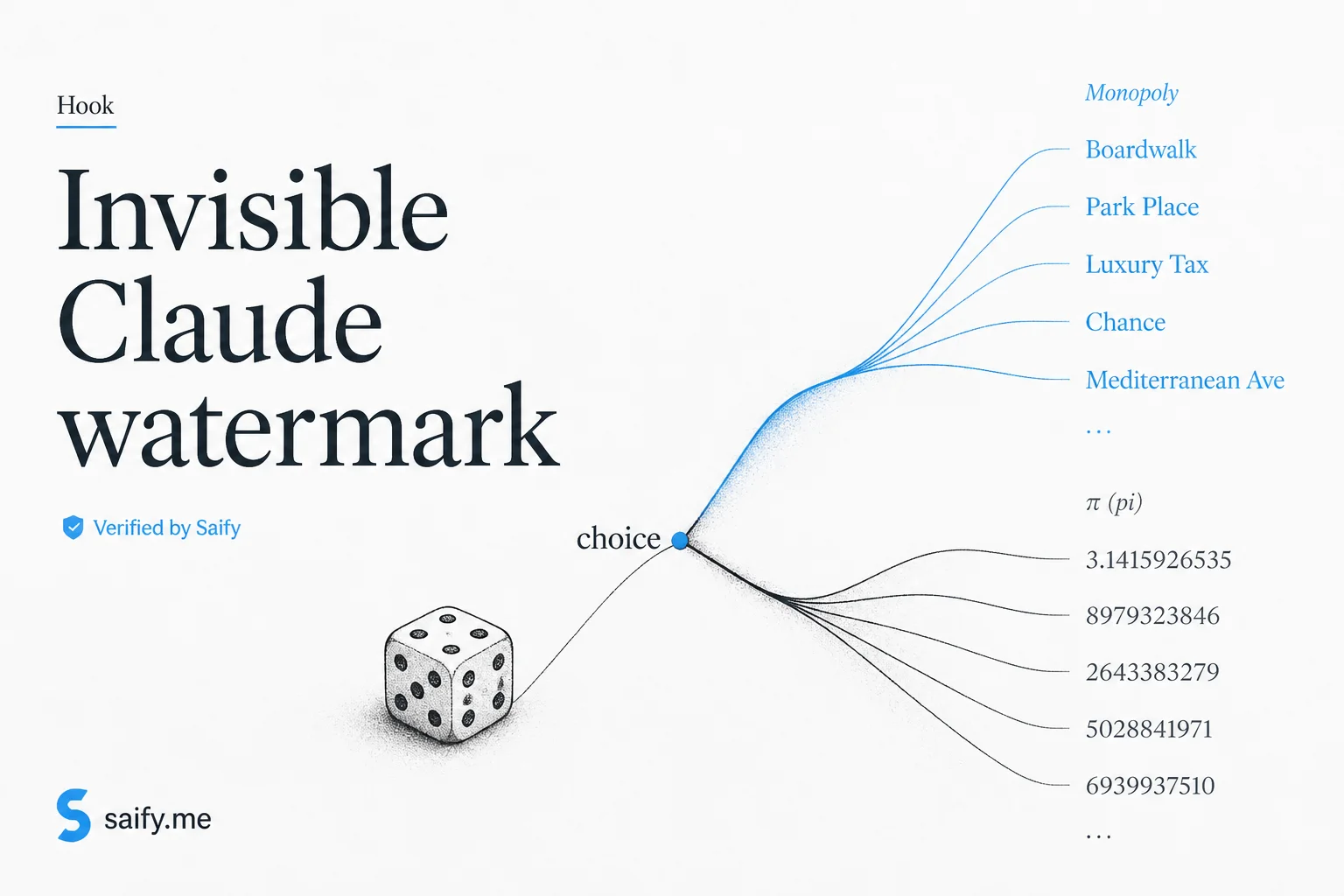
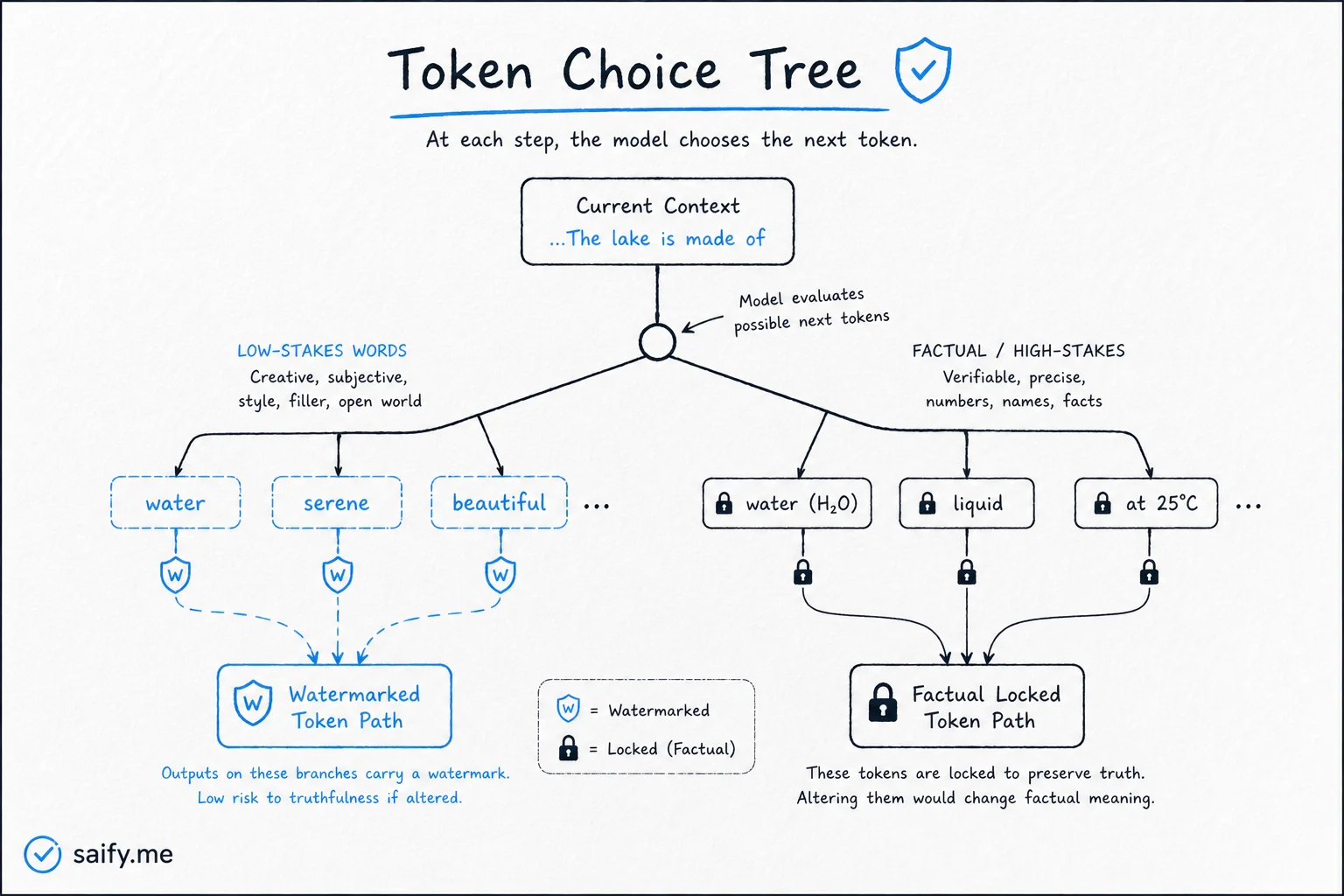
LLMs pick the next token from a candidate list. When two words are equally good ("overcast" vs "grey"), the model usually rolls dice. Watermarking changes the dice: still random-looking, but derived from a secret key plus prior words.
Anthropic's analogy is Monopoly played with digits of pi instead of physical dice. Moves still feel random to players. After the game, someone with the key can test whether the sequence matches the pi-driven pattern.
Important constraints from Anthropic's post:
| Property | Detail |
|---|---|
| Quality impact | Internal testing shows no readable difference |
| Cost / latency | No extra tokens; negligible speed impact |
| User tracing | Cannot recover person, org, or chat |
| Code | Sparse watermarking where tokens must be exact |
| Short text | Weak detection on small samples |
SynthID-Text, not a new invention
The method is a Claude-specific implementation of Google DeepMind's SynthID-Text approach (Nature, 2024), in the family of schemes Scott Aaronson proposed in 2022. Same design principle: only the randomness source changes, not the candidate word set.
That matters for procurement. Watermarking is becoming a checkbox in EU compliance reviews. It is not a Claude-only experiment.
Where watermarking barely applies
Factual completions have no slack. After "Isaac Newton's most famous work was called Principia...", the next token is essentially fixed. Proofreading human text leaves few model-chosen words, so detection may fail unless Claude rewrote heavily.
Code behaves similarly. Syntax and APIs constrain tokens. Watermarks may appear in comments or variable names where choices are arbitrary, not in 2 + 2 = 4.
Translations are fully watermarked because every word is a model choice.
Watermarks vs detectors vs C2PA
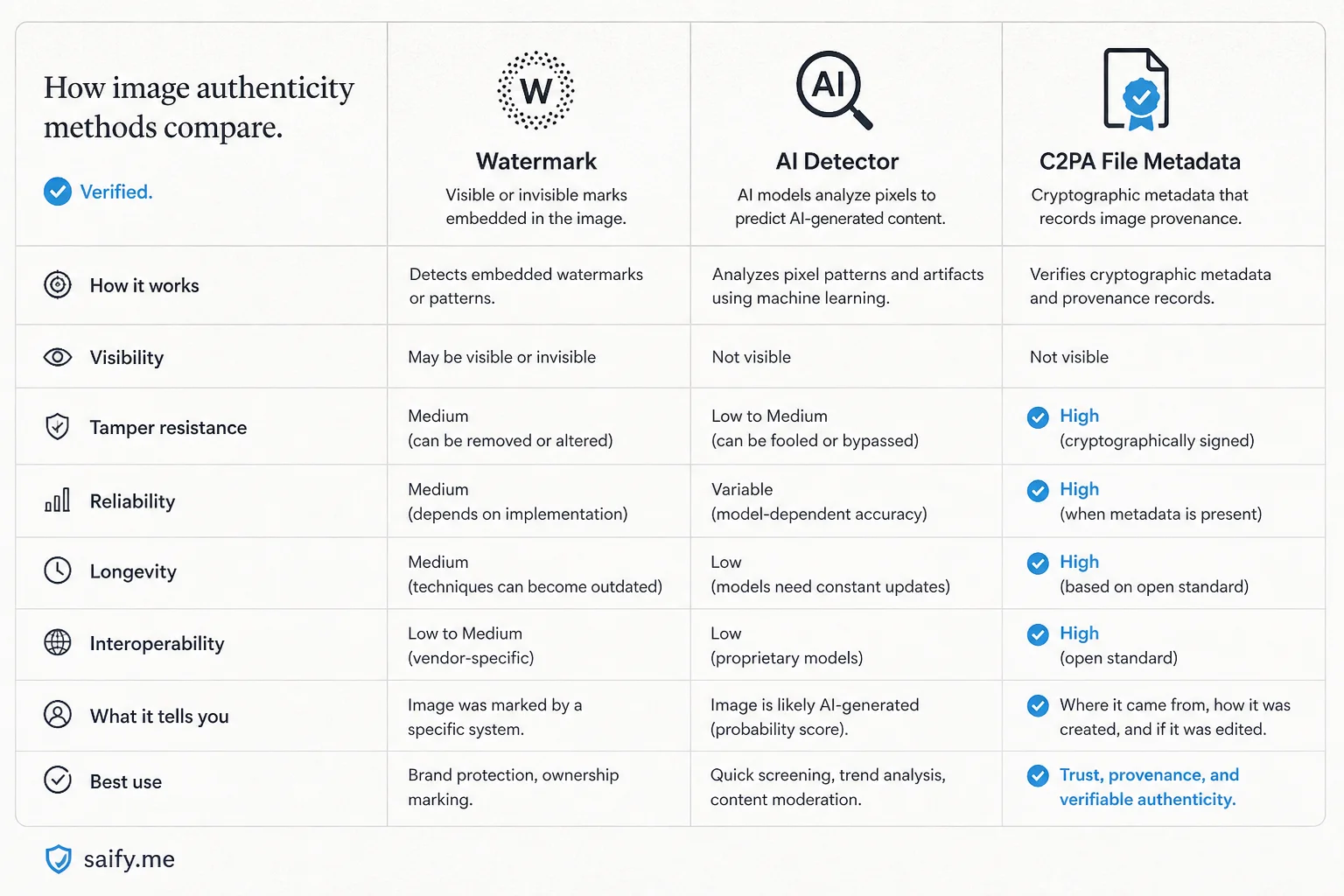
Anthropic draws a clean line:
- Watermark (with key): probabilistic proof Claude likely touched the text
- AI detectors (Pangram et al.): pattern guessing without the key; higher false-positive risk
- C2PA on images/files: signed metadata on PNG/JPG/SVG exports, not embedded pixels
If your compliance workflow already uses C2PA for generated images, text watermarking is the parallel lane for prose. Plan for both if you ship multimodal assets.
What builders should change this quarter
- Update customer-facing AI disclosure templates. EU users will expect marking language even when the mark is invisible.
- Do not promise "undetectable AI copy." Light edits may preserve the watermark; full rewrites remove it but also remove most AI signal.
- Separate authorship from assistance. Watermarks prove involvement, not ownership. Your terms of service still own the output story.
- Watch for the detection API. Anthropic says a watermark detection API is coming. If you run UGC platforms, decide whether you will check submissions automatically or only on dispute.
- Keep human review for high-stakes text. Watermark confidence grows with length. A two-sentence clinic SMS is a bad place to rely on detection either way.
The EU forcing function
Around 190 signatories joined the July 2026 EU Code of Practice. Anthropic notes other major providers will implement their own marks. Global rollout happened because regional scoping was not ready, not because every jurisdiction demanded it on day one.
For applied AI engineers, the lesson is boring and useful: regulatory requirements are now shaping sampling logic inside foundation models. Your integration layer should assume provenance questions are normal, not a 2024-era debate.
If you are wiring Claude into publishing pipelines, treat watermarking like HTTPS. Users do not see it, auditors will ask about it, and you should know what your vendor actually promises.
Book a free discovery call if you need help mapping EU AI Act obligations to a concrete content workflow.