
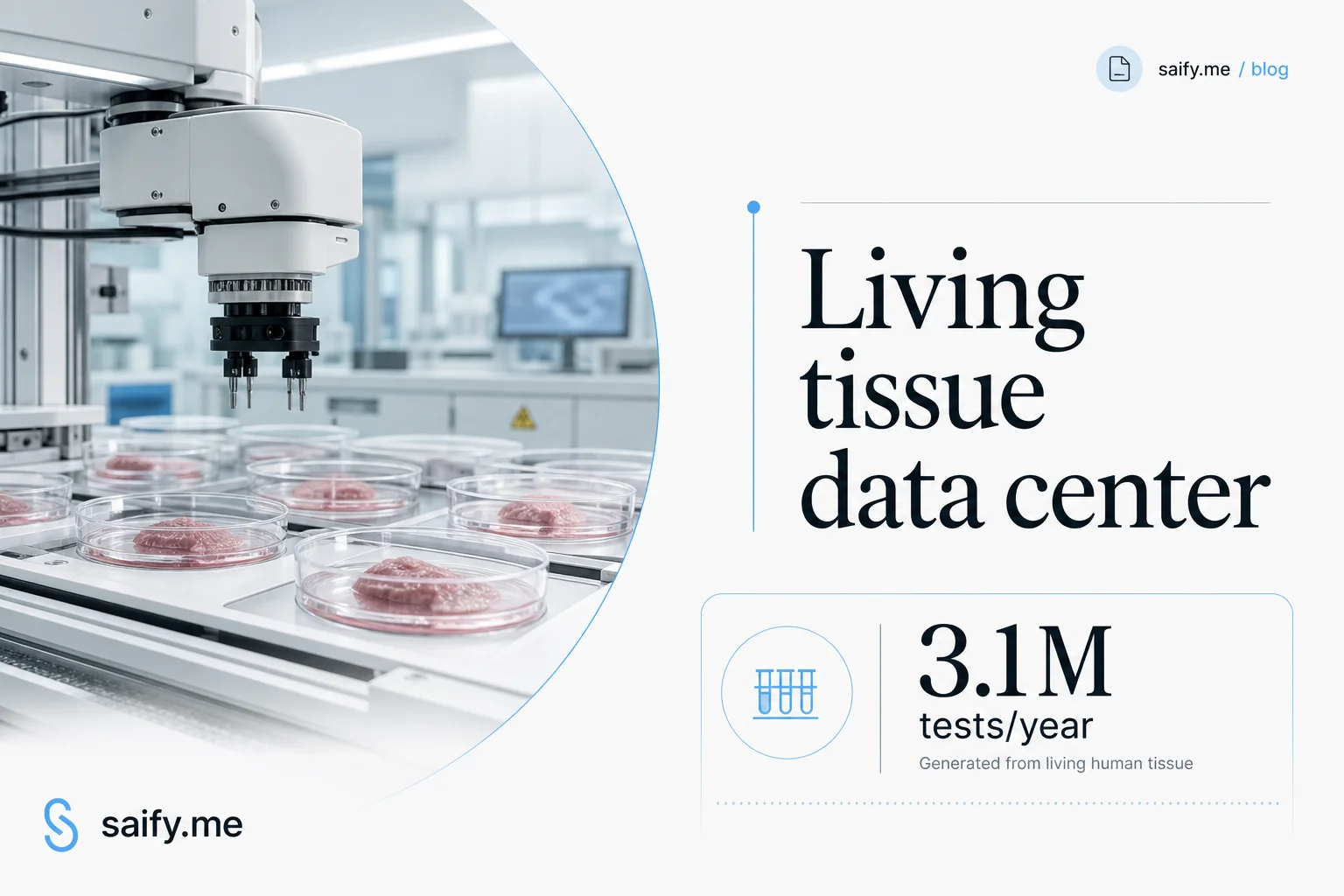
Most AI datacenters train on text scraped from the web. Vivodyne trains on liver cells in a dish that still behave like liver.
The startup opened what it calls the world's largest human biological datacenter: a network of 12 HIVE robotic labs running more than 3 million tests a year on lab-grown human tissues. The goal is not a chatbot. It is a world model of human biology that tells pharma which compounds will fail in people before they spend nine figures on trials.
Fast Company profile and Vivodyne's launch materials frame the system as a path to reduce animal testing while improving predictive accuracy.
What runs inside HIVE
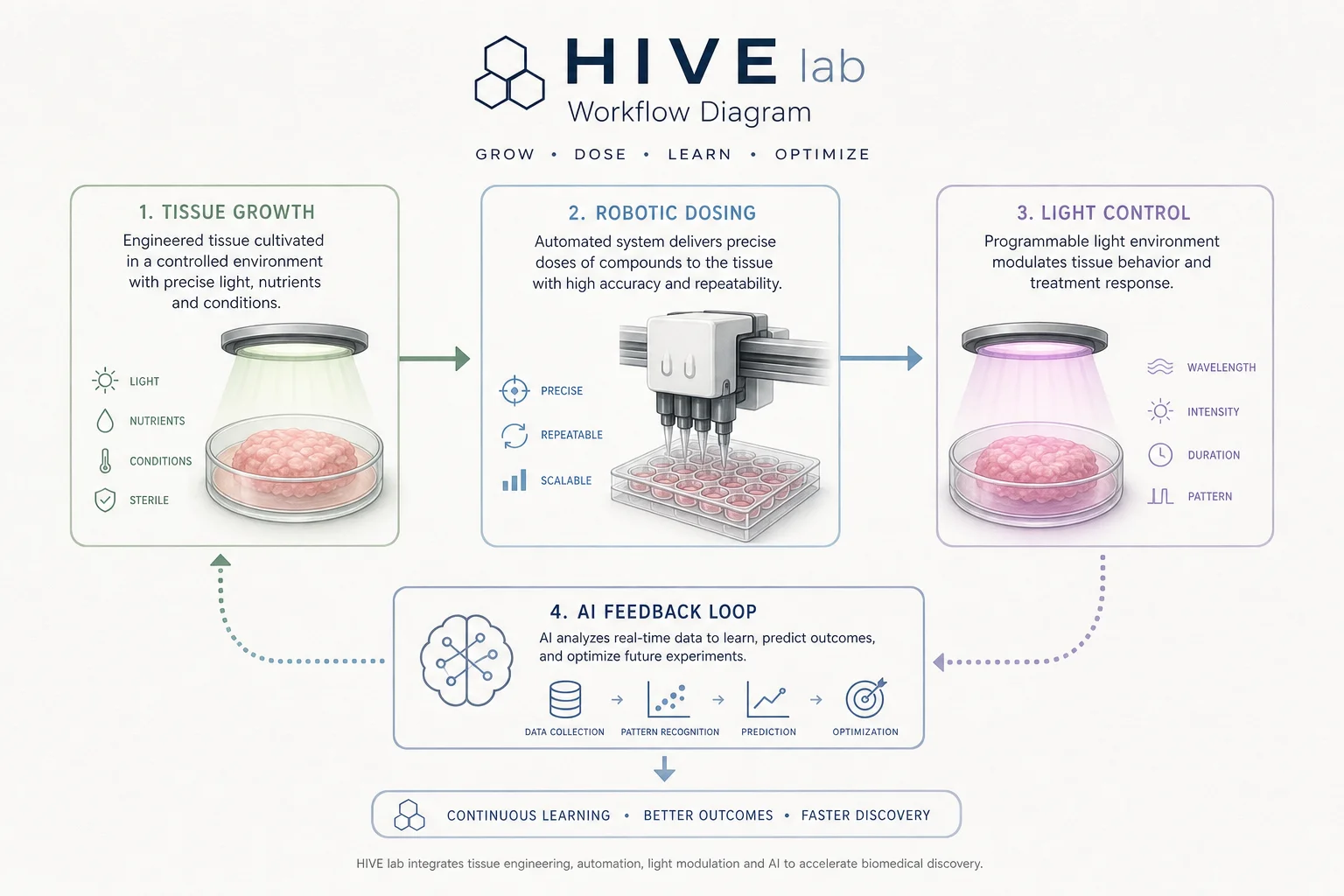
Each HIVE lab grows functional human tissues (liver, lung, kidney, gut, and more), then automates the boring wet-lab loop:
- Dose tissue samples
- Image and scan responses
- Extract quantitative readouts
- Feed results into models
- Design the next experiment batch
Vivodyne's TissueDisk hardware grows hundreds of living samples in parallel. The company cites 3.1 million experiments per year of system capacity when fully utilized.
| Layer | Role |
|---|---|
| Robotics | Repeatable handling at throughput humans cannot match |
| Living tissue | Biology that reacts like human organs, not plastic assays |
| Vision + assays | High-dimensional labels for each well |
| AI planner | Chooses next experiments based on prior outcomes |
| World model | Compressed simulator of human biological response |
That closed loop is the same pattern as autonomous lab startups in materials science, except the ground truth is alive.
Why pharma would pay early
Vivodyne says eight major pharma companies already bought early access. The economic pitch is simple: a failed Phase II trial costs far more than a high-throughput screen that says "this molecule is dead" in human-relevant tissue.
Animal models are proxies. They win regulatory familiarity but miss human-specific toxicity and metabolism paths. Human organoids and tissue systems sit in the middle: more human, still high throughput.
I have seen beauty and biotech clients chase similar causal data. Outer Bio's Yuna platform, which we covered recently, uses organoid screening for skincare compounds. Vivodyne is the pharma-scale version with robotics and a datacenter narrative.
AI world models beyond language
Biology world models are having a moment because language-only training hit a wall for physical and chemical prediction. NVIDIA, startups, and national labs are all betting that the next gains need simulators tied to real measurements.
Vivodyne's twist is measurement from living tissue, not just PDB structures or static assays. That gives time-series data under perturbation, which is what world models crave.
For applied AI engineers, the lesson is dataset design:
- Closed-loop data beats one-off dumps
- Active learning in the lab is expensive but label-efficient
- Domain-specific world models beat general LLMs on efficacy questions
Limits and honest skepticism
Scale claims are easy in press releases. Execution risks remain:
- Organoids are not full organs with immune and vascular complexity
- Automation breaks in biology in ways silicon fabs rarely see
- Regulatory acceptance of organoid-only evidence is still evolving
- World models can overfit to lab conditions that do not transfer
Still, shrinking animal use while improving early signal is a moral and financial win if the numbers hold.
The takeaway
Vivodyne is building an AI datacenter where GPUs schedule experiments on human tissue, not tokens. If the HIVE labs deliver, drug discovery gets a new bottleneck: who owns the best biological world model, not who has the biggest LLM.
Teams training domain models outside pharma should steal the pattern: tight feedback between model and physical measurement. Book a free call if you want help designing a similar loop for your industrial or clinical data, at smaller scale.