
For years, cancer vaccines sounded like the technology that always worked in mice and stalled in humans. Moderna and Merck may have broken that pattern.
On August 19, 2026, the companies announced that intismeran autogene plus KEYTRUDA (pembrolizumab) met recurrence-free survival and distant metastasis-free survival in INTerpath-001, a Phase 3 trial with 1,137 patients whose stage IIB-IV melanoma had been surgically removed. It is the first positive Phase 3 readout for an mRNA-based cancer therapy and the first individualized neoantigen therapy to beat active standard of care in the adjuvant melanoma setting.
Merck and Moderna Phase 3 announcement
One tumor, one vaccine batch
The manufacturing story is what separates this from mass-market COVID shots.
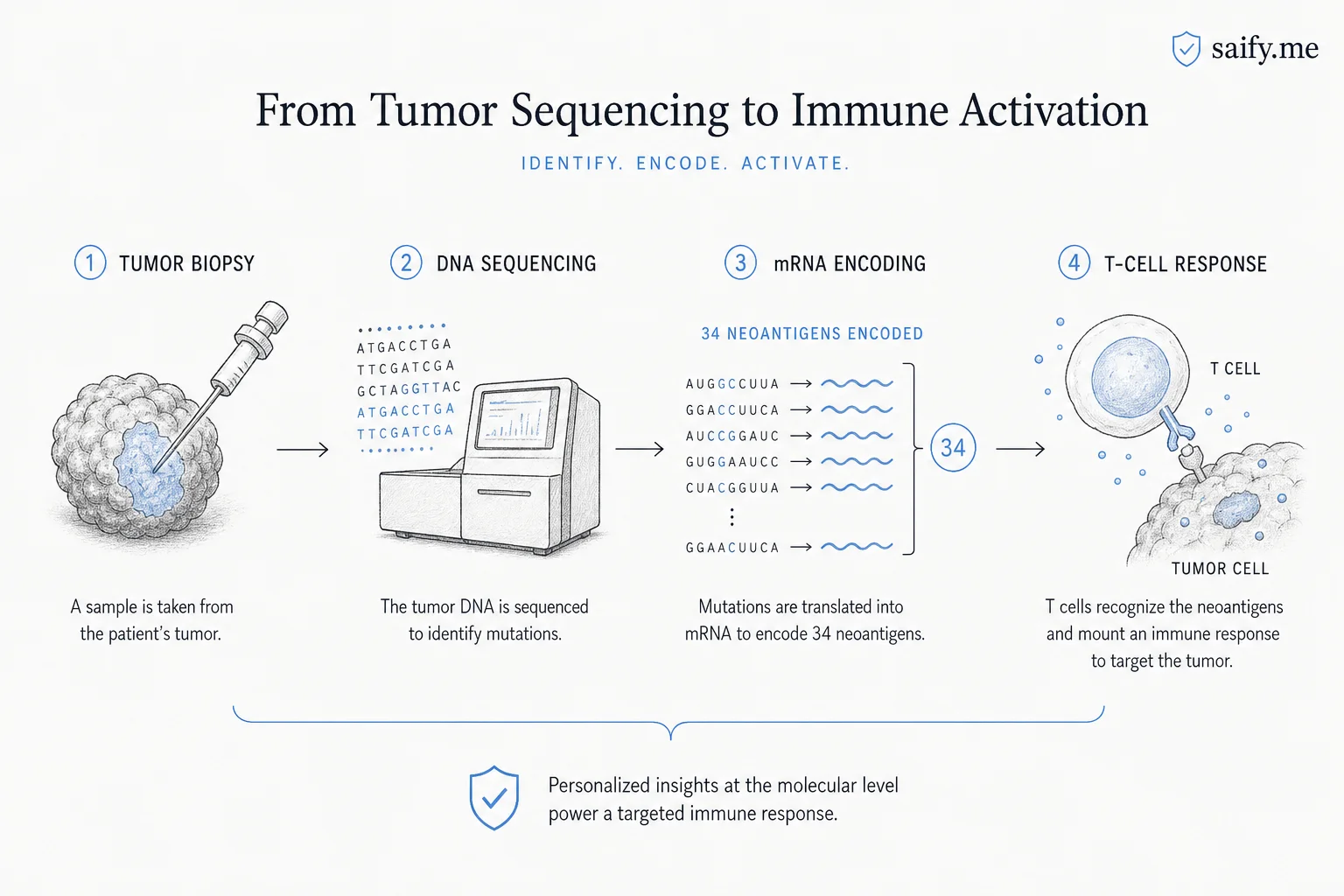
Intismeran is an individualized neoantigen therapy (INT). Clinicians sequence the patient's resected tumor, identify the mutational fingerprint, and encode up to 34 neoantigens into a single mRNA construct. That RNA is translated in the body so the immune system learns to recognize cancer-specific peptides.
| Step | What happens |
|---|---|
| Surgery | Tumor tissue removed |
| Sequencing | Unique mutations identified |
| Design | Up to 34 neoantigens encoded in mRNA |
| Manufacturing | Patient-specific batch produced |
| Delivery | Nine doses over roughly one year with Keytruda |
This is N-of-1 drug manufacturing at clinical scale. The COVID playbook (rapid mRNA synthesis, cold-chain logistics, regulatory familiarity) becomes the backbone for oncology personalization.
What the trial actually tested
INTerpath-001 randomized patients 2:1 after complete resection:
- Arm A: intismeran (1 mg every three weeks, up to nine doses) plus Keytruda (400 mg every six weeks, up to nine cycles)
- Arm B: Keytruda alone
Primary endpoint: recurrence-free survival (local, regional, or distant recurrence, or death). Key secondary: distant metastasis-free survival. The study continues for overall survival and quality-of-life endpoints.
Safety looked consistent with prior combination studies. No new signals in the topline release.
Phase 2b follow-up data presented at ASCO 2026 already showed strong separation: roughly 49% lower risk of recurrence or death (HR 0.51) and 59% lower risk of distant metastasis or death (HR 0.41) versus Keytruda alone over five years. Phase 3 confirms the direction at scale, though full curves await a medical meeting.
Why adjuvant melanoma is the right first win
Melanoma after surgery is a brutal waiting game. Recurrence often lands in the first two years, and metastatic relapse is worse than local relapse. Keytruda alone already moved the needle in adjuvant care, which makes beating it head-to-head a high bar.
Melanoma tumors are also mutation-rich. More mutations mean more neoantigen candidates for the mRNA payload. That biological fit helped Moderna and Merck pick melanoma as the proving ground.
The INTerpath program now spans nine Phase 2 and Phase 3 trials across melanoma, NSCLC, bladder, and kidney cancer. If manufacturing and regulatory paths hold, the platform is not a one-tumor story.
Applied AI angle: personalization at industrial scale
I build applied AI systems for operators, not wet labs. Still, the engineering parallels are hard to ignore.
- Per-entity pipelines: every patient is a custom data product (tumor sequence in, mRNA design out)
- Quality gates: neoantigen selection is a ranking problem over noisy genomic labels
- Latency budgets: adjuvant windows are finite; slow manufacturing loses clinical value
- Feedback loops: Phase 2 biomarker work feeds Phase 3 cohort design, similar to how production ML teams close the loop from offline eval to online routing
The RFK Jr. headline from the digest is real context: federal mRNA vaccine contracts were cut earlier in 2026. Private pharma capital is now carrying the individualized mRNA oncology bet without waiting on Washington.
What we still do not know
The August release was topline only:
- No hazard ratios or confidence intervals for Phase 3 yet
- Overall survival immature
- Pricing, reimbursement, and turnaround time per patient batch not disclosed
- Expansion to lung and bladder depends on separate trials reading out
Cancer vaccines have burned investors before. This readout is the strongest late-stage signal yet that mutation-matched mRNA can outperform an active immunotherapy standard, not just add noise in uncontrolled early studies.
If you are shipping AI in regulated domains (health ops, clinical workflows, voice triage), watch how Merck and Moderna operationalize per-patient compute plus per-patient chemistry. That combo is coming to more industries than oncology.
If you are wiring AI into health operations or need help scoping custom ML pipelines, book a free discovery call.