
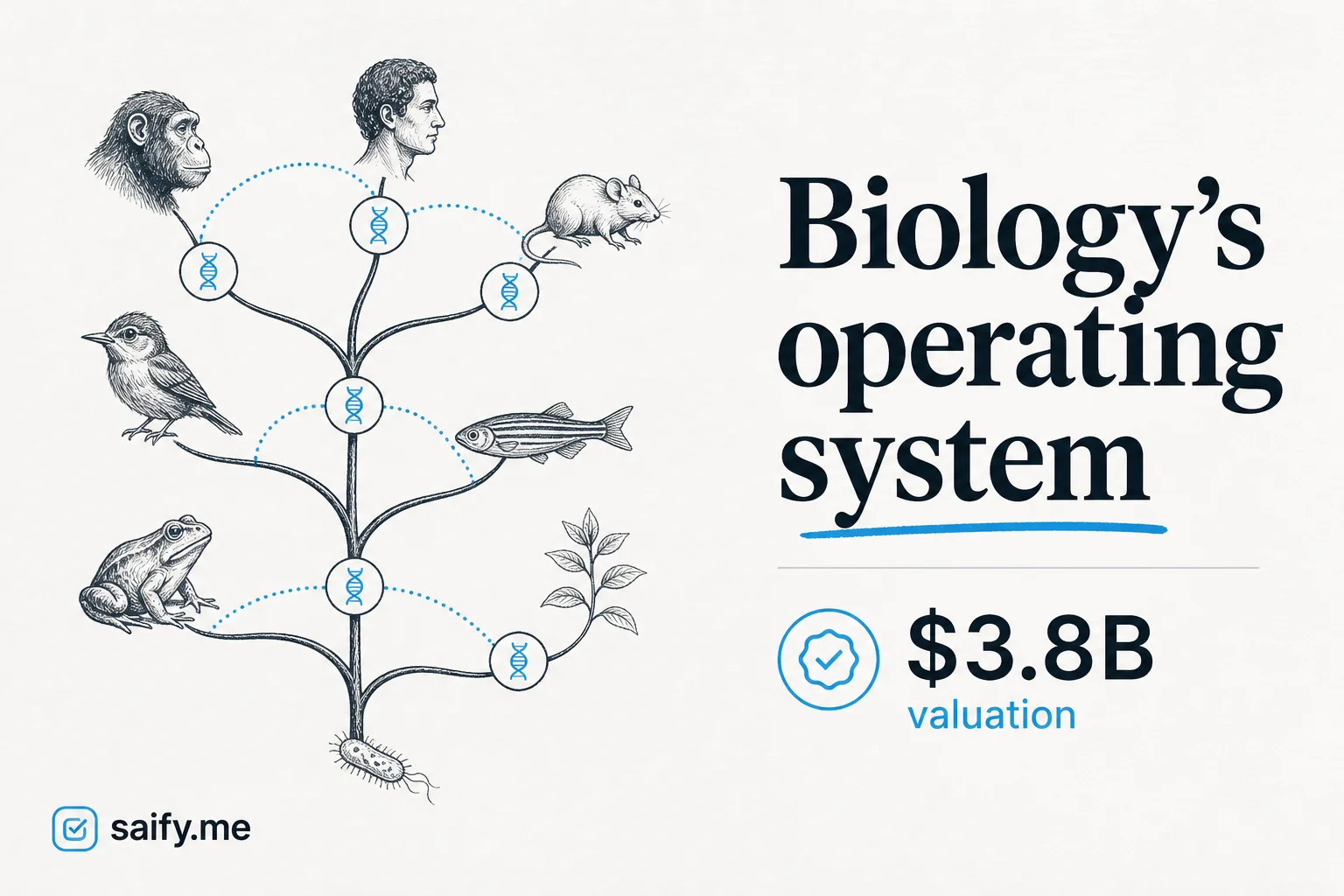
Colossal Biosciences chases woolly mammoths on billboards. Its spinout Astromech chases something harder: predictive models of how life changes.
Astromech raised $20 million in August 2026, led by biotech investor Bob Nelsen, lifting valuation to $3.8 billion (from roughly $2B in April). Total funding is about $60M. Co-founders Ben Lamm and geneticist George Church want a biological operating system that forecasts evolution the way meteorologists forecast storms.
SiliconANGLE on Astromech's $20M round
Weather models for genomes
Most biotech AI looks at current state: protein structure, cell assays, patient mutations today.
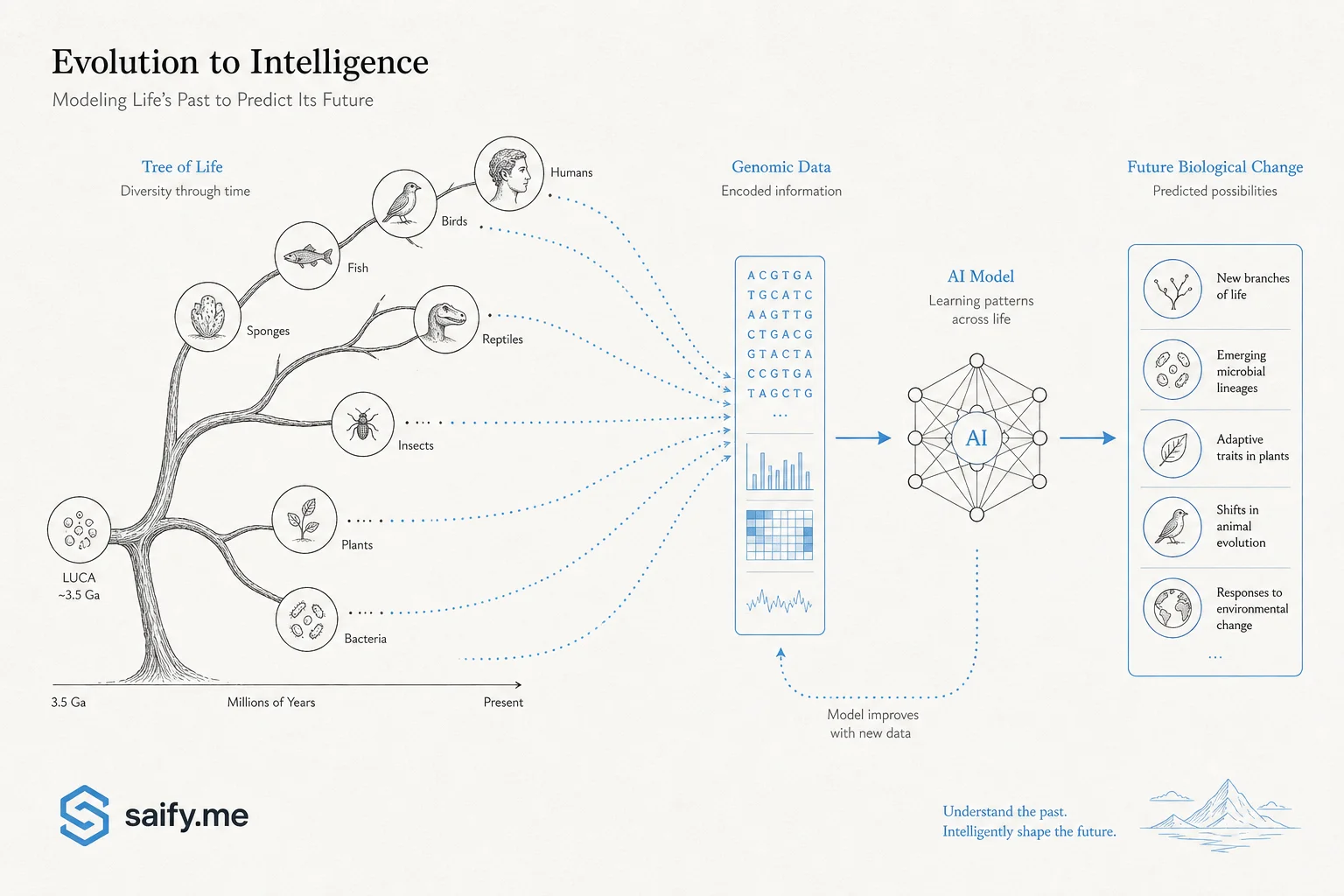
Astromech adds ancestral state reconstruction and forward projection. Lamm told Inc.com the stack is "algorithmic prediction" over historical evolutionary data plus present measurements, similar to combining climate archives with live radar.
Two model engines work together:
| Engine | Function |
|---|---|
| Pattern learner | Deep learning across species and time |
| Ancestral projector | Reverse-engineers regulatory history, then simulates forward |
Church stresses regulatory DNA, not just coding sequences. Morphology, longevity, and cancer resistance often live in non-coding regulation. Comparing modern genomes alone misses the levers that actually moved traits.
Colossal's startup factory
De-extinction is Colossal's billboard. The spillover businesses may be the real factory:
- Form Bio (2022): $30M Series A after genome-engineering software worked for internal Colossal projects
- Breaking (2024): $10.5M seed for plastic-eating microbe X-32, tied to Harvard Wyss work
- Astromech (2026): $3.8B paper valuation for evolutionary forecasting
Fast Company on Colossal's startup incubator model
If Colossal can keep spinning tools that work for mammoth DNA into standalone platforms, its most valuable output might never be a living dodo. It might be IP and model weights.
Longevity as proving ground
Astromech mapped 46 longevity-associated genes on a time-calibrated tree of life, studying how maintenance and cancer-resistance pathways evolved. Species like the Asian elephant (unique cancer suppression) and bowhead whale (200+ year lifespans) become natural experiments.
Near-term goals: expand comparative genomics infrastructure, onboard more species data, and run pilot projects with health and biosecurity partners on vulnerability forecasting (drug resistance, pathogen evolution, environmental stress).
That is the same product shape as applied AI world models in robotics or supply chain: simulate forward from learned dynamics, then intervene before failure.
What model builders should watch
- Multi-timescale data beats single-snapshot dumps for prediction tasks.
- Regulatory genomics is an under-labeled niche compared to protein folding hype.
- Spinout economics reward platforms that ship internal tools fast enough to sell externally.
- Valuation heat ($3.8B on $60M raised) means public proof points must arrive soon.
Astromech is not shipping a chatbot wrapper on PubMed abstracts. It is betting that evolutionary history is pre-training data for biology, the same way the whole web was pre-training for language.
Whether that bet clears clinically is still open. The capital allocation says investors think Colossal's lab exhaust is already worth more than most public biotech AI vendors.
Scoping custom ML, scientific data pipelines, or agent tools over private datasets? Book a free discovery call.