
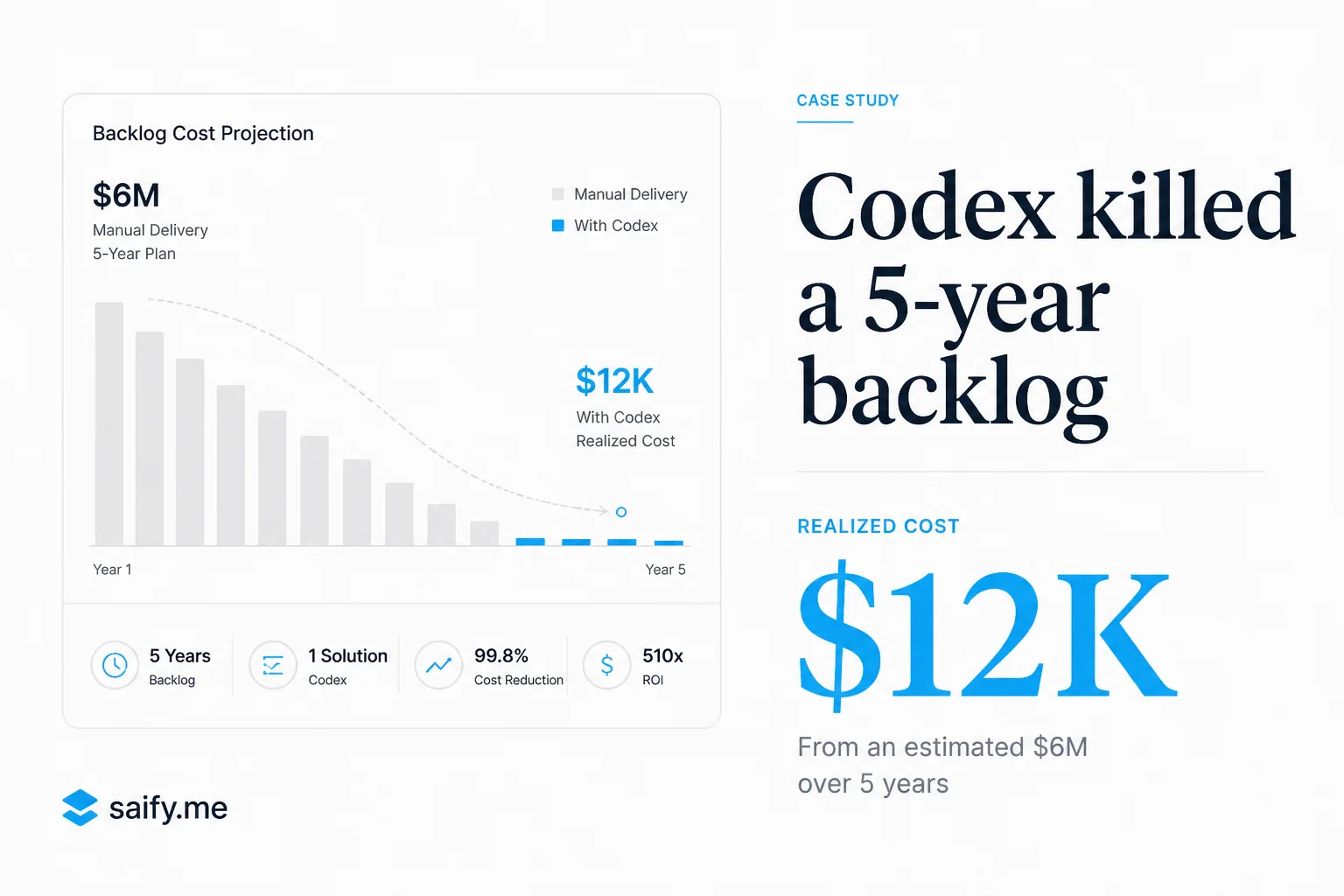
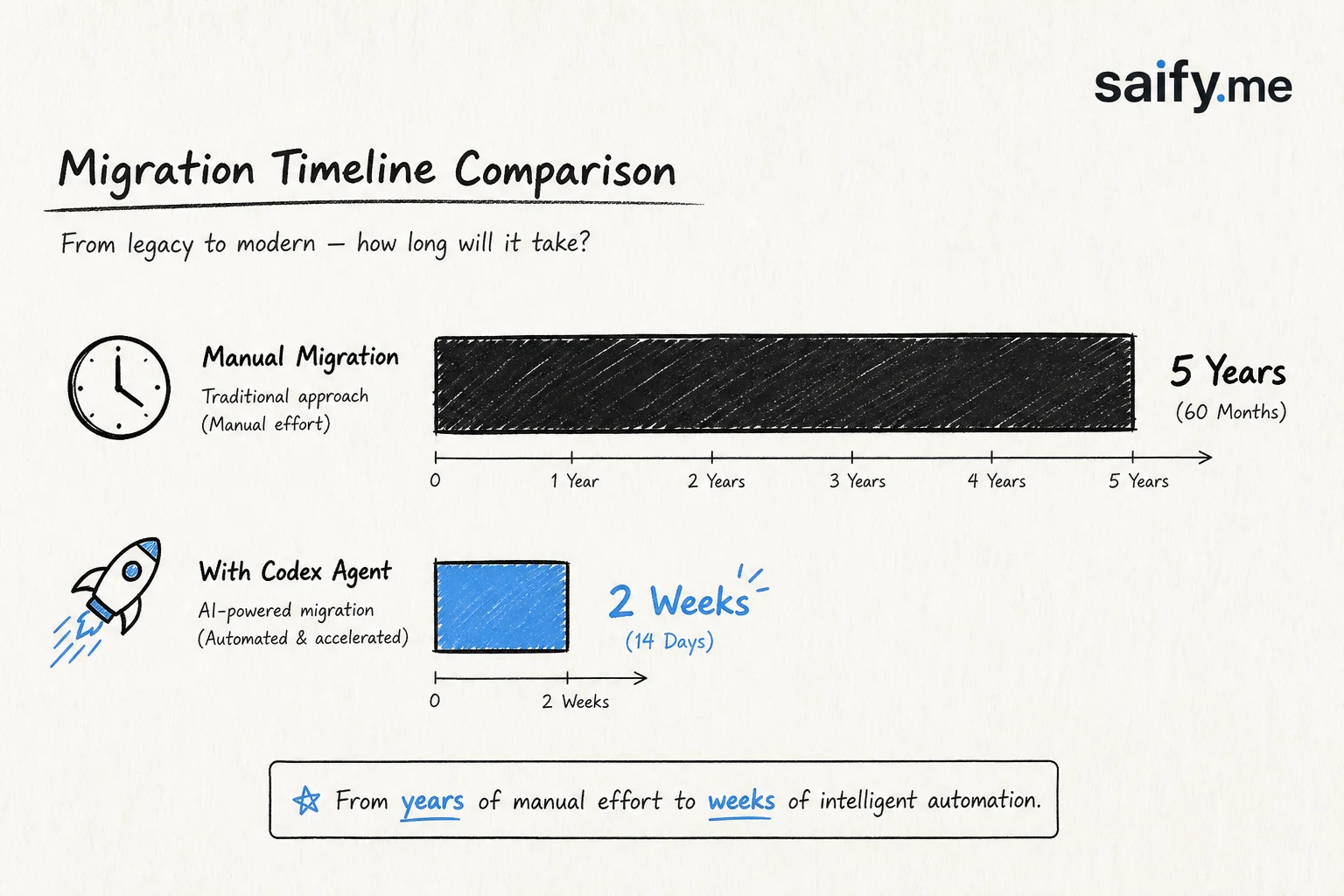
Five years and six million dollars is the kind of estimate that dies in a roadmap deck. Asana reportedly killed the project in two weeks for about twelve thousand dollars in Codex spend.
OpenAI's Asana write-up (August 2026) describes using Codex to remove an outdated testing framework across the codebase. Internal planning had scoped manual work at five years and $6M. The agent-assisted path finished in two weeks at roughly $12K API cost.
I do not treat vendor case studies as universal law. I do treat them as signals about which legacy chores agents already win.
What kind of work agents actually accelerate
Framework removal is a sweet spot:
| Property | Why agents help |
|---|---|
| Mechanical patterns | Thousands of similar import and config edits |
| Objective done state | CI green, deprecated runner gone |
| Searchable codebase | Codex can grep and batch refactors |
| Human review gate | Bad diffs get rejected before merge |
This is the same shape as Greptile-style runtime validation: bounded scope, verifiable output, human owns merge.
It is not the shape of "rewrite our architecture because we are bored."
How I would run the same playbook on a client repo
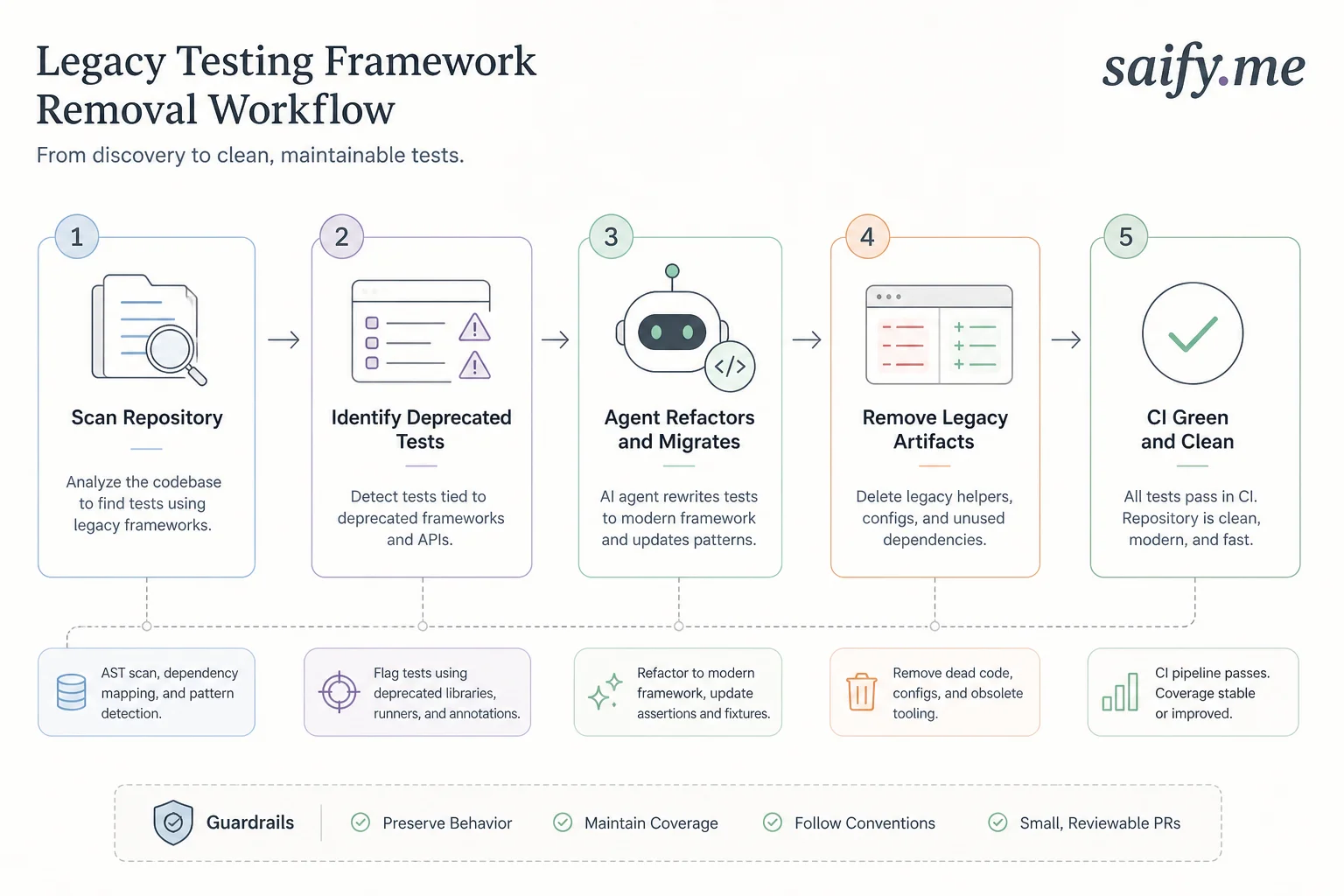
- Inventory the framework (config files, imports, CI jobs, docs)
- Freeze new usage with a lint rule or CI check
- Spin Codex with a written migration spec (allowed libraries, target test runner, file globs)
- Batch PRs by directory so review stays human-sized
- Run full CI on every batch; agents lie confidently about edge cases
- Delete the old runner only when coverage parity is proven
Skip step 5 and you trade a deprecated framework for flaky tests nobody trusts.
Reading the $12K number without hype
The headline ratio ($6M → $12K) is marketing-friendly. Decompose it:
| Line item | Reality check |
|---|---|
| $6M internal estimate | Includes eng salaries, opportunity cost, risk buffers |
| $12K API | Marginal inference cost only |
| Two weeks | Senior engineers still reviewed, unblocked, and merged |
| Asana scale | Large repo; savings absolute, not just percentage |
For a ten-person product team, the lesson is not "fire everyone." It is reprice backlog items you have been deferring because manual estimates looked absurd.
I keep a short list for clients:
- Deprecated test runners
- Lint rule autofix across monorepos
- TypeScript strictness ramps in bounded packages
- Config migrations (Jest → Vitest, Webpack → Turbopack) with CI proof
Each item gets a two-day agent spike before anyone writes a quarter-long epic.
Risks the case study will not emphasize
Silent behavior changes. Agents swap assertions that pass but mean less.
Incomplete migrations. Half the suite runs on the old runner because a weird integration test was skipped.
Review fatigue. Two weeks of rapid PRs can wear out senior engineers until they rubber-stamp.
Mitigations: mandatory diff size caps, mutation testing on critical paths, and a single migration owner who says no.
Pair spend tracking with AI token cost discipline. $12K is cheap until you run twenty parallel migrations without attribution.
When to hire help anyway
| Situation | Agent-first? |
|---|---|
| Greenfield product | No, just pick modern defaults |
| Bounded legacy removal with CI | Yes |
| Regulatory audit trail required | Agents draft, humans certify |
| No CI or tests | Fix observability first |
Asana's story is a permission slip to try the deferred chore this month, not a promise every $6M line item collapses to lunch money.
If you have a legacy testing or build framework you have been avoiding, book a free discovery call. I can scope a two-week Codex migration pilot with clear CI gates before anyone commits a multi-year estimate.