
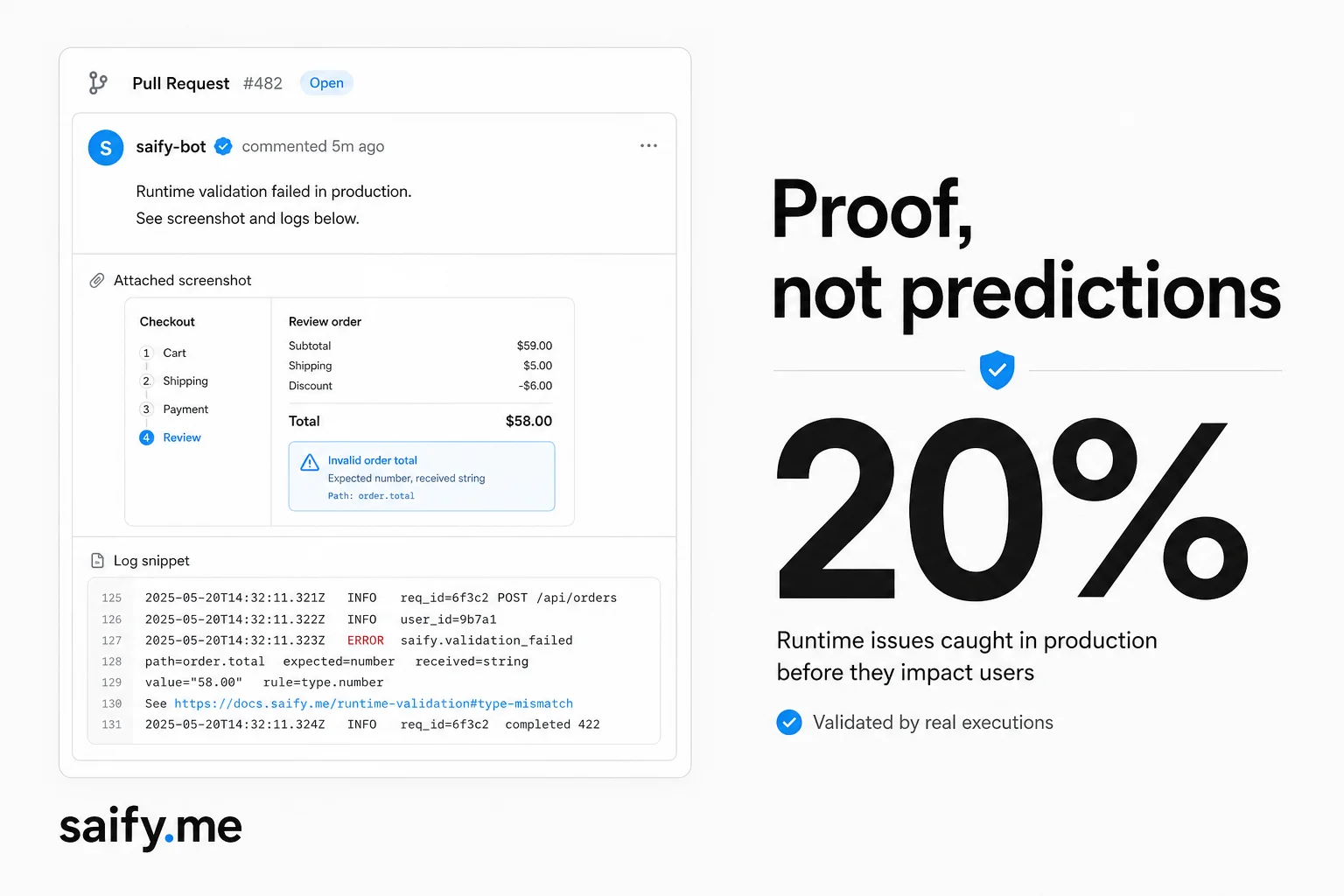
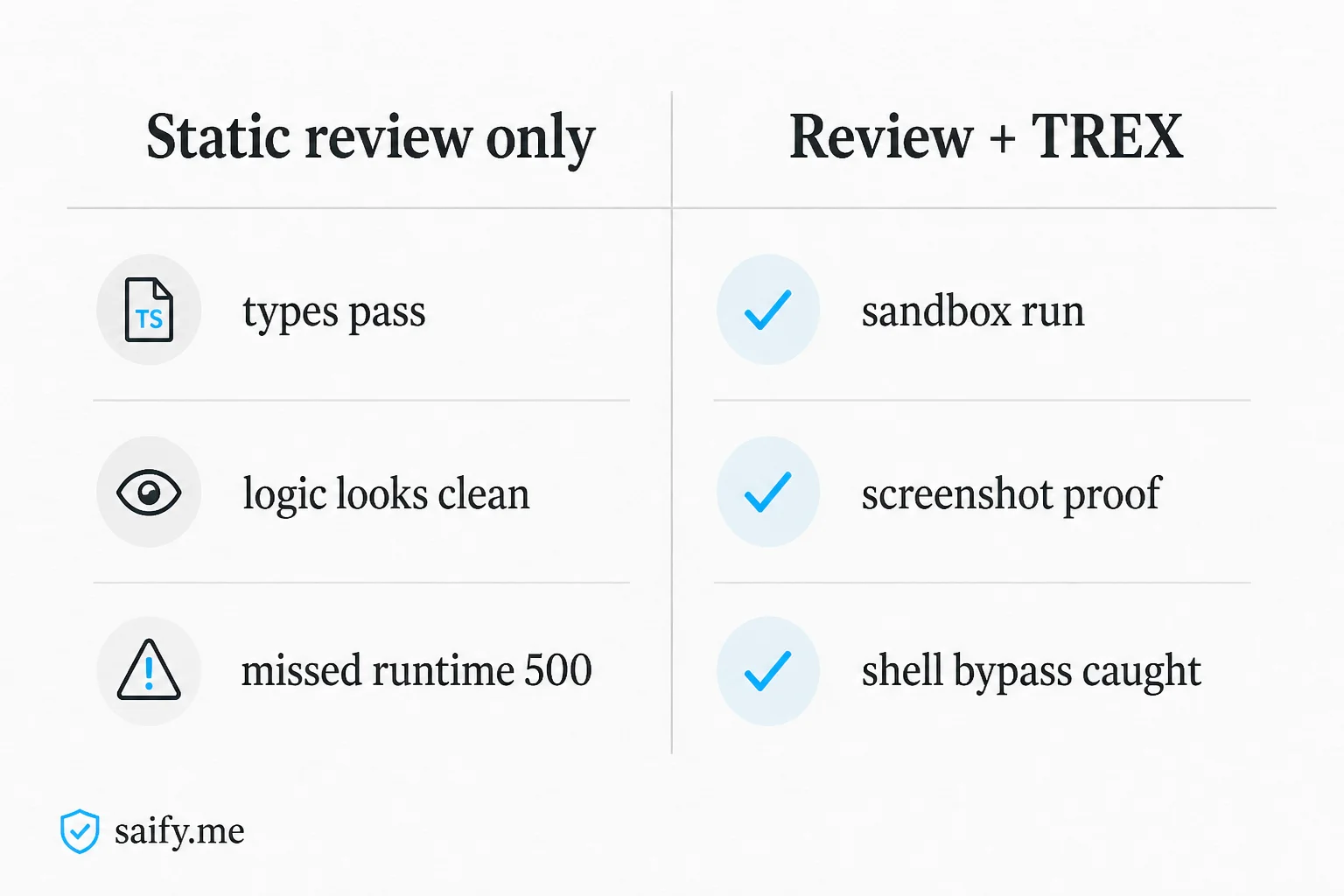
Your agent ships a clean pull request. Types pass. The diff reads fine. Then production throws a 500 on a null payload, the app hangs two seconds after boot, or a shell guard leaks a secret through expansion syntax nobody spotted in text review.
That debugging tax is the real bottleneck now. Generation got cheap. Validation did not.
Greptile's TREX launch post names the gap plainly: static review can reason about what code says, not what it does. TREX closes that gap by running the branch and attaching proof.
What TREX actually does
TREX is short for Test, Run, Execute. It is not a separate product sitting beside Greptile. It is an execution layer wired into the same review flow you already use on GitHub.
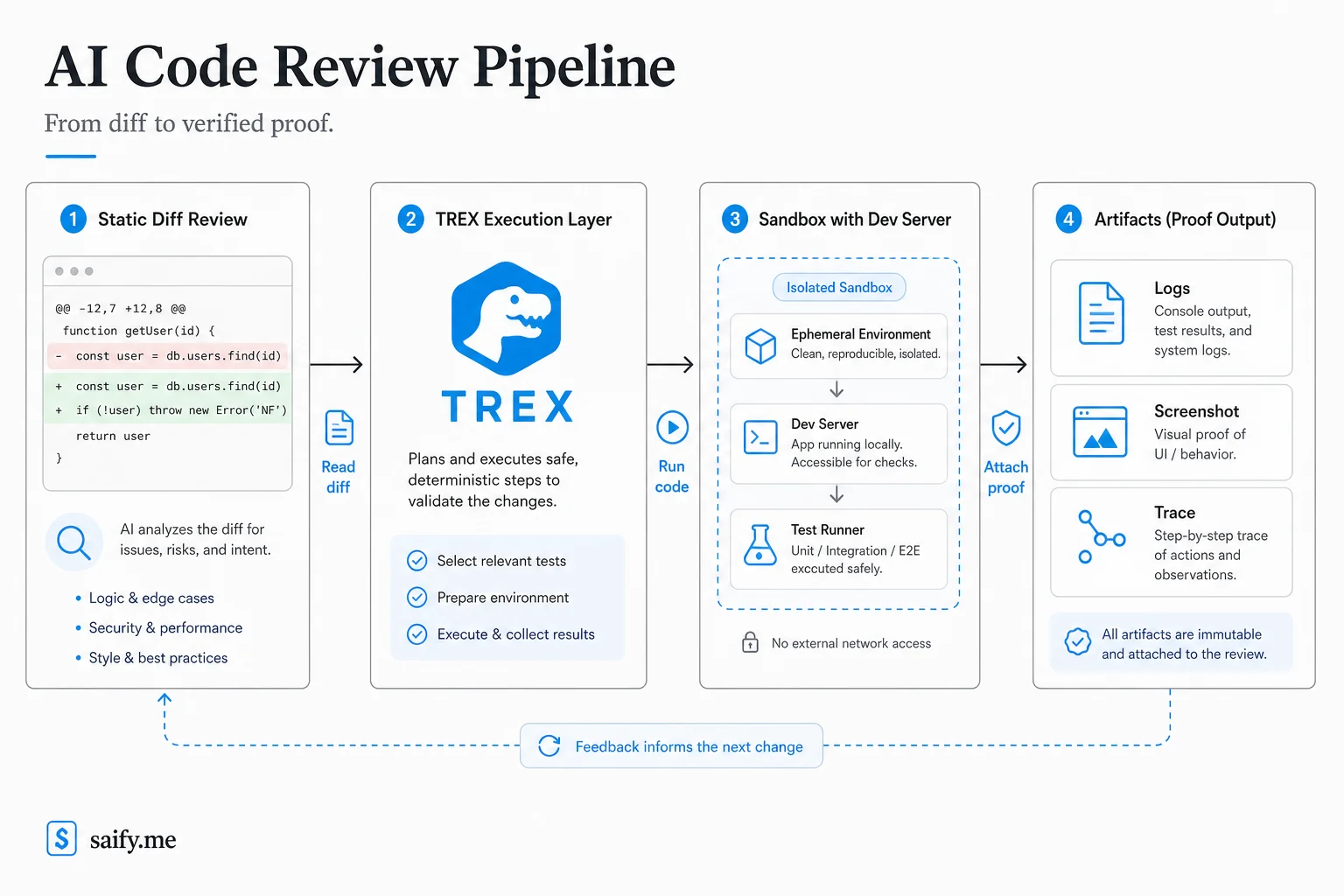
When Greptile reviews a PR, the main reviewer reads the diff, maps impact through Greptile's semantic code graph, and decides which behaviors are worth executing. For each suspect path, it spins up a scoped TREX sub-agent in a disposable sandbox.
That sub-agent can:
| Capability | Why it matters |
|---|---|
| Start dev servers and services | Many bugs only show up end-to-end |
| Mock API inputs | Reproduce edge payloads without prod data |
| Drive UI flows | Auth gates and feature flags included |
| Return multi-modal artifacts | Logs, traces, screenshots, scripts, video |
Greptile's TREX product page claims roughly 20% more bugs caught versus review alone in their evals. The number is vendor-reported, but the direction matches what I see on client agent projects: the scary failures are runtime failures.
Why static review hits a ceiling
Large models got better at spotting logic smells and cross-file dependencies. They still struggle with state that only exists while code runs:
- Async middleware chains and unhandled rejections
- Connection pool exhaustion under race timing
- Null payloads that types do not narrow away
- Security issues like shell expansion bypassing kubectl guards
A text comment that says "this might fail" creates more work. You still pull the branch, reproduce the environment, and verify manually.
TREX flips the burden. The reviewer runs the code and posts evidence on the PR. In public examples Greptile cited, TREX caught a correctness bug in workos/oagen and a severe shell expansion bypass in hashgraph-online/hol-guard with execution output attached, not just a warning paragraph.
Orchestrator plus sub-agents (not one overloaded agent)
Greptile's engineering write-up on building TREX explains why they did not bolt execution onto a single long-context agent.
One agent trying to run services, capture screenshots, and narrate findings overloads context and produces untrustworthy summaries.
Their pattern:
- Orchestrator (main Greptile reviewer) reads the diff and picks investigation targets
- Parallel TREX sub-agents each get a scoped context window for one issue
- Sandbox per run: isolated compute, milliseconds to start, thrown away after
- Artifact pipeline verifies outputs before they land on the PR
Bad evidence is worse than no evidence. Every artifact is meant to let a human or downstream agent confirm the run, not trust a pass/fail bit.
Artifacts are the product
Pass or fail alone is not enough. TREX attaches the work:
| Artifact | What it proves |
|---|---|
| Console logs | Runtime path and stack traces |
| API traces | Request/response state at failure |
| Screenshots | Rendered UI behind auth or flags |
| Execution scripts | Repro steps for humans or agents |
| Video | Animations and interaction timing |
If execution succeeds, artifacts can still land in the PR summary as proof the branch actually ran. That matters when you are merging agent-generated volume and reviewers are tired.
Greploop, CLI, and the validation layer mindset
Greptile is pushing past "comment bot" toward an automated validation suite.
Two workflow hooks worth knowing:
- Greptile CLI runs full-repo review locally, including an
--agentmode so coding assistants can call Greptile and read findings as text - /greploop skill runs a bounded loop: agent writes code, Greptile reviews, agent fixes, push, repeat (up to five cycles) until the PR scores clean
That loop only works if review feedback is actionable. Runtime artifacts make the difference between "maybe broken" and "here is the 504 log from the live endpoint."
Greptile also ingests docs and historical PR comments to adapt rules to team culture. Combined with the semantic code graph (directories, functions, classes, dependencies indexed before review), that is how they catch cross-service logical bugs and silent exception swallowing outside the changed lines.
Enterprise and cost reality
Greptile offers self-hosted, air-gapped deployments for VPC residency, plus SOC 2 Type II, SSO, and audit logs.
Pricing is worth planning around if you enable TREX on every agent PR:
| Item | Greptile public pricing (check current page) |
|---|---|
| Pro base | ~$30 per seat per month |
| Included reviews | ~50 per seat |
| Extra review | ~$1 each |
| TREX run (post-beta) | ~$2 per run |
Brex's public case study (cited in Greptile materials) claims ~30% faster feature shipping on an 8-year monorepo with less reviewer noise. Your mileage depends on how much agent volume you already merge without runtime checks.
Where this sits in your stack
I do not treat TREX as a replacement for human review or your CI test suite. I treat it as a runtime evidence layer between diff commentary and merge.
| Layer | Role |
|---|---|
| Unit/integration CI | Deterministic gates you own |
| Static AI review | Cross-file logic and style |
| Runtime validation (TREX-class) | Proof for async, UI, and security edge cases |
| Human reviewer | Product judgment and blast radius |
Cursor auto-review, Claude Code loops, and grok-build-style agents all increase PR throughput. Without execution-backed review, you are optimizing generation while validation stays manual. That is how teams end up in Friday hotfix mode with clean-looking diffs.
What I would test first
If you are evaluating Greptile with TREX on a repo that already uses agentic coding:
- Pick one PR class with painful runtime bugs (auth-gated UI, async API middleware, shell wrappers)
- Turn on TREX for that repo only and compare artifact quality for two weeks
- Measure time from PR open to verified fix, not just comment count
- Watch TREX run costs if agents open many PRs per day
Start narrow. Runtime sandboxes are compute. The win is fewer "cannot reproduce" threads, not another noisy bot on every typo.
If you are wiring agent coding pipelines for a product team and want help balancing generation speed with validation layers like this, book a free discovery call. I help founders ship applied AI without the debugging tax eating the velocity gains.