
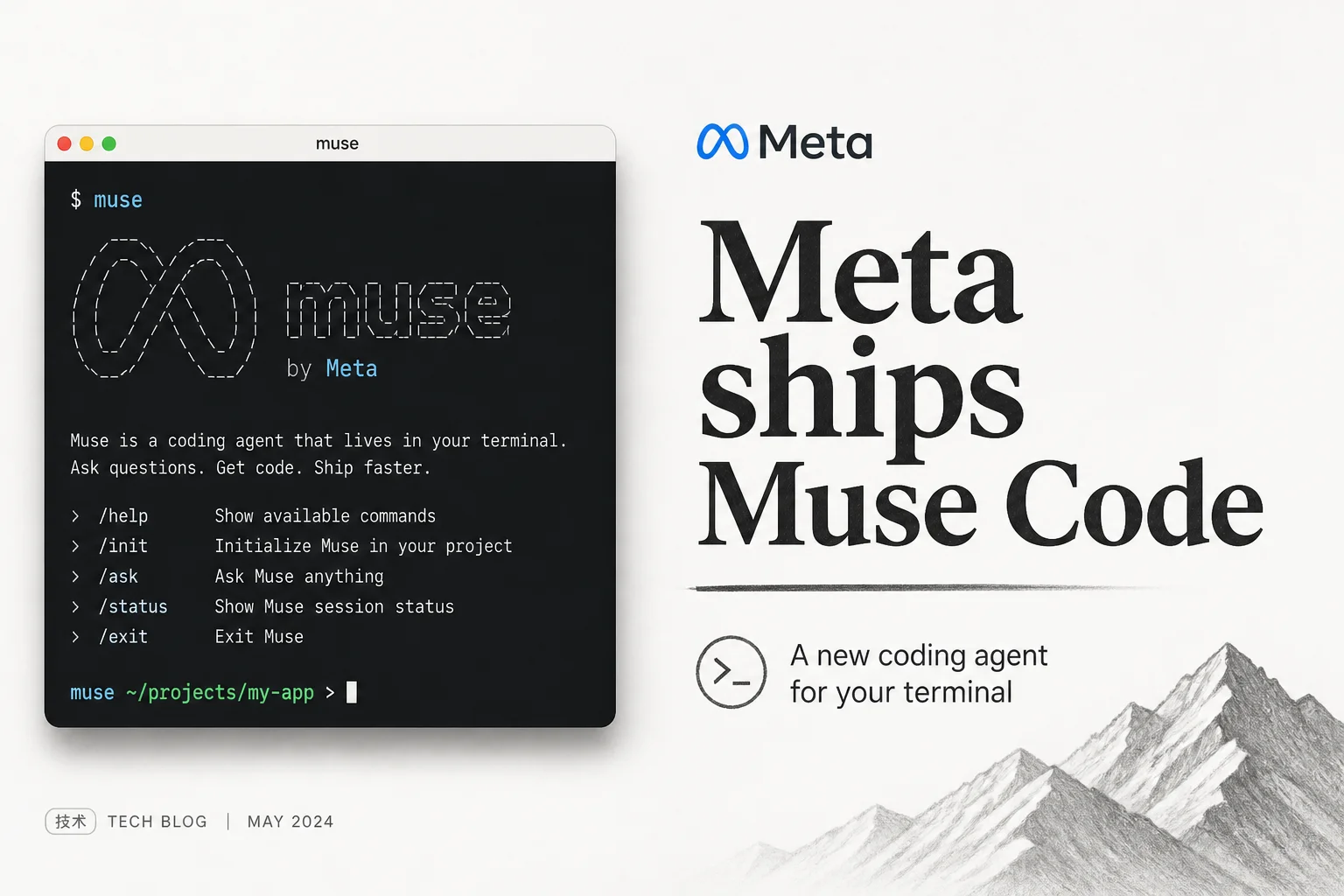
Meta was the lab everyone counted out on coding agents twelve months ago. On August 5, 2026, it shipped Muse Code, a terminal agent powered by Muse Spark 1.2, and expanded global API access the same day.
I have been routing agent work across Claude Code, Codex, and Cursor for client projects. Muse Code is the first Meta product I would actually trial on a real repo, not because it tops every chart, but because the runtime design solves problems I hit weekly.
The headline numbers (and the fine print)
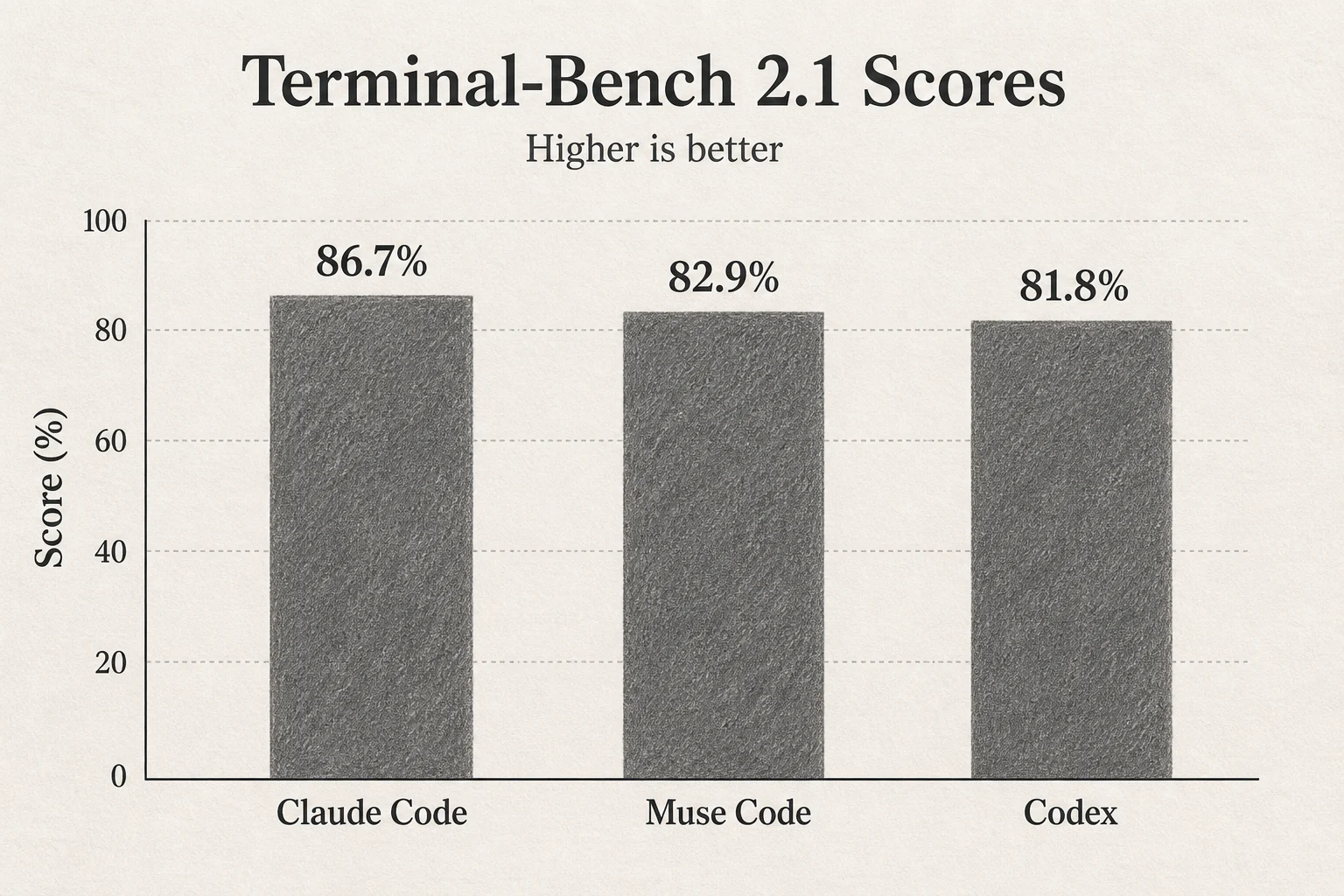
Meta published three benchmark charts in the launch post. The honest read:
| Benchmark | Muse Code + Spark 1.2 | Claude Code + Opus 5 | Codex + GPT-5.6 Terra |
|---|---|---|---|
| Terminal-Bench 2.1 | 82.9% | 86.7% | 81.8% |
| DeepSWE 1.1 | 59.3% | 65.0% | 64.8% |
| Meta Internal Coding Bench | 70.6% | 79.4% | (not shown) |
Second place on Terminal-Bench, behind Claude, ahead of Codex, on day one of a beta is a real result. It is not frontier dominance.
The catch analysts flagged quickly: on Terminal-Bench and DeepSWE, Spark 1.1 was scored inside mini-swe-agent while 1.2 runs in Muse Code. Part of the +6.7 point jump is model plus harness combined. Meta's harness-neutral internal bench moved only 68.3 to 70.6, a 2.3 point gain.
Artificial Analysis puts Spark 1.2 at 56.76 on its Intelligence Index, 7th of 20, with strong cost-per-task economics. Meta itself called 1.2 "a moderate improvement" over 1.1. That framing matches the data better than "Claude killer."
What Muse Code actually built differently
Three runtime choices stand out beyond the model weights.
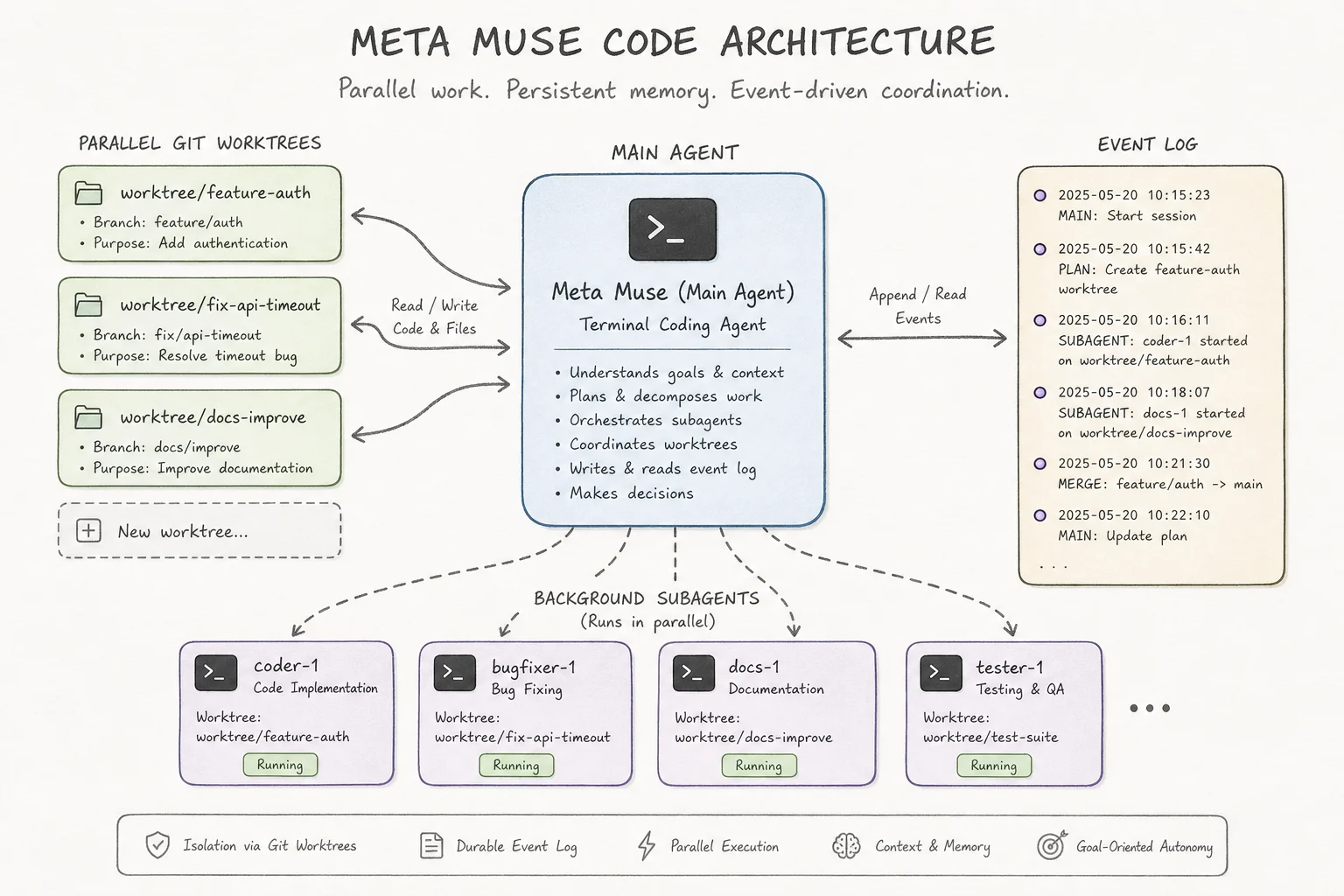
Parallel subagents with isolated git worktrees
When a task is big enough, Muse Code fans work out to child agents. Each child gets its own git worktree under .muse/. Your working copy stays untouched. Meta demoed six game features built in parallel with no file collisions.
That is the pattern I want for ticket batches: migration stubs, test coverage gaps, and doc updates that do not need serial hand-holding.
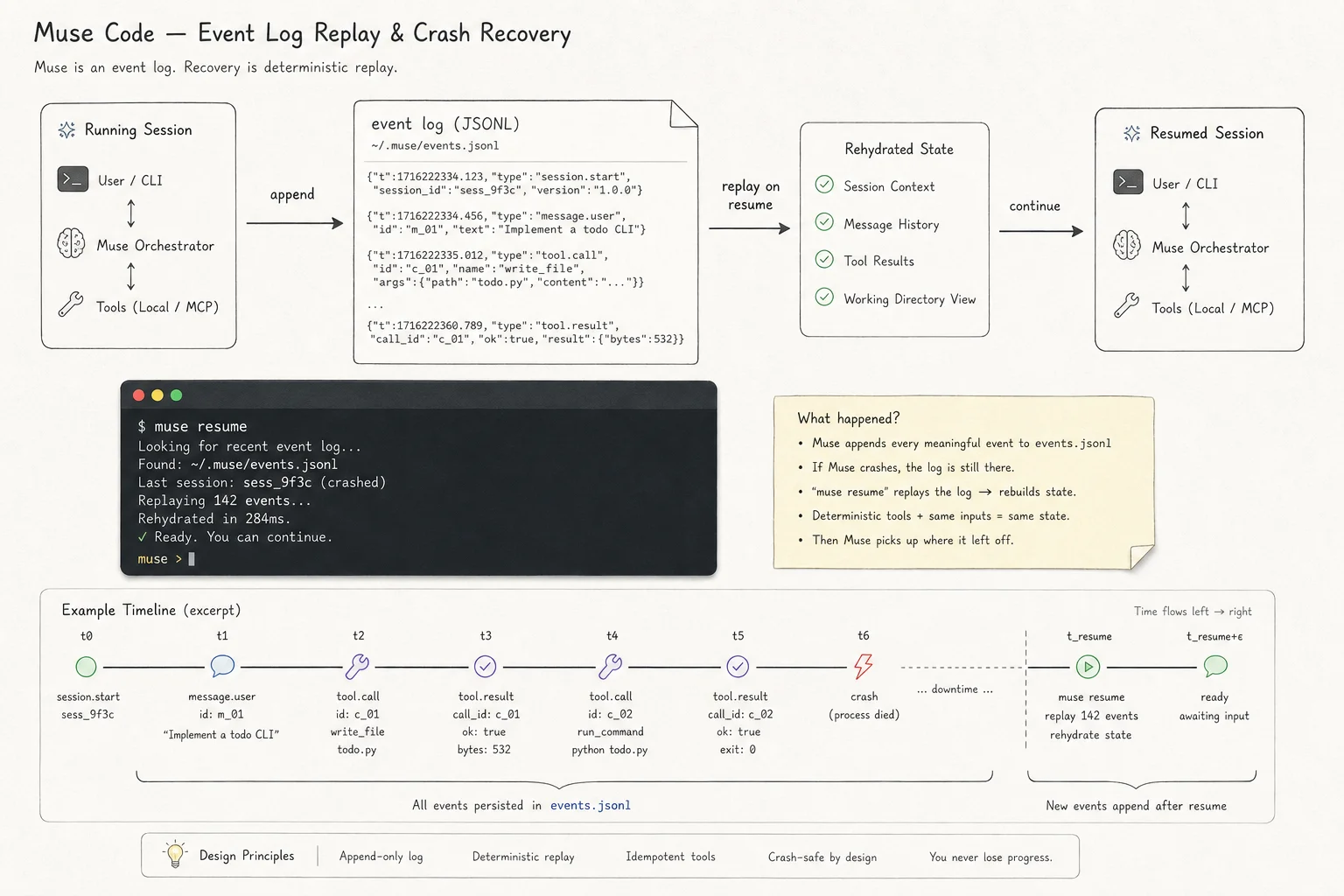
Replay-exact event log
Every model call, tool run, approval, and edit appends to a local JSONL log. If the session crashes, muse resume picks up from the last recorded step. For jobs that run hours (Meta tested 1,000+ tool calls over 24 hours on GPU kernel optimization), crash safety beats raw tokens-per-second.
Co-trained model + harness
Spark 1.2 was trained with Muse Code in the loop: rejection-sampled trajectories, goal conditioning, context compaction, and subagent recipes. Meta also used Spark 1.1 to generate hard environments and auto-grade solutions for 1.2 training.
The product implication: expect the best behavior inside Muse Code. OpenRouter access exists, but portable performance is unproven.
Bundled skills worth trying
Muse Code ships default slash commands:
/planturns a task into an approval-gated plan/grillstress-tests that plan until it holds/goaldrives toward completion of a stated objective
The multimodal demo is wild in a useful way: drop a fly-through house video as MP4, and Muse Code builds a vacation rental marketing page from it. That is closer to how non-engineers will brief agents than "fix line 42."
Pricing and the contributor tier trap
Standard Muse Spark 1.2 API pricing matches 1.1: $1.25 / $4.25 per million input/output tokens, with $0.15 cached input.
The contributor tier (muse-spark-1.2-contributor) drops to roughly $0.10 in / $0.20 out if you let Meta train on your prompts. Rate limits roll on a 5-hour token window, not request count.
What is missing compared to Claude Code and Codex: a flat monthly plan and a hard spend ceiling. For teams running automatic subagent fan-out, that matters more than saving four dollars per million tokens.
Install on macOS or Linux:
curl -fsSL https://dev.meta.ai/install.sh | bash
Then run muse in a project directory after browser auth. CI users can set META_API_KEY.
Docs and cookbooks live on Meta's developer blog and pricing page.
Where Muse Code fits in my stack
Good fits:
- Side projects where contributor-tier pricing and parallel worktrees beat subscription caps
- Long-horizon refactors where resume-after-crash matters
- CI pipelines that need OS sandboxing from the first run
Still Claude Code or Codex for me:
- Production repos where spend limits are non-negotiable
- DeepSWE-style overnight jobs (the gap widens on longer horizons)
- Teams already standardized on Anthropic or OpenAI identity and compliance reviews
A year ago Meta looked behind on agents. Since April it shipped Spark, an image generator, and now a credible terminal agent undercutting rivals on token price. The open-weights question remains open. Mark Zuckerberg teased more open releases; Spark weights were not in this launch.
The real lesson: harness economics
Muse Code is the clearest 2026 reminder that agent products are model plus runtime. Meta's own control chart shows two thirds of the Terminal-Bench jump may be tooling, not weights alone.
If you evaluate coding agents for a team, run the same repo task in each harness you might adopt. Compare cost per finished PR, not bar charts with different wrappers. That is the same routing mindset I wrote about in agentic coding cost per task.
Want help designing agent routing, spend guardrails, or a pilot harness on a real codebase? Book a free discovery call.