
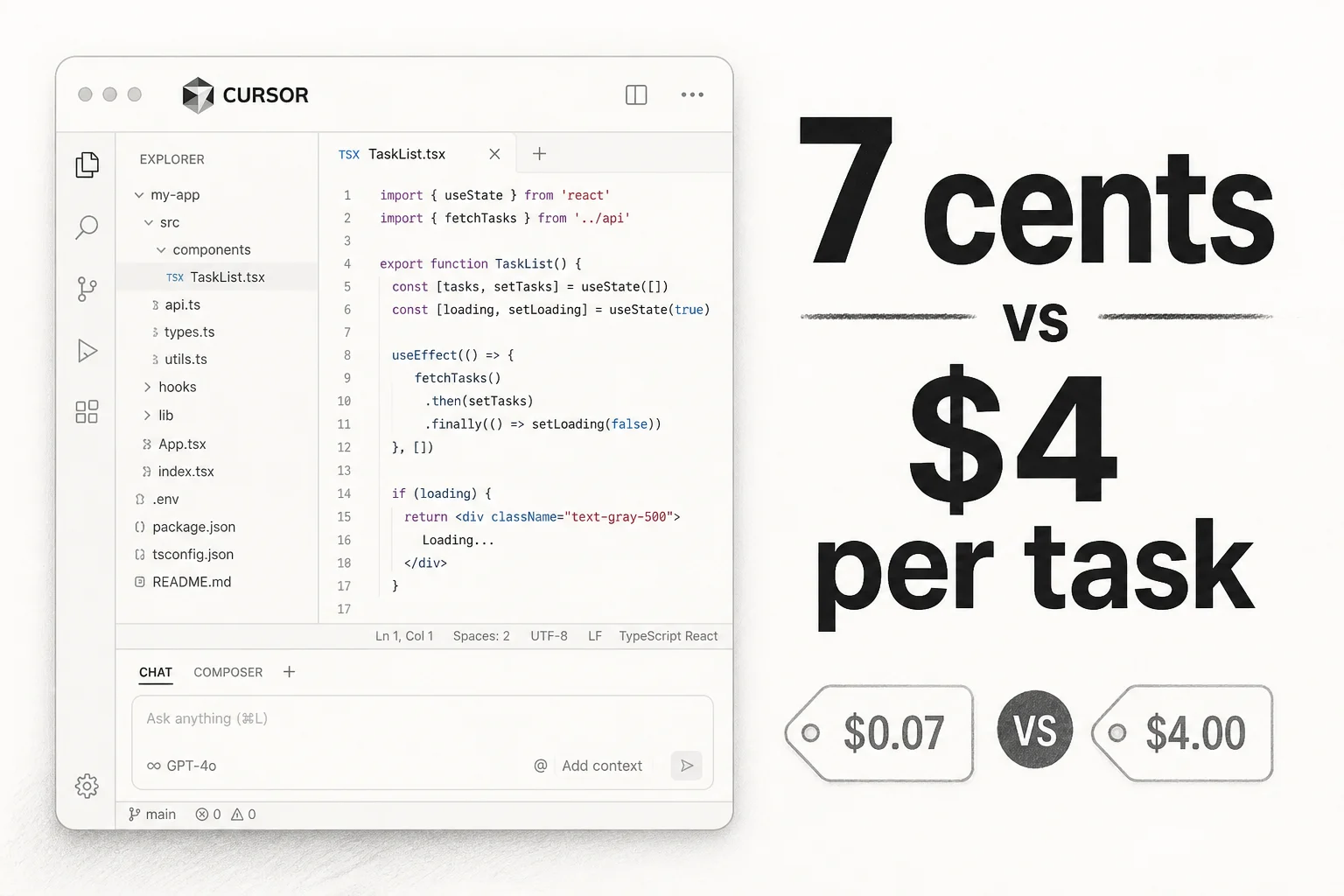
If you run agentic coding loops on a frontier model for every prompt, you are probably paying frontier prices for workhorse problems.
That is the quiet shift behind Composer 2.5. Not "smaller model wins forever." The unit economics of long-running agent loops finally make specialized models the default for most turns, with frontier models kept in reserve.
I ship agents for clients who care about margin, not leaderboard screenshots. This post is how I think about routing after the May 2026 benchmark wave.
The benchmark that actually maps to your bill
Leaderboard scores still matter. They just are not the number that clears at month end.
Artificial Analysisruns a Coding Agent Index: each model completes real agent tasks inside the harness the vendor ships (Cursor, Claude Code, Codex, and so on). The output is an index score and a measured cost per task.
That second number is what I watch.
| Model (harness) | Index score | Cost per task (USD) |
|---|---|---|
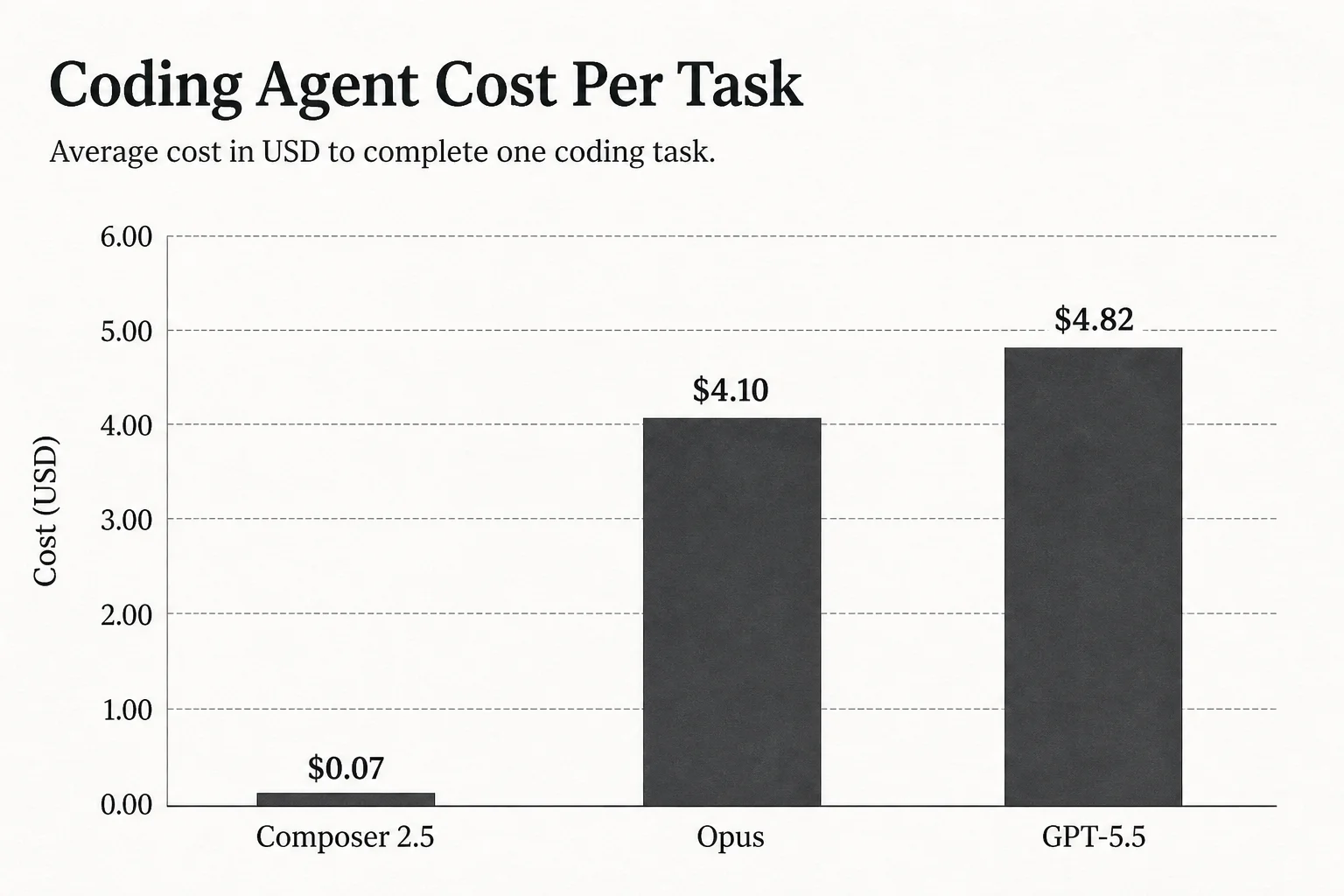
| Claude Opus 4.7 max (Claude Code) | 66 | $4.10 |
| GPT-5.5 xhigh (Codex) | 65 | $4.82 |
| Composer 2.5 standard (Cursor) | 62 | $0.07 |
| Composer 2.5 Fast (Cursor) | 62 | $0.44 |
Four index points separate first and third place. The cost column is not close.
List pricing tells a similar story. Composer 2.5 standard lists at $0.50/$2.50 per million input/output tokens. Frontier tiers sit closer to $5/$25. Token tables understate agent work because agents re-read files, retry failed edits, and burn context on tool output.
Cost per task is the benchmark I would put in a proposal deck. It is measured on finished work, not a single completion call.
Why agent loops punish "always use Opus"
A one-shot chat completion and an agent loop are different products.
An agent loop might: read six files, grep for a symbol, patch two modules, run tests, read stderr, patch again, and summarize. Each step adds tokens. Failures multiply turns. "Smartest model for everything" sounds safe until finance asks why API spend doubled while story throughput flatlined.
That is the ceiling Alpha Signal's Sunday deep dive describes. Raw capability is useless when ROI turns negative on autonomous loops.
In client work I see the same pattern on voice and ops agents, not just IDE bots. Long chains need routing, not hero models.
What specialized coding models actually optimize
Cursor did not train a foundation model from zero for Composer 2.5. They started from Moonshot's open-weight Kimi K2.5 checkpoint and poured compute into RL, synthetic tasks, and product data from the IDE harness.
Three details from their release blog stuck with me:
- 25x more synthetic coding tasks than Composer 2, including harder multi-step environments.
- Targeted textual feedback during RL: when the model veers off in step four of a fifty-step rollout, trainers inject a localized hint and distill the corrected behavior instead of relying on one noisy pass/fail grade at the end.
- Co-evolution with the harness because Cursor owns the editor surface and sees real tool traces.
Specialized models win on price, latency, and vertical utility, not on every generalized reasoning benchmark. For high-volume coding loops, that trade is often correct.
The hybrid stack I recommend in 2026
The digest's hybrid pattern matches what I already tell teams building production agents:
| Traffic share | Task type | Model tier |
|---|---|---|
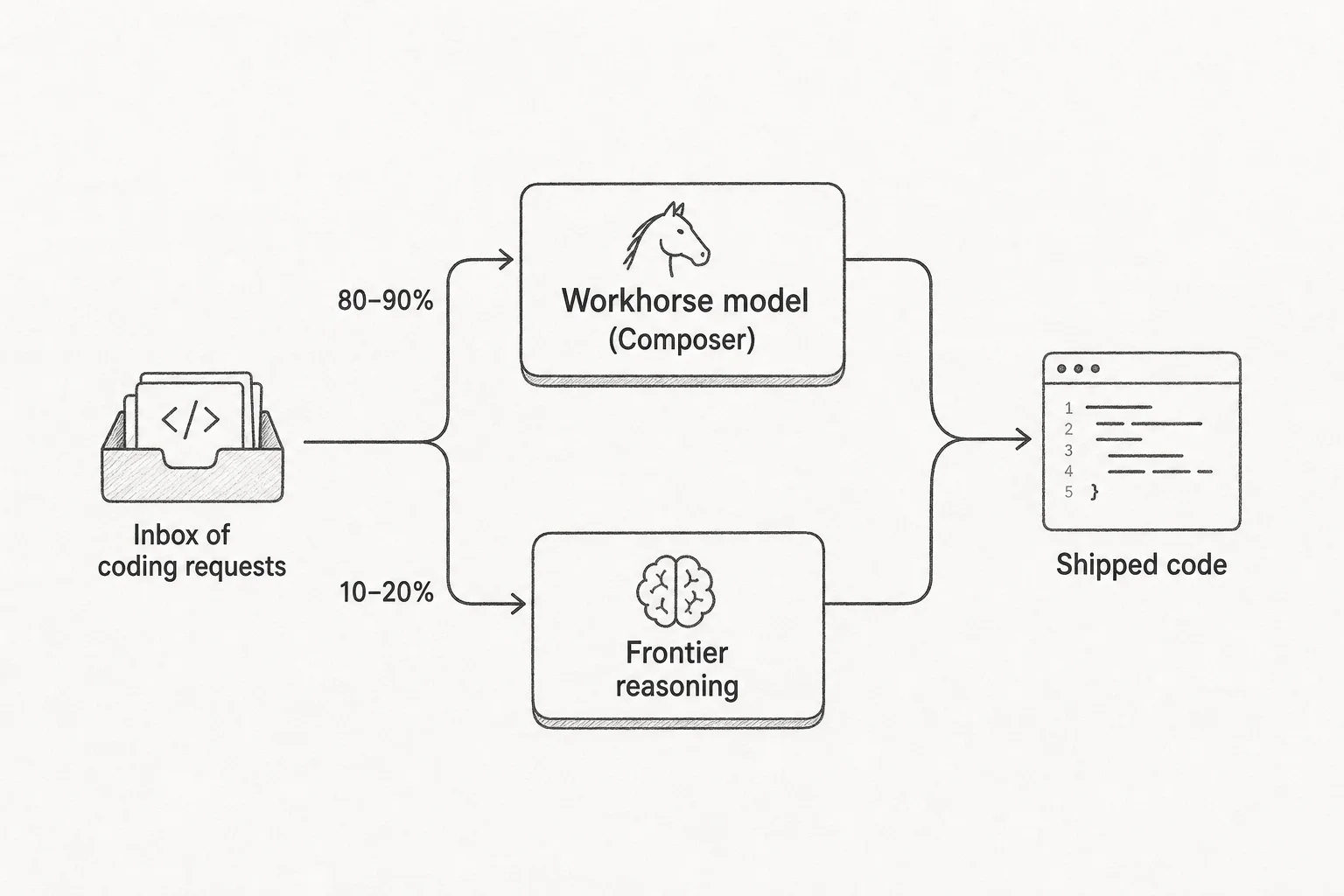
| ~80–90% | Refactors, tests, lint fixes, scoped edits | Workhorse / specialized (Composer 2.5, fast tiers, domain-tuned models) |
| ~10–20% | Novel architecture, zero-shot edge cases, deep research | Frontier reasoning (Opus, GPT-5.5 high reasoning, etc.) |
You do not need Cursor to execute this idea. The pattern is classify, route, escalate.
Cursor Routeris the productized version for teams: a classifier trained on hundreds of thousands of live requests that sends simple work to cheaper models and hard problems to frontier tiers. Early enterprise access reported roughly 30–50% lower spend versus routing everything to Opus 4.8, with online A/B tests citing up to 60% savings on some traffic while holding satisfaction metrics.
Even if you self-host agents, the lesson is the same: defaulting to one daily-driver frontier model taxes routine work at premium rates.
Where frontier models still win
Specialized models lag on the hardest out-of-distribution reasoning. Keep frontier models in the mix for:
- Greenfield system design with weak specs
- Security-sensitive refactors with thin test coverage
- Terminal-heavy workflows (benchmarks like Terminal-Bench still favor GPT-5.5 on shell trajectories)
- Research spikes where you cannot afford a wrong architectural bet
Composer 2.5 landing near Opus on SWE-style coding while trailing on terminal benchmarks is exactly the shape of gap routing should exploit.
Building your own specialized stack (without Cursor-scale data)
Not every shop has Cursor's distribution. You still might have a moat:
- Legal, medical, or finance corpora with compliance constraints
- Internal codebases with years of review comments and incident postmortems
- CRM and ops logs that show what "good" automation looks like in your business
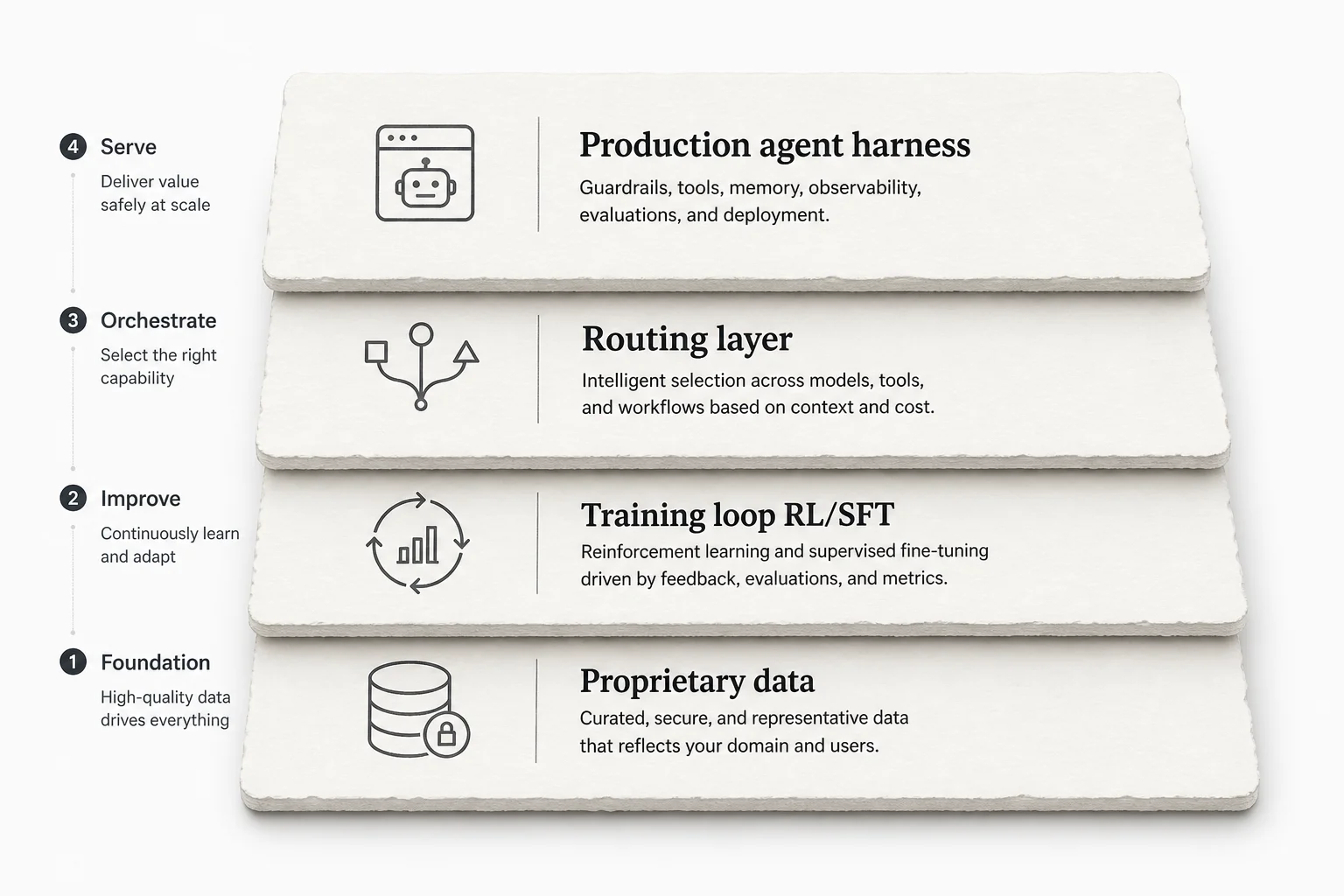
from Thinking Machines is one sign the infrastructure layer is maturing. It is a Python-native API for distributed LoRA fine-tuning: you write forward_backward, optim_step, and sample loops on a laptop, and the platform schedules GPU work. Checkpoints export as standard adapters you can serve elsewhere.
That lowers the bar to run a "Cursor playbook" without owning a supercomputer. It does not remove the need for good domain data and eval harnesses that mirror production.
What I would change in your agent architecture this week
If you are still routing 100% of agent turns to the largest model, treat that as a bug.
- Measure cost per finished task, not cost per request. Log tokens, tool steps, and human corrections per ticket.
- Write routing rules (or adopt a router) before the next model launch tempts you to bump everything to frontier again.
- Keep a frontier escalation path with explicit triggers: new repo, security-sensitive diff, failed workhorse attempt.
- Invest in harness data if you own the UI. The flywheel is interaction traces, not another generic system prompt.
For product builders, "we call Anthropic/OpenAI and markup tokens" is a shrinking margin strategy. Long-term defensibility looks like tuned backends plus routing plus eval loops you control.
For engineers, model routing and cost-aware orchestration are core skills now, same as writing idempotent tool handlers.
If you are wiring agents into ops or product and want a second pair of eyes on routing and spend, book a free discovery call. I will tell you honestly whether your bottleneck is the model, the harness, or the workflow you are automating.