
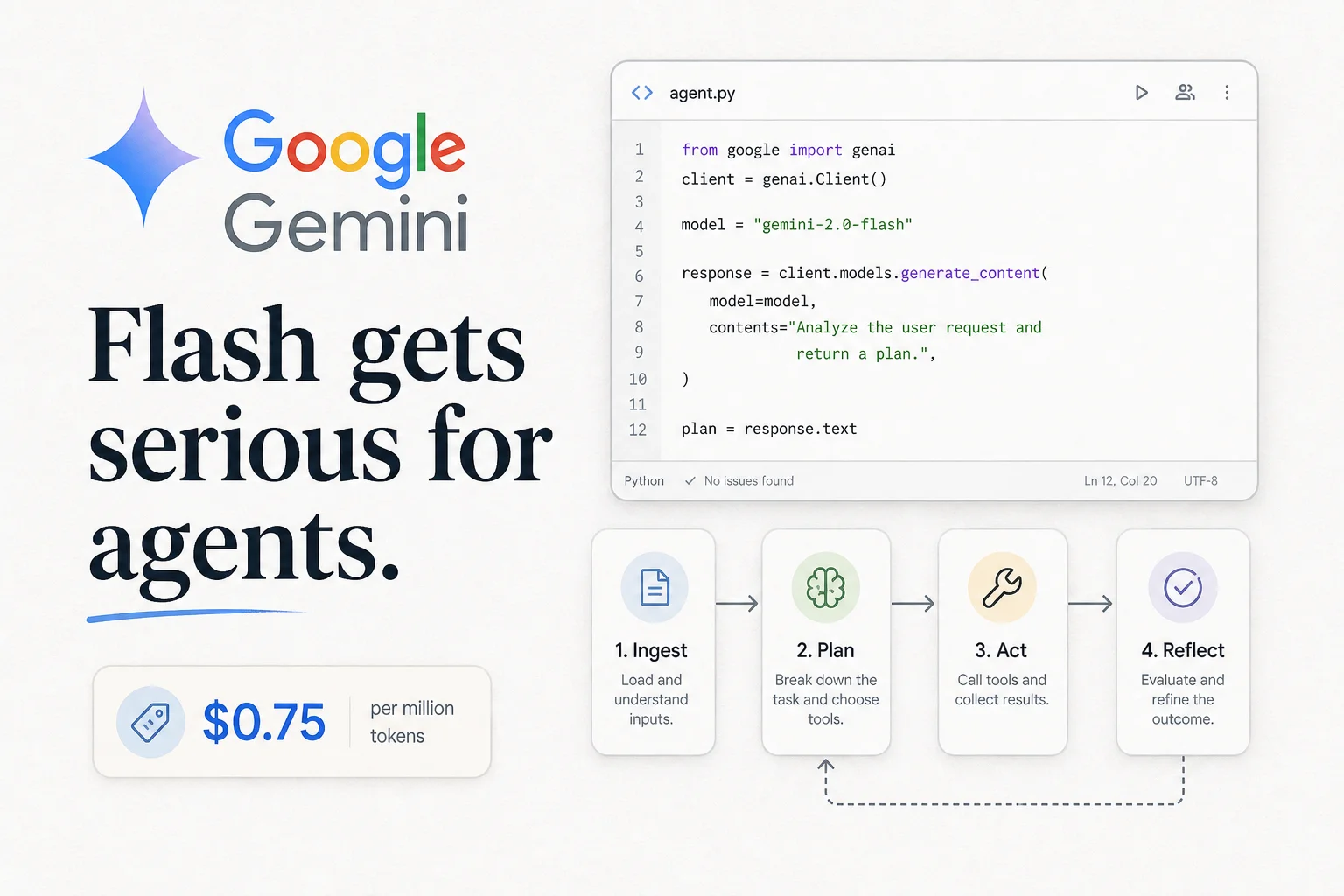
Google shipped another Flash model three weeks after the last one. That pace used to feel reckless. After reading the 3.7 Flash announcement, it feels more like a product line that finally found its rhythm.
Gemini 3.7 Flash is positioned as Google's most intelligent workhorse for coding and agents. Not the biggest Gemini. The one you route high-volume loops through without apologizing to finance.
I have been tracking Flash models for client stacks that need cheap inference with acceptable quality. 3.7 is the first Flash release where the benchmark deltas and the price cut landed in the same email.
The numbers that matter
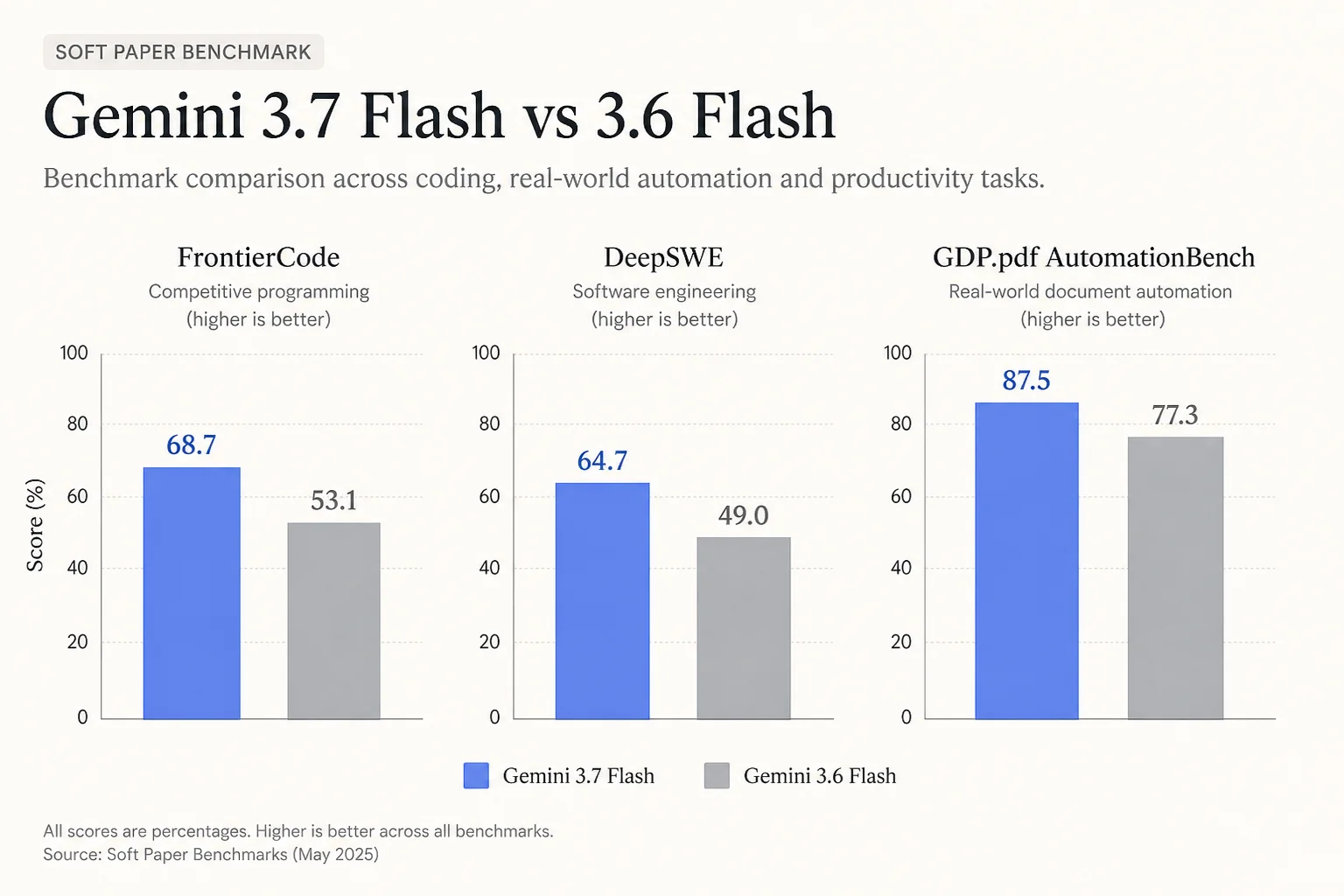
Google published several comparisons against 3.6 Flash. These are vendor evals, so treat them as directional. They still tell you where Google is aiming.
| Benchmark | 3.7 Flash | 3.6 Flash |
|---|---|---|
| FrontierCode 1.1 Main | 43.6% | 34.4% |
| DeepSWE v1.1 | 65.3% | 49.0% |
| WebDev Arena Elo | 1588 | 1538 |
| GDP.pdf (document reasoning) | 34.0% | 22.0% |
| AutomationBench (workflows) | 30.4% | 17.0% |
The coding jumps are large enough that I would rerun my own harness before switching production routes. The document and automation benches matter for ops agents that read PDFs, spreadsheets, and ticket exports, not just IDE refactors.
Pricing and the agent economics angle
Introductory API pricing through December 31, 2026:
| Token type | 3.7 Flash (intro) | After Jan 1, 2027 |
|---|---|---|
| Input | $0.75 / 1M | $1.50 / 1M |
| Output | $3.75 / 1M | $7.50 / 1M |
Google says that is half the original 3.6 Flash cost per million tokens during the intro window.
If you read my post on agentic coding model routing, you know I care about cost per completed task, not list price alone. Still, a workhorse tier that moves benchmark scores up while price moves down is exactly the combination that makes routing worthwhile.
Developer experience claims I would verify
Google's blog emphasizes behaviors that matter in real harnesses:
- Clarifies intent when specs are ambiguous
- Follows instructions with higher fidelity
- Plans multi-step tool use with fewer retries
- Better UI generation from screenshots or design references
Those are the differences you feel in daily use, not on a leaderboard. I would test 3.7 Flash on:
- A multi-file refactor with tests
- A PDF-to-summary pipeline with tables
- A simple internal tool built from a screenshot mock
If retries drop 20%, the model pays for itself even at equal token price.
Where 3.7 Flash shows up in Google's stack
Availability matters as much as benchmarks:
- Google AI Studio and Gemini API
- Android Studio
- Gemini Enterprise Agent Platform
- Antigravity agent-first workflows
- Gemini Spark for Pro and Ultra subscribers (24/7 personal agent)
Spark switching to 3.7 Flash is Google's bet that subscribers want action, not just chat. Workspace tool use, file consolidation, and status doc updates are the demo scenarios in the launch post.
That lines up with what I wrote about Antigravity as a multi-agent desktop: the IDE is becoming an orchestration surface. Flash-class models are the engine for the fan-out.
Safety note (brief)
Google mentions updated safeguards for CBRN and cyber offense misuse domains, with a published model card. For enterprise buyers, that is table stakes. For builders, it is a reminder that faster cheap models still need policy wrappers in production.
How I would slot 3.7 Flash into a stack
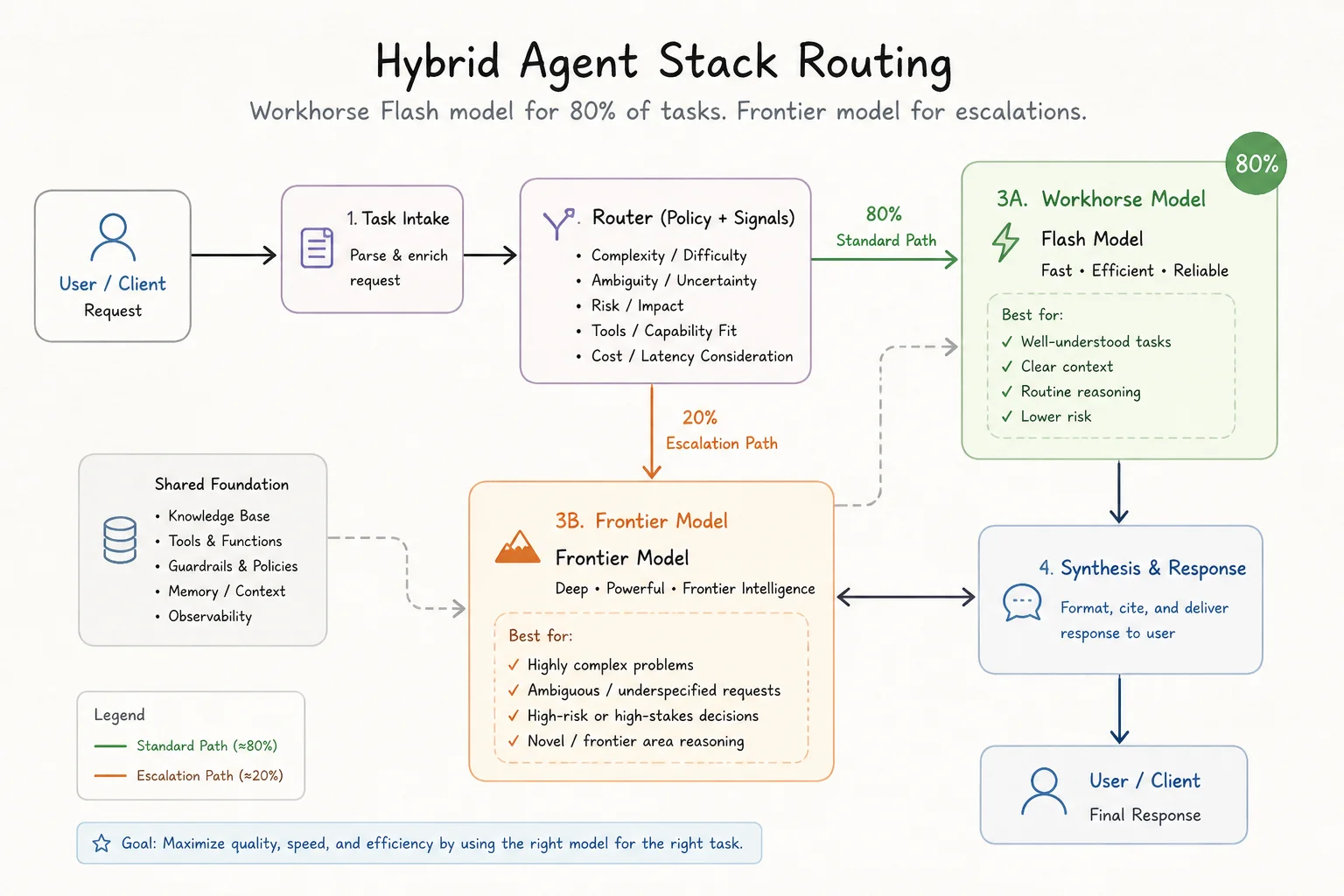
Not as your only model. As the default route for volume:
| Traffic | Model role |
|---|---|
| ~80% | 3.7 Flash for edits, summaries, structured extraction |
| ~15% | Prior Flash or specialized small models for latency-critical paths |
| ~5% | Frontier Gemini or other vendors for novel architecture |
Pair with explicit evals on your data. Google's GDP.pdf score is not your insurance claims PDF or your Shopify export.
The competitive frame
The Rundown compared 3.7 Flash pricing to Sonnet 5, GPT-5.6 Terra, and Muse Spark 1.2. I will not crown a winner from press releases. The useful frame is simpler: mid-tier models are now agent-class, not chat-class.
That shifts build vs buy math for SMEs. You can prototype agent workflows on Flash-tier pricing, then escalate only the steps that fail your eval.
What I am testing this week
If you are already on Gemini API:
- Swap 3.6 Flash to 3.7 Flash in a staging harness
- Log tokens, retries, and wall-clock per task for one week
- Compare against one frontier route on the same task set
If 3.7 wins on cost per task, promote it to default. If not, you spent a few dollars learning something real.
Need help picking model routes for agents that actually ship? Book a free discovery call.