
For years, picking a frontier model meant accepting a slower loop. You traded latency for intelligence. OpenAI's Ultrafast preview flips that trade, at least for one flagship model.
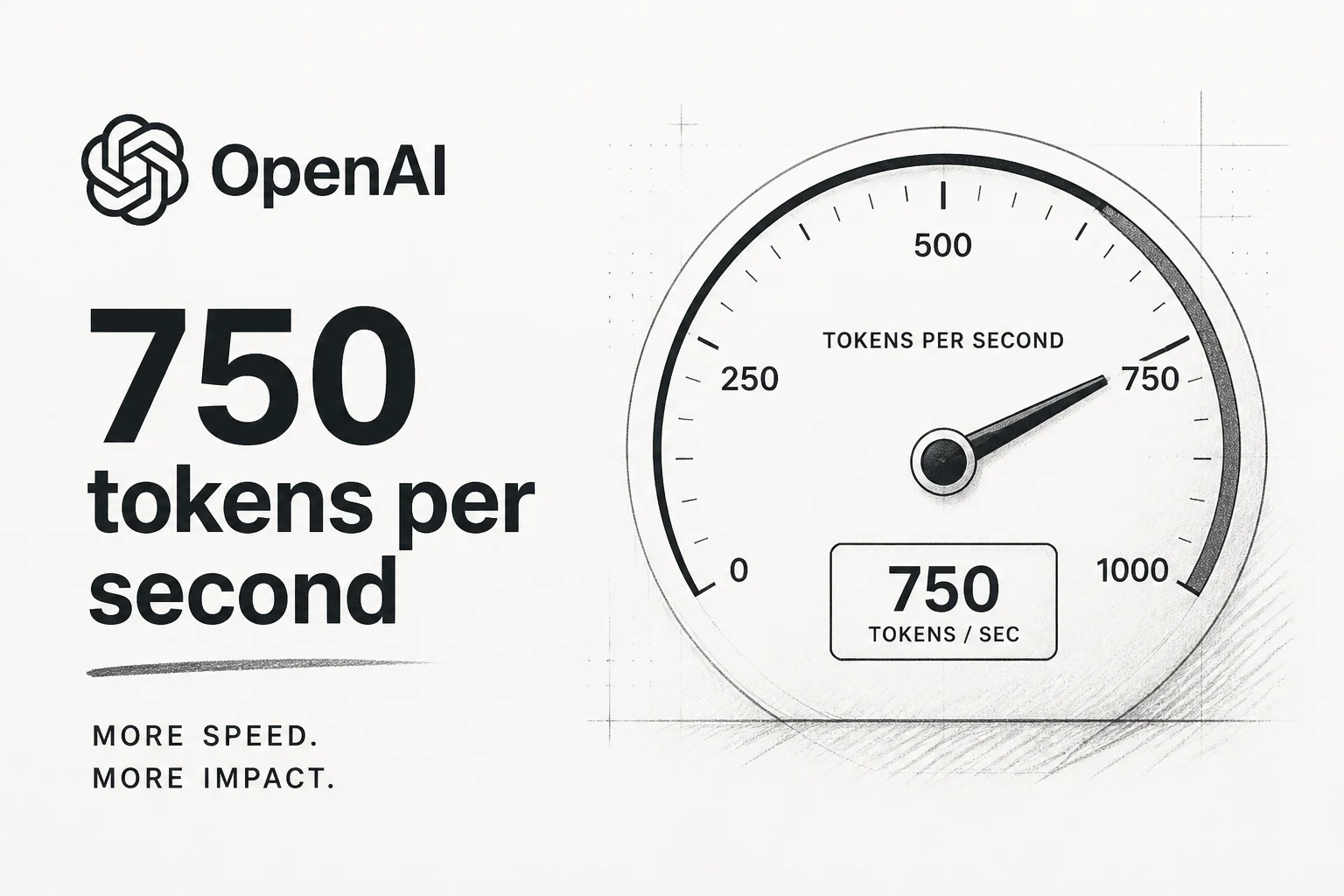
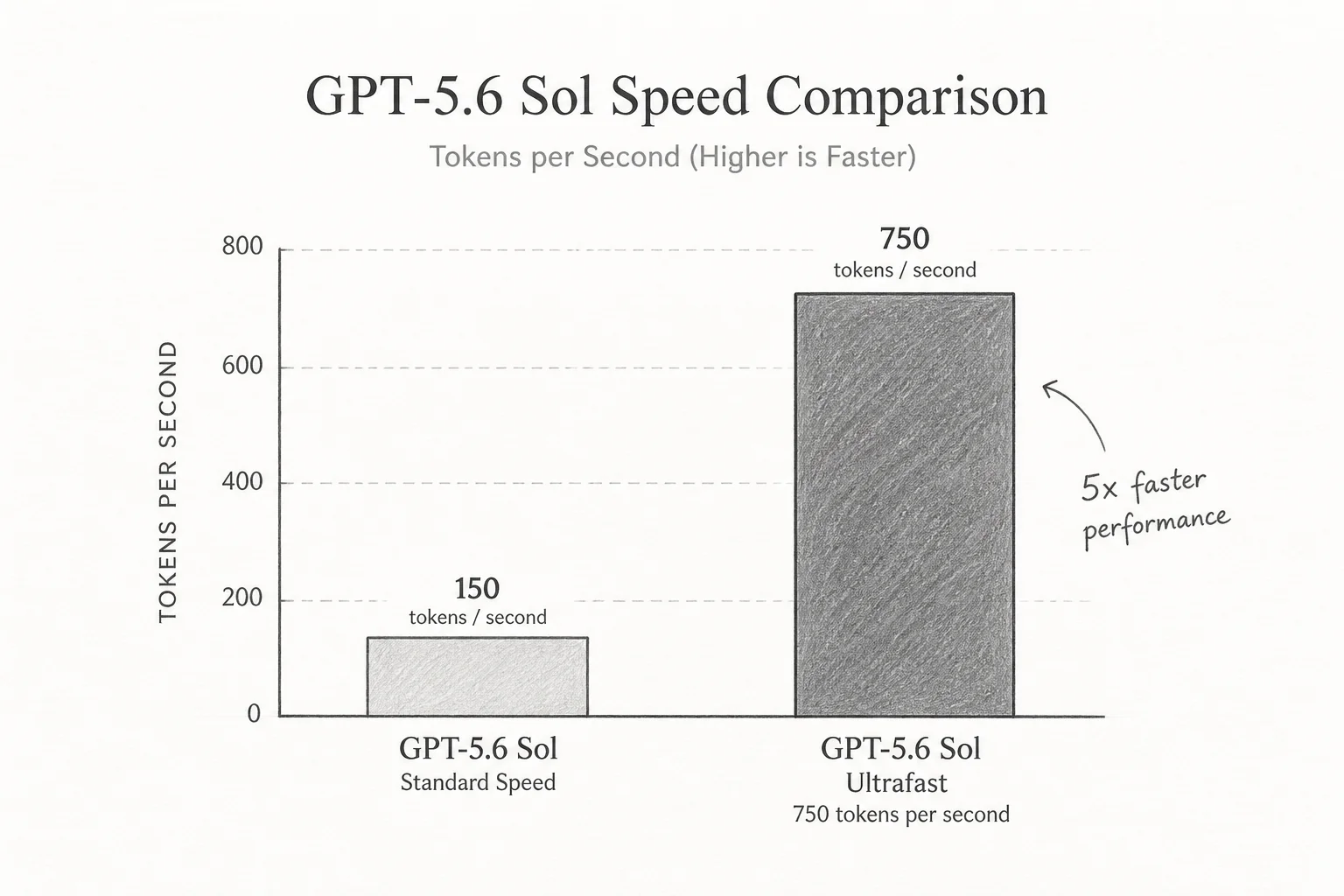
The company just showed off the first fruits of its Cerebras partnership: an API tier called Ultrafast that pushes GPT-5.6 Sol to as much as 14x normal speed, with peaks around 750 tokens per second. One staffer compared it to "genuinely cheating at my job." Another said a security investigation dropped from hours to ten minutes.
I build agent workflows for clients who measure ROI in minutes, not benchmark points. This release matters because speed is not a UX nicety in agent loops. It is a multiplier on how many tool calls you can afford before the user walks away.
What Ultrafast actually is
Ultrafast is not a new model name. It is a compute tier for GPT-5.6 Sol, powered by Cerebras systems OpenAI committed to in January alongside plans for hundreds of megawatts of speed-focused capacity.
The headline numbers from the preview:
| Metric | Ultrafast (Sol) | Context |
|---|---|---|
| Peak throughput | ~750 tokens/sec | Up to 14x vs standard Sol tier |
| Humanity's Last Exam (2,500 Q) | ~11 hours wall clock | vs ~78 hours for Fable, similar results |
| Availability | Invite-only API preview | Pricing not announced |
| Hardware partner | Cerebras wafer-scale | Partnership announced Jan 2026 |
The eval detail is the one I keep circling back to. Humanity's Last Exam is a brutal, broad knowledge test. Finishing it in eleven hours instead of seventy-eight is not "faster autocomplete." It is the difference between an overnight batch job and a same-day research sprint.
Why token speed changes agent economics
Agent harnesses do not bill like chat. They re-read files, emit patches, parse stderr, and loop. Every turn waits on generation.
When generation runs at 750 tokens per second, three things shift:
- Retry tolerance. Cheap retries mean you can let the model self-correct without blowing the SLA.
- Parallel fan-out. Security reviews, log triage, and multi-file refactors stop being serial bottlenecks.
- Human-in-the-loop density. A reviewer can stay in flow when each follow-up answer lands in seconds, not tens of seconds.
OpenAI's internal anecdotes match what I see in production voice and ops agents: the slow model is not always wrong, but it is expensive in attention. Investigators quit. Users abandon chat threads. Ultrafast targets that friction directly.
Speed at the frontier is not about shaving milliseconds off autocomplete. It is about how many agent turns fit inside a human work session.
The Cerebras bet behind the tier
OpenAI and Cerebras framed the January partnership around dedicated inference capacity, not a one-off benchmark stunt. The pitch is wafer-scale chips optimized for low-latency token streaming at scale.
That matters because the industry has danced between "smarter" and "faster" for years. Ultrafast is OpenAI saying the flagship model can wear both hats when the silicon is purpose-built for inference, not retrofitted from training clusters.
For builders, the practical read is simpler: hosted frontier intelligence may stop being the slow lane. If Ultrafast pricing lands in a sane band, a lot of teams will route interactive agent traffic here and keep batch jobs on cheaper tiers.
What we still do not know
OpenAI has not published Ultrafast pricing. That is the gating item for every architecture doc I would write this week.
Without price, you cannot answer the question clients actually ask: "Does 14x speed beat routing 80% of turns to a workhorse model?" Maybe. Maybe not. A specialized fast model at $0.07 per task can still win on unit economics even if Ultrafast feels magical in a demo.
Other open questions:
| Unknown | Why it matters |
|---|---|
| Rate limits and queueing | Peak t/s rarely equals sustained t/s under load |
| Quality parity at max speed | OpenAI claims comparable HLE results; your eval may differ |
| Regional availability | Cerebras capacity rollout is incremental |
| Tool-call latency | Tokens/sec does not fix slow filesystem or browser tools |
Access is invite-only for now. OpenAI says it will widen as more Cerebras capacity comes online.
How I would test it in a real stack
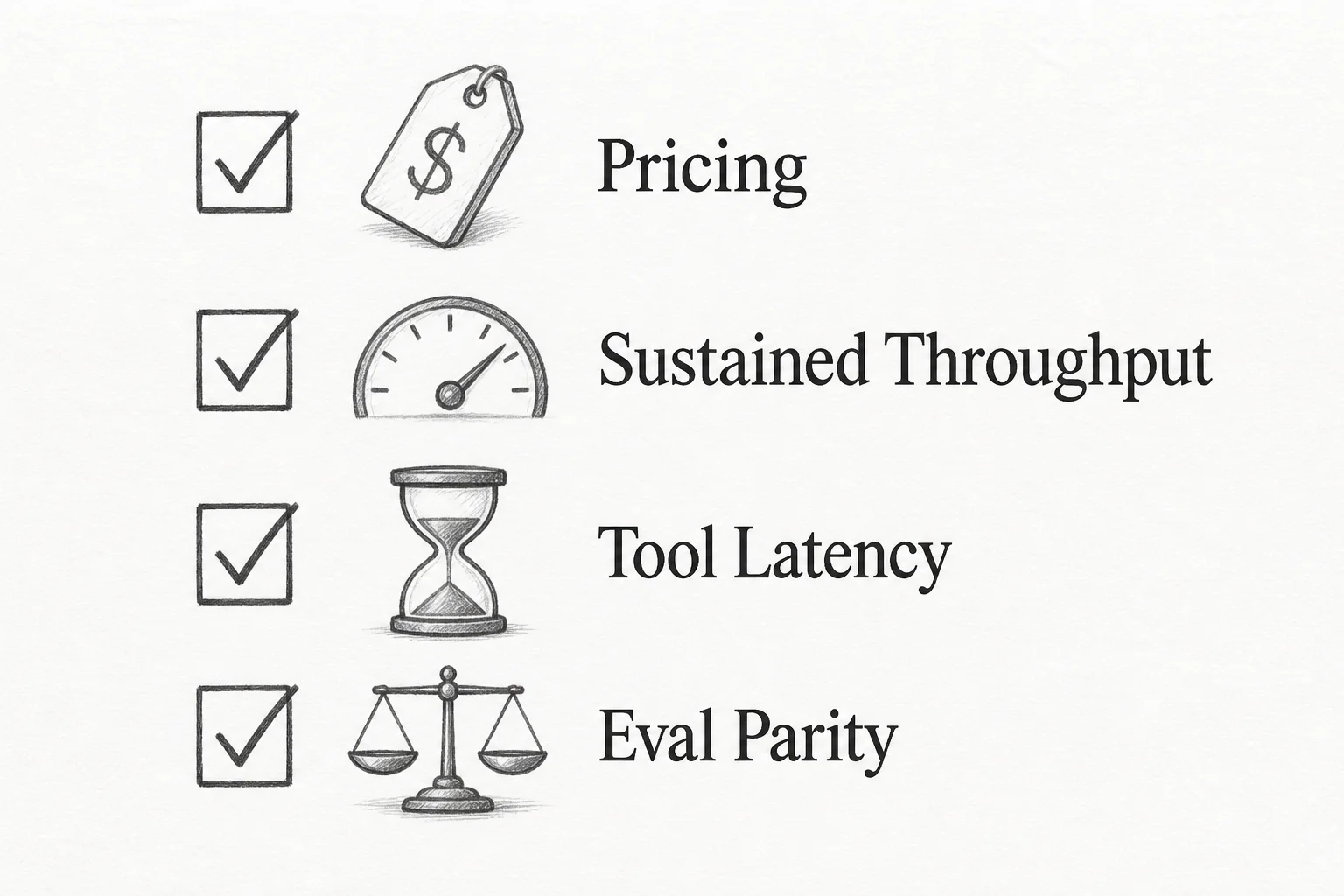
If you get preview access, skip the Twitter demo. Run four checks that map to shipped agents:
- Same prompt, two tiers. Pick a 20-turn coding or security task. Log wall clock, tokens, and human edits required on standard Sol vs Ultrafast.
- Parallel workers. Launch five identical sub-agents on independent files. Measure completion time and merge conflicts.
- Tool-heavy loop. Include grep, test runs, and HTTP fetches. See whether generation or tools dominate latency.
- Cost projection. Once pricing drops, model monthly spend at your p50 and p95 turn counts.
Write down where speed stops helping. That boundary is more useful than the peak t/s headline.
The bigger pattern
Ultrafast sits next to a wave of "fast enough frontier" releases: Gemini 3.7 Flash, cheap workhorse tiers, and routing layers that send easy turns to specialized models. The industry is attacking latency from both sides: faster flagship inference and smarter routing to smaller models.
For applied AI work, the lesson is not "buy the fastest API." It is that agent UX and agent economics are converging on speed as a first-class requirement. Ultrafast is the loudest data point so far.
If you are wiring agents into ops, security, or product workflows and want help stress-testing latency and cost trade-offs, book a free discovery call. I will bring a routing spreadsheet, not a hype deck.