
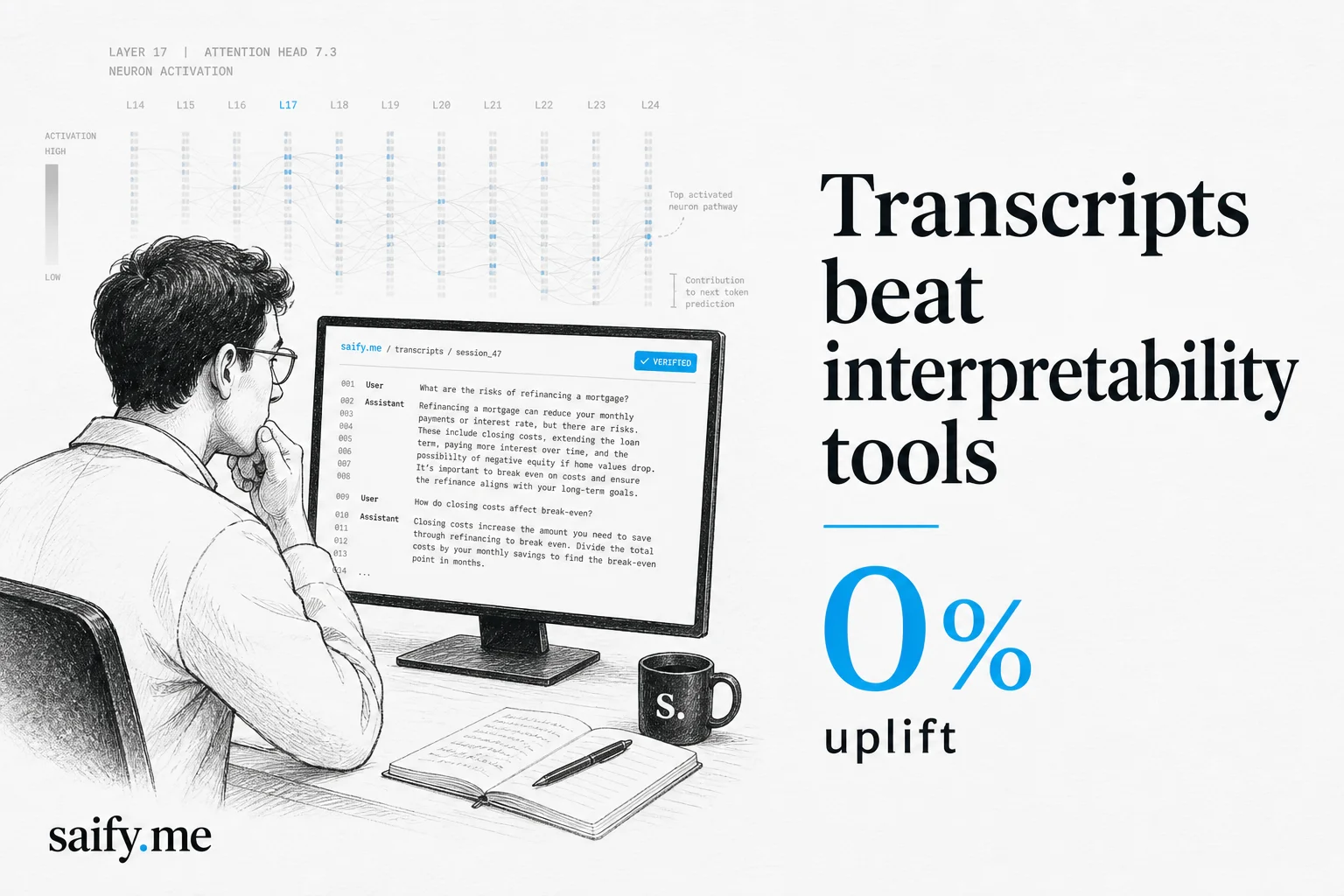
Every vendor deck has a slide about "opening the black box." Most production teams still debug models the old way: read the transcript, reproduce the prompt, change one variable, run again.
Anthropic's August 2026 CHIVE work says that boring workflow might be optimal for now.
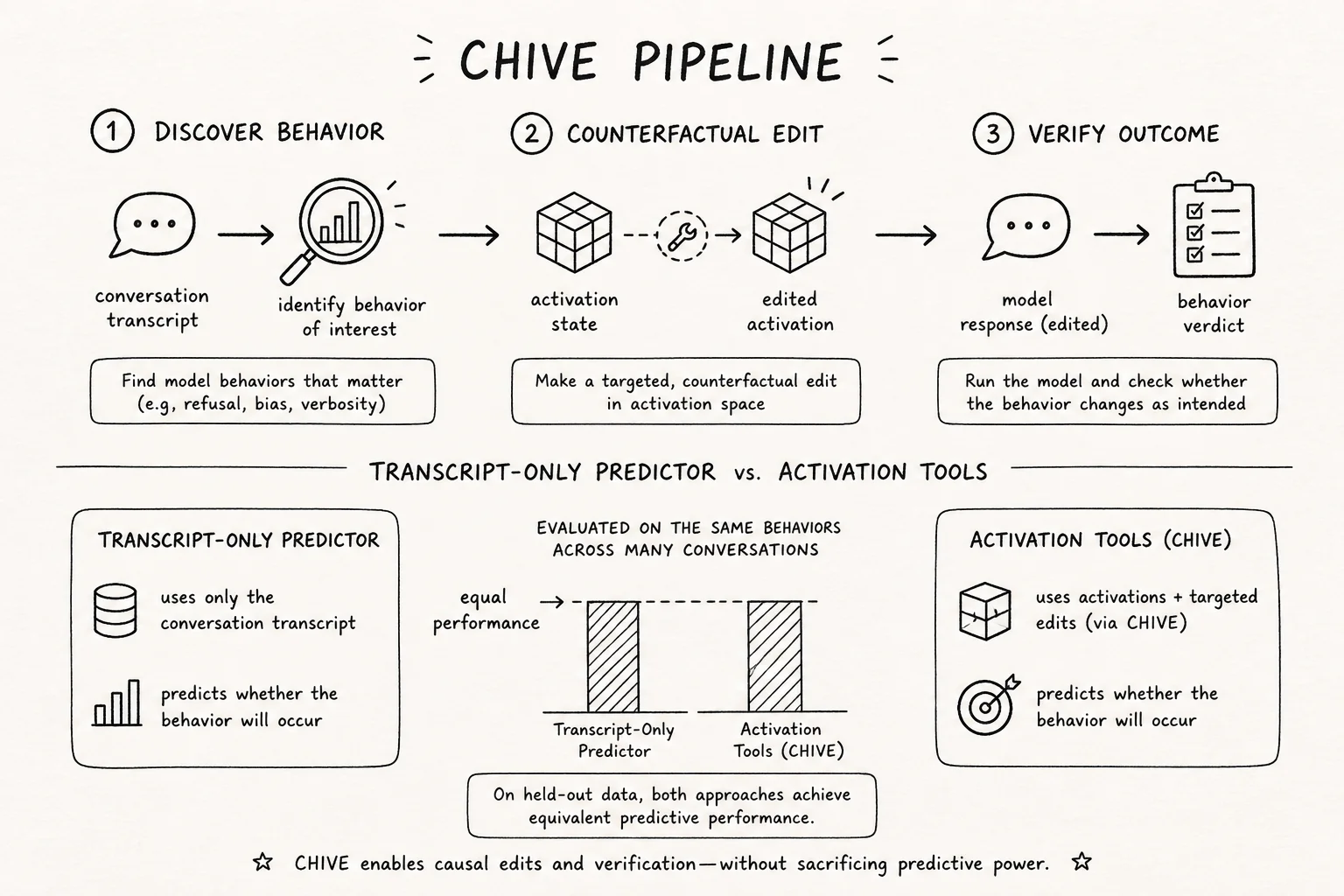
CHIVE (Counterfactual Harness for Interpretability and Verification of Explanations) discovers surprising behaviors on real user prompts, proposes counterfactual edits, and verifies outcomes experimentally. The team then asked: do activation-reading tools help another agent predict those outcomes?
Answer: no uplift over just reading the transcript.
How CHIVE works (two-minute version)
- Discover unexpected behaviors in the wild (not toy prompts)
- Propose counterfactual prompt edits that might flip the behavior
- Verify by actually running the counterfactual
- Evaluate whether interpretability tools help predict verification results
The evaluation is counterfactual simulatability: a good explanation should help you predict what happens if you edit the prompt.
Predictor agents (Claude Opus 4.8 in main runs) saw:
- The transcript
- A claimed counterfactual edit
- Optional read-only activation access (up to 5 calls)
Three tool families were tested because they showed uplift in narrow fine-tune auditing games:
| Tool | What it reads |
|---|---|
| Activation oracle | Target model activations via oracle interface |
| Natural-language autoencoder | Activations compressed to NL descriptions |
| Sparse autoencoder | SAE feature activations |
Transcript-only baseline won ties. No tool beat it across two target models and three predictor families.
Why this landed in my inbox
AlphaSignal summarized it as: interpretability tools add zero boost over reading transcripts.
That is punchy and mostly fair for this benchmark. The paper is careful: the same tool classes did help in controlled auditing setups on fine-tuned models. Wild behaviors are harder.
If you read my post on Goodfire Silico in predictive data debugging, you might wonder if this kills mechanistic interpretability for product teams.
I read it differently: lab tools do not automatically transfer to production forensics.
What applied teams should do Monday morning
1. Treat transcripts as first-class telemetry
Store full agent transcripts with:
- Tool calls and return payloads
- Model + effort/version identifiers
- Prompt hash and retrieval context version
You cannot run CHIVE on logs you never kept.
2. Adopt counterfactual debugging habits
When a user reports "the agent went weird," do not jump to neuron dashboards. Run:
1. Freeze the failing transcript
2. Hypothesize one prompt edit (role, example, tool rule)
3. Run the edit in staging
4. Record whether behavior flips
5. Only then escalate to heavier interpretability tooling
CHIVE literally trains models to predict edit outcomes. That skill generalizes to held-out settings in the paper.
3. Keep interpretability tools in the lab lane
SAEs and activation oracles still matter for:
- Safety research
- Targeted fine-tune audits
- Dataset debugging before post-training (see Goodfire workflow)
Do not buy an interpretability platform expecting instant production RCA magic on general chat logs.
4. Pair with harness fixes from the same digest
The same AlphaSignal issue covered CLI vs MCP cost and DeepSeek vision at flash prices. The through-line: infrastructure theater loses to measured loops.
Limits and open questions
| Caveat | Implication |
|---|---|
| Read-only tool access | Intervening predictors could cheat by running counterfactuals directly |
| Opus 4.8 predictors | Other predictor models may behave differently |
| Wild vs fine-tune gap | Tools may still help on narrow behaviors you intentionally train |
Anthropic also trains models on CHIVE data to predict behavioral changes from edits. That may become a product feature before SAE dashboards do.
Relationship to Anthropic's other interpretability work
This is not a repudiation of global workspace research or circuit tracing. It is a scope statement: explanation quality must be measured on the task you care about.
For most SaaS teams, the task is "will this prompt change fix the ticket?" not "which SAE feature fired?"
Bottom line
CHIVE gives applied engineers permission to stay pragmatic. Read the transcript. Run counterfactual edits. Verify in staging. Spend activation budget where the paper showed uplift, not where a vendor slide implied it.
If you want help building agent observability that survives audits and weird production edge cases, book a free discovery call. I optimize for loops you can run at 2 a.m., not dashboards that only researchers understand.