
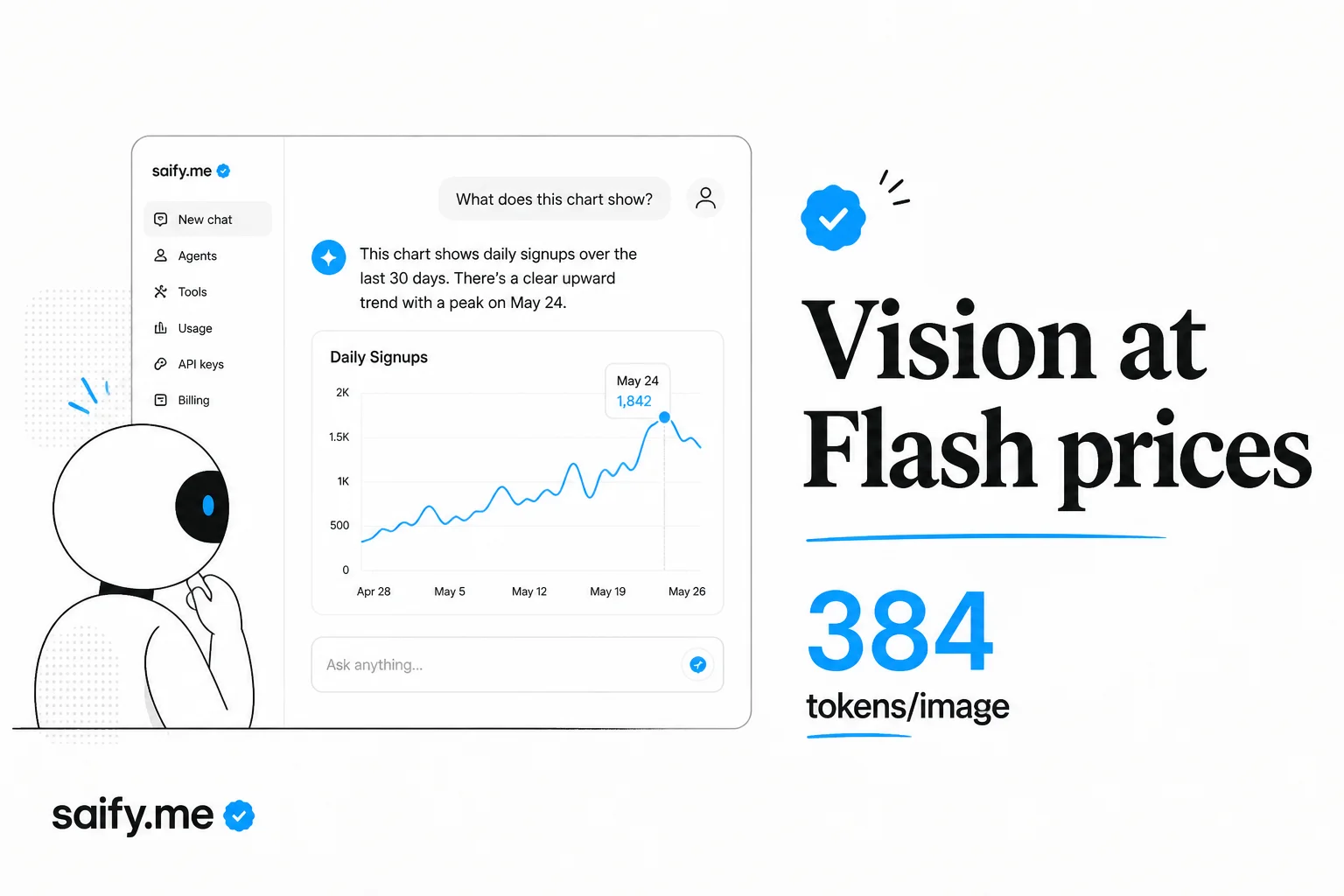
Agent loops that read screenshots used to mean one thing: route vision to a frontier model and eat the bill.
DeepSeek shipped V4-Flash-Vision-Exp on August 21, 2026. Same V4-Flash text stack, plus native image input for screenshots, charts, and documents. Images bill as ordinary input tokens with a 384-token cap per image and no vision surcharge.
For high-volume agent triage, that pricing shape matters more than a benchmark flex.
What you get on day one
From the launch coverage and API notes:
| Capability | Detail |
|---|---|
| Model ID | deepseek-v4-flash-vision-exp |
| Context | 1M tokens in, up to 384K output |
| Image input | Base64, external URLs, or Files API references |
| Files API | Upload once, reuse file_id across requests (free storage) |
| Harness | DeepSeek Harness 0.1.1 ships with support |
Mix text and images in Chat Completions, Messages, or Responses endpoints. No separate vision SKU.
The 384-token image cap is the product decision
DeepSeek resizes images before inference. Large screenshots land around 800×800 effective resolution, then tokenize to at most 384 input tokens per image.
At off-peak V4-Flash rates (~$0.22 per million input tokens), a maxed image is on the order of $0.000085. That is roughly 11,000 images per dollar before output tokens.
The catch is predictable: tiny UI text, dense spreadsheets, and wide dashboards may lose detail after resize. For "what page is this?" triage, the cap is a feature. For OCR on 4K scans, tile first or use a dedicated OCR pass.
Benchmarks: read the footnotes
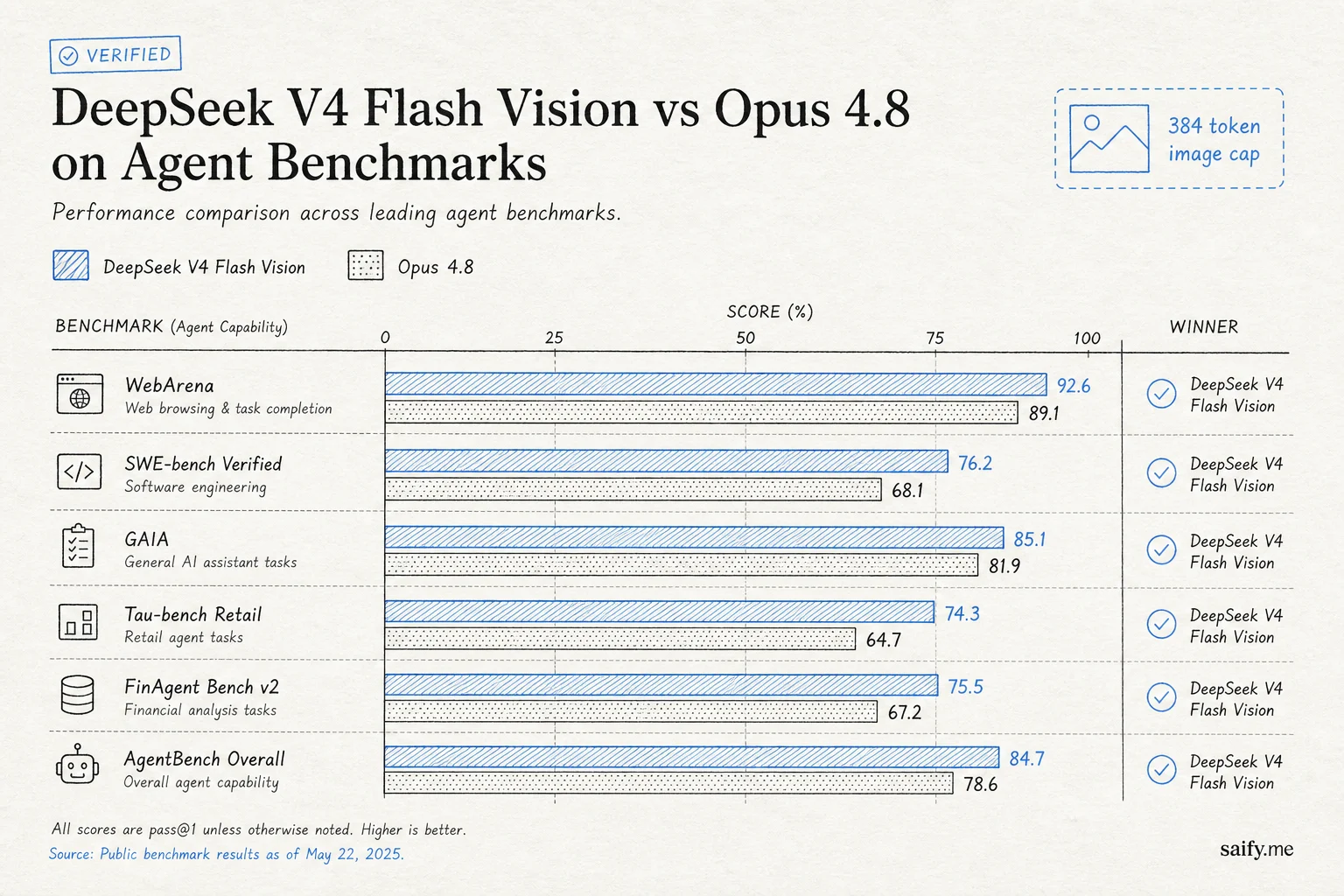
DeepSeek's table positions V4-Flash-Vision-Exp close to Claude Opus 4.8 on several agent benchmarks:
| Benchmark | Vision-Exp (vendor) | Opus 4.8 (vendor) |
|---|---|---|
| Terminal-Bench 2.1 | 83.9 | 85.0 |
| DeepSWE | 59.3 | 58.0 |
| NL2Repo | 57.7 | 69.7 |
| Chartography | 64.3 | 65.0 |
| Agents' Last Exam | 27.3 | 25.7 |
| ApexBench Pass@1 | 36.5 | 39.4 |
Two honest caveats:
- Vendor-run numbers in Harness minimal mode. Wait for third-party harness parity (see my take on harness benchmarks).
- Part of the "leap over V4-Flash" on multimodal benches is simply giving the text-only model eyes. The Opus column is the fair fight.
On text-only benchmarks, DeepSeek claims the vision variant matches base V4-Flash, so you are not buying vision with a text tax.
When I would route agents here
Good fits:
- Screenshot QA loops (does this build match the Figma frame?)
- Chart and dashboard summarization inside agent harnesses
- Document image triage before expensive RAG ingestion
- Bulk eval pipelines where vision calls run thousands of times per day
Skip or chain:
- Fine-grained UI automation on dense admin panels (pair with computer-use batching on a frontier tier)
- Security review of obfuscated code images (use Mythos-class scans or local plugins instead)
Drop-in API sketch
from openai import OpenAI

client = OpenAI(
    api_key="YOUR_KEY",
    base_url="https://api.deepseek.com",
)

response = client.chat.completions.create(
    model="deepseek-v4-flash-vision-exp",
    messages=[{
        "role": "user",
        "content": [
            {"type": "text", "text": "Summarize this error screenshot."},
            {"type": "image_url", "image_url": {"url": "https://example.com/shot.png"}},
        ],
    }],
)
For repeated assets, upload via the Files API once and reference file_id on later turns. That avoids re-upload tax in long agent threads.
Economics vs routing everything through Opus
My default agent stack for clients is tiered:
- Flash-class vision for look-and-decide steps
- Frontier model only when the flash tier fails a confidence gate or touches merge-critical code
V4-Flash-Vision-Exp makes step 1 cheaper without standing up a separate vision vendor. Pair it with the routing ideas in agentic coding model routing and specialized model economics.
Risks on the checklist
| Risk | Mitigation |
|---|---|
| Experimental SKU | Pin model ID; snapshot evals before upgrades |
| Resize detail loss | Tile large screenshots; add OCR pre-pass when needed |
| Geo / compliance | Treat like any third-party API; log data residency requirements |
| Benchmark hype | Measure cost per solved task on your harness, not vendor tables |
Bottom line
DeepSeek did not invent multimodal agents. They priced vision like text inside an already-cheap flash tier. For screenshot-heavy loops, that is the unlock.
If you want help designing tiered agent routing with real per-task cost numbers, get in touch. I build these stacks for teams that invoice on outcomes, not token vanity metrics.