
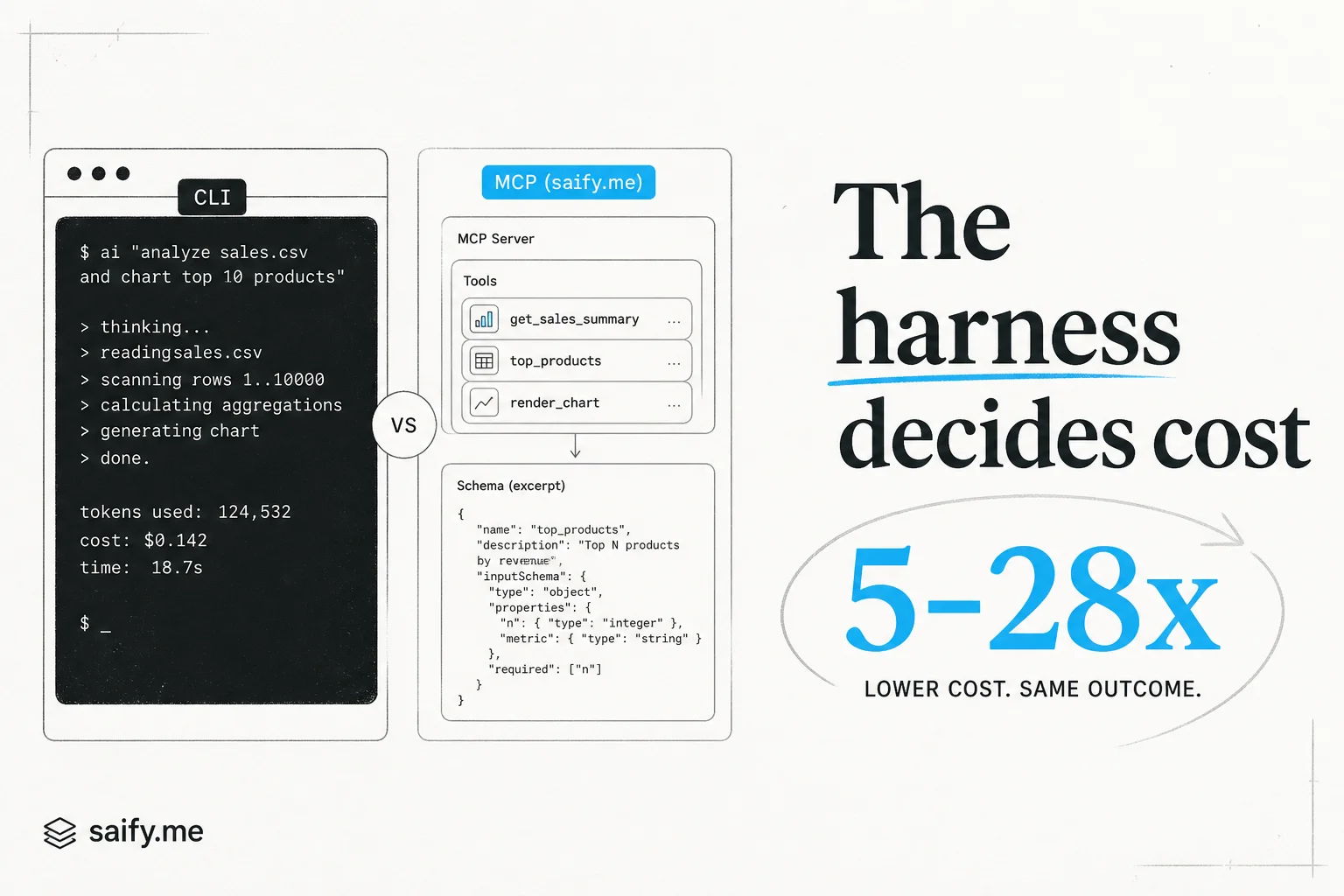
The AlphaSignal digest led with a spicy number: CLI agents are 5–28x cheaper than MCP.
That headline is directionally useful and technically wrong if you paste it into a budget slide without reading the paper.
The August 2026 arXiv preprint "The Scaffolding Matters More Than the Interface" ran one fixed git task across seven agent scaffoldings and five language models, verifying success by inspecting the repo instead of trusting agent self-reports.
The dominant effect was harness choice, not MCP vs CLI religion.
What the study actually measured
Researchers assigned agents six operations against a private online git repository. Completion was ground-truthed from repository state.
Key findings:
| Result | Detail |
|---|---|
| Scaffolding dominance | Two harnesses ship no MCP support; they completed every run on CLI alone |
| Headline 5–28x gap | Compares those CLI-only harnesses vs five MCP-capable harnesses using CLI runs with no MCP server attached |
| Paired ratios unstable | 13 MCP-to-CLI pairs span 0.43x to 29x (MCP cheaper in some pairs) |
| Failure cost | 12.9% of MCP spend bought no completed work vs 2.2% on CLI |
| Behavior drift | Agents often ignored assigned interfaces; unverified comparisons measure noise |
A 27B local model varied 139x in cost across scaffoldings while still completing the task. Interface is not the whole story.
Why MCP looks expensive in practitioner benchmarks
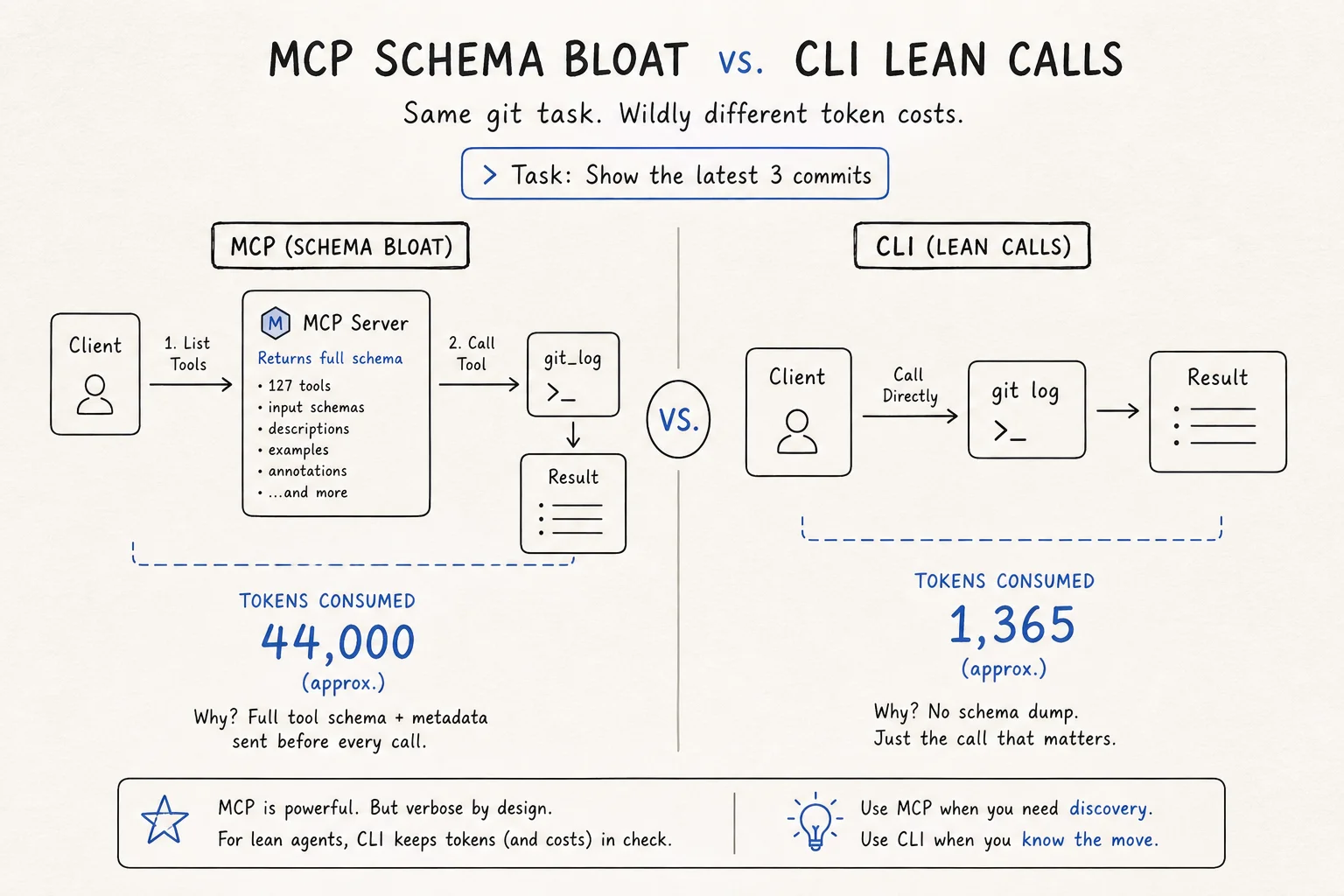
Separate work from Scalekit nails the mechanism on a concrete task: "What language is this repo?"
| Interface | Tokens (example) |
|---|---|
| CLI | ~1,365 |
| MCP (GitHub server, full schemas) | ~44,026 |
The delta is mostly 43 tool definitions injected up front, most of which the agent never touches.
At 10,000 operations per month, that pattern can land around $3 CLI vs $55 MCP before you fix the harness.
Schema filtering through a gateway (return 2–3 relevant tools instead of 43) can cut MCP tokens ~90% and close most of the gap. I wrote about adjacent fixes in Cursor's MCP and skills optimization.
Scale Labs complicates the simple story further
Scale's MCP vs CLI benchmark on frontier models shows cost per solved task can flip by harness:
| Model + harness | Cheaper interface |
|---|---|
| Opus 4.8 on Claude Code | MCP ($18.9 vs $25.1 per solved task) |
| GPT-5.5 on OpenAI Agents SDK | CLI ($12.8 vs $25.2 per solved task) |
CLI trajectories used more turns and wall clock. Dollar cost did not follow turn count because harnesses spill or inline large tool outputs differently.
Translation: do not cargo-cult CLI because a newsletter said 28x.
How I decide MCP vs CLI on client projects
I use a simple decision matrix:
| Signal | Lean CLI | Lean MCP |
|---|---|---|
| Task shape | Shell-native git, build, test, deploy | Cross-app orchestration (CRM + docs + browser) |
| Tool count per step | 1–3 commands | Many services with typed schemas |
| Team skill | Strong terminal culture | Mixed skill, needs discoverable tools |
| Compliance | Easy to audit bash transcripts | Needs structured tool permissions |
For MCP deployments, I require three harness features before production:
- Lazy tool loading (subset per workflow phase)
- Schema cache across turns
- Cost per solved task dashboard (not cost per session)
Fixes that work without ripping MCP out
[ ] Gateway filters schemas to hot-path tools only
[ ] Cold tools load on explicit agent request
[ ] Large MCP outputs spill to files (Claude Code pattern)
[ ] Verify actual tool interface used in logs
[ ] Benchmark one real ticket end-to-end monthly
If you run Composio-style connectors or custom MCP servers, trim schema surface area aggressively. One mega-tool with forty optional fields is a token bomb.
What the AlphaSignal theme gets right anyway
The digest framed "doing more with less": elaborate infrastructure, then discovering the simple path was faster.
That matches my field notes. Teams buy MCP marketplaces, connect twelve servers, then wonder why a one-line git status agent costs dollars.
The lesson is not "MCP bad." It is default paths are expensive until someone owns harness economics.
Bottom line
Borrowed multipliers do not belong in your CFO deck. Run one representative task in your scaffolding with MCP attached and detached. Count tokens, failures, and dollars per verified outcome.
If you want an agent cost audit on a real repo (not a toy benchmark), book a free discovery call. I optimize harnesses for teams that ship weekly, not slide decks.