

Cloud agents do not fail because the model is dumb. They fail because you feed the model the entire toolbox on every turn.
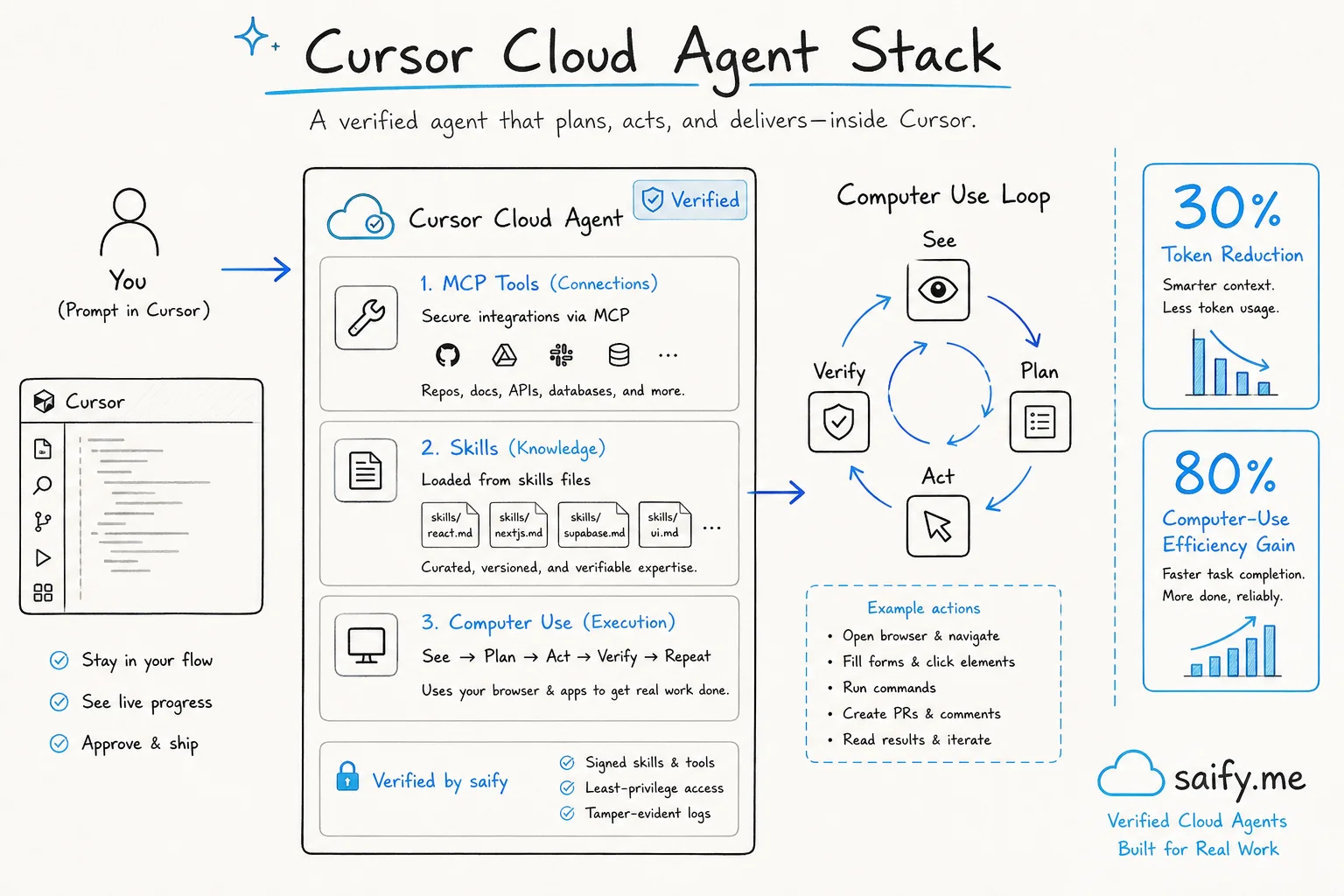
Cursor said in an August 2026 update that its cloud AI agents now handle MCPs, skills, and computer use more efficiently. Reported results: up to 30% less token usage and ~80% better computer-use efficiency.
If you run long agent sessions, that is not a micro-optimization. It is margin.
The three levers Cursor tightened
| Subsystem | Problem before | Optimization direction |
|---|---|---|
| MCP tool schemas | Full server catalogs in context each turn | Smarter loading / caching of tool definitions |
| Skills | Entire skill libraries injected broadly | Selective skill injection per task phase |
| Computer use | Heavy screenshots and action loops | Tighter loop efficiency (80% gain cited) |
None of this requires a new flagship model. It is harness engineering, the same layer I wrote about in Claude Code harness benchmarks and agent skills as portable workflows.
Why MCP bloat hurts more than people admit
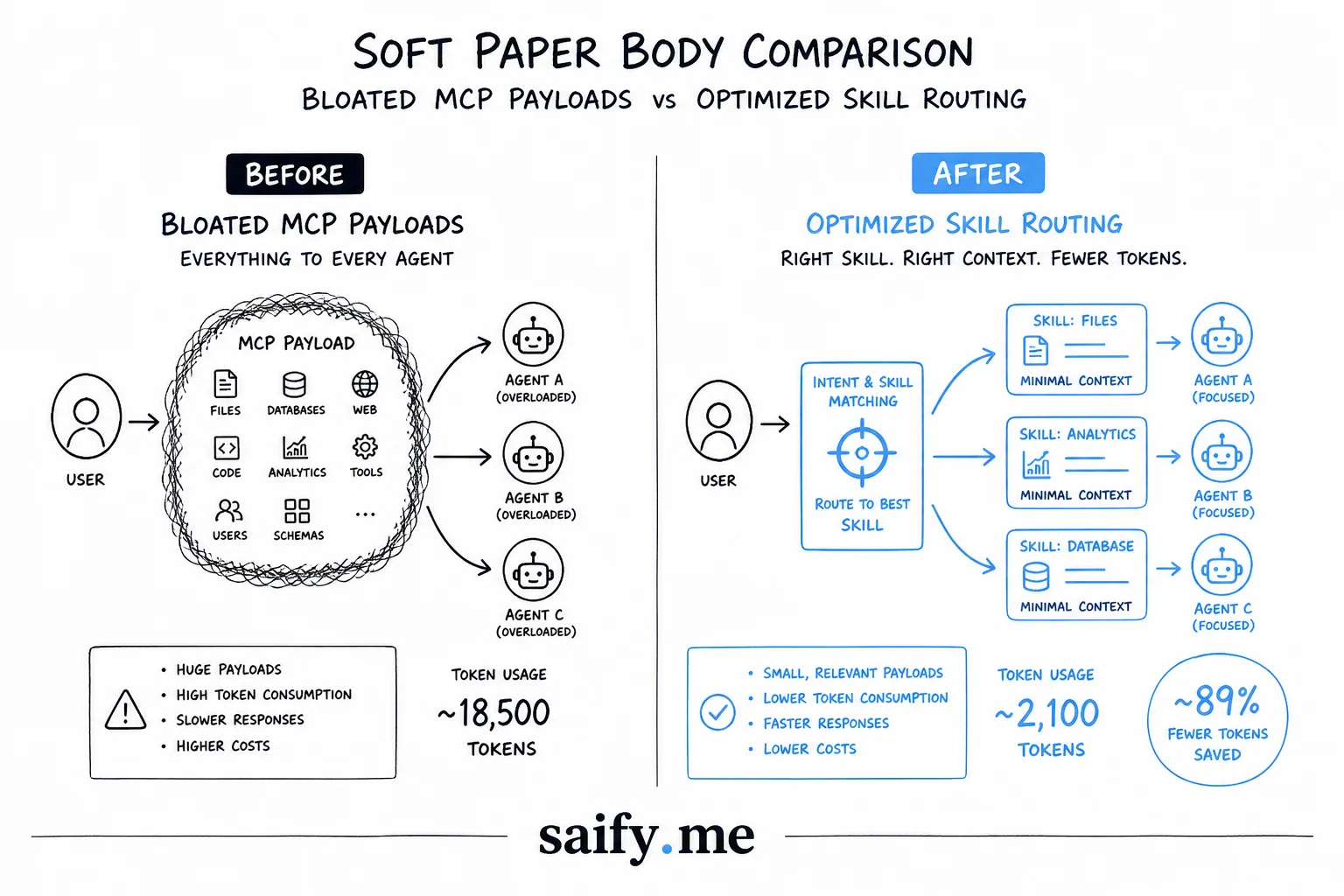
MCP (Model Context Protocol) servers expose tools with JSON schemas. Connect five servers for GitHub, Slack, Postgres, browser, and internal APIs, and your first turn can spend thousands of tokens before the user asks a question.
That tax repeats if your harness re-injects full schemas every step.
Practical symptoms I see in client audits:
- Agent "forgets" the plan after tool calls (context crowded out)
- Cost spikes on simple tickets that should be 20k tokens, not 200k
- Latency climbs because the model reads boilerplate instead of diffs
Cursor's fix is in the orchestration layer: treat MCP like a library catalog, not a dump truck.
If you maintain MCP servers, you can help:
- Trim schema surface area. Expose narrow tools instead of one mega-tool with 40 optional fields.
- Version schemas so clients cache stable definitions.
- Document which tools are hot-path vs admin-only.
Skills: portable workflows without permanent baggage
Skills (markdown instructions agents pull for specialized work) are having a moment. See skills.sh v1.2 and Anthropic's own skill packs.
The failure mode is identical to MCP: if every session loads every skill file "just in case," you pay rent on context you never use.
Selective injection means:
- Load planning skills during spec phase
- Load deployment skills only when CI tools activate
- Drop skills after phase completes
That mirrors how good human teams work. You do not bring the security runbook to every standup.
Computer use: efficiency != capability
Cursor's 80% computer-use efficiency claim is about the loop, not raw vision IQ.
Computer-use agents burn tokens on:
- Full-screen screenshots each step
- Verbose action JSON
- Re-planning from noisy UI state
Efficiency gains usually come from:
| Technique | Effect |
|---|---|
| Region captures instead of full desktop | Fewer vision tokens |
| Action deduplication | Less repeated planning |
| State diffing | Model sees what changed, not entire UI |
| Shorter tool responses | Less re-ingestion next turn |
I covered adjacent patterns in Anthropic Claude computer-use batch actions and Codex Windows computer use. The lesson holds: vision agents are billing agents.
What you should change in your own harness
Even if you do not use Cursor cloud agents, steal the checklist:
1. Measure tokens per successful task
Not per session. Per merged PR, closed ticket, or booked appointment. Optimization targets appear quickly.
2. Lazy-load tools
Default deny all MCP tools. Enable subsets by workflow state machine.
3. Skill TTL
Skills loaded for a subtask should unload when the subtask completes.
4. Cap screenshot resolution
1080p full desktop for clicking a button is overspending.
5. Cache static context
Repo maps, API docs fragments, and schema headers that do not change mid-run belong outside the hot loop.
How this fits the Cursor product map
Cursor has been expanding cloud agents with MCP, skills, and computer use in one stack (The Rundown also noted Google Workspace access in the same tooling roundup). Token efficiency directly affects:
- How many parallel cloud agents a team can afford
- Whether long-running refactors finish inside context limits
- Whether computer-use demos survive real apps with dense UIs
This update is infrastructure for scale, not demo glitter.
Compare with Cursor auto review run mode and ngrok remote coding models. The product story is the same: agents everywhere, bill carefully.
Risks after optimization
Cheaper loops can mean more autonomous action if teams skip governance. Faster computer use without permission files is still twelve million .env files waiting to happen.
Optimization does not replace:
- Secret scanning on agent workspaces
- Network egress allowlists for cloud agents
- Human review on customer-facing outputs
Bottom line
Cursor's August 2026 cloud agent update is a reminder that harness economics beat raw model IQ for production margins. Trimming MCP and skill bloat bought 30% tokens back. Tightening computer-use loops bought efficiency on the most expensive modality.
If your agent bills jumped when you added MCP integrations, the fix is probably architectural, not "switch to a smarter model."
If you want help auditing agent context budgets for a team running Cursor or Claude Code in production, book a free discovery call.