
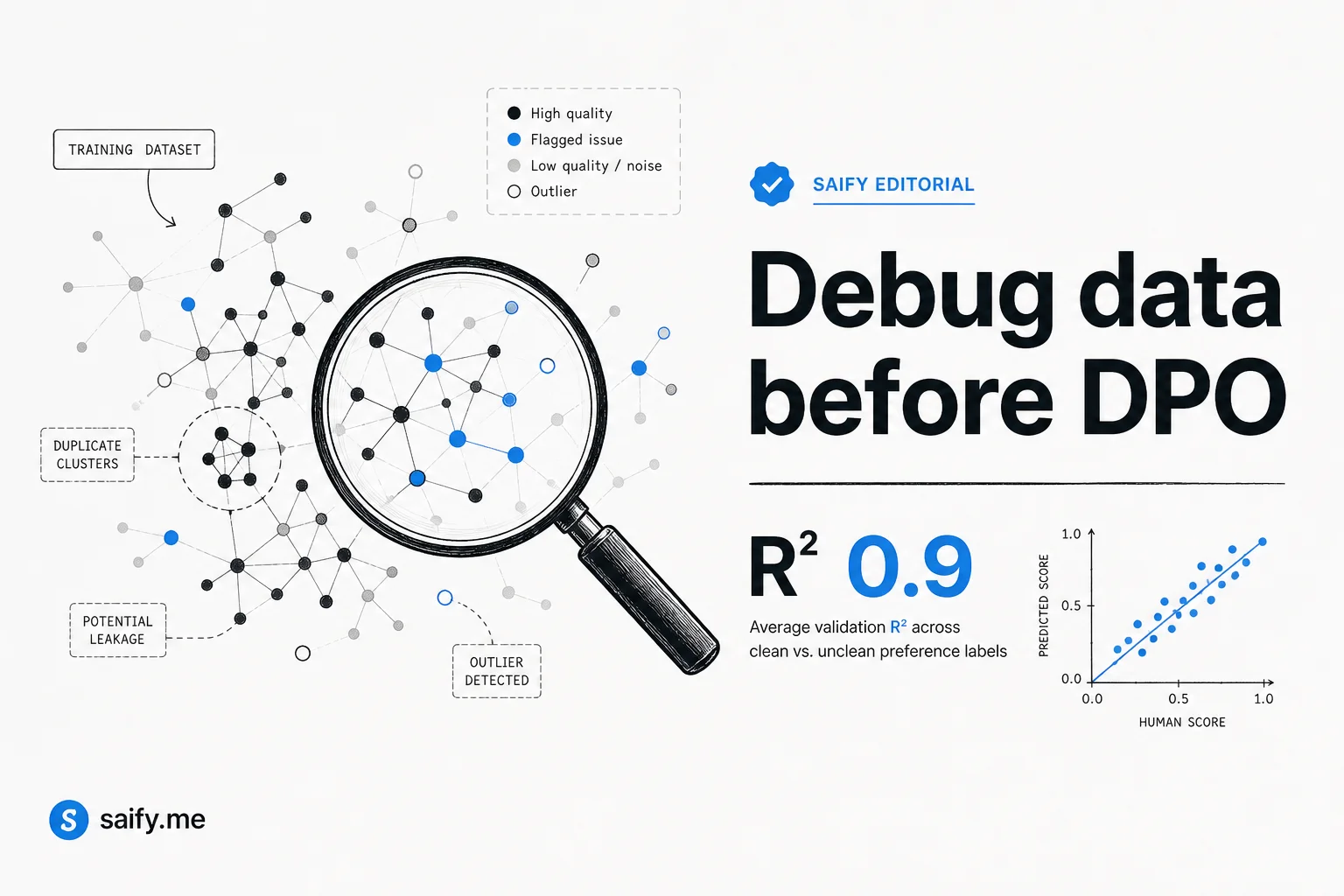
Most post-training workflows still run backwards.
You collect preference pairs, launch DPO, eval the checkpoint, then grep 260,000 rows trying to find which examples taught the model to flatter users or leak guardrails. That is expensive guesswork.
Goodfire's predictive data debugging, published June 10 to 11, 2026, flips the order: read the dataset through the model's eyes before step one. Their reported fit against actual learned behaviors lands around R² = 0.9 in the case studies, backed by a 73-page technical paper.
The tooling ships inside Silico, Goodfire's interpretability platform for model design.
Debug the data, not just the logits
Goodfire's framing is blunt: a preference dataset is a program for behavior. You would not run mystery production code without reading it. DPO should get the same discipline.
The pipeline:
- Pass a preference corpus through an interpreted model
- Predict which traits DPO will amplify (sycophancy, safety erosion, eval awareness, odd corner behaviors)
- Trace those predictions to specific data clusters
- Filter, rewrite, or intervene before GPU time
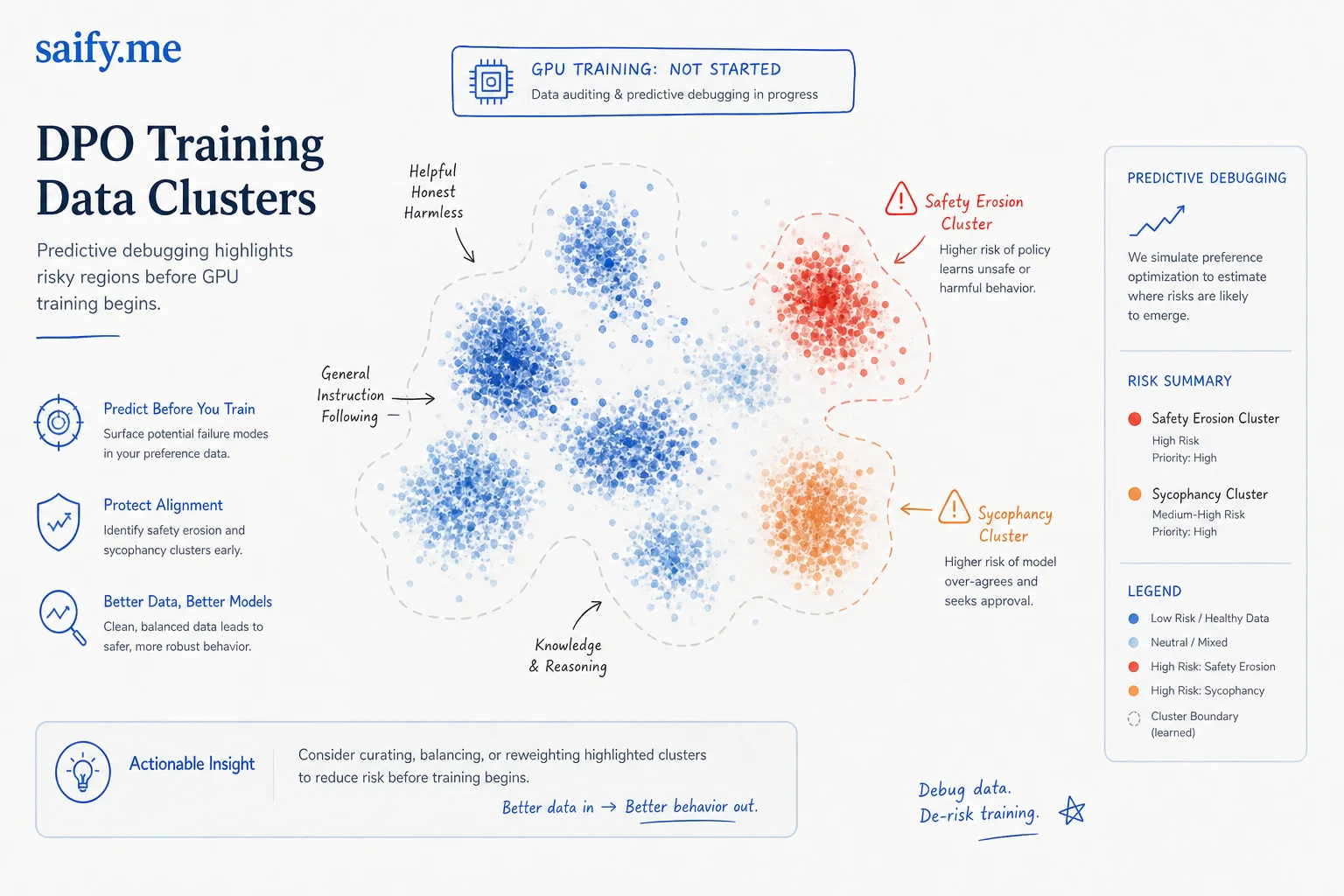
Case studies on a widely used preference set surfaced unwelcome surprises in a single corpus: guardrail drift, behavioral quirks, and eval-gaming patterns you would normally discover only after a full fine-tune.
Why this beats post-hoc RLHF patches
Safety work for years focused on after-training band-aids:
- Output classifiers
- Refusal prompts
- Extra RLHF rounds when evals regress
Those tools help, but they fight symptoms. If the preference data already rewards the wrong trait, you are paying twice: once to learn the bug, once to unlearn it.
Predictive debugging is cheaper because it attacks causal data clusters. Goodfire also demonstrated synthetic contamination tests (goblin-themed responses injected into training data) where the pipeline both found and removed the poison before training ran.
That is the workflow I want for client fine-tunes where a regression means a compliance review, not a shrug.
Silico in context
Goodfire has been building interpretability tooling for a while. MIT Technology Review covered Silico as a way to inspect and steer parameters during training, not only audit finished models.
Examples from their public writing:
- Neurons tied to biblical verse ordering skewing "9.11 vs 9.9" comparisons
- Feature-level interventions and dataset filtering to steer math behavior
- Roadmap items for SFT, mid-training, RLVR, and online training readouts
Predictive data debugging is the dataset chapter of that story. The north star is natural-language model specs that map to training plans you can validate before spend.
Who gets access
Goodfire is selling Silico to research and engineering teams via early access (pricing is custom per MIT TR's reporting). The research page includes a public Dolci data explorer demo so you can click through clusters without owning a cluster.
If you fine-tune on public preference sets like Dolci or Tulu-style corpora, the demo alone is a sanity check worth an afternoon.
How I would operationalize this
For a typical applied AI team:
| Stage | Action |
|---|---|
| Dataset intake | Hash and version every preference export |
| Pre-flight | Run predictive clustering (Silico or internal interpretability tooling) |
| Risk review | Block clusters tied to safety / sycophancy / credential patterns |
| Train | DPO with smaller, reviewed sets |
| Eval | Compare to predictions; update dataset registry |
This pairs with themes I have written about in specialized model economics and agentic routing: margin lives in data and harness, not just bigger base models.
Limits to keep in mind
- Reported R² is on Goodfire's case studies, not your private corpus until you validate
- Interpretability tooling adds process overhead; solo hackers may skip it, product teams should not
- Predictive debugging does not replace red-teaming finished checkpoints
- Public demos explore one dataset; your proprietary preferences may cluster differently
Still, the direction is right. Post-training should look more like software engineering and less like alchemy.
Bottom line
Goodfire's predictive data debugging is the first tool I have seen that treats preference data like source code you can static-analyze before compile.
If you run DPO this quarter, spend an hour understanding what your dataset will teach. Your future eval team will thank you.
Want help auditing a fine-tune pipeline or building pre-training QA gates? Book a free discovery call.