
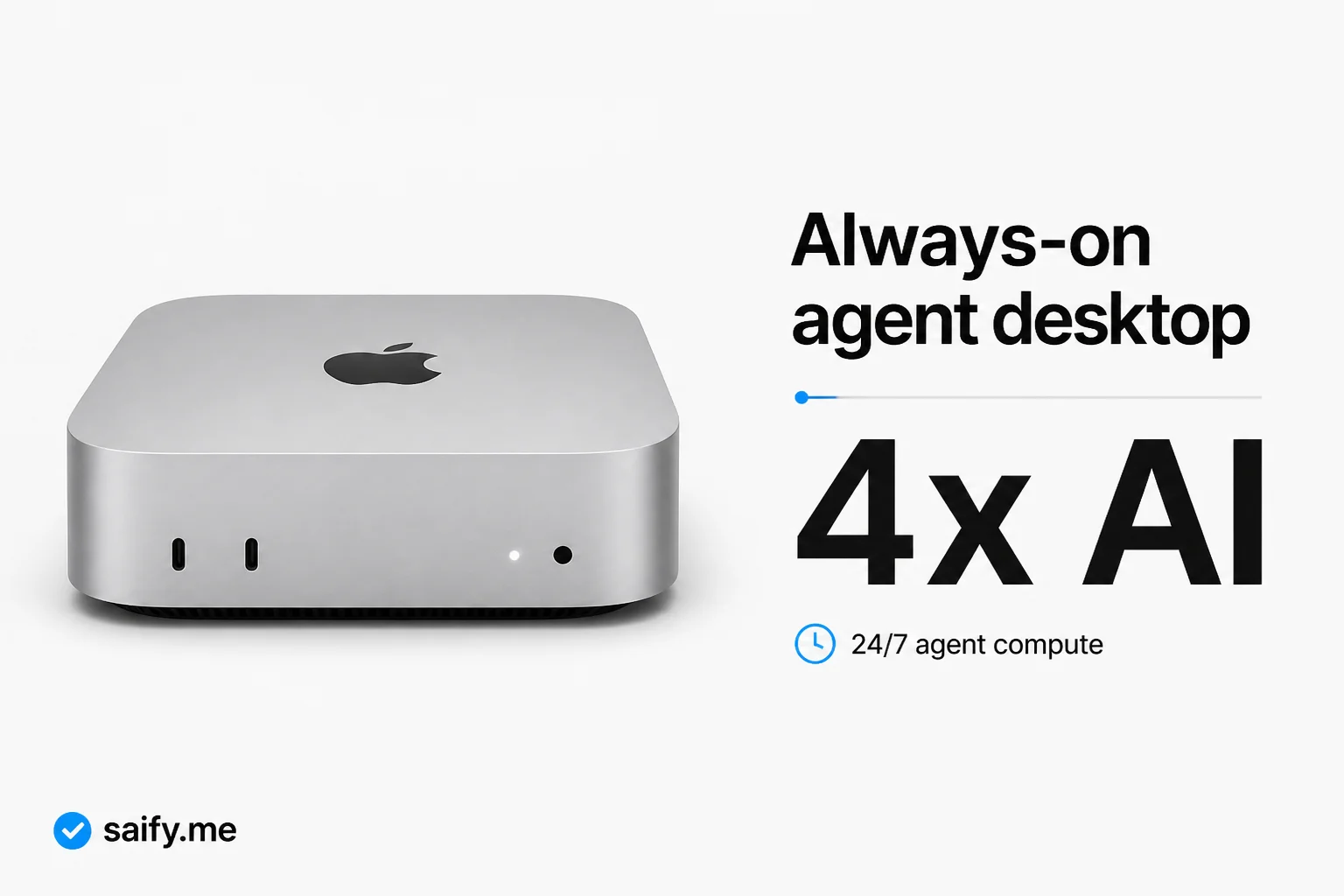
The Mac mini used to be the quiet desktop you tucked behind a monitor. In 2026 it became the box AI developers hoarded for local inference, OpenClaw-style agents, and overnight coding loops that never touch a cloud API.
Apple's August 25 refresh stops pretending that trend is accidental. The press release calls Mac mini a candidate for always-on, deskside agentic computing and quotes hardware chief Johny Srouji on agent workloads in the enterprise. That is marketing catching up to what the supply chain already showed: months of shortages, long lead times, and a secondary market where people bought minis specifically to run models locally.
What Apple actually shipped
Two SKUs landed together:
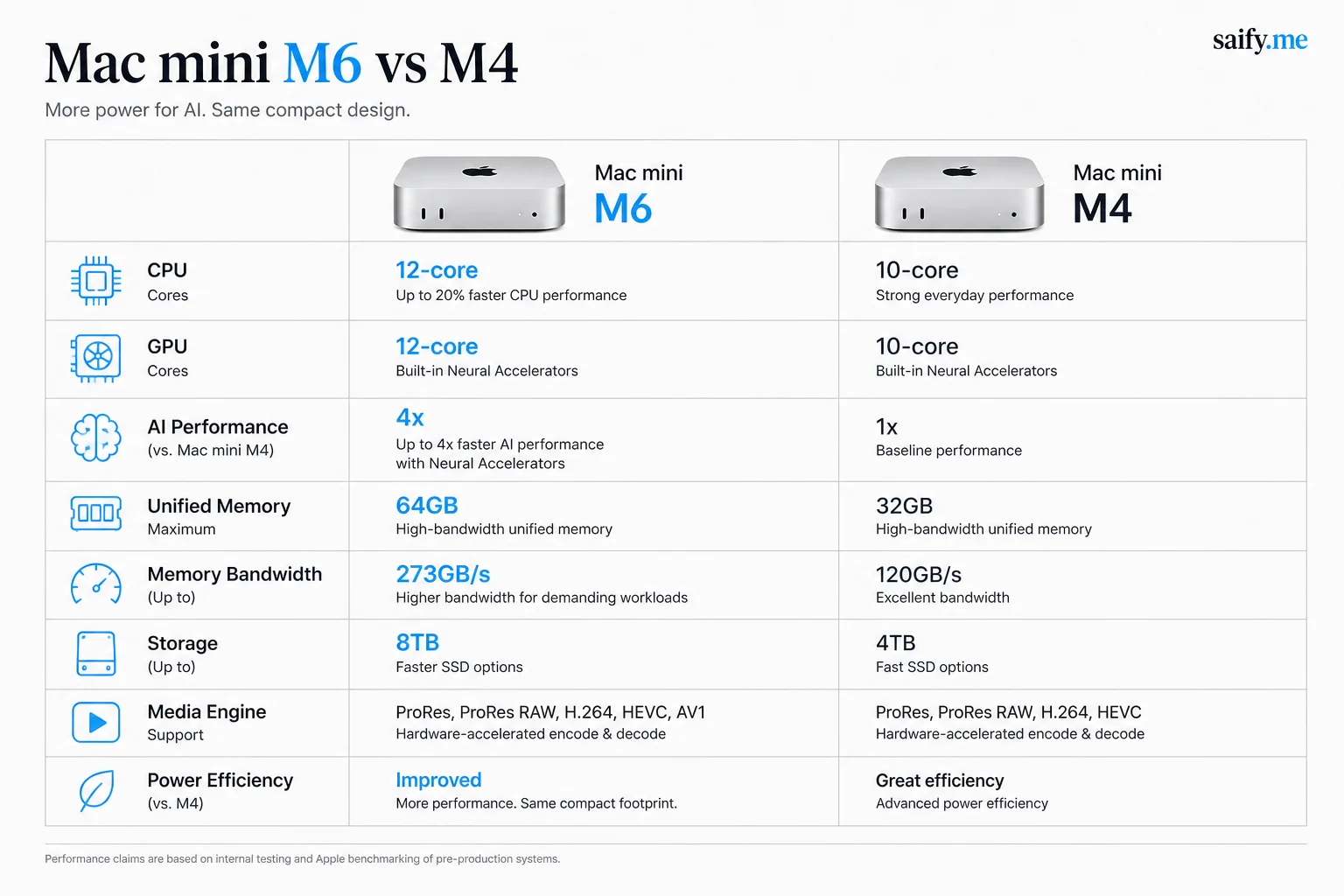
| Model | Starting price (U.S.) | CPU / GPU | Unified memory | Bandwidth |
|---|---|---|---|---|
| Mac mini M6 | $899 | 12-core CPU, 12-core GPU | 16GB standard, up to 32GB | up to 170 GB/s |
| Mac mini M5 Pro | $1,699 | up to 18-core CPU, up to 20-core GPU | up to 64GB | 307 GB/s |
Preorders opened August 25. Deliveries start September 22.
The M6 chip is Apple's first 2nm Mac silicon in this form factor, with Neural Accelerators baked into every GPU core for the first time on Mac mini. Apple also highlights a Dual 16-core Neural Engine and LM Studio benchmarks showing up to 4.8x faster LLM prompt processing versus M4 (and up to 13.5x versus M1).
For agent builders, the M5 Pro headline is memory: 64GB unified on a desktop that still fits in a backpack. That is the spec sheet people wanted when they were queueing for M4 Pro minis with 32GB caps.
Why unified memory still wins local agents
Cloud APIs hide the memory problem. Local agents live inside it.
When a coding harness, RAG stack, or multimodal workflow shares one RAM pool between CPU, GPU, and model weights, you avoid the PCIe copy tax that makes small GPUs feel smaller. Apple's pitch is blunt: run local models, build agents that automate daily tasks, cluster machines when one box is not enough.
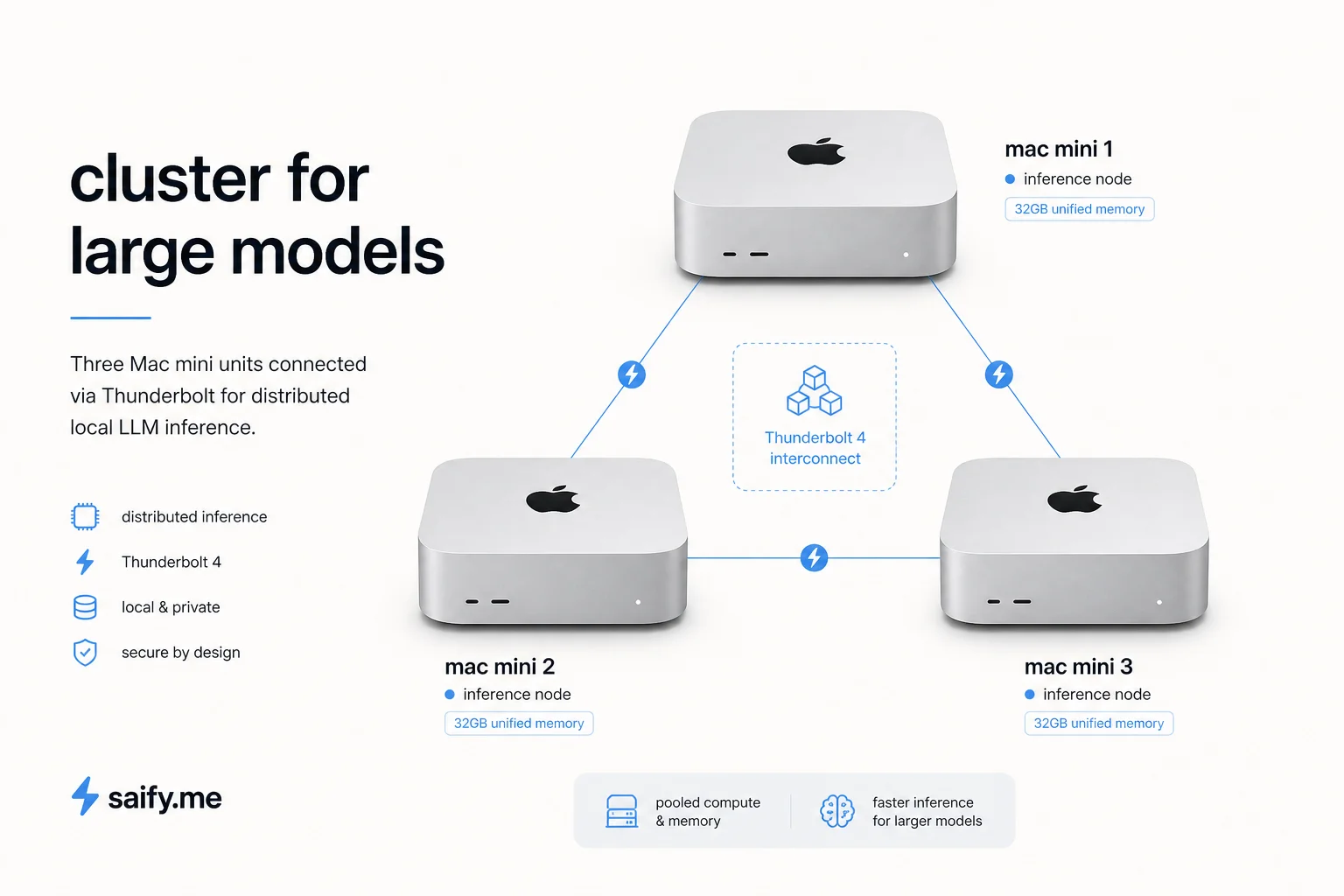
Thunderbolt 5 on M5 Pro adds a practical ops angle. Apple says users can cluster multiple Mac mini systems to run larger models entirely on device. That is not hobbyist trivia. It is how teams stretch 64GB per node into something that can hold bigger quant stacks without renting an A100 for every experiment.
I have clients who run always-on automations (inbox triage, CRM sync, nightly report generation) on a Mac mini in a closet. The failure mode is never peak tokens per second. It is reliability, thermals, and wake-from-sleep behavior when the agent must stay up 24/7. Apple positioning the mini as an enterprise deskside agent box signals they want that workload on the balance sheet, not just in Discord threads.
macOS 27 and the Siri AI layer
Hardware without software is a paperweight. The same announcement ties the mini to macOS 27 Golden Gate, Siri AI, and the next wave of Apple Intelligence features.
Siri AI is supposed to draw on personal context across messages, email, and photos, answer open-domain questions, and act across apps. Visual Intelligence via a dedicated shortcut lets users ask about what is on screen. That is the consumer story.
For builders, the interesting bit is consolidation: Spotlight, system context menus, and Shortcuts automations described in natural language. If Apple ships reliable on-device routing for those features, the Mac mini becomes the always-on host that bridges local agents with OS-level permissions users already trust.
Fair warning: Siri AI is in beta through the Apple Beta Software Program, with English first and broader languages later. I would not bet a production agent architecture on Siri hooks until the APIs and entitlements are stable. I would bet on MLX, llama.cpp, and Ollama on the same box while watching what Apple exposes to developers.
The Houston manufacturing subplot
The Rundown Tech digest tied this launch to Apple's made-in-America Mac mini plans in Houston. I have not seen a ship date for that factory in Apple's newsroom post, but the timing matters politically and practically.
If Apple can assemble minis domestically while developers treat them as AI infrastructure, lead times might ease and enterprise buyers get a supply-chain story that matters for regulated industries. For a solo builder, Houston is background noise. For a clinic or law firm that wants on-prem agents without foreign assembly paperwork, it can be a checkbox.
How this compares to the phone-local wave
This digest landed the same week as PrismML's Bonsai 27B phone demo and ongoing chatter about running agents on pocket hardware. The Mac mini is the opposite end of the same curve: more watts, more RAM, fewer battery constraints.
| Deployment | Strength | Weakness |
|---|---|---|
| Phone-class (Bonsai 27B, etc.) | Data never leaves the device | Decode speed, RAM ceiling |
| Mac mini M6 | Quiet 24/7 desk agent, 32GB tier | Still not a 128GB workstation |
| Mac mini M5 Pro | 64GB, TB5 clustering, pro media | $1,699 entry, Apple software lock-in |
| Cloud API | Frontier quality, zero hardware ops | Cost, privacy review, outage risk |
My rule for clients: pick the tier where peak RAM and uptime matter more than peak model IQ. Receptionist voice loops and calendar agents often fit a mini. A 70B coding reviewer usually still belongs in VPC or API land unless you cluster.
We wrote about the Mac mini hype gap in Qwen3 8B local coding: screenshots of Ollama running are not the same as a multi-turn harness with tool calls. The M6 numbers are real silicon gains. Your eval should still measure end-to-end agent latency, not a single LM Studio prompt.
What I would test before buying three minis
- Same harness, same prompts you use in production (JSON repair, tool routing, retrieval).
- Overnight soak: thermals, fan curve, and whether macOS sleep kills your daemon.
- Memory headroom with your target quant + context length (32GB vs 64GB is the real fork).
- Cluster only if you need it: TB5 cables, failover, and orchestration are a project, not a checkbox.
If you are comparing local vs cloud for an agent rollout, also read RAMageddon and laptop shortages. Memory supply pressure makes the mini's unified RAM story sharper: you are buying a scarce resource attached to a small box.
Apple finally said the words agentic computing in a Mac mini press release. Developers were already living there. The question is whether September shipments stay on schedule and whether Siri AI becomes a platform or another year of demos.
If you are designing where inference should live for your agents, book a free discovery call. The hardware choice is cheaper before it is baked into every deployment.