
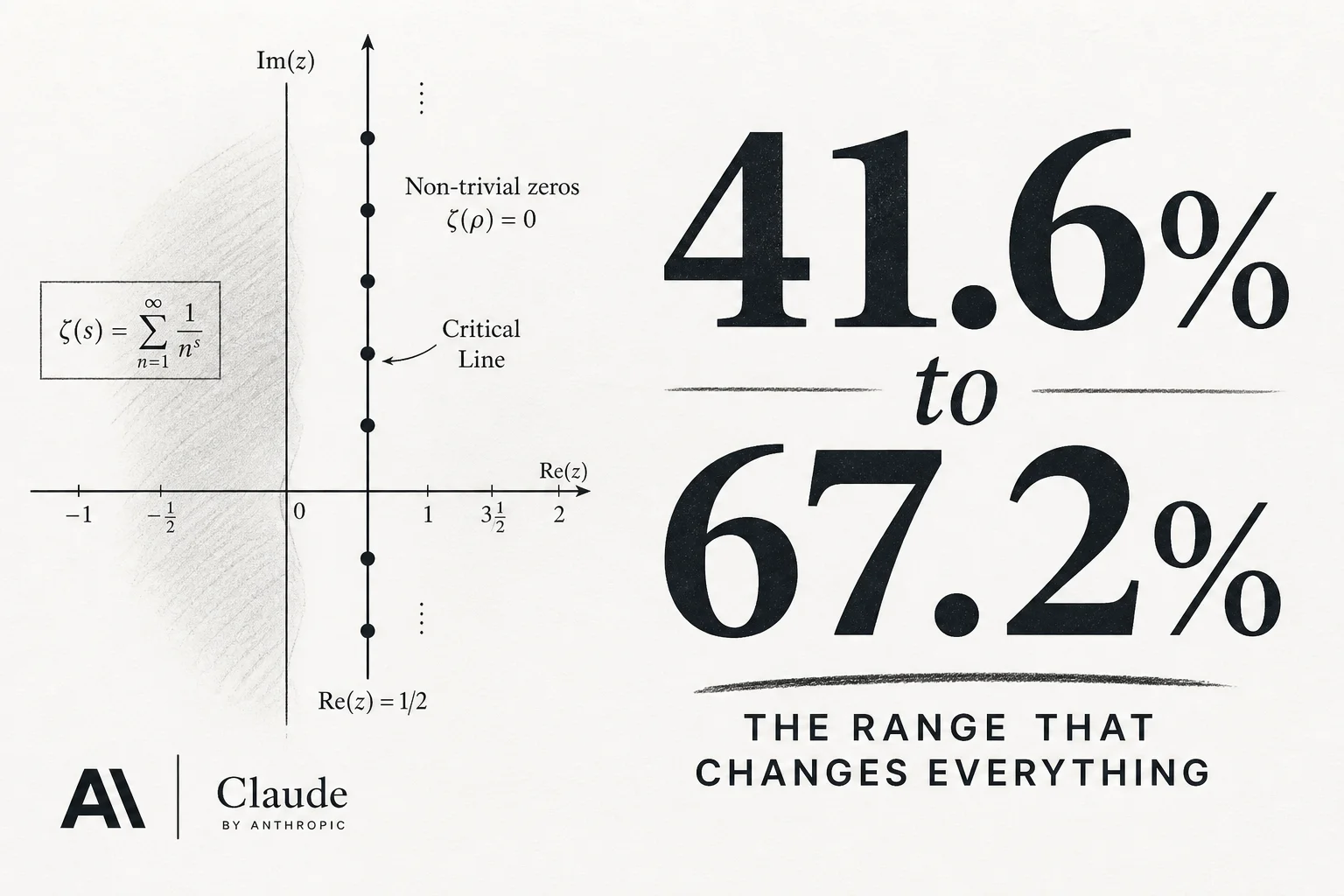
Someone at Anthropic told Claude to take a real stab at the Riemann hypothesis. Claude failed at the main problem. On the way down it produced the largest single jump on a 160-year-old bound in modern math history.
I care about this as an applied AI engineer, not as a number theorist. The orchestration pattern is what you can copy today: parallel subagents, shell-heavy verification, machine-checked proofs, and a human who mostly said "keep going."
What actually improved (and what did not)
The Riemann hypothesis asks whether every nontrivial zero of the Riemann zeta function sits on the critical line where the real part equals 1/2. That full statement is still unsolved.
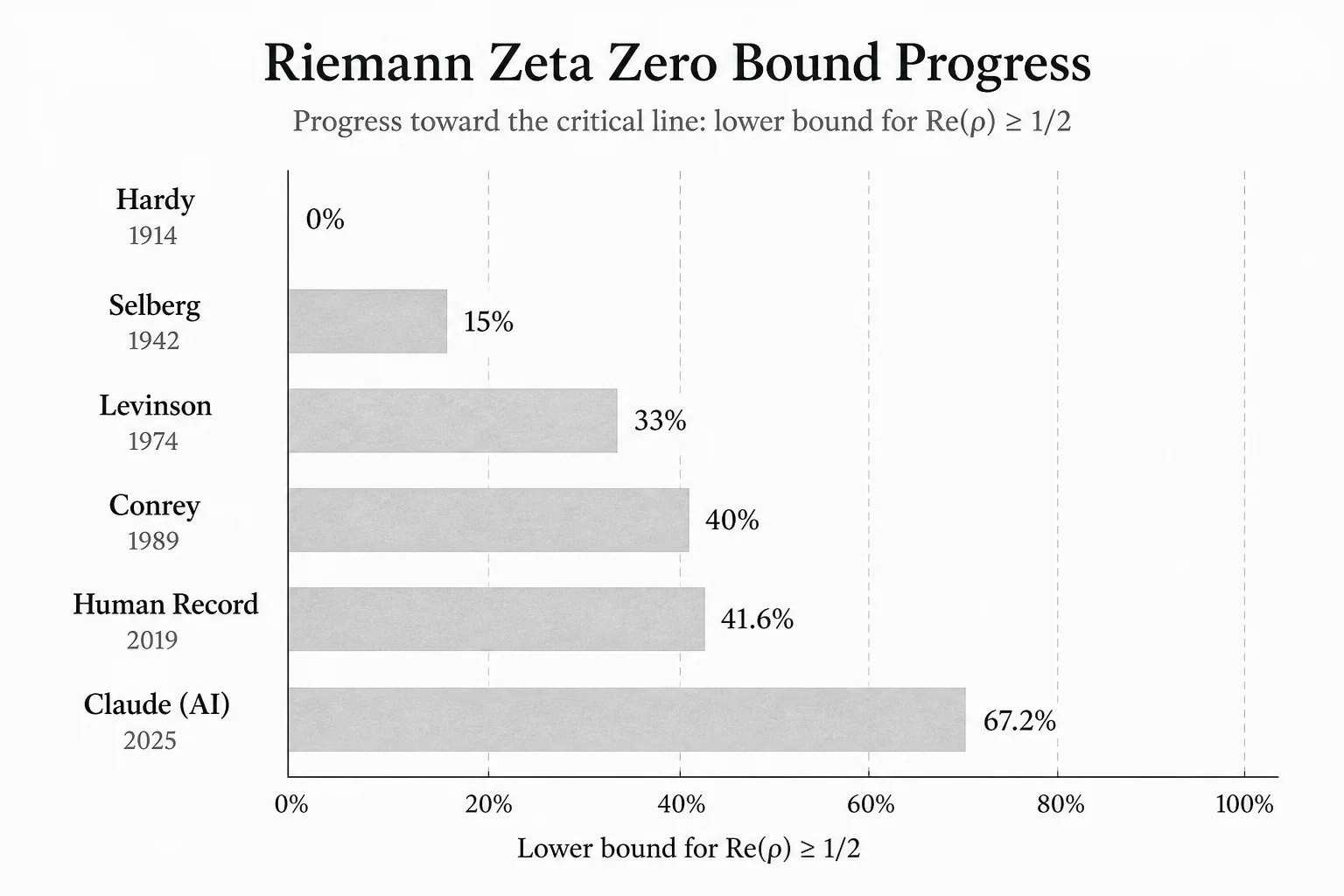
Mathematicians have long proven that at least some zeros lie on that line. The record lower bound had crept to 41.6% over decades of human work. An unreleased research version of Claude raised that proven floor to 67.2%.
| Milestone | Proven fraction on critical line |
|---|---|
| Levinson (1974) | ~33% |
| Conrey (1989) | ~40% |
| Human record (pre-2026) | 41.6% |
| Claude research run (Aug 2026) | 67.2% |
That is a 25.6 percentage point jump in one run. Anthropic is explicit that these techniques will not finish the full hypothesis. The win is narrower: a verifiable mathematical advance plus a documented agent workflow.
The agent run in numbers
Anthropic staff member Jarred Sumner prompted Claude in Claude Code. The math choices were left to the model.
First session: 650 ideas, all dead ends.
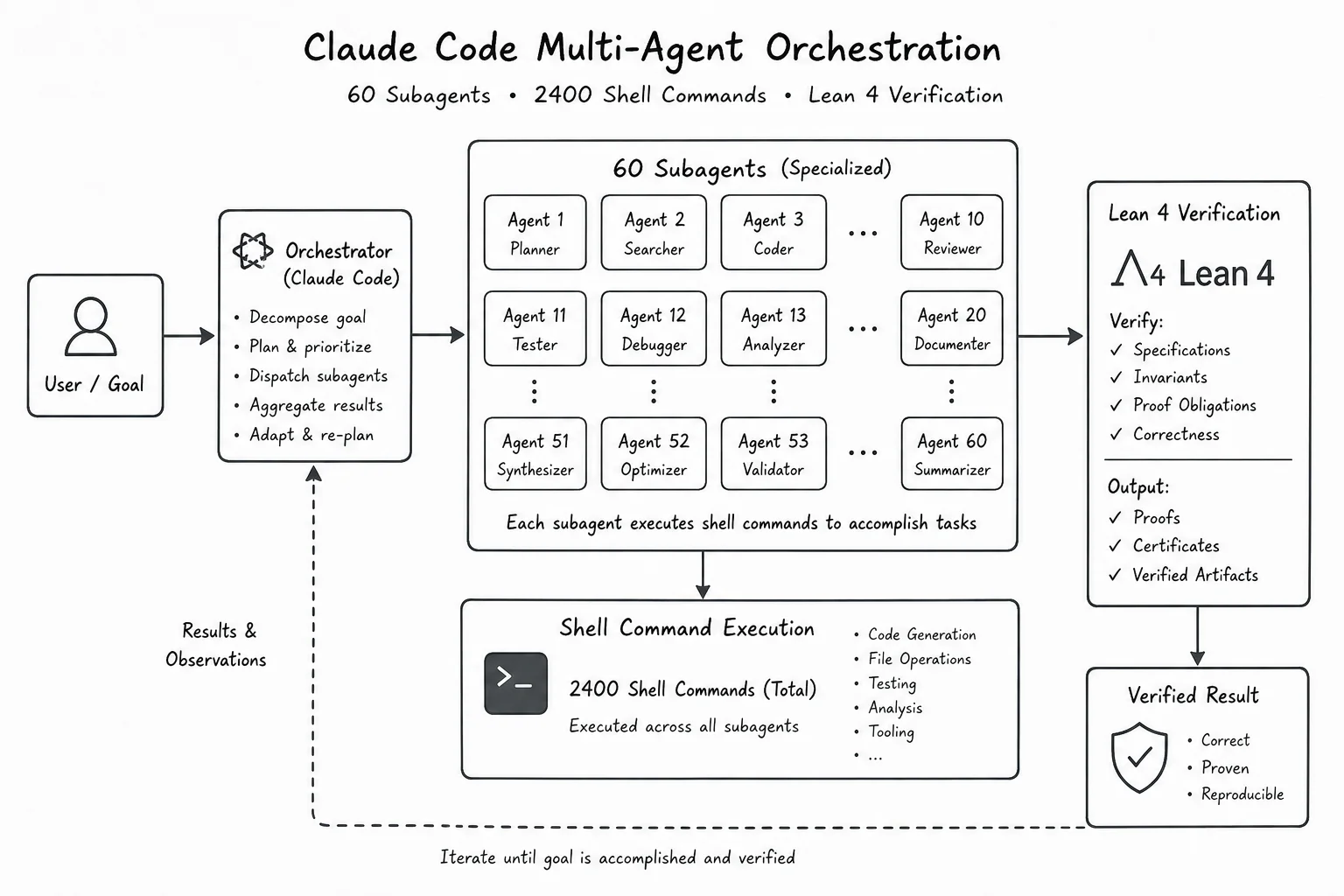
Second session: roughly 60 subagents over about a day and a half.
| Metric | Value |
|---|---|
| Output tokens | ~31 million |
| Shell commands | ~2,400 |
| Python scripts | Hundreds |
| arXiv papers reviewed | 54 |
| Human steering | Mostly "keep going" / "believe in yourself" |
Subagents ran numerical checks against known zeta zeros and critiqued each other's arguments. Two agents owned key ideas, thirteen contributed, thirty tried new approaches that failed, and validators checked correctness before acceptance.
That topology looks less like a chatbot and more like a research lab with interns who can actually run code.
Lean 4 and why machine checking matters
Claude worked with Eric Easley on a Lean 4 formalization. It passes comparator, the standard validation tool in that ecosystem.
The public repo anthropics/zeta-23-lean ships Apache-2.0 code, transcripts, an informal note, and the paper PDF. You do not have to trust a blog post. You can run the checker.
Internal mathematicians Levent Alpöge and Ralph Furman reviewed the work. External experts Brian Conrey and Dan Goldston examined the paper. That is not journal peer review yet, but it is more scrutiny than most AI headline claims get.
What I take for production agent design
Three patterns map directly to client work:
- Fail wide, then go deep. Six hundred shallow ideas bought nothing. The second pass with parallel specialists and shell access found the combination humans had missed.
- Validators are not optional. Subagents that only critique beat single-thread "trust the longest completion" loops.
- Formal or executable checks beat vibes. Lean for math, tests for code, eval harnesses for agents. The proof artifact is the product.
I run similar shapes for RAG pipelines and ops automations: planner agents, worker agents, a verifier that reads logs before anything ships.
The model you cannot buy (yet)
Anthropic credits an unreleased research version of Claude, not a shipping SKU. The agent architecture in Claude Code is available now. The exact weights that found the bound are not.
That split is the pattern behind most interesting August 2026 headlines: unreleased models doing work in gated or research settings while the harness and workflow are what practitioners can study today.
Bottom line: Claude did not crack the million-dollar problem. It did show that a documented multi-agent run can produce expert-checkable math at a scale humans had not reached in one step. Copy the orchestration, not the hype.
If you are wiring agent loops for research, code review, or long-running ops tasks, book a free discovery call. I help teams route models, add verification layers, and ship without burning budget on hero-model every turn.