
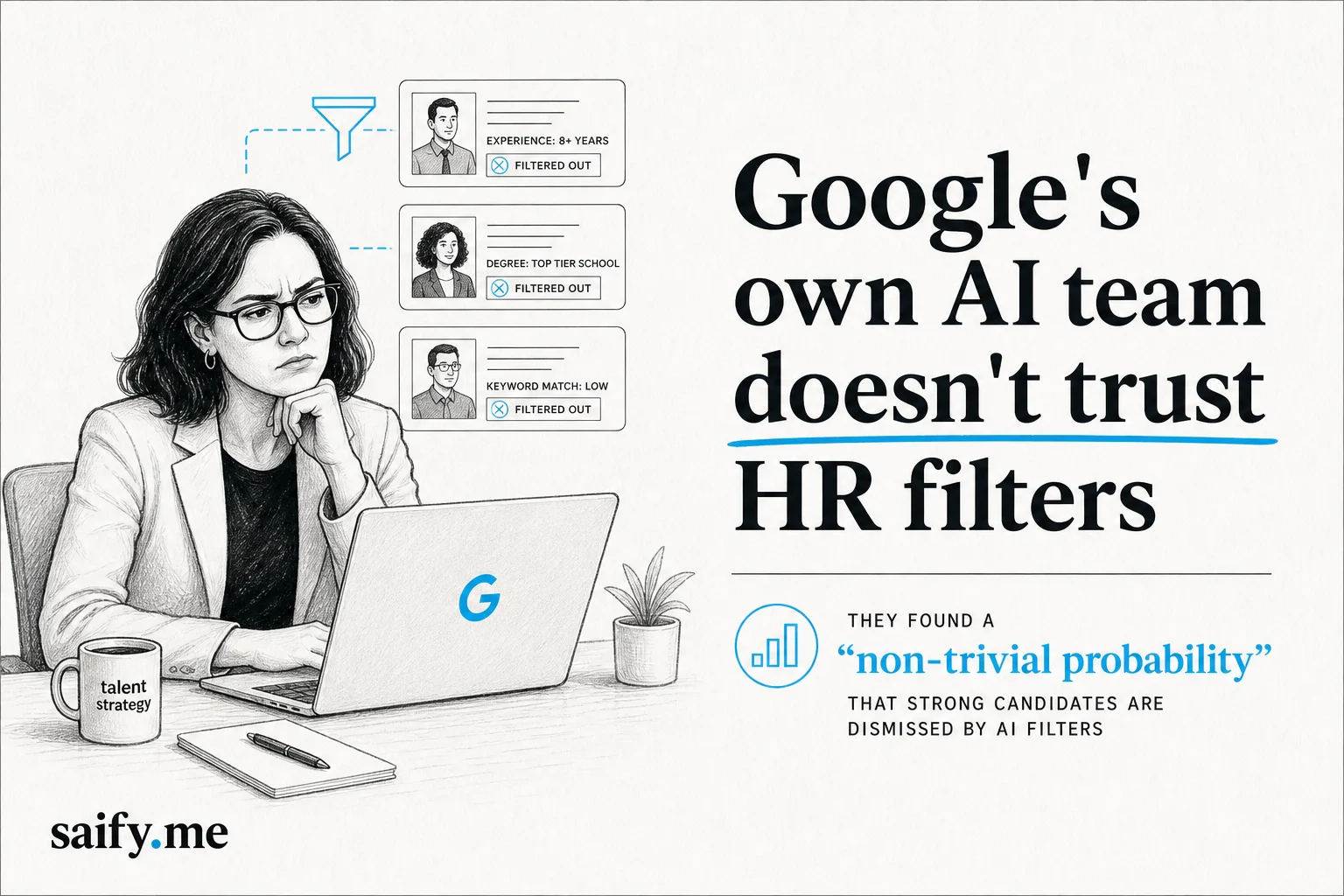
Google sells AI tools to HR departments so recruiters can blast through thousands of resumes. Meanwhile, inside Google DeepMind, the team literally tasked with making advanced AI safe is telling job applicants not to trust those same filters.
A Bloomberg report on an internal document from DeepMind's AGI Safety and Alignment Team put it bluntly: applicants face a "non-trivial probability" their CV gets screened out incorrectly or takes too long to reach a human.
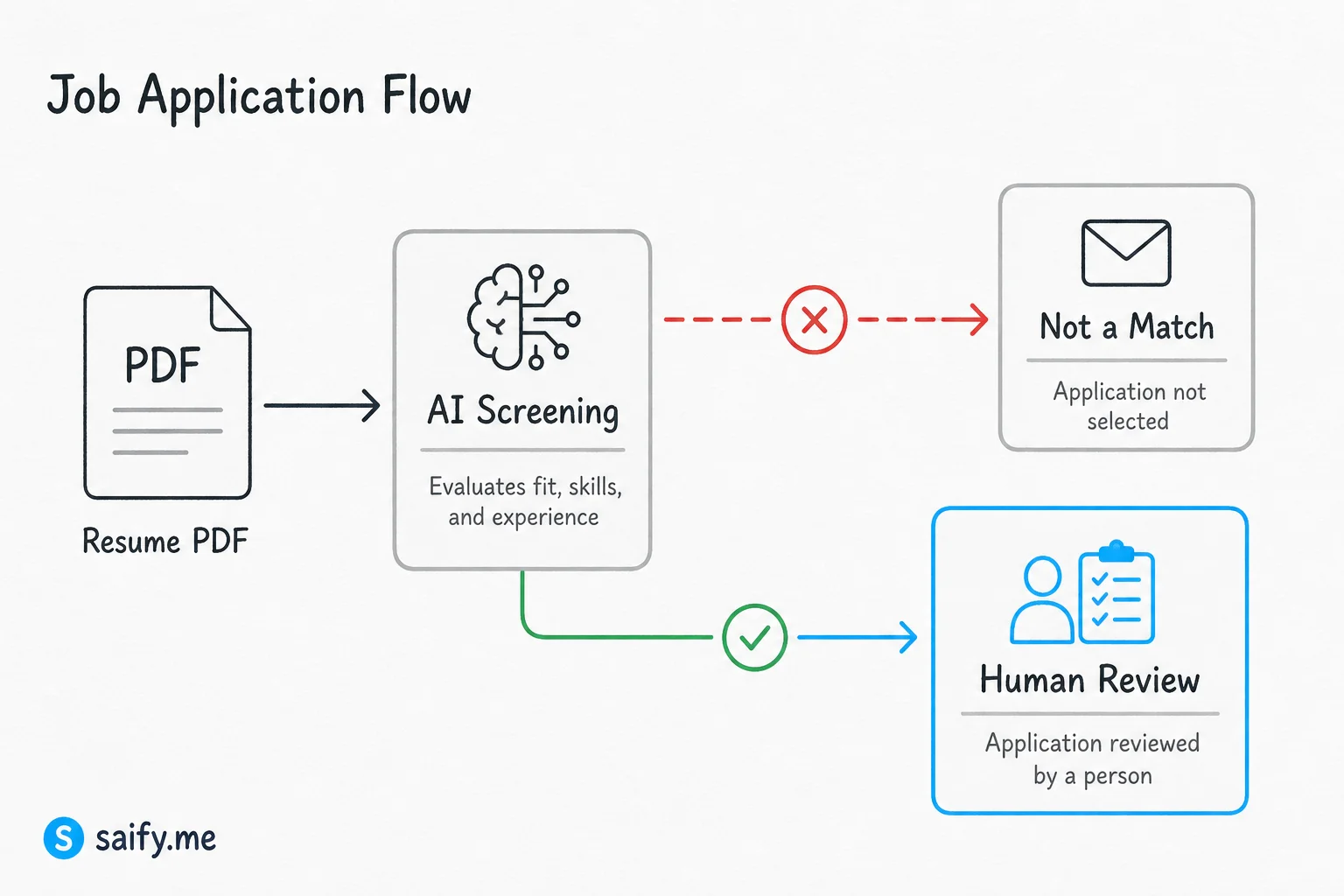
The fix? A special form that bypasses automated recruiter review so "a real human on the team will get to see your application."
I wrote about the open-source Hiring Agent pipeline last week. This story is the corporate mirror image: even the company building frontier models does not want its own hiring stack deciding who gets a shot.
What the internal document actually said
Bloomberg viewed a document marked "PLEASE DO NOT SHARE THIS DOC WIDELY." It encouraged candidates for open roles on the AGI Safety and Alignment Team to fill out a parallel form alongside the standard Google application.
The reasoning was practical, not philosophical:
We have an applications system with a non-trivial probability your curriculum vitae will be screened out incorrectly or take too long to reach us.
That is not a footnote. That is an admission that the default funnel has meaningful false-negative risk.
The form also included advice that should be tattooed on every AI hiring product landing page:
A real human will read these. These humans get really tired of reading LLM answers, because they all sound very samey.
So the team is fighting two failure modes at once: machines rejecting good humans, and humans rejecting templated LLM slop.
Google's public response vs. the internal warning
A Google DeepMind spokesperson told Bloomberg the company aims to recruit the most qualified talent and denied that systems filter applicants incorrectly.
The spokesperson framed the form as a routing shortcut:
This team set up a special form to go past the recruiter review, and get their resumes direct to the people on the team. But there are no shortcuts to getting hired.
Classic corporate tension. External comms: nothing to see here. Internal ops: please use the side door so our best candidates do not die in the ATS.
I do not think the spokesperson is lying. I think both statements can be true. The ATS may work fine on average while still producing enough false negatives that a frontier research team refuses to rely on it for their hires.
That is exactly how production ML fails in the wild: acceptable aggregate metrics, unacceptable tail risk on the decisions that matter.
Why this matters if you ship hiring automation
I help clients automate ops: voice agents, CRM routing, lead scoring. Recruiting AI sits in the same architectural bucket, with higher stakes.
| Failure mode | What DeepMind's workaround implies |
|---|---|
| False negatives | Qualified candidates never reach a human |
| Latency | Good applicants age out while stuck in queue |
| Adversarial applicants | LLM-generated answers homogenize the signal |
| Governance gap | The team closest to AI risk does not trust default tooling |
If you are selling or building resume screeners, this is a case study in who gets an override path. DeepMind researchers get a human backdoor. Your applicants probably do not.
That is not sustainable ethics. It is not good funnel design either.
What I would implement instead
I am not anti-automation. I am anti silent rejection.
1. AI produces evidence packets, not verdicts. Parse PDFs, enrich GitHub, score against rubrics, summarize gaps. Humans (or a second-stage reviewer) make advance/reject calls. This is the shape of Hiring Agent and what I would wire for a client.
2. Measure false negatives on escalations. Roseville-style audits matter for surveillance alerts. The same logic applies to hiring: what percentage of candidates who would have passed a human screen get auto-rejected? If you do not measure it, your model is guessing with people's careers.
3. Offer a trusted-team bypass by design. DeepMind hacked one in with a Google Form. Productize it: "If you were referred / have open-source work / match this niche, use this intake." Transparency beats secret docs leaked to Bloomberg.
4. Ban LLM boilerplate at the UI layer. DeepMind's "samey answers" warning is funny because it is true. If your form asks essay questions, expect GPT paste. Ask for artifacts instead: repo links, incident writeups, Loom walkthroughs of a shipped feature.
5. Audit for bias like you audit for uptime. Projects like Candisift exist because keyword ATS systems already skew rankings. Adding LLM scoring without bias tests is not progress.
The awkward sales pitch Google is making
Google's Workspace team sells HR time savings with AI drafts and screening assist. DeepMind's safety researchers are quietly telling candidates the screening layer is unreliable enough to route around.
That tension will show up in every enterprise that buys "AI recruiting" without an override story. Sales deck says 10x throughput. Internal hiring managers still DM candidates on LinkedIn because they do not trust the funnel.
If you are a founder evaluating hiring AI, ask one question in the demo:
"Show me your false-negative audit and your human bypass path."
If the vendor stares at you, you have your answer.
Building recruiting or ops automation and want audit trails, not black-box rejections? Book a free discovery call.