
OpenAI shipped a model trained to refuse less on the exact prompts that keep security teams stuck. Then it put that model behind a gate, mandatory hardware keys, and legal attestations.
The headline proof is already in Chrome's release notes: CVE-2026-15903, a high-severity V8 bug reported through coordinated disclosure after GPT-5.6-Cyber research.
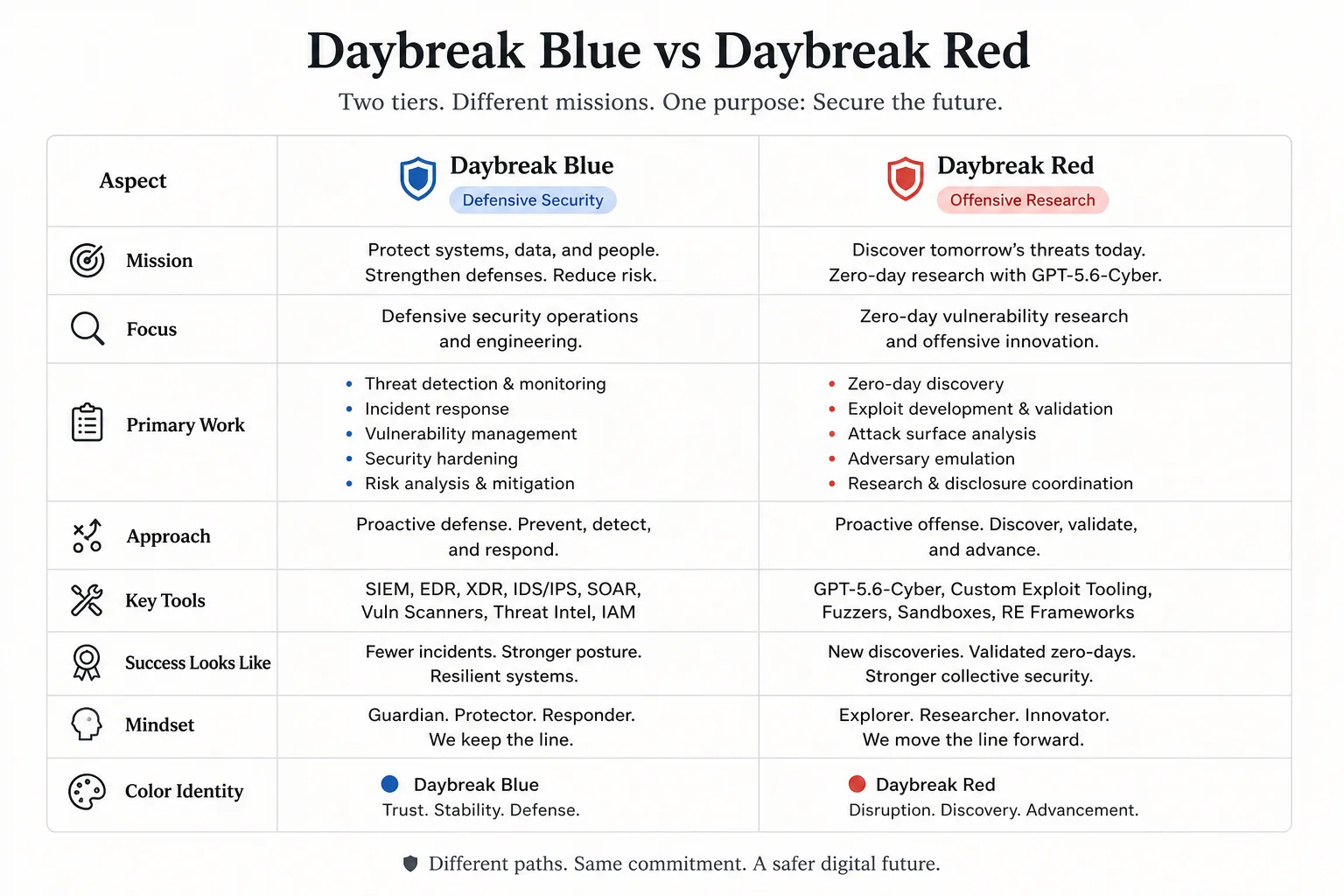
Daybreak Blue vs Red
Daybreak is OpenAI's controlled program for putting frontier models in vetted security hands. August 2026 split it into two tiers:
| Tier | Model | Typical work |
|---|---|---|
| Daybreak Blue | GPT-5.6 Sol (guardrails loosened) | Vulnerability discovery, malware analysis, IR, patch validation |
| Daybreak Red | GPT-5.6-Cyber | Zero-day research, exploit validation, red team testing |
Blue is the default recommendation for defenders. Red unlocks the purpose-trained cyber model.
On an internal sensitive-security prompt set, OpenAI reports 95% answer rate for GPT-5.6-Cyber versus 1.5% for Sol under standard safeguards and 2% for Sol through Blue. GPT-5.5-Cyber sat at 57.3%.
Those numbers are vendor benchmarks. The Chrome CVE is independently verifiable.
CVE-2026-15903 and the V8 chain
V8 is the JavaScript engine inside Chrome. OpenAI researchers used GPT-5.6-Cyber to investigate it and found two previously unknown vulnerabilities that could be chained to corrupt memory and escape the V8 heap sandbox.
Google received the report through coordinated disclosure. Chrome 150.0.7871.128 credits OpenAI's security research. NVD lists CVE-2026-15903 as out-of-bounds read and write in V8, high severity, affecting Chrome before that build.
The flaw: V8's optimizing compiler skipped a safety check when converting values to integers, so undefined inputs could produce unexpectedly large numbers.
A second chained issue remains under restricted disclosure. That is normal for coordinated release, but it means the public story is only half the chain.
Access, monitoring, and the September key deadline
Daybreak Red is not a SKU you add to a cart. Apply at openai.com/daybreak/partners with identity verification, monitoring, approved-use restrictions, and legal attestations.
From September 1, 2026, every individual Daybreak account must use a hardware security key.
OpenAI also pushes Codex users toward auto-review mode with more monitoring. Under its Preparedness Framework, both Sol and GPT-5.6-Cyber rate High on cyber capability, below the Critical threshold. A system card was promised later.
Cyber is not an upgrade for every security task
Third-party analysis notes an important trade-off. On some OpenAI evals, plain Sol writes better vulnerability reports and wins ExploitBench at the standard turn limit while using fewer tokens.
Treat GPT-5.6-Cyber as a specialized tool for offensive-adjacent work under authorization, not a blanket replacement for defensive analysis.
| Task | Better default |
|---|---|
| Incident response writeups | Sol via Blue |
| Malware triage reports | Sol via Blue |
| Authorized exploit chain research | Cyber via Red |
| Zero-day discovery on engines like V8 | Cyber via Red |
What this means if you ship AI products
Three lessons land for applied AI work:
- Capability and policy ship together. The model that finds zero-days is the same class of system vendors must gate. Your product's guardrails are part of the architecture, not a compliance afterthought.
- Proof beats benchmark slides. A CVE in Chrome stable is the kind of evidence that survives skeptical engineering review.
- Dual-use routing will get formal. Tiered access, hardware keys, and attestations are the shape of frontier cyber tooling in 2026.
I wire similar separation in client stacks: read-only analysis agents versus action-capable agents with approval queues and audit logs.
Practical takeaway: GPT-5.6-Cyber is real, gated, and already tied to a shipping browser fix. Most teams should plan on Sol plus harness discipline until Red access and legal scope are clear.
Building agents that touch production systems or sensitive code paths? Book a free discovery call. I help teams design capability tiers, monitoring, and safe tool access before they need a Daybreak-style incident.