
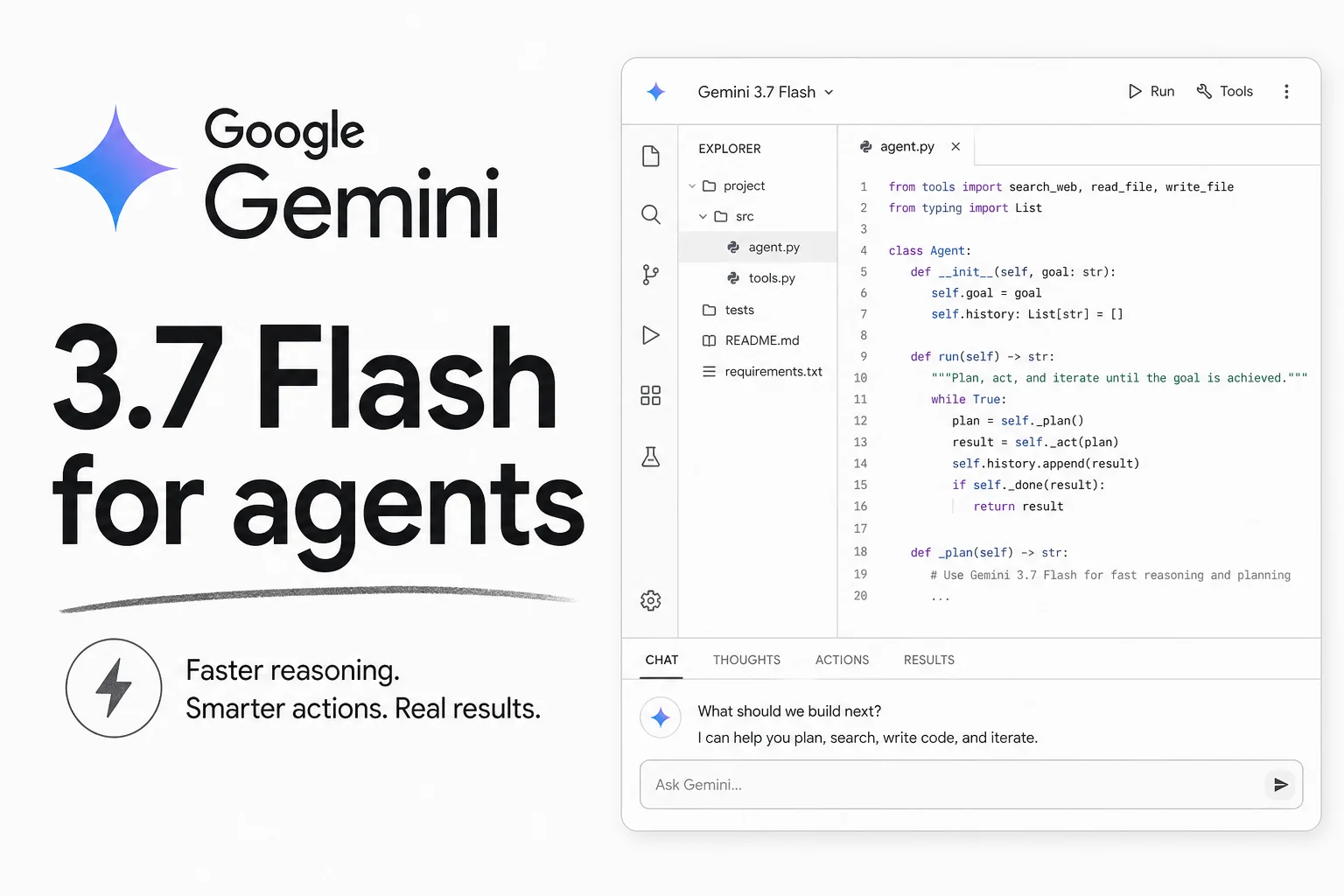
Google did not wait long between Flash releases. Three weeks after Gemini 3.6 Flash, the team shipped Gemini 3.7 Flash and called it their most capable workhorse yet for coding and agents.
The pitch is familiar: more intelligence per dollar, faster iteration on tool-heavy workflows, and introductory API pricing at half what 3.6 Flash launched with. If you route agent traffic for a living, that combination is worth a serious eval week, not a bookmark.
What changed versus 3.6 Flash
Google positions 3.7 Flash as a direct response to developer feedback plus internal algorithmic wins they plan to carry forward.
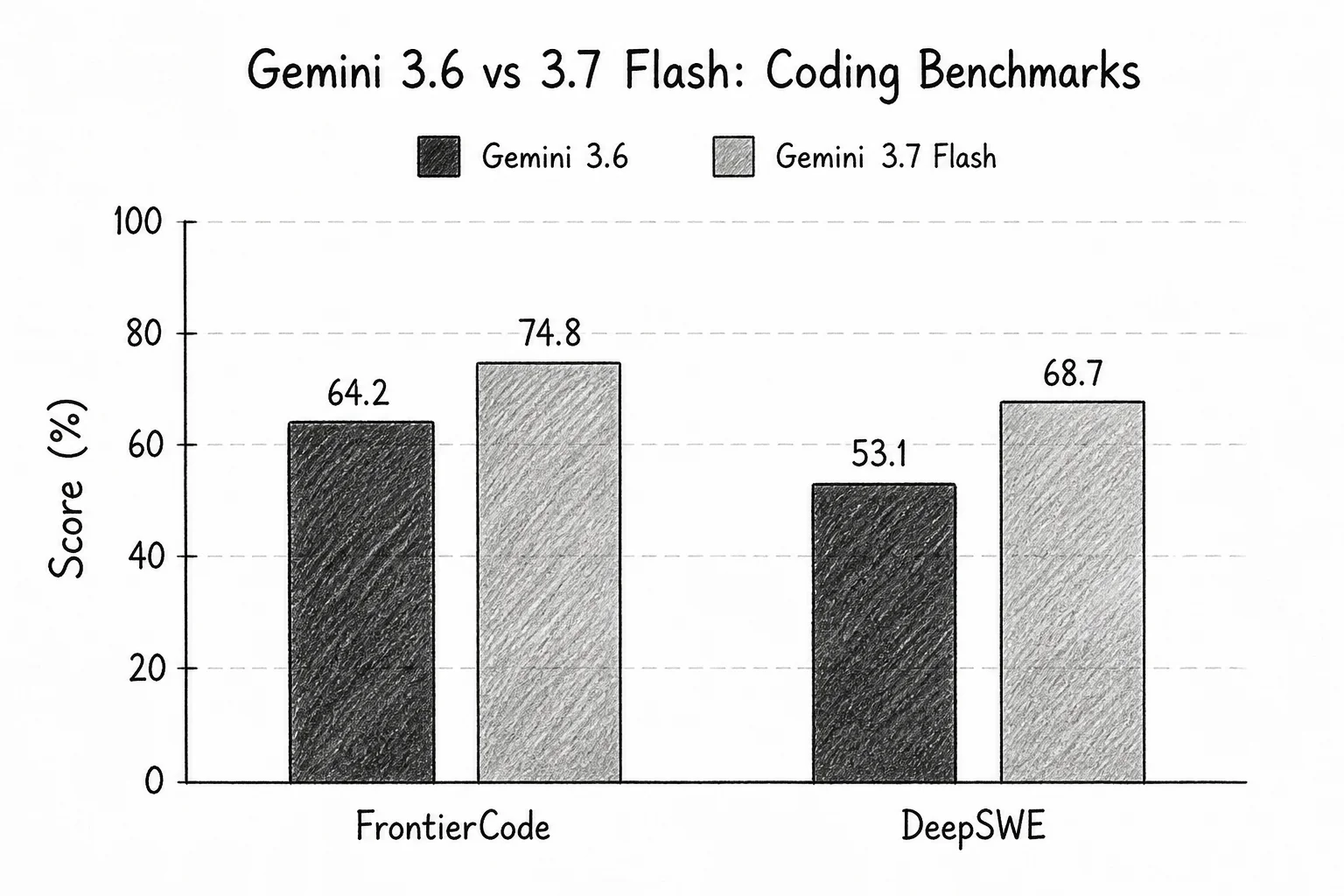
Published benchmark deltas against 3.6 Flash:
| Benchmark | 3.6 Flash | 3.7 Flash |
|---|---|---|
| FrontierCode 1.1 Main | 34.4% | 43.6% |
| DeepSWE v1.1 | 49.0% | 65.3% |
| WebDev Arena Elo | 1538 | 1588 |
| GDP.pdf (document reasoning) | 22.0% | 34.0% |
| AutomationBench (business workflows) | 17.0% | 30.4% |
The coding jumps are the headline for this audience. DeepSWE and FrontierCode are closer to "finish a repo task" than trivia accuracy. WebDev Arena rewards layouts that actually work in a browser, not screenshots that lie.
For knowledge work, GDP.pdf tests messy PDF comprehension. AutomationBench tests multi-step business flows. Those are the tasks ops teams offload to agents when they stop treating chat as a toy.
Developer experience, not just leaderboard points
Google's blog emphasizes behavior inside long harness runs:
- Clarifies intent when prompts are ambiguous instead of guessing wrong
- Plans multi-step work with more disciplined tool use
- Adapts when it hits roadblocks instead of spamming retries
- Follows instructions with higher fidelity on production-style tasks
That is the difference between a model that wins a single completion and one that survives a fifty-turn agent loop. I care about the second number because that is what clients pay for.
Early customer quotes in Google's post highlight "precision at low cost," which matches the routing story I wrote about for Composer-style workhorse tiers. Flash-class models are not backup plans. They are the default lane for most turns.
Pricing and the January 2027 cliff
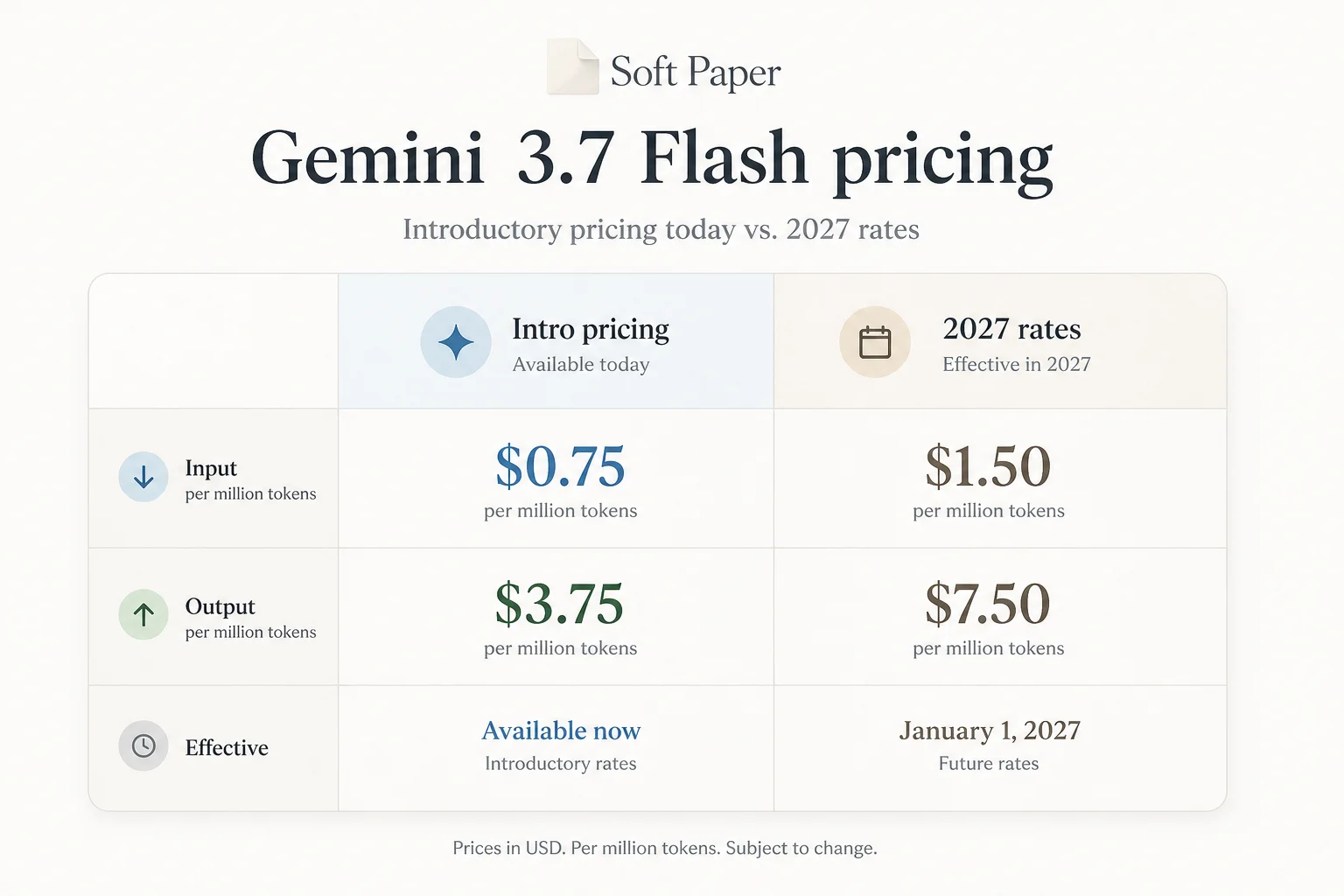
Introductory API pricing (through December 31, 2026):
| Token type | 3.7 Flash (intro) | After Jan 1, 2027 |
|---|---|---|
| Input | $0.75 / 1M | $1.50 / 1M |
| Output | $3.75 / 1M | $7.50 / 1M |
Even after the cliff, 3.7 Flash remains in Flash territory, not Opus territory. The strategic window is the next sixteen months: ship agents on a model that is cheap and stepping up coding scores, then renegotiate routing when pricing doubles.
Spark, Antigravity, and where Google wants you to build
3.7 Flash is not API-only. Google is threading it through the surfaces that keep developers inside their stack:
- Gemini API and AI Studio for raw agent loops
- Google Antigravity for agent-first IDE workflows
- Gemini Spark for Pro and Ultra subscribers, now on 3.7 Flash for Workspace tool use
- Gemini Enterprise Agent Platform for governed corporate deployments
Spark's story is "24/7 personal agent under your direction." The model swap matters because tool use across Gmail, Docs, and Drive is where latency and accuracy compound. A faster Flash tier makes scheduled automations feel less brittle.
Safety notes worth logging
Google says 3.7 Flash ships with updated safeguards on CBRN and cyber-offense misuse, aligned with their bioresilience and cyber programs. Beneficial use cases stay enabled; the details live in the model card.
For builders, the practical takeaway is simpler: treat Flash as production-grade, not as "safe because it is small." Run your own red-team prompts on tool access before you point it at customer data.
How I would slot 3.7 Flash in a routing table
Here is the stack pattern I would test this month:
| Lane | Model role | Example tasks |
|---|---|---|
| Default | Gemini 3.7 Flash | Refactors, doc Q&A, web UI drafts, CRM automations |
| Escalation | Gemini Pro / Opus-class | Novel architecture, ambiguous specs, legal-heavy reasoning |
| Batch | Cheaper or self-hosted | Embeddings, classification, offline summarization |
Run paired evals on your repo and your tools. Google's tables are a filter, not a purchase order.
Concrete week-one tests:
- DeepSWE-style ticket: Give an agent a real GitHub issue with tests. Count turns to green CI.
- PDF ops: Feed a messy vendor statement. Check extraction accuracy against a human baseline.
- Web UI shot: Provide a screenshot plus design tokens. Measure visual parity and interactive bugs.
- Cost per merged PR: Log tokens and wall clock for ten merged changes. Compare to your current default model.
The pattern behind the release cadence
Shipping 3.7 Flash three weeks after 3.6 signals that Google is optimizing the Flash line like a product surface, not a yearly paper launch. That matches where the market is headed: continuous model swaps behind routers, with benchmarks and price as the guardrails.
For applied AI engineers, the actionable line is not "switch everything to Google." It is refresh your workhorse tier quarterly and measure cost per finished task, not cost per million tokens on a leaderboard.
If you want help wiring Gemini (or a multi-vendor router) into production agents with eval harnesses and spend caps, book a free discovery call. Bring your worst real ticket; I will bring a spreadsheet.