
Cursor proved you can beat frontier models on coding economics without training a foundation model from scratch. Start from an open checkpoint, pour compute into RL and synthetic data, co-evolve the model with the product harness.
Most companies are not Cursor. They do not have a million-developer IDE funneling interaction traces into training pipelines. They do have domain data, a narrow task distribution, and a token bill that hurts.
The blocker used to be infrastructure: multi-node scheduling, failure recovery, memory sharding across MoE layers, writing distributed training code before you even test an idea.
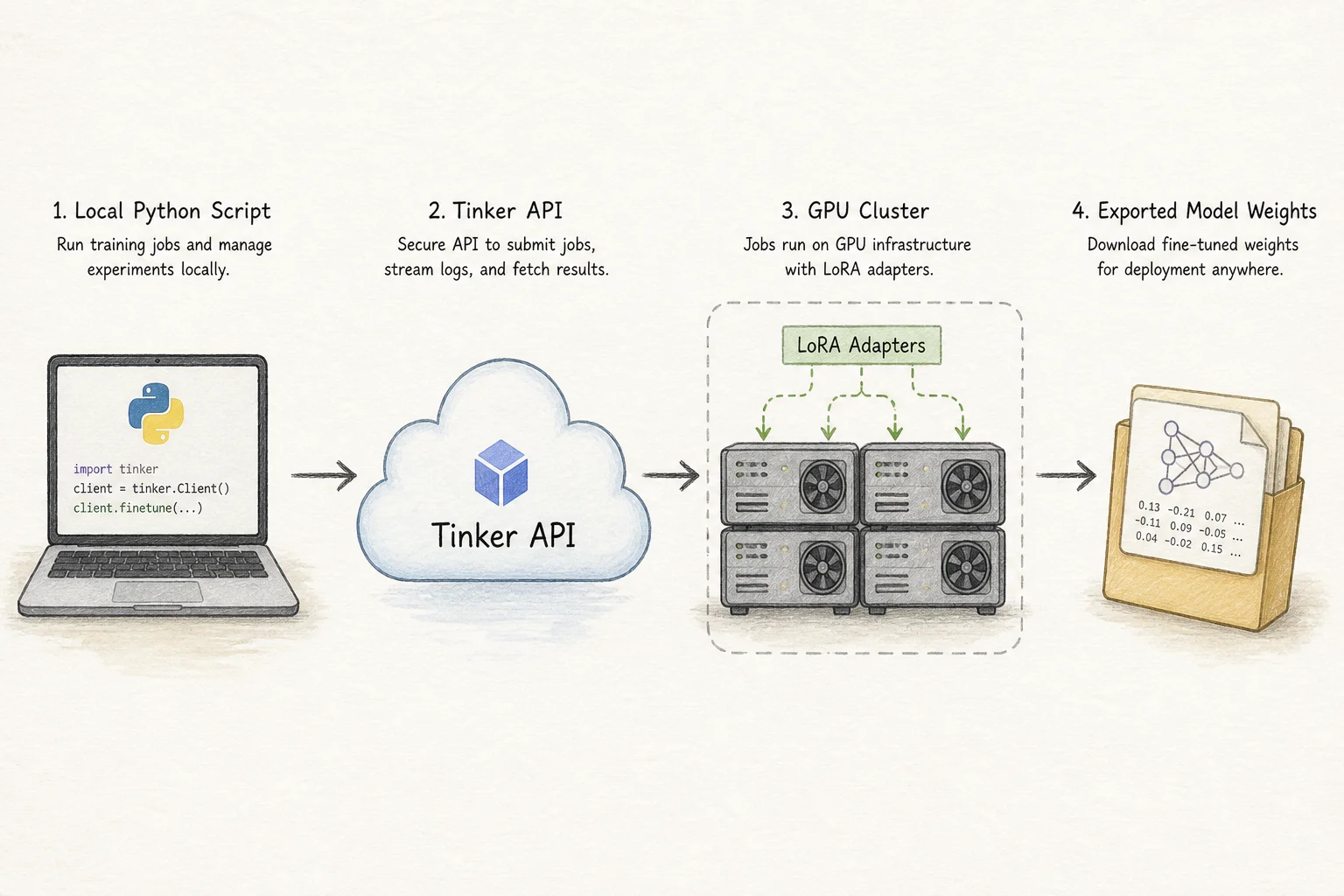
Tinker, from Mira Murati's Thinking Machines Lab, is an attempt to remove that blocker. It is a Python training API where you own the algorithm and data on a CPU machine, and Tinker runs the heavy distributed work on their GPU fleet.
What Tinker actually is
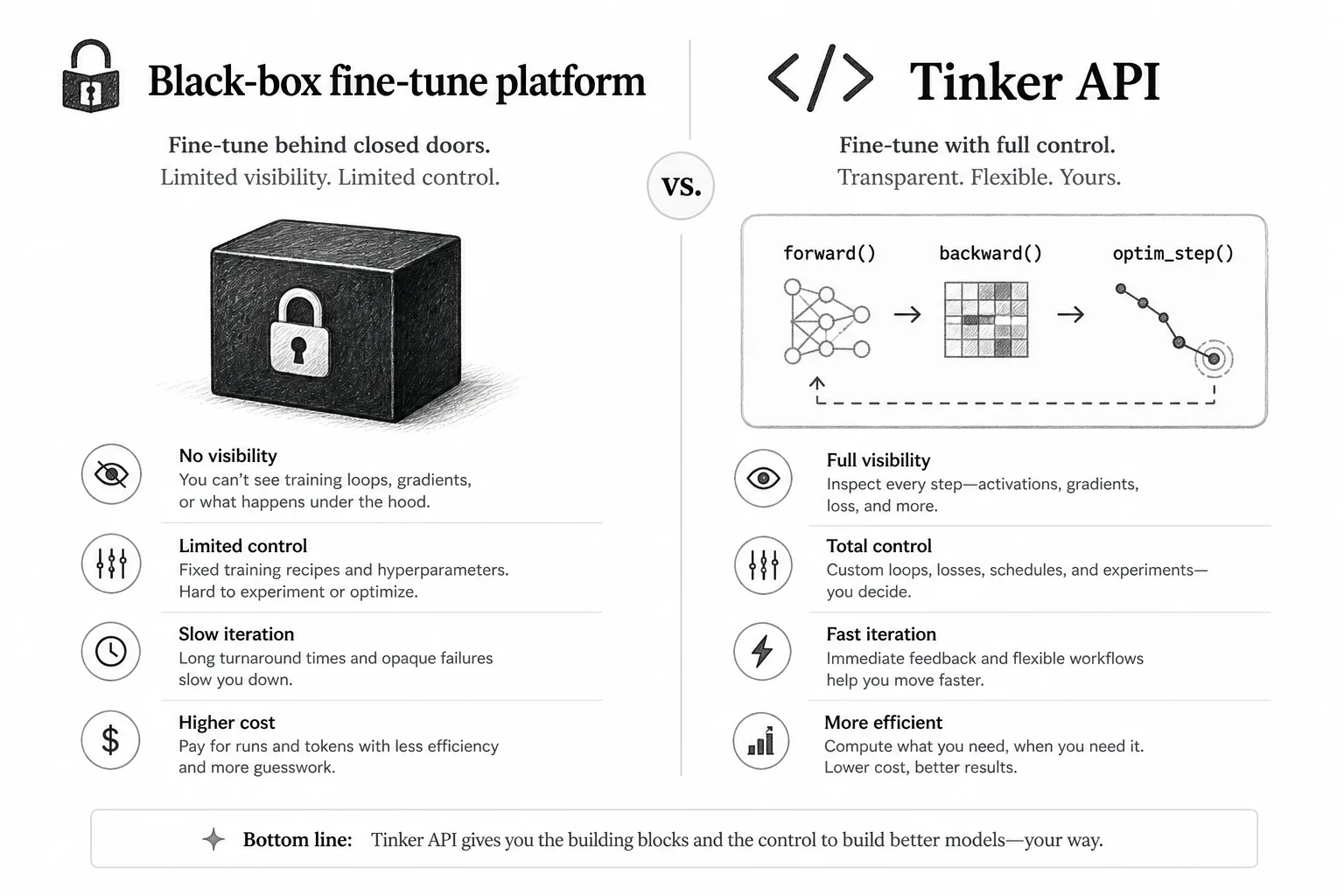
Tinker is not a "upload CSV, get a model" black box. It exposes low-level primitives so researchers keep control:
| API call | What it does |
|---|---|
forward_backward | Feed a batch + loss; accumulate gradients |
optim_step | Update LoRA adapter weights |
sample | Generate from a sampling client for eval or RL |
save_state / checkpoint helpers | Persist adapters and optimizer state |
You write a standard training loop locally. Switching from a 4B model to a 235B MoE is, in theory, changing one string in your code. Tinker handles scheduling, hardware failures, and the distributed execution underneath.
Official docs describe the split clearly: you focus on datasets, environments, and loss functions; they focus on running those computations efficiently across large open models like Qwen3 and Kimi K2.x families.
Why LoRA is the default
Tinker fine-tunes with LoRA adapters, not full weight updates. That is a product decision, not a compromise.
LoRA trains a small low-rank matrix on top of frozen base weights. Adapters are tiny (often tens of megabytes), so multiple training jobs can share GPU memory pools. Tinker can keep warm base models resident and hot-swap adapters between tenants, which lowers cost versus dedicated full fine-tune clusters.
Thinking Machines publishes research arguing LoRA can match full fine-tuning on important RL workloads when setup is right. For applied teams, the practical win is iteration speed: you can afford to run more experiments per week.
How this maps to the Cursor playbook
Cursor's Composer line shows the pattern:
- Pick a strong open checkpoint (Kimi K2.5).
- Generate domain-specific synthetic tasks at scale.
- Run RL with verifiable rewards inside your product harness.
- Use localized feedback (SDFT-style hints) where end-of-rollout grades are too noisy.
Tinker does not give you Cursor's IDE data. It gives you the training runtime so step 2 through 4 is reachable without hiring a distributed systems team first.
Example workflows that fit:
- Support tone and policy fine-tunes on ticket transcripts with a custom reward for citation accuracy.
- Internal code assistants trained on your monorepo patterns with tool-call traces you already log.
- Extraction agents for invoices, CRM notes, or clinical forms where a 30B specialized adapter beats a frontier generalist on cost.
The harness still matters. Tinker will faithfully optimize whatever loss you write. Garbage loops still produce garbage adapters.
A minimal mental model for the training loop
Per public tutorials, a supervised fine-tune on Tinker looks like familiar PyTorch logic, except GPU steps are remote:
# Pseudocode shape. See Tinker Cookbook for full examples
client = ServiceClient()
training_client = client.create_lora_training_client(base_model="qwen3-32b")

for batch in dataset:
    fwd = training_client.forward_backward(batch, loss_fn=my_loss)
    fwd.result()  # or pipeline async futures
    training_client.optim_step().result()

sampling = training_client.save_weights_and_get_sampling_client()
output = sampling.sample(prompts=eval_prompts)
Async futures are recommended so you pipeline requests and keep GPUs fed. Checkpoint to Tinker storage, then export adapters if you want to serve elsewhere.
Pricing is usage-based (USD per million tokens) with checkpoint storage around $0.10/GB-month per their site. They launched with starter credits for waitlist users; check current docs before budgeting a production run.
When Tinker is the right tool
Good fit:
- You have proprietary data and a narrow task distribution.
- You need custom RL or non-standard losses black-box platforms reject.
- You want to experiment across model sizes without rewriting distributed code.
- Your inference plan can consume LoRA adapters (or you export to a compatible host).
Poor fit:
- You need a one-click UI and zero training literacy.
- Your problem is retrieval architecture, not model weights (fix the harness first).
- You have no eval set. Fine-tuning without evals is expensive random search.
How I would run a first experiment
If a client asked me to test Tinker next week, this is the sequence:
- Freeze the harness. Same tools, prompts, and delivery path you will ship.
- Build a 200 to 500 example golden set from real failures, not synthetic fluff.
- Baseline the base model inside that harness. Log cost and accuracy per task.
- Supervised LoRA pass on Tinker with simple cross-entropy until validation loss plateaus.
- Optional RL pass only if you have a verifiable reward (unit tests, judge with constraints, tool success flags).
- A/B on held-out production-shaped tasks before touching routing in prod.
Skip straight to RL because it sounds advanced and you will debug two systems at once.
Tinker in a hybrid agent stack
Tinker trains the specialized tier. It does not replace routing logic.
Pair a Tinker-trained adapter for high-volume execution with a frontier model for orchestration and escalation. That mirrors what NVIDIA Switchyard and AWS hybrid agent patterns describe: expensive models touch planning; cheap or custom models touch repetition.
Your fine-tune is the moat when:
- The task distribution is stable enough to learn.
- Errors are measurable automatically.
- Token volume is high enough that inference savings repay training cost within quarters, not years.
Takeaway
Frontier models set the ceiling. Specialized models, trained on your data and tuned for your harness, set the floor on unit economics.
Tinker lowers the infrastructure tax for teams running the Cursor playbook without Cursor's scale. You still need good data, honest evals, and a routing policy that knows when not to use your adapter.
If you want help scoping whether fine-tuning beats prompt engineering for your agent (or designing the eval harness first), book a free discovery call.