
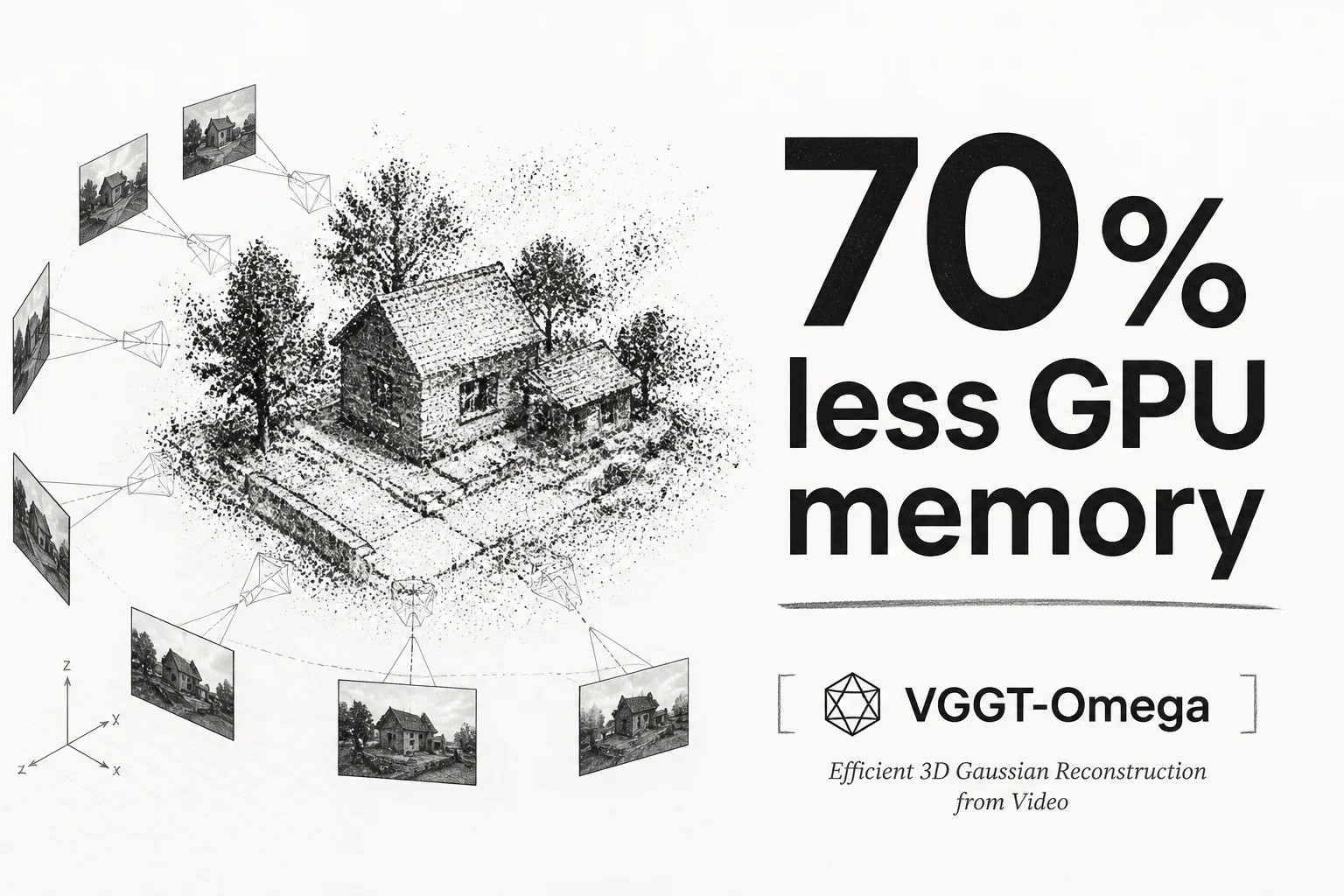
COLMAP-style pipelines still win mindshare in photogrammetry circles. You capture frames, run structure-from-motion, wait, tweak, wait again. Feed-forward models promised to skip that loop. VGGT proved the idea at CVPR 2025. VGGT-Omega (written VGGT-Ω) is the scaling sequel: same team from Oxford's Visual Geometry Group and Meta AI, CVPR 2026 oral, Best Paper finalist, and the clearest evidence yet that 3D reconstruction obeys power-law scaling like language models.
The headline that caught my eye in a May digest: a 10B parameter variant that reportedly uses 70% less GPU memory during training than VGGT while beating benchmarks by wide margins. That is not a incremental tweak. It is an architecture bet that unlocks 15× more supervised data and 18 million self-supervised videos.
What VGGT-Omega actually ships
VGGT-Omega is a feed-forward 3D reconstruction model. You feed it images or video frames. It predicts camera poses and per-frame depth in one forward pass. No iterative bundle adjustment at inference time.
Compared to the original VGGT, Omega adds three big moves:
- Register attention instead of full global attention between every frame token
- One lightweight dense head (MLP + pixel-shuffle) instead of multiple heavy convolutional DPT heads
- Dynamic-scene training via a new annotation pipeline plus self-supervised video learning
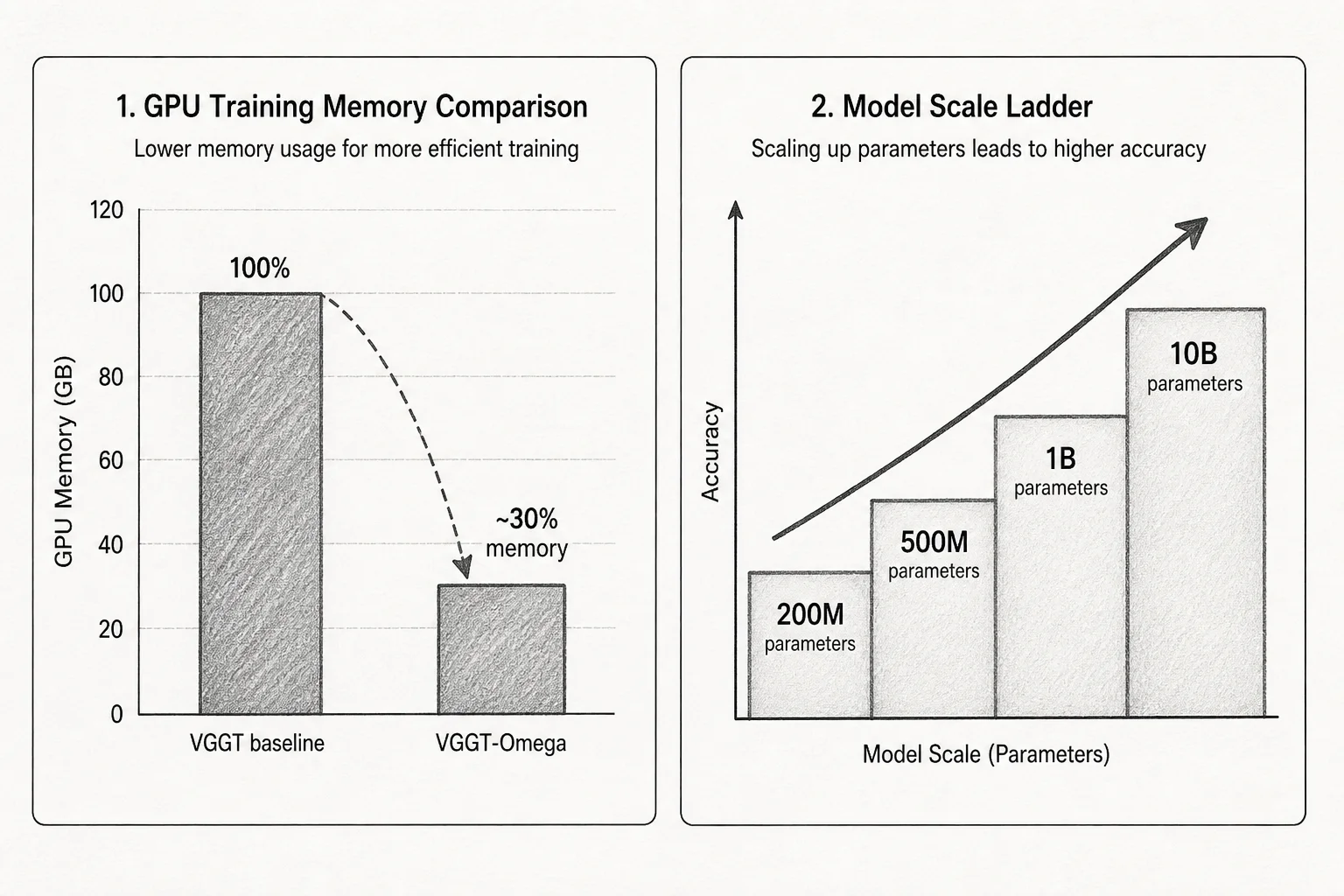
The released checkpoints on Hugging Face are 1B models (gated access). The paper trains and reports results up to 10B parameters across four sizes: 200M, 500M, 1B, and 10B. Do not assume you can download the 10B weights tomorrow. Treat the 10B row as a scaling-law data point, not a product SKU.
| Variant | Blocks | Hidden size | Role |
|---|---|---|---|
| 200M | 12 | 384 | Smallest scaling point |
| 500M | 12 | 768 | Mid-scale ablation |
| 1B | 24 | 1024 | Released checkpoint |
| 10B | 16 | 4096 | Paper's top scaling run |
Why register attention is the memory story
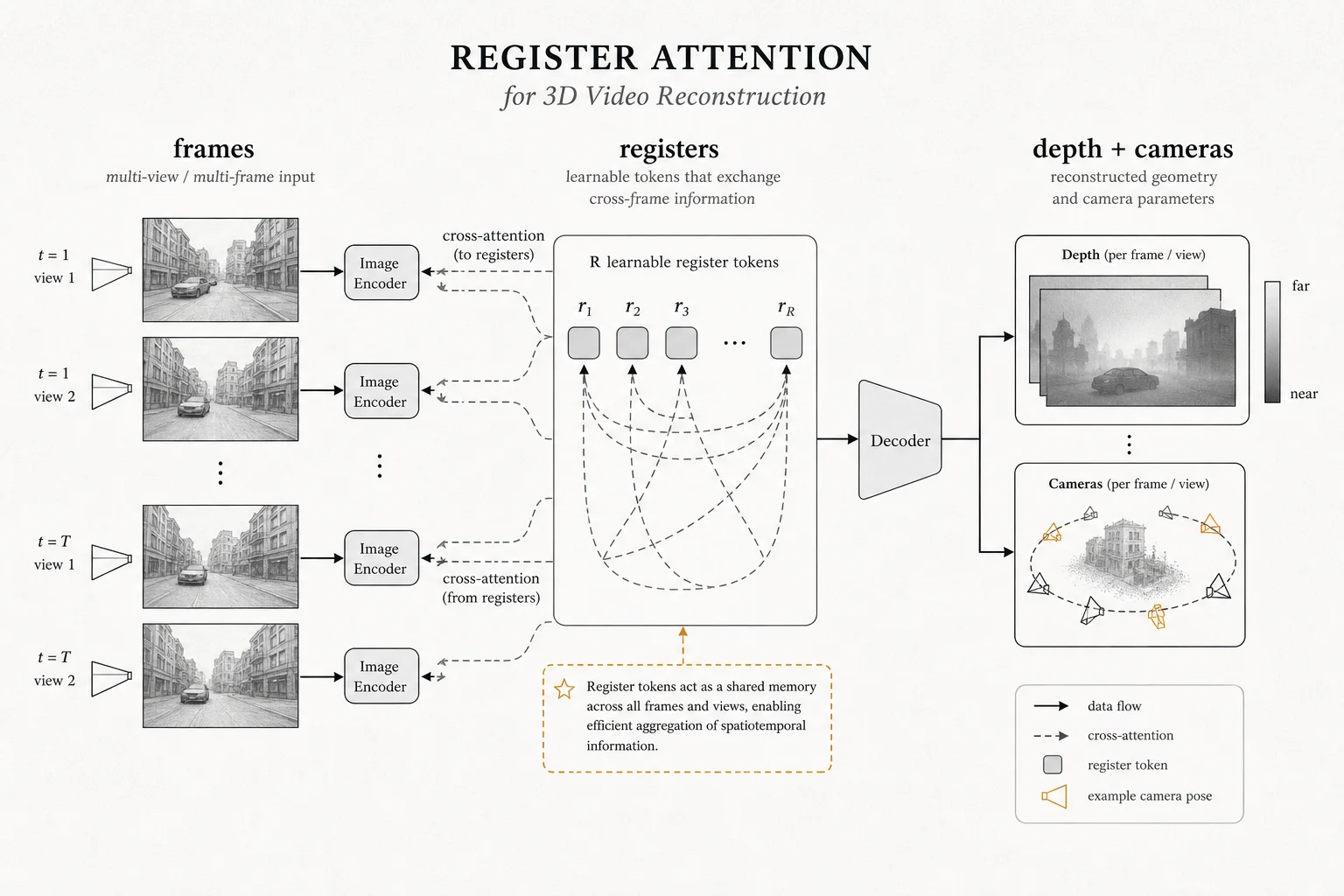
Global attention between every patch in every frame scales badly. VGGT already used register tokens as auxiliary carriers. Omega promotes them.
Register attention restricts most cross-frame information exchange to a compact set of learned registers per frame. Global attention still exists, but a meaningful slice of inter-frame mixing moves through registers instead of the full token grid.
That sounds like an implementation detail until you see the training bill. The authors report Omega uses roughly 30% of VGGT's GPU memory during training. Same ballpark as "70% reduction," depending on which side of the fraction you quote.
For applied teams, memory is the gate. VGGT was already impressive at inference. Omega's trick is making bigger models and bigger datasets affordable to train. That is how you get from ~260K sequences (VGGT) to ~4M supervised sequences plus 18M self-supervised videos.
Benchmarks worth quoting (with caveats)
On Sintel, a dynamic-scene benchmark where rigid point maps break, Omega's 10B variant reports large gains over prior feed-forward and optimization methods. One cited number: +77% camera estimation accuracy versus the previous best on that benchmark. Depth metrics move too (δ1.25 around 93.5% for the 10B row in third-party summaries).
| Method | Camera AUC@3° | Camera AUC@30° | Depth δ1.25 |
|---|---|---|---|
| MegaSaM | 22.5 | 58.3 | 74.1 |
| VGGT | 15.0 | 50.0 | 79.2 |
| Depth Anything 3 | 16.2 | 52.7 | 86.1 |
| VGGT-Ω (1B) | 35.3 | 73.0 | 89.5 |
| VGGT-Ω (10B) | 40.0 | 79.1 | 93.5 |
I have not reproduced these numbers locally. Treat them as the authors' map, then run your own clips.
Important caveat (August 2026): the team posted a notice that an ancestor checkpoint of the released 1B model may have benchmark contamination. The weights still work for downstream apps unrelated to those eval sets. Do not publish leaderboard claims against the contaminated tables until they finish investigating.
Official project page and demosDynamic scenes: why this beats "another depth model"
VGGT was trained mostly on static scenes. Put a walking person in frame and rigid 3D point maps lie. Omega trains on dynamic video with a pipeline that supports moving subjects.
Instead of one rigid world point per pixel across time, Omega predicts per-frame depth plus cameras and lets motion emerge from consistent per-frame geometry. With enough dynamic footage, the model appears to learn what moves versus what stays fixed.
That matters for robotics, AR, and any product that points a phone at real streets instead of NeRF-friendly objects on turntables.
Inference memory on hardware you might actually own
LearnOpenCV ran a fair side-by-side on consumer GPUs (pinned PyTorch/CUDA versions). Rough peaks at 35 frames:
| Setup | Peak GPU memory (35 frames) |
|---|---|
| VGGT | ~13.4 GB |
| VGGT-Ω (default) | ~10.7 GB |
| VGGT-Ω (bf16 backbone) | ~6.6 GB |
Enabling model.aggregator.bfloat16() after load dropped Omega's peak from ~10.7 GB to ~6.6 GB with negligible depth error in their test. A 12 GB card can run Omega (bf16) at moderate frame counts. VGGT still wants 16 GB+ for similar workloads.
Omega also claims 1,000+ frames on a single 80 GB A100 for the 1B checkpoint at 512px inputs. Long-sequence reconstruction without chunking hacks is a real unlock for drone and dashcam pipelines.
Power-law scaling: the thesis behind the 10B headline
Figure 1 in the paper is the slide you show your CTO. Point error improves smoothly as model size grows from 200M to 10B and as dataset size grows from thousands to millions of sequences. Same shape as LLM scaling curves, different modality.
If that holds under independent replication, the strategic implication is blunt: 3D understanding becomes a data and compute game, not a bespoke COLMAP tuning game. Teams with video corpora and GPU budget can buy accuracy the way NLP teams bought perplexity.
Registers add a second twist. The authors show learned registers transfer to vision-language-action models and can align with language embeddings without task-specific finetuning on every downstream job. Reconstruction becomes a proxy task for spatial intelligence. That is a research claim today. It is a product roadmap hint tomorrow.
How to try it this week
You do not need the 10B weights to learn whether Omega fits your stack.
- Request access to the gated Hugging Face VGGT-Omega checkpoints
- Or use the public Hugging Face Gradio demo (no approval required)
- Clone
facebookresearch/vggt-omega
and run
demo_gradio.pylocally once you have weights
pip install -r requirements_demo.txt
python demo_gradio.py \
  --checkpoint checkpoints/VGGT-Omega-1B-512/model.pt \
  --image-resolution 512
Run four eval clips before you write an architecture doc:
- Static indoor scan (your office hallway). Check wall flatness and loop closure feel.
- Handheld outdoor walk with parallax. Watch drift on far buildings.
- Dynamic subject (person walking through frame). Compare against VGGT or a COLMAP baseline if you have one.
- Long sequence (60+ frames). Measure peak VRAM with and without bf16 backbone.
Log failure modes. They become acceptance tests if you wire this into a production pipeline.
Where this lands in the May 2026 CV stack
This AlphaSignal digest also covered Gemini Omni Flash, Antigravity 2.0, and GitHub Spec Kit. Different layers of the same story: multi-turn, stateful AI replacing one-shot generation. Omega does it for geometry.
| Layer | Omega's position |
|---|---|
| Consumer creative | Indirect (feeds AR/VR and video tools) |
| Robotics / VLA | Registers as portable spatial tokens |
| Mapping / inspection | Feed-forward pose + depth without SfM wait |
| Research | Scaling laws for 3D |
Do not rip out your photogrammetry pipeline because a paper hit CVPR. Do start asking whether your latency budget assumes iterative SfM when a forward pass might be "good enough" for a first draft mesh.
What I'd watch next
- Independent replication of the 10B scaling curve (not just 1B checkpoints)
- Resolution of the benchmark contamination notice for the 1B release
- Community ports to ONNX/TensorRT for edge deployment
- Whether register embeddings show up in open VLA stacks without retraining from scratch
If you are choosing between feed-forward 3D, classical SfM, and hybrid pipelines for a product (drones, digital twins, inspection), book a free discovery call. I am happiest when the demo survives your actual camera shake and motion blur.