
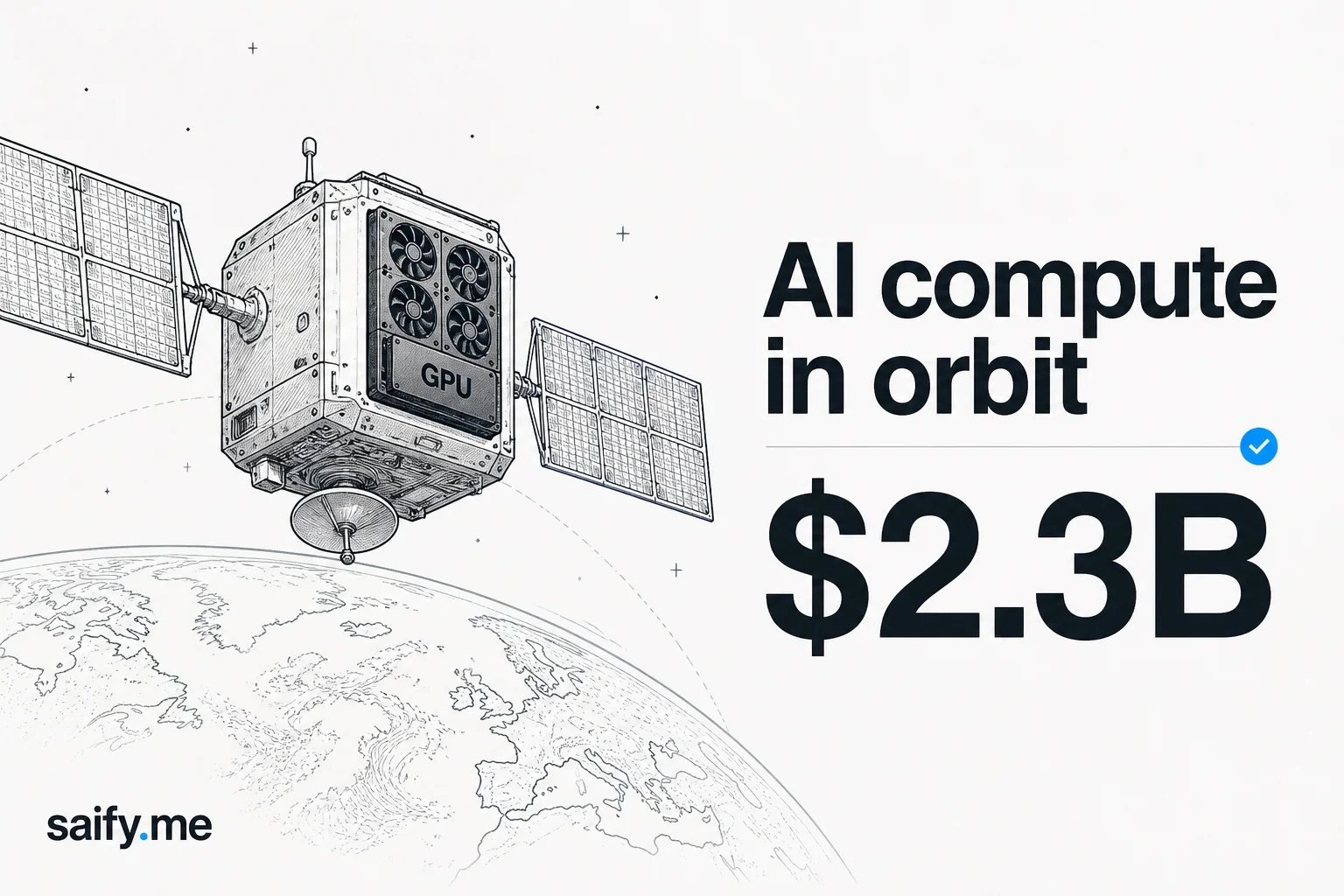
Earthbound data centers are running into land, power, and cooling limits faster than chipmakers can ship HBM. So capital is flowing to a stranger idea: AI compute in orbit.
Starcloud, a Redmond startup founded in 2024, closed a $250 million extension to its March 2026 Series A at a $2.3 billion valuation. Total raised is now about $450 million. Manhattan West led; Nvidia and Cisco joined, alongside Benchmark, EQT, Soma, NFX, 776, Cedar Capital, Goanna Capital, and Standard Capital.
The headline is not just novelty. It is Nvidia betting twice on space compute (Starcloud and SpaceX) while Falcon 9 rideshare slots disappear past 2028.
What Starcloud actually does
Starcloud builds satellites that run data-center-class AI inference and training in low Earth orbit. CEO Philip Johnston frames it as orbital datacenters that first serve other spacecraft with cloud and edge services, then compete with terrestrial facilities on energy economics.
They are not starting from a PowerPoint:
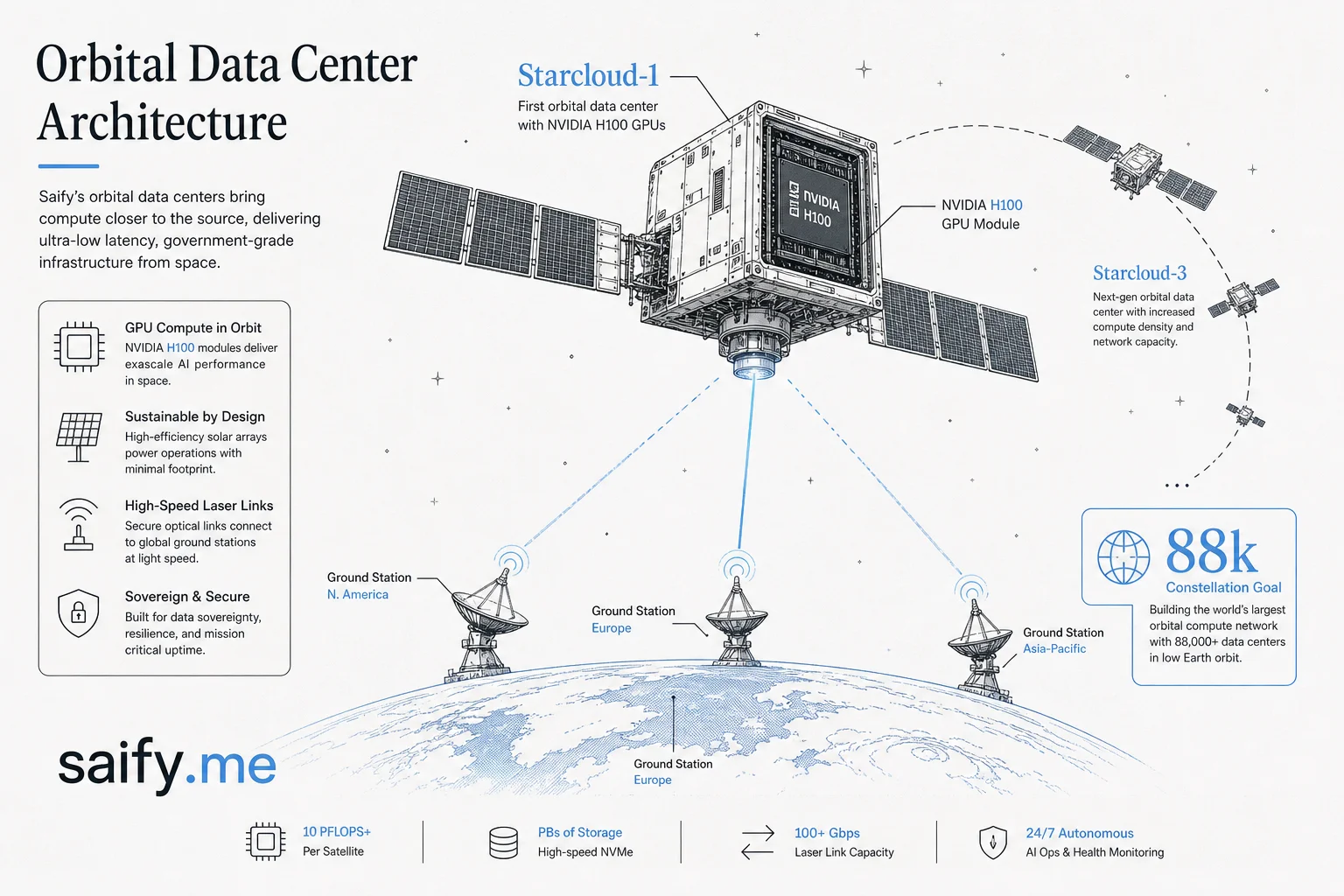
- Starcloud-1 (November 2025): ~60 kg spacecraft, first known orbital deployment of an Nvidia H100 data-center GPU.
- Starcloud-2: ~8 kW spacecraft, targeted roughly eight months after Starcloud-1.
- Starcloud-3: multi-ton, ~200 kW class vehicle aimed at Starship, filed as part of a regulatory path toward 88,000 satellites and ~20 GW of orbital compute.
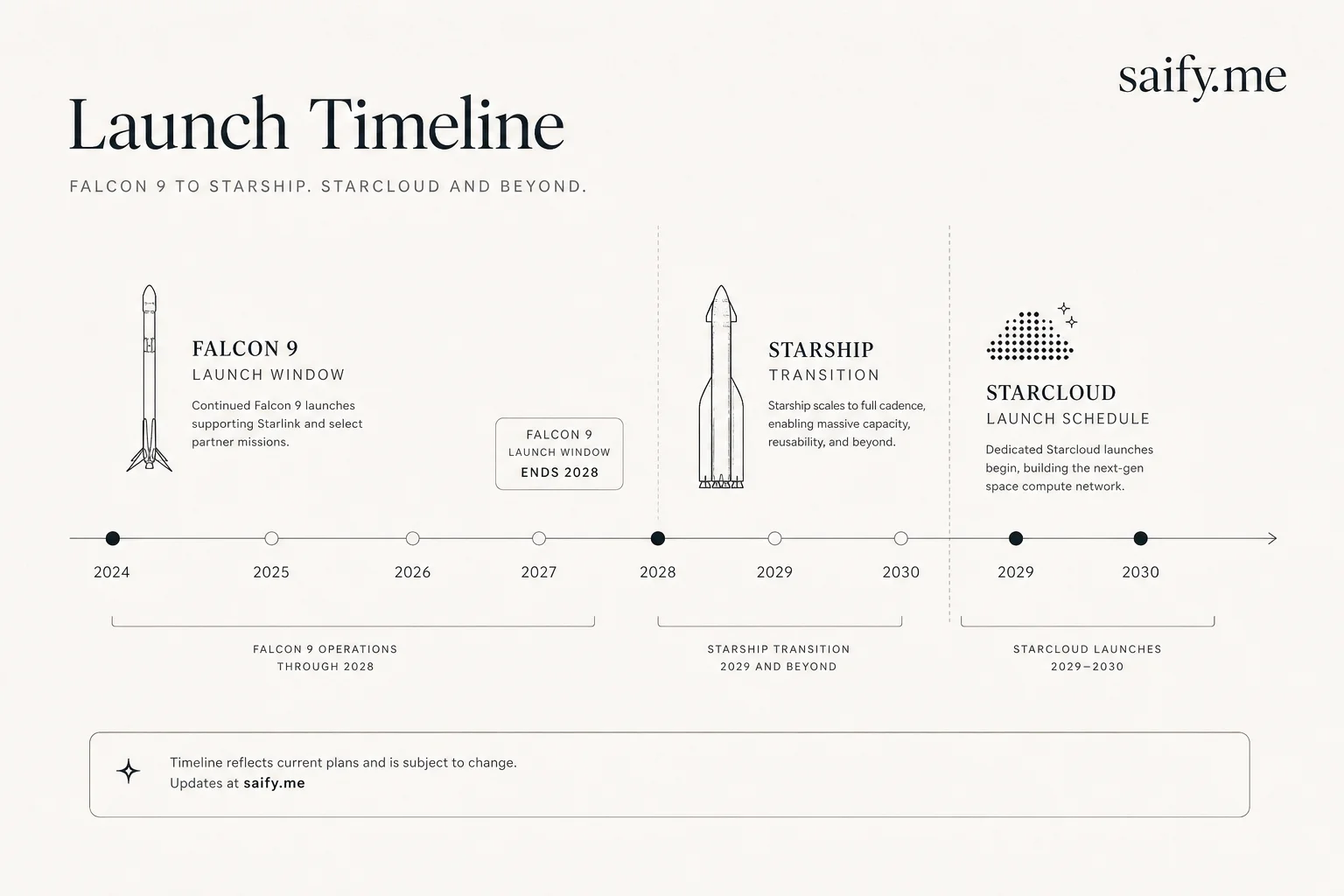
SpaceNews quoted Johnston saying the 88,000 figure depends on Starship flying frequently, with commercial customer payloads perhaps in 2029 or 2030.
Why Nvidia cares (and put money in)
TechCrunch reported Nvidia invested about $25 million in the extension. That is a strategic check, not a vanity logo slide.
Starcloud claims it is the only company publicly operating an H100 terrestrial data-center GPU in orbit, and that it trained a model (open-source NanoGPT) on that hardware. Most space GPUs target edge sensing, not datacenter-class training.
The feedback loop runs into Nvidia's Space-1 Vera Rubin Module, a space-rated compute stack Nvidia unveiled in March 2026 for satellite AI. Starcloud's H100 flight data feeds ruggedization work on mass, thermal, and radiation constraints. If orbital AI becomes real, Nvidia wants the chip spec, not a third-party FPGA workaround.
Cisco's participation hints at the boring part that actually ships: networking between orbit and ground. Orbital inference is useless without predictable backhaul and security models enterprises will accept.
Launch capacity is the hidden bottleneck
Funding rounds love TAM slides. Operators live in launch manifests.
SpaceNews reported that Falcon 9 rideshare reservations are effectively sold out beyond late 2028 or early 2029 as SpaceX pivots toward Starship. Starcloud's extension is partly launch insurance: hoard slots before prices spike and before Starship proves commercial cadence.
That is the same pressure we see on the ground in RAMageddon and in Musk's Terafab story: when open-market supply tightens, well-funded players pre-buy capacity years ahead.
For Starcloud, a missed launch window is not a delayed feature ship. It is a stranded factory line in Woodinville, Washington, where the company is scaling toward a 100,000-square-foot manufacturing footprint near other satellite builders.
Business model: who pays for watts in space?
Early revenue skews defense and specialty space workloads: cloud and edge for other spacecraft, government experiments, and partners that need compute where downlink is expensive.
The commercial hook is energy. Solar in orbit is continuous; cooling can use radiators without fighting ambient air temperature. Johnston told SpaceNews Starcloud signed a large agreement with Crusoe (the firm building data centers for OpenAI) to supply 10 GW of power from the early 2030s. If orbital watts beat terrestrial marginal cost, hyperscalers with power constraints become buyers, not skeptics.
I am still skeptical of latency-sensitive agent loops in orbit. Round-trip time to LEO is milliseconds, not datacenter-local microseconds, and weather plus ground station geography matter. Training and batch inference that tolerate delay look like the first fit.
How this fits the infra map I use with clients
| Layer | Terrestrial trend | Orbital bet |
|---|---|---|
| Power | Grid bottlenecks, diesel backup drama | Continuous solar, radiator cooling |
| Silicon | HBM shortages, RAMageddon | Purpose-built Vera Rubin Space modules |
| Launch | N/A | Falcon 9 cliff, Starship dependency |
| Software | Kubernetes, vLLM, CUDA | Same CUDA stack, harsher environment |
Most of my clients will not buy orbital inference in 2026. They should still watch the category because it shapes Nvidia's roadmap, launch pricing, and the narrative that terrestrial buildouts are not infinite.
We already covered robotic satellite servicing and space-adjacent automation in other posts. Starcloud is the compute layer above that stack: if buses get cheaper to repair, orbital GPUs get more maintainable too.
What operators should track next
- Starcloud-2 launch and published benchmarks (not just "we trained NanoGPT").
- Vera Rubin Space-1 sampling timelines and whether CUDA features diverge from datacenter parts.
- Starship customer manifest dates (Starcloud-3 is not a Falcon rideshare problem).
- Regulatory filings on the 88,000-satellite plan (spectrum and debris politics will be loud).
Starcloud at $2.3B is a bet that AI's energy problem is bad enough to industrialize orbit. Nvidia's check says the chip story is serious. The launch calendar says the race is already crowded.
If you are sizing inference architecture and want help separating hype from what you can ship this quarter, book a free discovery call. Orbital compute is a horizon item; your agent unit economics are this year's budget.