
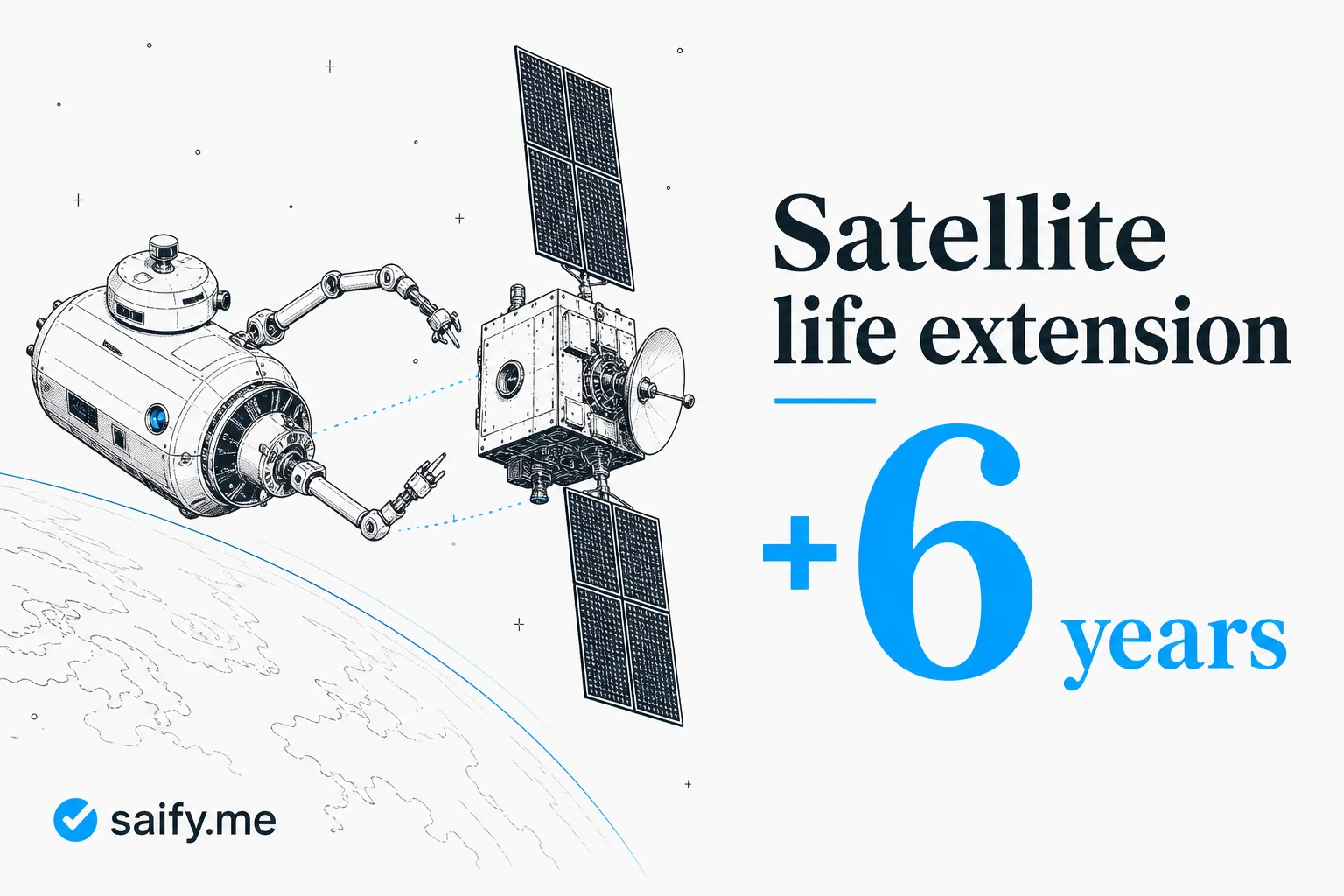
Satellites usually die with full tanks of working electronics. They run out of fuel to stay in position, not brainpower.
Northrop Grumman is scaling a robotic answer: a Mission Robotic Vehicle (MRV) with dual arms that bolts modular propulsion pods onto aging spacecraft. First customer job: Optus in 2027, adding roughly six more years to a satellite launched in 2009 with a 15-year design life.
In-orbit servicing is moving from one-off hero missions toward repeatable business.
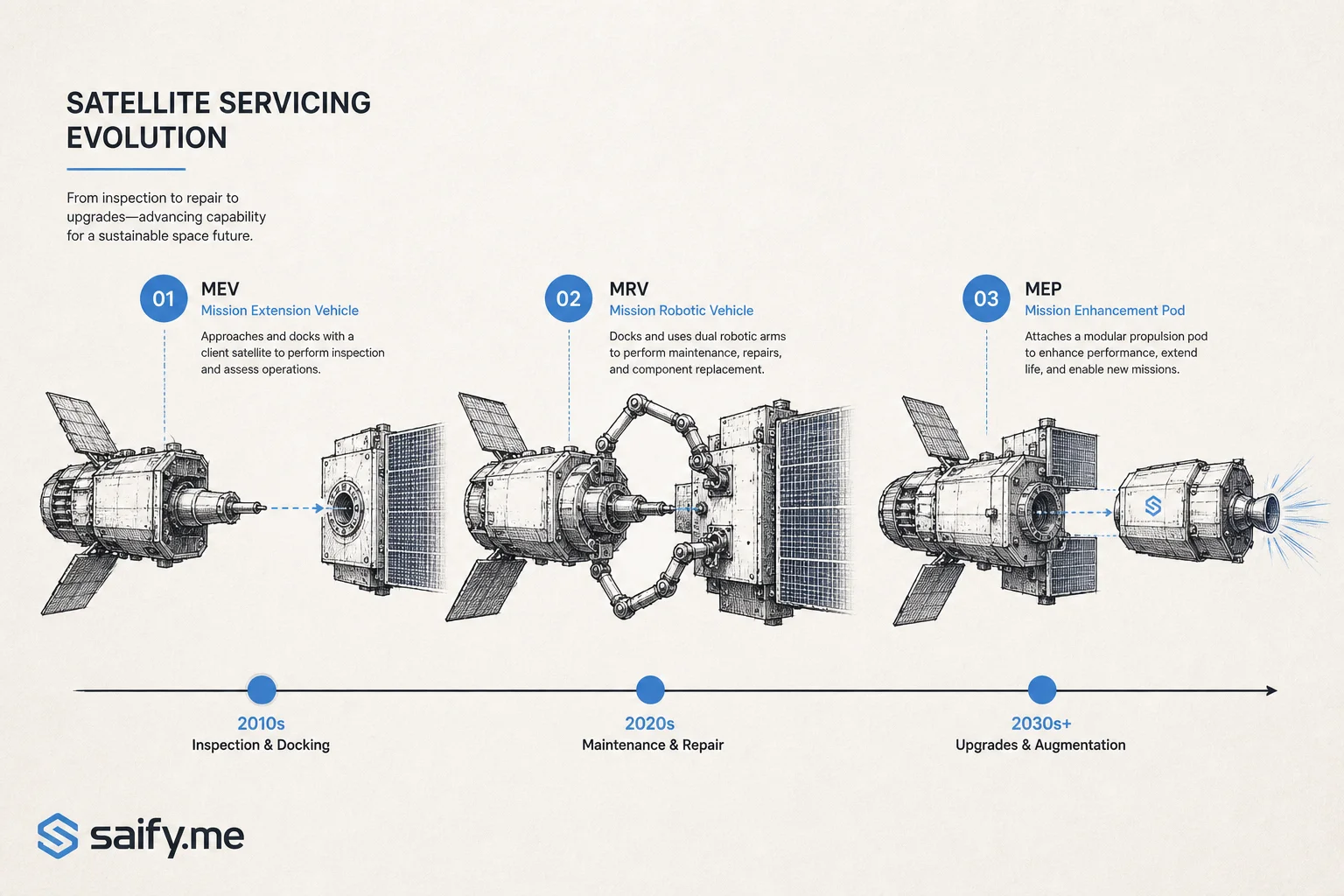
The handoff from MEV to MRV
This week, Northrop's earlier Mission Extension Vehicle (MEV) undocked from the Optus satellite after more than a year of station-keeping. The MEV had been physically attached, keeping the comms bird in the right orbital slot.
Now four new Northrop spacecraft are en route on a SpaceX Falcon 9 launch from July 2026:
| Vehicle | Role |
|---|---|
| MRV | Robotic servicer with DARPA-developed dual arms |
| MEP (×3) | Modular propulsion pods bolted onto client satellites |
The MRV and pods are headed for targets around 27,000 miles above Earth. In 2027, the MRV will use its arms to attach one MEP to Optus.
Why satellites fail before their radios do
Communications and Earth-observation satellites are expensive assets. Optus launched in 2009 with a 15-year lifespan. Transponders and computers often outlast propulsion budgets.
Northrop's goal, per director Cassie Wong in TechCrunch coverage, is a paradigm shift toward sustainable space: repairs, life extension, upgrades, and maintenance in orbit.
Two MEVs are already operating:
- MEV-1 waits in a parking orbit for another customer after prior Intelsat work
- MEV-2 remains attached to an Intelsat customer until 2030
Those vehicles delivered 10 years of life extension across three customers, including two Intelsat spacecraft and Optus.
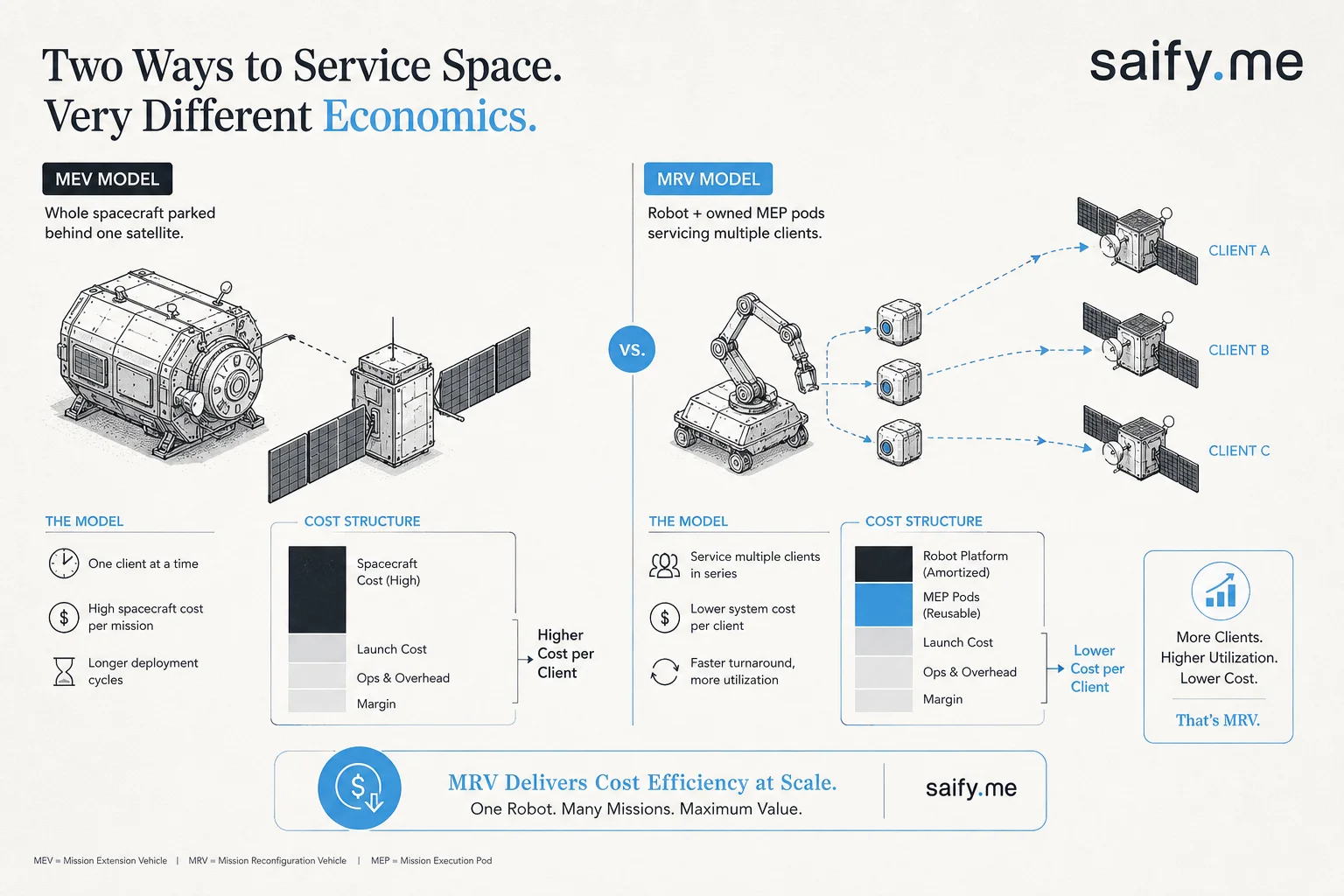
Business model evolution: own the pod, rent the robot
The MRV represents an economic shift.
Old model (MEV): Park an entire servicing spacecraft behind one customer satellite. The servicer stays attached. One robot, one bill, limited reuse.
New model (MRV + MEP): Satellite operators buy and own the Mission Extension Pods permanently attached to their spacecraft. The MRV robot frees up to service more vehicles.
That creates a cheaper per-extension offering because the expensive robotic platform is not stranded on a single job.
Technology hurdles at orbital velocity
Docking at thousands of miles per hour is not a gentle parking lot merge.
| Challenge | Approach |
|---|---|
| Autonomous rendezvous | Vehicles approach and dock without human joystick control |
| MEV docking | Probe plugs into satellite thruster nozzles |
| MRV attachment | Robotic arms carefully install MEP pods |
| Refueling | MRV designed for in-orbit refuel as proof of concept |
Unlike most satellites, the MRV is designed to be refueled in orbit, partly to prove capabilities other spacecraft will need if servicing becomes normal.
Today, extra cost and weight keep most operators from building refuelable buses. Northrop hopes successful MRV ops change that calculus.
LEO vs GEO and the defense angle
The current trend favors cheap replaceable spacecraft in low Earth orbit, as Starlink and Amazon's LEO constellations demonstrate. But large, expensive satellites in higher orbits still justify extension.
Wong told TechCrunch the MRV could also extend life for valuable LEO assets. Startup Katalyst Space is attempting a similar rescue for a malfunctioning NASA space telescope.
Defense customers loom large. DARPA involvement in the MRV arms and the U.S. Space Force's prior characterization of Chinese servicing spacecraft as potential weapons (grappling rivals) show how dual-use this category is.
Northrop says its vehicles focus on servicing missions. The geopolitical frame still shapes buyer behavior.
What applied AI builders can learn
Space robotics looks exotic, but the systems patterns match factory humanoids and mobile agents:
- Perception under noise (thermal, glare, debris)
- Closed-loop control with hard safety envelopes
- Fleet economics (one platform, many jobs)
- Modular upgrades instead of full replacements
If you design agent orchestration or physical AI roadmaps, the MRV/MEP split is a useful template: cheap attachable modules + expensive reusable orchestrator.
The bottom line
Northrop is turning satellite life extension into a repeatable service line. Bolt a pod, free the robot, move to the next customer.
If you are building long-horizon physical AI strategy (space, defense, or heavy industry) and want a sanity check on what is shipping versus slide decks, book a free call. I help teams map deployable robotics economics without the keynote gloss.